
基于大滑移溫度非共沸工質雙冷源制冷機組的分析
2017-04-07 12:50:49張小松徐國英
制冷學報 2017年2期
滿 亮 張小松 劉 劍 徐國英
(東南大學能源與環境學院 能源熱轉換及其過程測控教育部重點實驗室 南京 210096)
滿 亮 張小松 劉 劍 徐國英
(東南大學能源與環境學院 能源熱轉換及其過程測控教育部重點實驗室 南京 210096)

隨著我國經濟的發展,建筑能耗在全國總能耗中所占的比例不斷增大。統計表明,暖通空調系統能耗占建筑總能耗55%[1],因此對暖通空調系統進行節能改造十分重要。為了降低暖通空調系統能耗,國內外學者對冷水機組進行了大量研究,其中溫濕度獨立控制系統因其節能、衛生等特點被廣泛關注[2-3]。目前,溫濕度獨立控制主要通過固體吸附除濕或溶液吸收除濕等方法排出室內濕負荷實現濕度控制,通過冷水機組制取高溫冷凍水排出室內熱負荷實現溫度控制,研究表明具有良好的節能效果[4-5]。但固體吸附除濕存在設備體積大、需要較高的再生熱源溫度(140 ℃以上)等問題[6],溶液吸收除濕存在溶液對管道腐蝕,除濕效率低等問題[7]。因此,國內一些學者提出通過制取高低溫冷凍水的方式實現溫濕度獨立控制。梁彩華等[8]通過兩套以R22為工質的冷水機組來制取兩種溫度的冷凍水(7 ℃和16 ℃),用于空調負荷的熱濕分段處理。研究表明:當表冷器設計溫差為7 ℃、出風溫度為16 ℃時,冷水機組的COP相對于傳統空調方式提高9.14%,在回風干球溫度為25 ℃、濕球溫度為21 ℃時,冷水機組COP提高達8%以上。但采用兩套機組存在造價高、耗材量大的問題。劉劍等[9-10]利用非共沸混合工質的特性[11],提出一種以大滑移溫度非共沸工質R32/R236fa為循環工質的新型雙冷源制冷機組,通過該冷水機組可制取不同溫度的高低溫冷凍水,從而實現溫濕度獨立處理。研究表明當冷卻水進水溫度為32 ℃,高、低溫冷凍水的出水溫度分別為18 ℃和7 ℃,R32質量組分比例為60%時,機組COP可達3.92,可見該雙冷源制冷機組具有一定的節能潛力,對該系統的進一步分析和優化具有重要意義。

1 構建雙冷源制冷機組分析模型
(1)
I=exq-Δexh-Ws
(2)
exh=h-h0-T0(s-s0)
(3)
(4)
1.1建立系統模型
圖1所示為采用混合工質R32/R236fa的雙冷源制冷機組的系統流程圖,與之相對應的理論循環T-s圖見圖2。該制冷循環由壓縮過程(1-2)、等壓冷凝過程(2-3)、節流過程(3-4,節流前后焓值相等,但非等焓過程)、等壓蒸發過程(4-5)和等壓蒸發過程(5-1)組成。
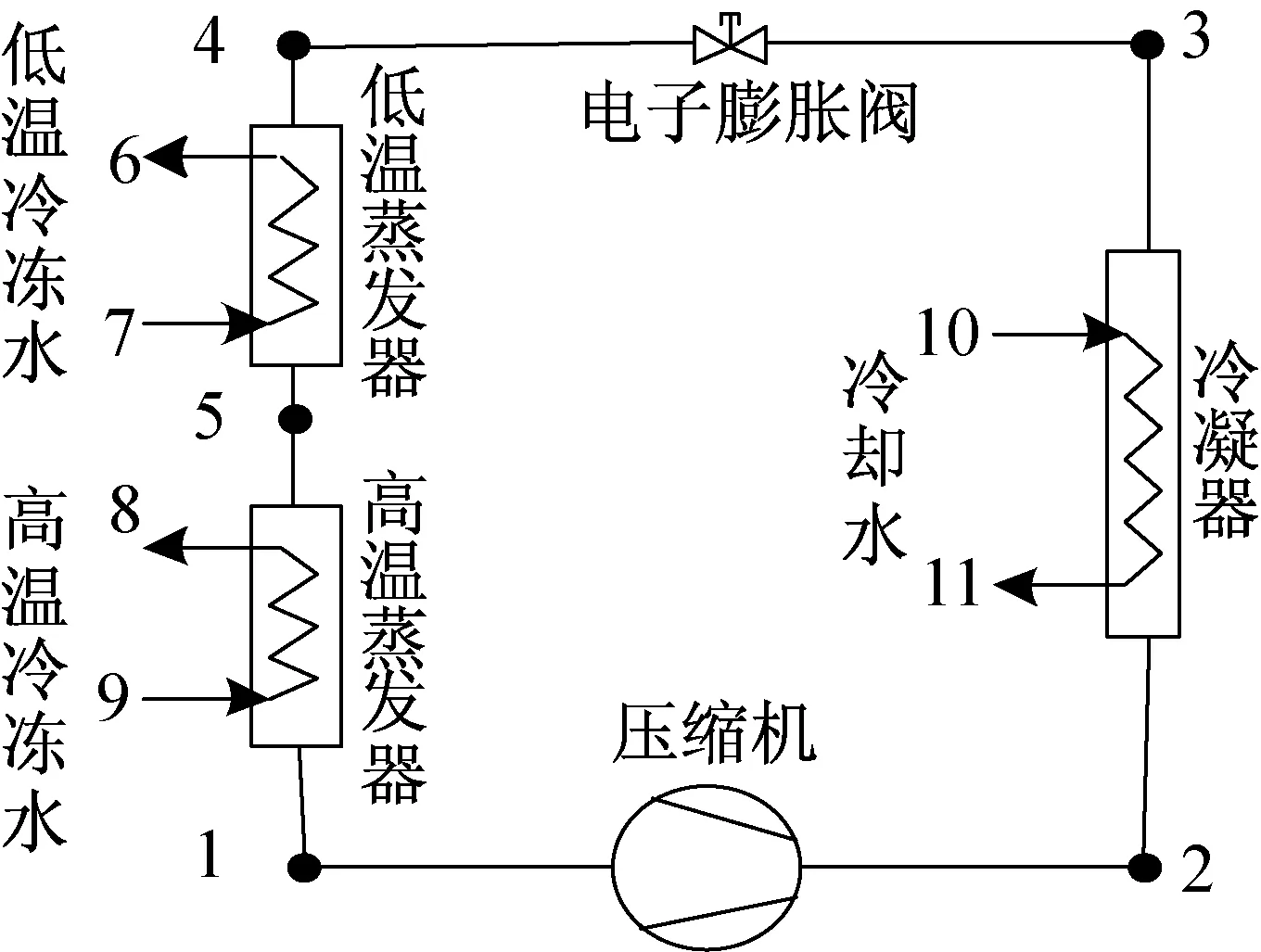
圖1 雙冷源制冷機組原理圖Fig.1 Schematic diagram of double cooling source refrigerating unit

圖2 制冷劑理論循環T-s圖Fig.2 T-s diagram of the theoretical cycle
mrexh1+Wcom=mrexh2+Lcom
(5)
Lcom=mrexh1+Wcom-mrexh2
(6)
mw,evalexh7+mrexh4=mw,evalexh6+mrexh5+Leval
(7)
Leval=mw,eval(exh7-exh6)-mr(exh5-exh4)
(8)
mw,evahexh9+mrexh5=mw,evahexh8+mrexh1+Levah
(9)
Levah=mw,evah(exh9-exh8)-mr(exh1-exh5)
(10)
mw,conexh10+mrexh2=mw,conexh11+mrexh3+Lcon
(11)
Lcon=mw,con(exh10-exh11)-mr(exh3-exh2)
(12)
mrexh3=mrexh4+Ltxv
(13)
Ltxv=mr(exh3-exh4)
(14)
Lsys=Leval+Levah+Lcon+Ltxv+Lcom
(15)
2 雙冷源制冷機組實驗研究
2.1 實驗裝置
基于大滑移溫度非共沸工質R32/R236fa的單級壓縮水冷式雙冷源制冷機組實驗平臺,由雙冷源制冷機組裝置和測量裝置兩部分構成,其中雙冷源制冷機組循環由制冷劑循環和水(冷凍水與冷卻水)循環組成。此外,雙冷源制冷機組裝置采用兩個蒸發器將蒸發過程分為兩段進行,利用溫度不同的兩個冷源獲得高低溫度冷凍水。具體情況如表1和表2所示。

表1 雙冷源制冷機組裝置
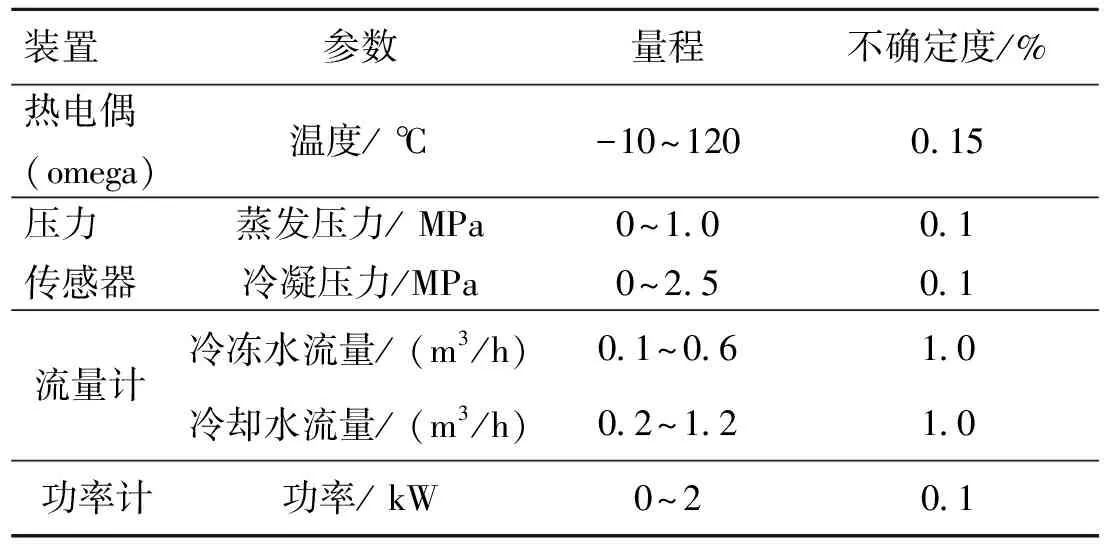
表2 測量裝置
根據圖2和圖3可以判斷制冷循環和冷凍水循環的大致流程。制冷循環:大滑移溫度非共沸工質R32/R236fa先經壓縮機壓縮成高溫高壓的過熱氣體,再經冷凝器冷凝成高壓過冷液體,高壓過冷制冷劑液體流經儲液器、干燥過濾器后,經電子膨脹閥節流到低溫低壓的兩相區,然后混合工質先在低溫蒸發器內蒸發,制取低溫冷凍水,再經過高溫蒸發器蒸發,制取高溫冷凍水,蒸發后的工質由壓縮機吸入,完成制冷循環。冷凍水循環:低溫蒸發器所制取的冷凍水通過循環水泵排入低溫冷凍水箱,之后經過電熱器加熱,消耗冷量。高溫蒸發器制冷的冷凍水采用同樣方式抵消冷量。通過控制電熱器加熱量,改變高低溫蒸發器入口處高低溫冷凍水的溫度,可得實驗所需的高低溫冷凍水出水溫度。在冷凝器中進行換熱之后的高溫冷卻水,進入冷卻水水箱與自來水補水混合,之后通過電加熱器,將冷卻水溫度準確控制到32 ℃,之后再進入冷凝器,完成循環。

圖3 雙冷源制冷機組實驗裝置圖Fig.3 Schematic diagram of experimental system
2.2 非共沸工質[18]
實驗中采用質量比為60%/40%的R32/R236fa的混合工質作為制冷劑。R32與R236fa均屬于環境友好型制冷劑,ODP均為0,GWP分別為650和6 300。
3 雙冷源制冷機組分析
對不同常用高低溫冷凍水組合進行變工況實驗,具體運行工況如表3所示。

表3 變冷凍水溫度運行工況表
為便于理論分析計算,做出如下假設:1)冷凝器與蒸發器出口工質為飽和狀態;2)忽略混合工質在系統中的阻力;3)不計系統與環境間的散熱;4)壓縮過程絕熱但不等熵,等熵效率取0.65;5)忽略潤滑油對混合工質熱物性的影響;6)蒸發器與冷凝器中最小傳熱溫差取5 ℃。
3.3 實驗結果與討論

圖4 雙冷源制冷機組變工況條件下各部件的理論損Fig.4 Theoretical exergy loss of all parts in variable chilled water temperature

圖5 雙冷源制冷機組變工況條件下各部件的實驗損Fig.5 Experimental exergy loss of all parts in variable chilled water temperature
表4 雙冷源制冷機組系統變工況條件下的總損

圖6 雙冷源制冷機組系統高低溫冷凍水溫度17 ℃/8 ℃條件下各部件的損Fig.6 Exergy loss rate of all parts in 17 ℃/8 ℃
4 結論
符號說明
COP——制冷效率
GWP——全球變暖潛能值
ODP——臭氧層消耗能值
T——溫度,℃


p——壓力,MPa
W——壓縮機功耗,kW
G——換熱介質體積流量(水),m3/h
m——質量流量,kg/s
Q——制冷量,kW
下標
com——壓縮機
r——制冷劑
con——冷凝器
sys——系統
eval——低溫蒸發器
txv——節流閥
evah——高溫蒸發器
w——水
[1] 江億. 我國建筑耗能狀況及有效的節能途徑[J]. 暖通空調, 2005, 35(5): 64.(JIANG Yi. Current building energy consumption in China and effective energy efficiency measures[J]. Journal of HV&AC, 2005, 35(5): 64.)
[2] 張濤, 劉曉華, 張海強, 等. 溫濕度獨立控制空調系統設計方法[J]. 暖通空調, 2011, 41(1): 1-8. (ZHANG Tao, LIU Xiaohua, ZHANG Haiqiang.Design method of temperature and humidity independent control air conditioning system[J]. Journal of HV&AC, 2011, 41(1): 1-8.)
[3] 李偉. 基于熱濕分段處理的空調系統優化與控制策略研究[D]. 南京: 東南大學, 2012.(LI Wei. Optimization and control strategy analysis of the segmented handling air-conditioning system[D]. Nanjing: Southeast University, 2012.)
[4] 李維, 葛楊慧, 陳立楠, 等. 實現溫濕度獨立控制的固體吸附材料吸附除濕性能研究[J]. 制冷學報, 2013, 34(3): 40-44. ( LI Wei, GE Yanghui, CHEN Linan. Research on dehumidifier performance of solid adsorbent for temperature and humidity independent control[J]. Journal of Refrigeration, 2013, 34(3): 40-44.)
[5] 代彥軍, 臘棟. 轉輪式除濕空調研究與應用最新進展[J]. 制冷學報, 2009, 30(4): 1-8. (DAI Yanjun, LA Dong. Rotary desiccant air conditioning systems: a state-of-the-art review[J]. Journal of Refrigeration, 2009, 30(4): 1-8.)
[6] Lowenstein A, Slayzak S, Kozubal E. A zero carryover liquid-desiccant air conditioner for solar applications[C]// In: Proceedings of the ASME International Solar Energy Conference, U.S.:American Society of Mechanical Engineers, 2007, 397-407.
[7] Yang K, Yao Y, Liu S Q. Effect of applying ultrasonic on the regeneration of silica gel under different air conditions[J]. International Journal of Thermal Sciences, 2012, 61: 67-78.
[8] 梁彩華, 張小松, 蔣赟昱, 等. 一種新型的空調系統空氣處理方法及其節能分析[J]. 東南大學學報(自然科學版), 2009, 39(5): 973-977. (LIANG Caihua, ZHANG Xiaosong, JIANG Yunyu. Novel air handling method and its energy-saving potential in air-condition system[J]. Journal of Southeast University (Natural Science Edition), 2009, 39(5): 973-977.)
[9] Liu J, Zhang X S. Performance analysis of a novel double-temperature chilling water unit using large temperature glide zeotropic mixture[J]. Procedia Engineering, 2015, 121: 1222-1229.
[10] 劉劍, 張小松. 冷凍水流量和溫度對基于混合工質的雙溫冷水機組性能影響[J]. 制冷學報, 2015, 36(6): 83-89.(LIU Jian, ZHANG Xiaosong. Effect of variable chilled water flow rates and temperature on performance of double temperature chiller with large temperature glide zeotropic refrigerant[J]. Journal of Refrigeration, 2015, 36(6): 83-89.)
[11] 芮勝軍, 張華, 吳裕慶. 非共沸混合工質單級壓縮回熱循環試驗研究[J]. 制冷學報, 2012, 33 (6): 63-67. (RUI Shengjun, ZHANG Hua, WU Yuqing. Experimental study of single-stage compression heat regenerative cycle of zeotropic refrigerant mixtures[J]. Journal of Refrigeration, 2012, 33(6): 63-67.)
[12] Bejan A. Advanced engineering thermodynamics [M]. Hoboken, New Jersey, United States: John Wiley & Sons, 1988.
[13] Ahamed J U, Saidur R, Masjuki H H. A review on exergy analysis of vapor compression refrigeration system[J]. Renewable & Sustainable Energy Reviews, 2011, 15(3): 1593-1600.
[14] Kabul A, Kizilkan ?, Yakut A K. Performance and exergetic analysis of vapor compression refrigeration system with an internal heat exchanger using a hydrocarbon, isobutane (R600a)[J]. International Journal of Energy Research, 2008, 32(9): 824-836.
[16] Kaynakli O, Saka K, Kaynakli F. Energy and exergy analysis of a double effect absorption refrigeration system based on different heat sources[J]. Energy Conversion & Management, 2015, 106: 21-30.
[17] Yataganbaba A, Kilicarslan A, Kurtbas I. Exergy analysis of R1234yf and R1234ze as R134a replacements in a two evaporator vapour compression refrigeration system[J]. International Journal of Refrigeration, 2015, 60: 26-37.
[18] 劉兆永, 趙力, 趙學政. 高溫熱泵工況下非共沸工質在換熱器中的換熱特性[J]. 化工學報, 2011, 62(12): 3386-3393. (LIU Zhaoyong, ZHAO Li, ZHAO Xuezheng.Heat exchange characteristics of zeotropic mixture in heat exchangers in high temperature heat pump[J]. CIESC Journal, 2011, 62(12): 3386-3393.)
About the corresponding author
Zhang Xiaosong, male, professor, School of Energy and Environment, Southeast University, +86 13951974528,E-mail: rachpe@seu.edu.cn. Research fields: new technology of refrigeration and performance optimization of air conditioning system.
Exergy Analysis of Double Cooling Source Refrigerating Unit Based on Large Temperature Glide Zeotropic Mixture
Man Liang Zhang Xiaosong Liu Jian Xu Guoying
(School of Energy and Environment, Ministry of Education of Key Laboratory of Energy Thermal Conversion and Control, Southeast University, Nanjing, 210096, China)
To study the influence of the temperature of chilled water on the exergy loss of the double cooling source refrigerating unit, the model of exergy analysis on the unit that adopts the large temperature glide zeotropic mixture R32/R236fa (60%/40%) as refrigerant is established, and the experimental platform of the double cooling source refrigerating unit was set up for experimental exergy analysis in this paper. The theoretical exergy loss and the experimental exergy loss of the refrigeration unit are studied when the condensation temperature is 32 ℃ and the temperature of chilled water is 18 ℃/8 ℃, 17 ℃/6 ℃, and so on respectively. The results show that the minimum exergy destruction occurs when the inlet water temperature of the condenser is 32 ℃, higher and lower outlet water temperatures of the evaporator are 8 ℃ and 17 ℃. At the same time, the maximum exergy loss of the unit is compressor, followed by the condenser.
zeotrope; chiller; test conditions; exergy analysis
0253- 4339(2017) 02- 0089- 07
10.3969/j.issn.0253- 4339.2017.02.089
國家重點研發計劃項目(2016YFC0700303)和國家自然科學基金(51376044)資助項目。(The project was supported by the China National Key R&D Program (No. 2016YFC0700303) and the National Natural Science Foundation of China (No. 51376044).)
2016年4月21日
TB61+2;TU831.4
A
張小松,男,教授,東南大學能源與環境學院,13951974528,E-mail: rachpe@seu.edu.cn。研究方向: 制冷新技術與制冷空調系統性能優化。
