
過阻尼搓板勢系統的隨機共振?
2017-08-07 07:59:26謝勇劉若男
物理學報 2017年12期
謝勇劉若男
1)(西安交通大學航天航空學院,機械結構強度與振動國家重點實驗室,西安 710049)
2)(西安交通大學數學與統計學院,西安 710049)
過阻尼搓板勢系統的隨機共振?
謝勇1)?劉若男2)
1)(西安交通大學航天航空學院,機械結構強度與振動國家重點實驗室,西安 710049)
2)(西安交通大學數學與統計學院,西安 710049)
(2017年2月10日收到;2017年3月21日收到修改稿)
研究在周期信號和高斯白噪聲共同作用下過阻尼搓板勢系統的隨機共振.由于用直接模擬法研究隨機系統所用時間較多,考慮用半解析的方法對系統的隨機共振現象進行研究.在弱周期信號極限下,結合線性響應理論和擾動展開法提出一種計算系統線性響應的矩方法.在此基礎上,利用Floquet理論和非擾動展開法將矩方法擴展到系統非線性響應的計算.通過直接數值模擬結果和矩方法所得結果的比較展示了矩方法的有效性并采用均方差作為量化指標給出其適用的參數范圍.研究結果表明,以系統的功率譜放大因子作為量化指標,發現在適當的參數條件下,系統的共振曲線有一個單峰出現,說明過阻尼搓板勢系統存在隨機共振現象.而且在一定范圍內調節偏置參數時,共振曲線的峰值隨偏置參數的增大而增大;在調節驅動幅值時,隨機共振效應隨驅動幅值的增大而增強.
隨機共振,線性響應理論,Floquet理論,矩方法
1 引 言
隨機共振本質上是一種噪聲增強信噪比的統計現象,是Benzi等[1]在解釋地球冰川時代周期性發生現象時所提出的概念.目前隨機共振現象已廣為人知[2,3],并跨越學科邊界存在于多個學科領域,如細胞生物學[4]、化學反應[5]、經濟金融[6]、信號探測[7,8]、社會系統[9]等.
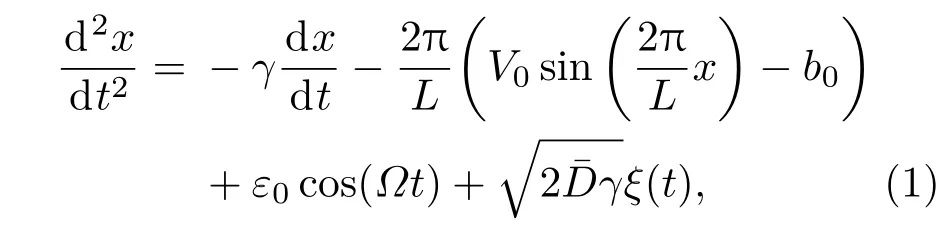
布朗粒子在周期勢系統中的運動是一個非常重要的理論抽象模型,比如超離子導體的導電性[10]、約瑟夫森結[11]、分子生物馬達[12]等.因此,周期勢系統中的隨機共振現象不論是在過阻尼[13?17]還是欠阻尼[18?22]情形下都引起了廣泛的研究興趣.Kim和Sung[13]利用數值方法對周期勢系統中的隨機共振進行了研究,通過躍遷模型說明了過阻尼周期勢系統中不存在隨機共振現象.Dan等[14]研究了非均勻介質中質點在過阻尼搓板勢系統中的運動,發現當選取質點的遷移率作為量化指標時,系統會出現隨機共振的現象.Tu等[15]對非均勻介質中非對稱耦合粒子在周期勢場中的運動建立了分數階模型,采用分數階差分法進行數值仿真研究其定向輸運現象,發現當系統存在噪聲時,粒子鏈平均速度出現了廣義隨機共振現象.Fronzoni和Mannella[16]通過搭建鎖相環電路進行直接模擬發現了傾斜的周期勢系統中的隨機共振現象,但在嘗試用基于線性響應理論的方法研究隨機共振時,其理論推導和模擬結果的符合程度并不令人滿意.Marchesoni[17]考察了白噪聲激勵下過阻尼搓板勢系統的隨機共振現象,研究表明在線性響應意義下,當滿足絕熱近似條件時,隨機共振會發生在臨界偏置附近.我們考慮用半解析的矩方法研究周期信號和高斯白噪聲共同作用的過阻尼搓板勢系統的隨機共振.本文以一個單位質量的質點在搓板勢系統中的過阻尼運動為研究對象,其勢函數表達式為滿足以下Langevin方程:
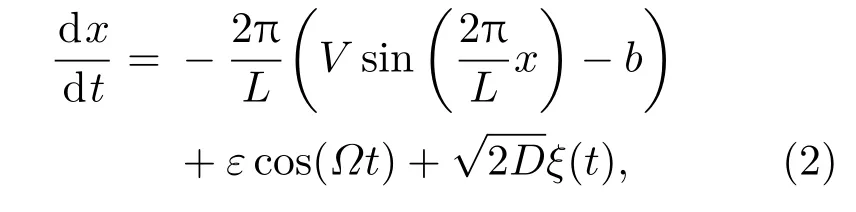
其中V=V0/γ,b=b0/γ,ε=ε0/γ,D=/γ.
當周期信號非常弱時,即0<ε?1,此時系統(2)對應的確定性系統近似地等價為

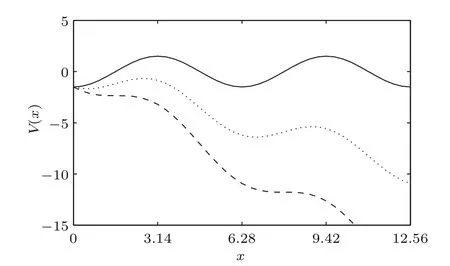
圖1 系統勢函數V(x) (參數V=1.5,L=2π;b=0(實線),b=0.5V(點線),b=V(短劃線))Fig.1.The potential function.The curves correspond to b=0(solid line),b=0.5V(dotted line),and b=V(dashed line),respectively,when V=1.5 and L=2π.
本文首先應用線性響應理論對受弱周期信號激勵的過阻尼搓板勢系統進行研究,提出基于擾動展開法的矩方法,通過比較矩方法和直接數值模擬法所得結果驗證矩方法的有效性,并通過計算系統功率譜放大因子研究隨機共振現象.然后,根據Floquet理論,給出基于非擾動展開法的矩方法,并對其適用范圍加以研究.
2 基于擾動展開法的矩方法
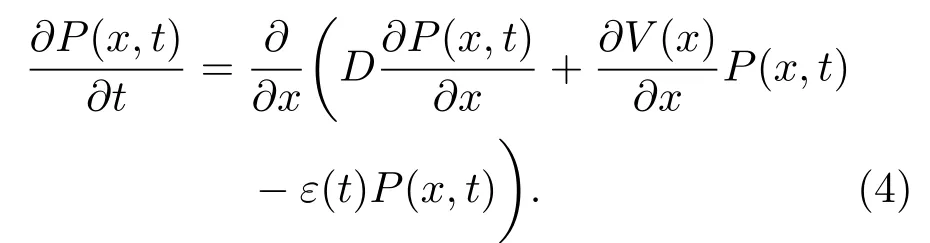
以P(x,t)表示系統(2)在時刻t的狀態概率密度,則它的Fokker-Planck(FP)方程為

假設ε?1,在線性響應意義下,方程(4)的解可以分解為[25]
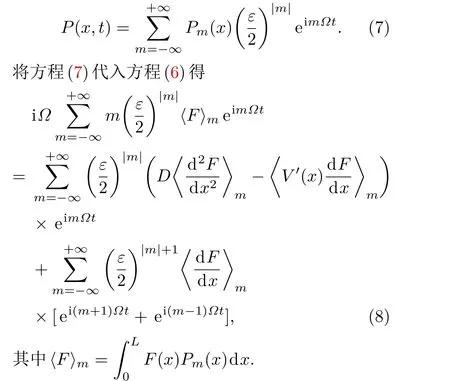
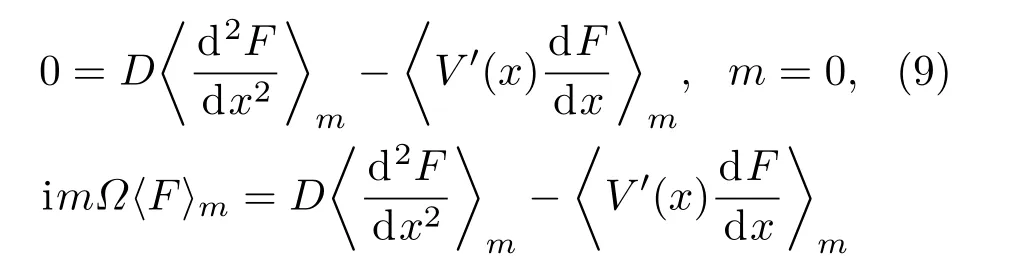
利用三角函數系的正交性并舍去ε的高次項得
由概率規范化性質可知,P(x,t)必須滿足約束條件
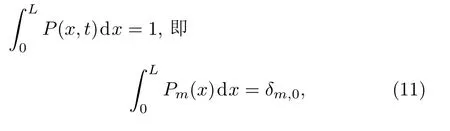
其中δm,0為Kronecker符號.
考慮到pm(x)是周期為L的函數,把它展成如下形式的三角級數[26]:
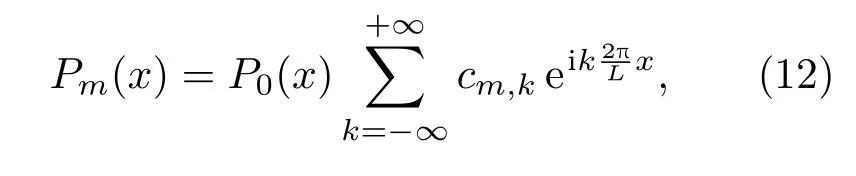
其中c0,k=δ0,k,并且選取

將展(12),(13)式代入方程(10),有
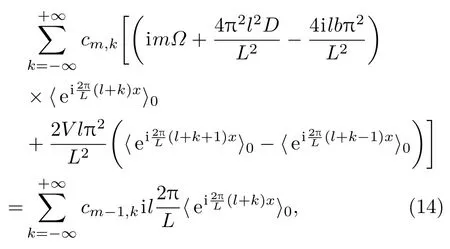
這里〈·〉0表示對未擾隨機系統的平穩分布(3)取期望,也稱作未擾隨機系統的平穩矩.
當l=0即F(x)=1時,有

這和概率規范化性質(11)式一致.
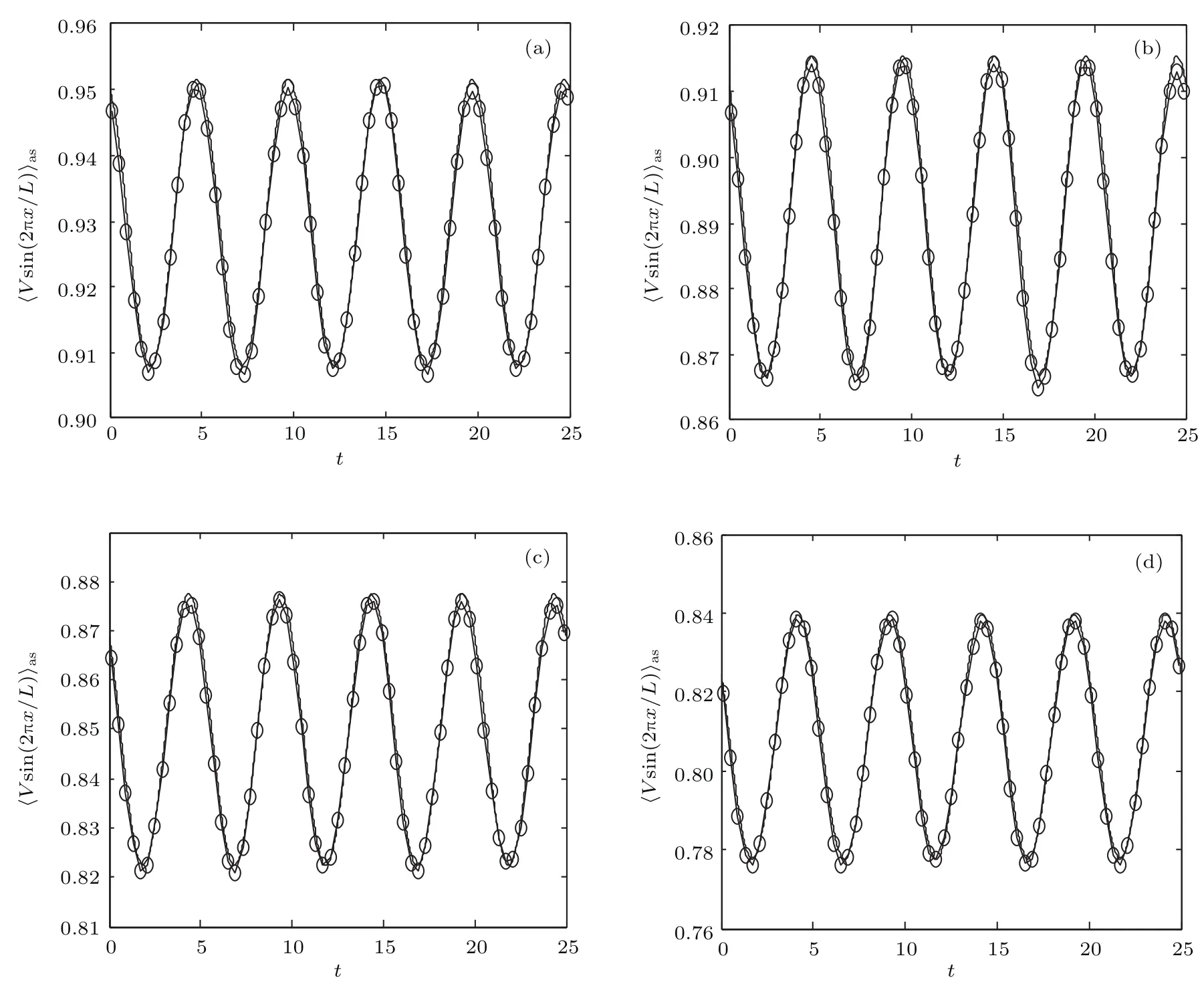
圖2 系統的長時間總體均值響應(矩方法(實線)、直接模擬法(圓圈)),其中,參數D=0.2,? =0.4π,V=1.5,L=2π,ε=0.05;b為(a)0.95V,(b)V,(c)1.05V,(d)1.1VFig.2.The long time ensemble averages calculated from stochastic simulation(circle)and the method of moments(solid line).The parameter b corresponds to(a)0.95V,(b)V,(c)1.05V,and(d)1.1V,respectively,when D=0.2,? =0.4π,V=1.5,L=2π,and ε =0.05.
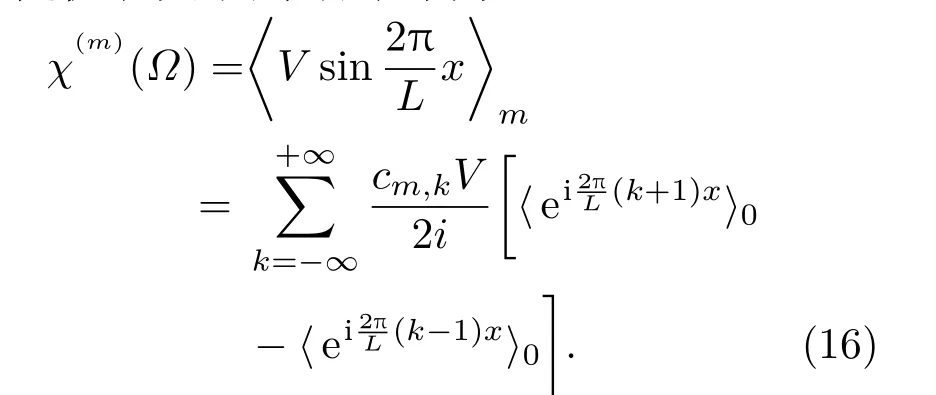
由文獻[27]可知,系統的m階線性敏感性可由未擾隨機系統的平穩矩表示為
系統的長時間線性響應可以表示為
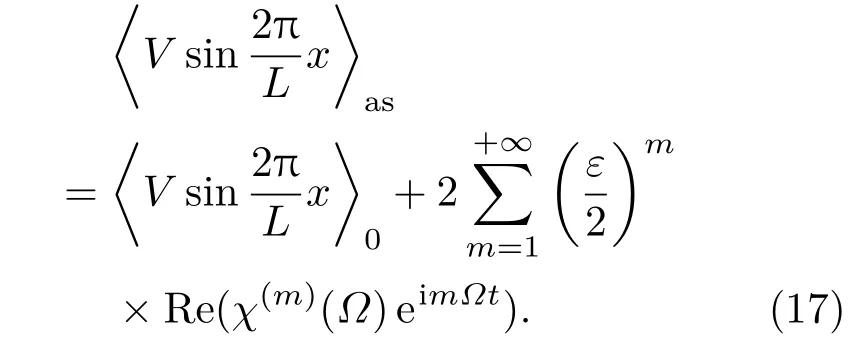
為了求解方程(14),必須選擇一個截斷階K使得|k|6 K,計算結果表明,當K取16之后的值時,結果沒有明顯變化,因此取K=16展示數值結果.為了驗證基于擾動展開法的矩方法的精確性,我們用Box-Muller隨機數算法[28]生成高斯白噪聲,在此基礎上用歐拉算法對系統(2)進行直接模擬,并將該直接模擬的結果與矩方法計算所得結果進行比較.圖2給出了兩種方法計算的系統的長時間總體均值響應,可見數值模擬與矩方法所得的結果幾乎完全符合,這說明了矩方法的有效性.
3 基于非擾動展開法的矩方法
對于任意ε,根據Floquet理論,FP方程(4)的長時間解是時間的周期函數,其周期與輸入周期信號相同,即考慮到長時間解的周期性,可將其按傅里葉級數展開[29,30]
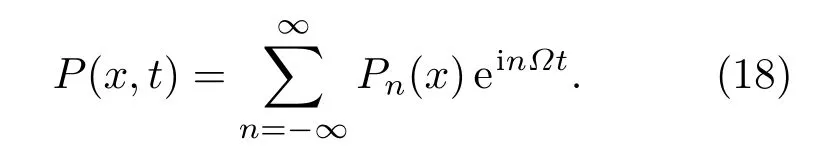
將展(18)式代入方程(6),有
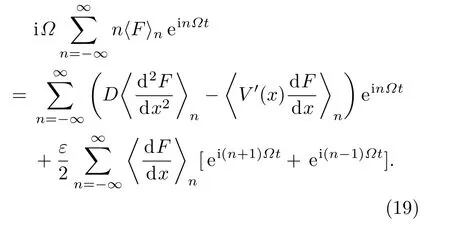
利用三角函數系的正交性得
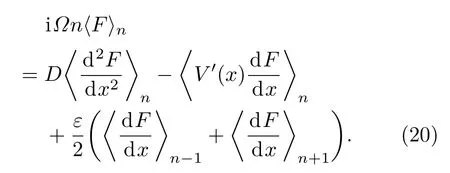
下面過程和線性響應的計算相似.考慮到未知函數Pn(x)必須滿足周期邊界條件,把它展成如下形式的三角級數:

有p0,k=δ0,k,將展(21)式代入方程(20)并且選取有
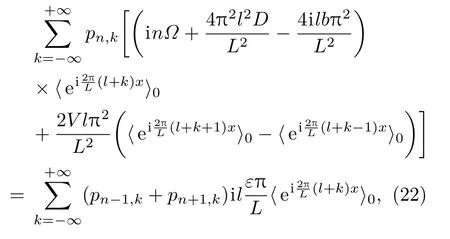
其中l=0時概率規范化性質自然滿足.
系統n階響應敏感性可由未擾隨機系統的平穩矩表示為
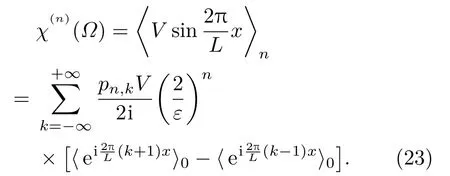
系統的長時間響應可以表示為
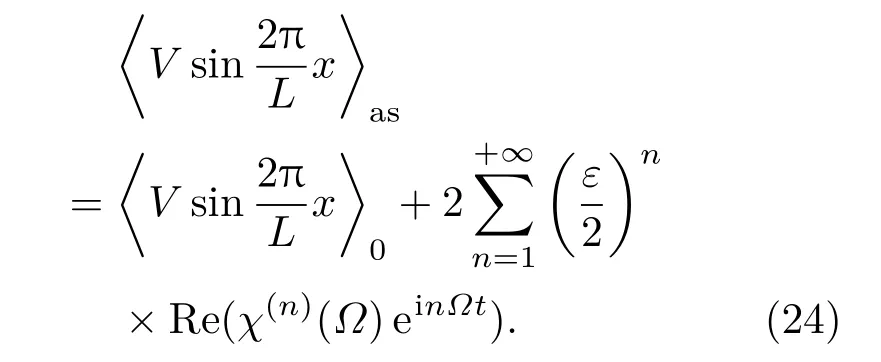
選取截斷階N=10,K=16,應用高斯塊消去法,對方程(22)進行求解,并且為了驗證基于非擾動展開法的矩方法的準確性,圖3給出了矩方法和直接模擬法得到的系統(2)的長時間總體均值響應.由圖3可見,這兩種方法所得結果符合程度較高,這表明了該方法在計算系統響應時的有效性.
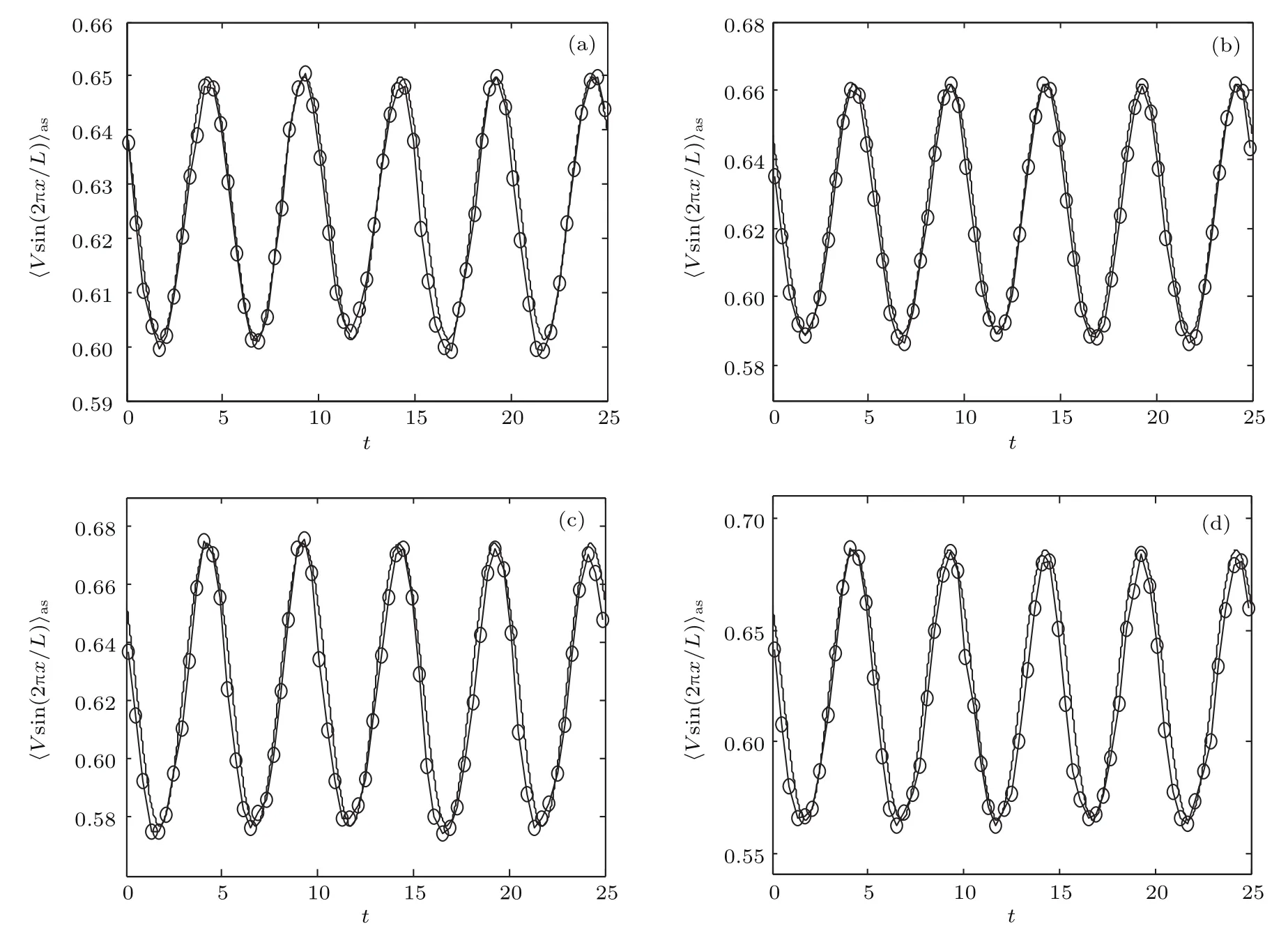
圖3 系統的長時間總體均值響應(矩方法(實線)、直接模擬法(圓圈)),其中,參數D=0.6,? =0.4π,V=1.5,L=2π,b=V;ε為(a)0.1,(b)0.15,(c)0.2,(d)0.25Fig.3.The long time ensemble averages calculated from stochastic simulation(circle)and the method of moments(solid line).The parameter ε corresponds to(a)0.1,(b)0.15,(c)0.2,and(d)0.25,respectively,when D=0.6,? =0.4π,V=1.5,L=2π,and b=V.
4 搓板勢系統的隨機共振
這里選取前三階諧波的譜放大因子|χ(n)|2,n=1,2,3作為觀察系統(2)的隨機共振現象的量化指標,圖4和圖5給出了在弱周期信號極限下,基于擾動展開法的矩方法計算的譜放大因子隨噪聲強度的演化曲線.由圖4和圖5中共振曲線的非單調性可知系統存在隨機共振現象,且在一定的偏置范圍內,隨著偏置b的逐漸增加,共振曲線的峰值逐漸增加,而共振峰對應的噪聲強度逐漸減小.對于充分大的阻尼,我們可以忽略慣性效應,在沒有噪聲時,質點將進行爬行運動.有噪聲時質點在過阻尼搓板勢系統中不會長時間停留在固定狀態,而是會在某一時刻被“踢出”勢阱,向與其相鄰的更低的勢阱運動.隨機共振理論指出,當有噪聲的系統發生隨機共振時,部分噪聲能量會轉化為有用的信號能量.系統的勢壘與系統、信號和噪聲三者發生協同效應的條件有關,其高度揭示了系統按照信號的頻率節奏產生躍遷、進入隨機共振狀態時信號和噪聲所需的能量.勢壘高度越低,意味著系統進入隨機共振狀態時所需能量越少.反之,所需的能量越多.當增大偏置b時,勢壘高度會降低,即質點在向更低的勢阱運動時所需的能量降低,從而由噪聲引起的阱間躍遷更容易發生.
下面從隨機系統的功率譜出發研究隨機共振現象,考慮到b-sinx關于x的周期性,采用{sinx(t)}的功率譜描述系統響應,其定義如下[31]:

其中功率譜S(ω)在計算時取為1000次實驗的平均值.隨機共振作為周期信號和噪聲之間的一種協作效應,系統(2)若存在隨機共振現象,則其輸出響應具有和輸入周期信號相同的頻率,即系統的功率譜在驅動頻率處應該有峰值,并且在隨機共振的最優噪聲強度處峰值最大.圖6(a)和圖6(b)分別給出了系統輸出響應在頻率f=0.2和f=0.4處的功率譜隨噪聲強度的演化.將圖6(a)和圖4(b)、圖6(b)和圖5(a)進行比較可以看出,從功率譜出發所得一階諧波的最優噪聲水平D=0.1、二階諧波的最優噪聲水平D=0.2和矩方法計算所得的一致.
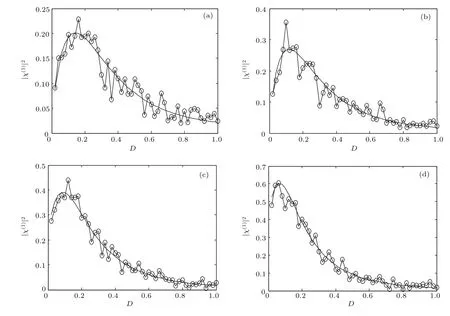
圖4 一階諧波功率譜放大因子隨噪聲強度的演化(矩方法(實線)、直接模擬法(圓圈)),其中,參數ε=0.05,? =0.4π,V=1.5,L=2π;b為(a)0.95V,(b)V,(c)1.05V,(d)1.1VFig.4.The dependence of the spectral ampli fi cation factor on the noise intensity at the fi rst harmonic:stochastic simulation(circle)and the method of moments(solid line).The parameter b corresponds to(a)0.95V,(b)V,(c)1.05V,and(d)1.1V,respectively,when ? =0.4π,V=1.5,L=2π,and ε =0.05.
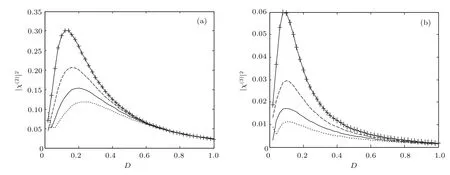
圖5 (a)二階諧波和(b)三階諧波功率譜放大因子隨噪聲強度的演化,其中,參數?=0.4π,V=1.5,L=2π;b為0.95V(點線),V(實線),1.05V(短劃線),1.1V(+)Fig.5.The dependence of the spectral ampli fi cation factor on the noise intensity at(a)the second harmonic and(b)the third harmonic.The parameter b corresponds to 0.95V(dotted line),V(solid line),1.05V(dashed line),and 1.1V(+),respectively,when ? =0.4π,V=1.5,and L=2π.
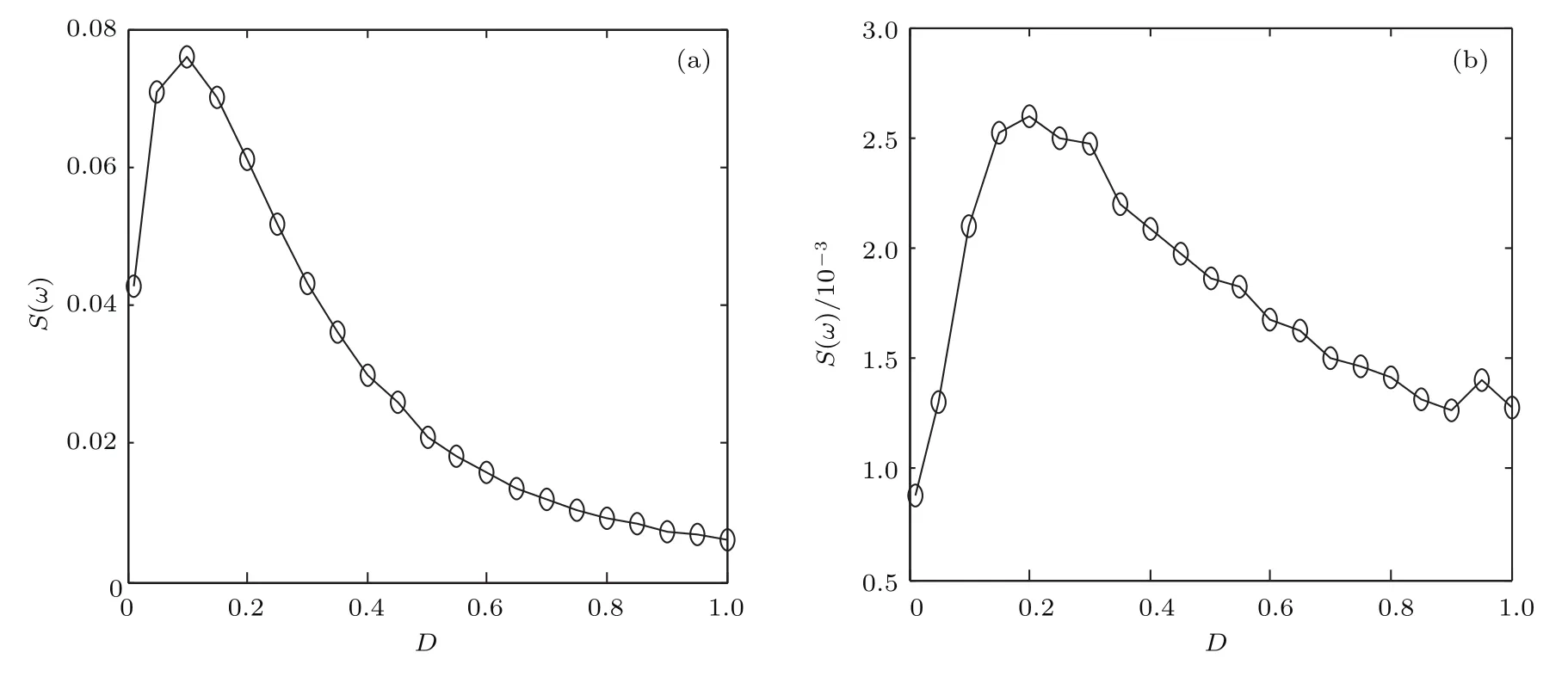
圖6 系統輸出響應在頻率(a)f=0.2,(b)f=0.4處的功率譜隨噪聲強度的演化,其中,參數ε=0.05,? =0.4π,V=1.5,L=2π,b=VFig.6.The dependence of the power spectrum of the system output response on the noise intensity at the frequency(a)f=0.2,(b)f=0.4.The parameters ε=0.05,? =0.4π,V=1.5,L=2π,and b=V.

圖7 一階諧波功率譜放大因子隨噪聲強度的演化(矩方法(實線)、直接模擬法(圓圈)),其中,參數? =0.4π,V=1.5,L=2π,b=V;ε為(a)0.1,(b)0.15,(c)0.2,(d)0.25Fig.7.The dependence of the spectral ampli fi cation factor on the noise intensity at the fi rst harmonic:stochastic simulation(circle)and the method of moments(solid line).The parameter ε corresponds to(a)0.1,(b)0.15,(c)0.2,and(d)0.25,respectively,when ? =0.4π,V=1.5,L=2π,and b=V.
為了進一步研究周期信號的幅值對隨機共振效應的影響,在圖7和圖8展示了不同驅動幅值下由基于非擾動展開法的矩方法計算的系統(2)前三階諧波的譜放大因子隨噪聲強度演化的結果.將該方法所得的一階諧波的計算結果與直接模擬的結果進行比較,發現在ε 6 0.25的情況這兩種方法符合較好,這驗證了矩方法的有效性.由圖7和圖8可見,隨著周期信號幅值的增大,隨機共振效應會增強.周期信號幅值對系統隨機共振效應的影響與偏置類似,增大周期信號的幅值相當于降低勢壘高度,使得系統進入隨機共振狀態所需的能量降低,但是由于考慮的幅值遠小于偏置,對勢壘高度的改變并不明顯,即所需能量的改變也不明顯,所以增大幅值時,隨機共振效應雖然有所增強,但對應的最優噪聲強度并沒有明顯改變.為了得到基于非擾動展開法的矩方法的適用范圍,采用均方差作為比較不同信號幅值下理論和數值計算差異性的量化指標,定量分析矩方法和隨機模擬法所得結果的差異性.圖9給出了均方差隨信號幅值的演化,由圖可見當ε 6 0.25時誤差小于0.1%,這說明矩方法的適用范圍是ε 6 0.25.
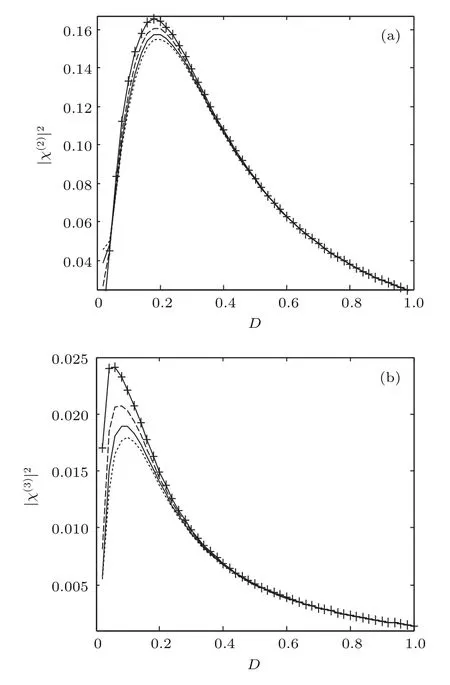
圖8 (a)二階諧波和(b)三階諧波功率譜放大因子隨噪聲強度的演化,其中,參數? =0.4π,V=1.5,L=2π,b=V;ε為0.1(點線),0.15(實線),0.2(短劃線),0.25(+)Fig.8.The dependence of the spectral ampli fi cation factor on the noise intensity at(a)the second harmonic and(b)the third harmonic.The parameter ε corresponds to 0.1(dotted line),0.15(solid line),0.2(dashed line),and 0.25(+),respectively,when? =0.4π,V=1.5,L=2π,and b=V.
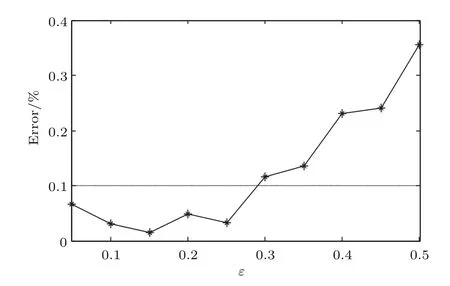
圖9 均方差隨信號幅值的演化,其中,參數?=0.4π,V=1.5,L=2π,b=VFig.9.The dependence of the mean error on the amplitude of the periodic signal. The parameters? =0.4π,V=1.5,L=2π,and b=V.
5 結 論
目前,對過阻尼搓板勢系統的研究大多基于直接模擬法,花費時間較多,因此,本文采用矩方法研究受周期信號和高斯白噪聲激勵的過阻尼搓板勢系統中的隨機共振現象,研究工作表明在適當的參數條件下,過阻尼搓板勢系統中存在隨機共振現象.在線性響應意義下,采用譜放大因子作為隨機共振現象的量化指標,基于擾動級數展開法的矩方法和直接模擬法所得的譜放大因子隨噪聲強度的演化曲線得到很好的擬合,這說明了矩方法的有效性.周期信號較大時,我們給出了基于非擾動展開法的計算系統非線性響應的矩方法,展示了前三階諧波譜放大因子的計算結果,將該方法所得的一階諧波的計算結果和直接模擬的結果進行了比較,驗證了矩方法的有效性,并且通過采用均方差作為比較這兩種方法在不同信號幅值下差異性的量化指標,得到矩方法的適用范圍是ε 6 0.25.而且在一定范圍內共振曲線的峰值隨偏置參數的增大而增大,隨機共振效應隨驅動幅值的增大而增強.搓板勢系統對于研究超離子導體的導電性、約瑟夫森結中超電流的波動、ad-原子在晶體表面的運動等物理問題具有現實針對性.本文所得的譜放大因子的適用范圍突破了以往絕熱近似條件和線性響應條件[16,17]的限制,使得矩方法在更廣泛的參數范圍下都有效,接下來我們將把這種方法推廣到欠阻尼的情況.
[1]Benzi R,Sutera A,Vulpiani A 1981 J.Phys.A 14 L453
[2]Gammaitoni L,Hanggi P,Hung P,Marchesoni F 1998 Rev.Mod.Phys.70 223
[3]McNamara B,Wiesenfeld K,Roy R 1988 Phys.Rev.Lett.60 2626
[4]Paulsson J,Ehrenberg M 2000 Phys.Rev.Lett.84 5447
[5]Leonard D S,Reichl L E 1994 Phys.Rev.E 49 1734
[6]Mao X M,Sun K,Ouyang Q 2002 Chin.Phys.11 1106
[7]Zhang G L,Lü X L,Kang Y M 2012 Acta Phys.Sin.61 040501(in Chinese)[張廣麗,呂希路,康艷梅 2012物理學報61 040501]
[8]Jiao S B,Ren C,Huang W C,Liang Y M 2013 Acta Phys.Sin.62 210501(in Chinese)[焦尚彬,任超,黃偉超,梁炎明2013物理學報62 210501]
[9]Wallace R,Wallace D,Andrews H 1997 Environ.Plan.A 29 525
[10]Asaklil A,Boughaleb Y,Mazroui M,Chhib M,Arroum L E 2003 Solid State Ion.159 331
[11]Falco A M 1976 Amer.J.Phys.44 733
[12]Hanggi P,Talkner P,Borkovec M 1990 Rev.Mod.Phys.62 251
[13]Kim Y W,Sung W 1998 Phys.Rev.E 57 R6237
[14]Dan D,Mahato M C,Jayannavar A M 1999 Phys.Rev.E 60 6421
[15]Tu Z,Lai L,Luo M K 2014 Acta Phys.Sin.63 120503(in Chinese)[屠浙,賴莉,羅懋康 2014物理學報 63 120503]
[16]Fronzoni L,Mannela R 1993 J.Stat.Phys.70 501
[17]Marchesoni F 1997 Phys.Lett.A 231 61
[18]Saikia S,Jayannavar A M,Mahato M C 2011 Phys.Rev.E 83 061121
[19]Reenbohn W L,Pohlong S S,Mahato M C 2012 Phys.Rev.E 85 031144
[20]Saikia S 2014 Physica A 416 411
[21]Liu K H,Jin Y F 2013 Physica A 392 5283
[22]Ma Z M,Jin Y F 2015 Acta Phys.Sin.64 240502(in Chinese)[馬正木,靳艷飛 2015物理學報 64 240502]
[23]Risken H 1989 The Fokker Planck Equation(Berlin:Springer)pp287–289
[24]Monnai T,Sugita A,Hirashima J,Nakamura K 2006 Physica D 219 177
[25]Kang Y M,Jiang Y L 2008 Chin.Phys.Lett.25 3578
[26]Kang Y M,Jiang J,Xie Y 2011 J.Phys.A:Math.Theor.44 035002
[27]Evistigneev M,Pankov V,Prince R H 2001 J.Phys.A:Math.Gen.34 2595
[28]Fox R F,Gatland I R,Vemuri G,Roy R 1988 Phys.Rev.A 38 5938
[29]Jung P 1993 Phys.Rep.234 175
[30]Asish K D 2015 Physica D 303 1
[31]Qian M,Wang G X,Zhang X J 2000 Phys.Rev.E 62 6469
PACS:05.45.–a,05.40.–a,05.45.Mt,05.40.CaDOI:10.7498/aps.66.120501
Stochastic resonance in overdamped washboard potential system?
Xie Yong1)?Liu Ruo-Nan2)
1)(State Key Laboratory for Strength and Vibration of Mechanical Structures,School of Aerospace,Xi’an Jiaotong University,Xi’an 710049,China)
2)(School of Mathematics and Statistics,Xi’an Jiaotong University,Xi’an 710049,China)
10 February 2017;revised manuscript
21 March 2017)
Brownian motion in a washboard potential has practical signi fi cance in investigating a lot of physical problems such as the electrical conductivity of super-ionic conductor,the fl uctuation of super-current in Josephson junction,and the ad-atom motion on crystal surface.In this paper,we study the overdamped motion of a Brownian particle in a washboard potential driven jointly by a periodic signal and an additive Gaussian white noise.Since the direct simulation about stochastic system is always time-consuming,the purpose of this paper is to introduce a simple and useful technique to study the linear and nonlinear responses of overdamped washboard potential systems.In the limit of a weak periodic signal,combining the linear response theory and the perturbation expansion method,we propose the method of moments to calculate the linear response of the system.On this basis,by the Floquet theory and the non-perturbation expansion method,the method of moments is extended to calculating the nonlinear response of the system.The long time ensemble average and the spectral ampli fi cation factor of the fi rst harmonic calculated from direct numerical simulation and from the method of moments demonstrate that they are in good agreement,which shows the validity of the method we proposed.Furthermore,the dependence of the spectral ampli fi cation factor at the fi rst three harmonics on the noise intensity is investigated.It is observed that for appropriate parameters,the curve of the spectral ampli fi cation factor versus the noise intensity exhibits a peaking behavior which is a signature of stochastic resonance.Then we discuss the in fl uences of the bias parameter and the amplitude of the periodic signal on the stochastic resonance.The results show that with the increase of the bias parameter in a certain range,the peak value of the resonance curve increases and the noise intensity corresponding to the resonance peak decreases.With the increase of the driven amplitude,comparing the changes of the resonance curves,we can conclude that the e ff ect of stochastic resonance becomes more prominent.At the same time,by using the mean square error as the quantitative indicator to compare the di ff erence between the results obtained from the method of moments and from the stochastic simulation under di ff erent signal amplitudes,we fi nd that the method of moments is applicable when the amplitude of the periodic signal is lesser than 0.25.
stochastic resonance,linear response theory,Floquet theory,the method of moments
10.7498/aps.66.120501
?國家自然科學基金(批準號:11672219,11372233)資助的課題.
?通信作者.E-mail:yxie@mail.xjtu.edu.cn
?2017中國物理學會Chinese Physical Society
http://wulixb.iphy.ac.cn
*Project supported by the National Natural Science Foundation of China(Grant Nos.11672219,11372233).
?Corresponding author.E-mail:yxie@mail.xjtu.edu.cn
猜你喜歡
工業設計(2022年8期)2022-09-09 07:43:20
鴨綠江(2021年35期)2021-04-19 12:24:18
軍民兩用技術與產品(2021年10期)2021-03-16 06:05:30
北京測繪(2020年12期)2020-12-29 01:33:58
考試與評價·高一版(2020年6期)2020-11-02 02:45:24
電子制作(2018年11期)2018-08-04 03:25:42
家庭影院技術(2017年9期)2017-09-26 03:41:45
Coco薇(2016年2期)2016-03-22 02:42:52
鑿巖機械氣動工具(2016年3期)2016-03-01 04:00:25
Coco薇(2015年1期)2015-08-13 02:47:34
