
廣義(3+1)維Zakharov-K uznetsov方程的對稱約化、精確解和守恒律?
2017-08-12 03:20:36張麗香劉漢澤辛祥鵬
物理學報 2017年8期
張麗香 劉漢澤 辛祥鵬
(聊城大學數學科學學院,聊城252059)
廣義(3+1)維Zakharov-K uznetsov方程的對稱約化、精確解和守恒律?
張麗香 劉漢澤?辛祥鵬
(聊城大學數學科學學院,聊城252059)
(2016年1月1日收到;2017年1月2日收到修改稿)
運用李群分析,得到了廣義(3+1)維Zakharov-Kuznetsov(ZK)方程的對稱及約化方程,結合齊次平衡原理,試探函數法和指數函數法得到了該方程的群不變解和新精確解,包括沖擊波解、孤立波解等.進一步給出了廣義(3+1)維ZK方程的伴隨方程和守恒律.
Zakharov-Kuznetsov方程,李群分析,精確解,守恒律
1 引言
非線性發展方程的求解一直是數學和物理工作者研究的熱點問題,經過多年研究,提出了許多有效的方法,如經典李群方法[1?3],改進的tanh函數方法[4],Hirota方法[5],Painlevé截斷展開法[6],Clarkson-K ruskal直接約化方法[7,8],(G′/G)展開方法[9],Jacobi橢圓函數展開法[10].其中李群方法是研究偏微分方程的有力工具之一,本文將采用李群分析研究廣義(3+1)維Zakharov-Kuznetsov(ZK)方程

其中u=u(x,y,z,t),a1,a2,a3,a4,a5,a6是任意非零常數.方程(1)包含了許多著名的方程,例如當a1=a3=a4=a6=0時,該方程就是著名的Korteweg-de Vries方程[11];當a1=a2=a3=a4=0時,該方程就是正則長波方程[12];當a2=a4=a5=0時,該方程就是(2+1)維ZK-MEW方程[13,14];當a1=a4=a6=0時,該方程就是(2+1)維ZK方程[15];當a2=a3=a4=a5=0時,該方程就是修正的(1+1)維MEW方程.
本文主要由以下幾部分組成:第2部分,求出方程(1)的李點對稱;第3部分,對方程(1)進行約化;第4部分,利用試探函數法[16]、指數函數法[17]和齊次平衡原理[18?20],求約化方程的精確解,進而得到方程(1)的精確解;第5部分,給出方程(1)的伴隨方程和守恒律[21?24];最后,對本文做簡要總結.
2 廣義(3+1)維ZK方程的對稱
設方程(1)的單參數向量場為

其中,ξ1(x,y,z,t,u),ξ2(x,y,z,t,u),ξ3(x,y,z,t,u),ξ4(x,y,z,t,u),?(x,y,z,t,u)是待定函數.若向量場(2)是方程(1)的李點對稱,那么V需要滿足以下李對稱條件:

其中pr(3)V是V的三階延拓,并且?=ut+a1u2ux+a2uxxx+a3uxyy+a4uxzz+a5uux+a6uxxt.

必須且只需

其中,系數函數
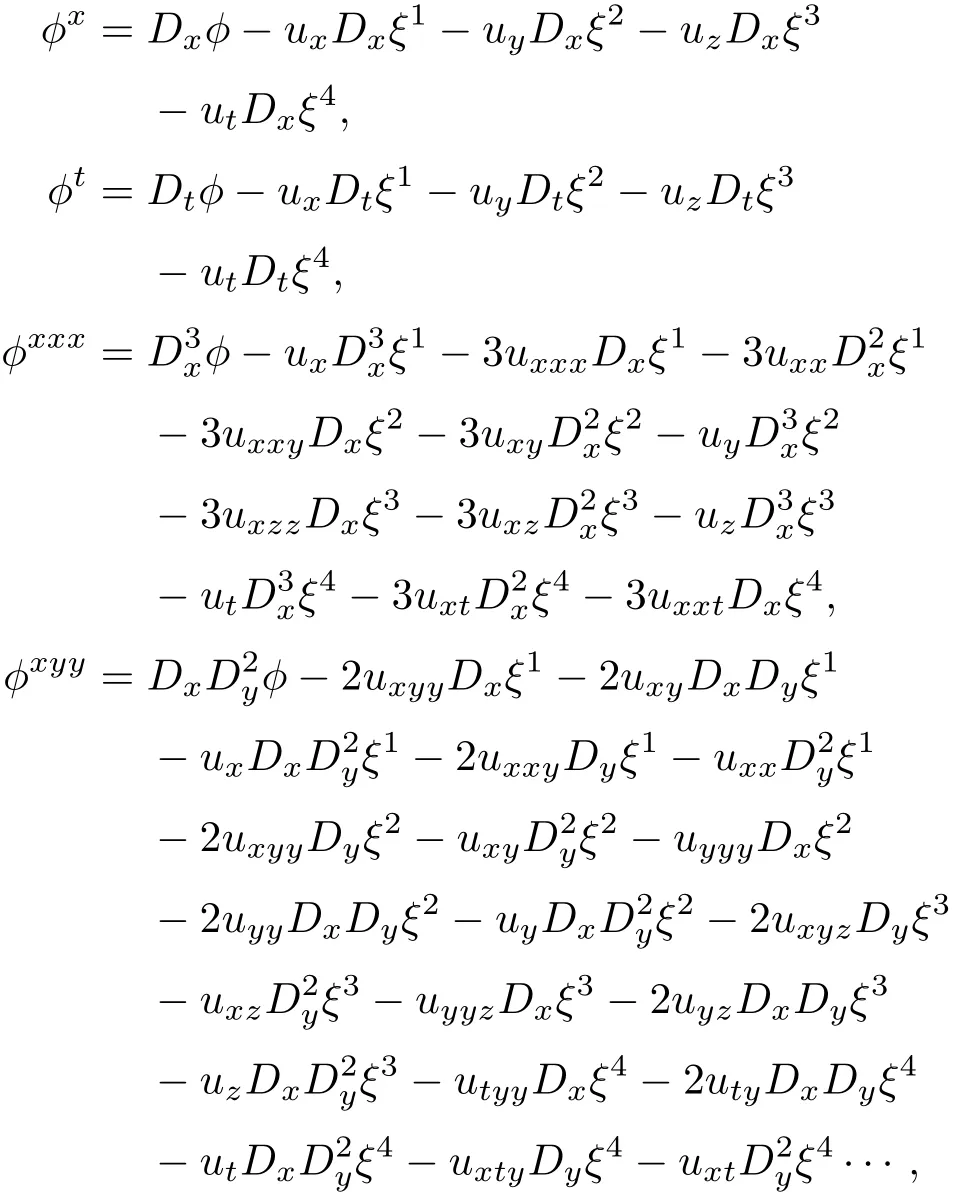
其中Dx,Dy,Dz,Dt為全導算子.把以上系數函數代入(5)式,得到關于ξ1,ξ2,ξ3,ξ4,?的決定方程組,解之得

其中C1,C2,C3,C4,C5為任意常數.同時也得到了方程(1)的相似對稱

這樣就利用李群分析得到了方程(1)的所有向量場

與它們相對應的單參數變換群為

根據上面的單參數不變群可知,若u=f(x,y,z,t)是方程(1)的解,下列u1,u2,u3,u4,u5也是方程(1)的解:

其中ε是任意常數.
3 廣義(3+1)維ZK方程的對稱約化

可以得到下面的相似變換

在前面,已經得到了方程(1)的對稱,在這部分,對方程(1)進行約化.
情況1令C2=1,C1=C3=C4=C5=0,則
方程(1)的群不變解為w=f(ξ,η),即u=f(ξ,η),代入方程(1)中,可將方程(1)約化成(1+1)維偏微分方程

情況2令C2=C4=0,C1=C3=C5=1,則

可以得到下面的相似變換

方程(1)的群不變解為u=f(ξ),代入方程(1)中,得約化后的常微分方程為

其中f′=d f/dξ.
情況3令C1=1,C2=C3=C4=C5=0,則

可以得到下面的相似變換

方程(1)的群不變解為u=f(ξ),代入方程(1),可得到約化后的常微分方程為

其中f′=d f/dξ.
情況4令C1=C2=0,C3=C4=C5=1,則

可以得到下面的相似變換

方程(1)的群不變解為u=f(ξ),代入方程(1),可得到約化后的常微分方程為

其中f′=d f/dξ.約化后的方程(10)和方程(9)相同.
4 廣義(3+1)維ZK方程的精確解
在這一部分,結合齊次平衡原理、指數函數法和試探函數法,對約化后的方程(7)—方程(9)分別求其精確解,進而得到方程(1)的精確解.
情況1為求方程(7)的解,我們應用齊次平衡原理,假設方程(7)有如下形式的解

其中g=g(h),h=h(ξ,η).由齊次平衡原理,得到m=1,n=0,故方程(7)有如下形式的解

將(11)代入方程(7)中,合并h的各種偏導數同次項,并令的系數為零,得到


把以上等量關系代入(11)式,得

解(12)式—(14)式得

把上式代入(12)式—(14)式得

故方程(7)的準確孤立波解為

因此,方程(1)的精確解為

情況2為求方程(8)的解,我們利用試探函數法求其沖擊波解.對方程(8)積分一次得

其中
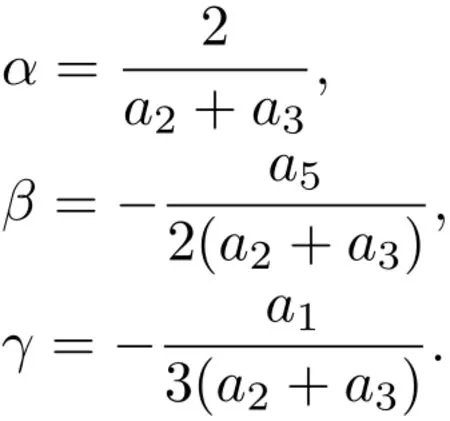
假設方程(15)有如下形式的解:


因此,方程(1)的解為

情況3為求方程(9)的解,我們結合指數函數法和齊次平衡原理求其精確解.為方便,把方程(9)寫成以下形式:

假設方程(17)有如下形式的解:

其中c,d,p,q為正整數,cn,bm為待定常數.則

其中di為各項系數.平衡最高階導數項(19)式和非線性項(20)式的次數,得

同理,平衡最低階導數項和非線性項次數得q=d,為計算簡便,令p=c=1,且q=d=1,故(18)式為

把(21)式代入方程(17)中,借助Maple軟件,得到關于eiξ的各項系數,令每項系數為零,可以得到關于c?1,c0,c1,b0,b?1的超定方程組,解得

其中

c1,b0為任意常數,故方程(17)的解為

因此,方程(1)的解為

其中

c1,b0為任意常數.
5 廣義(3+1)維ZK方程的伴隨方程和守恒律
在這部分,我們將給出方程(1)的伴隨方程和守恒律.方程(1)的伴隨方程為

并且Largrangian記作

利用Ibragimov的結論,守恒向量的公式為

根據Ibragimov給出的結論,我們給出向量場的通式:

那么方程(1)的守恒律由下式決定:

則向量場C=(C1,C2,C3,C4)由下面的式子決定:

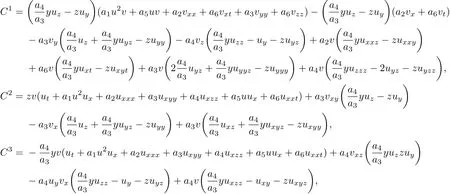

以上守恒向量(C1,C2,C3,C4)包含了伴隨方程(21)的任意解,因此以上守恒向量給出了方程(1)的無窮多個守恒律.
6 結論
本文利用李群分析求得了廣義(3+1)維ZK方程的李點對稱,將(3+1)維方程直接約化成常微分方程和(1+1)維偏微分方程,并結合齊次平衡原理,試探函數法和指數函數法對約化方程求其精確解,從而得到原方程的精確解.豐富了廣義(3+1)維ZK方程的顯示解.可見,李群分析對偏微分方程的求解問題有重要的作用,李群分析在其他領域的應用,有待進一步研究.
[1]O lver P J 1993 Applications of Lie Groups to D iff erential Equations(New York:Sp ringer)pp186–206
[2]T ian C 2001 Applications of Lie Groups to D iff eren tia l Equations(Beijing:Science Press)pp243–248(in Chinese)[田疇2001李群及其在微分方程中的應用(北京:科學出版社)第243—248頁]
[3]Cao L M,Si X H,Zheng L C 2016 J.App l.Math.Mech.37 433
[4]Li D S,Zhang H Q 2005 Acta Phys.Sin.54 1569(in Chinese)[李德生,張鴻慶2005物理學報54 1569]
[5]H irota R,SatsuMa J 1976 Suppl.Prog.Theor.Phys.59 64
[6]W eiss J,Tabor M,Carnevale G 1983 J.Math.Phys.24 522
[7]C larkson P 1989 J.Math.Phys.30 2201
[8]Lou S Y,Ma H C 2005 J.Phys.A:Math.Gen.38 L129
[9]W ang ML,Li X Z,Zhang J L 2008 Phys.Lett.A 372 417
[10]Pan J T,Gong L X 2007 Acta Phys.Sin.56 5585(in Chinese)[潘軍廷,龔倫訓2007物理學報56 5585]
[11]Pang J,Bian C Q,Chao L 2010 App l.Math.Mech.30 884(in Chinese)[龐晶,邊春泉,朝魯2010應用數學和力學30 884]
[12]Naher H,Abdullah F A 2014 Res.J.Appl.Sci.Eng.Techno l.7 4864
[13]Han Z,Zhang Y F,Zhao Z L 2013 ComMun.Theor.Phys.60 699
[14]Xu F,Yan W,Chen Y L 2009 CoMput.Math.Appl.58 2307
[15]W azwaz A M2005 ComMun.Non linear Sci.NuMer.SiMu l.10 97
[16]Liu S S,Fu Z T,Liu S D,Zhao Q 2001 App l.Math.Mech.22 281(in Chinese)[劉式適,付遵濤,劉式達,趙強2001應用數學和力學22 281]
[17]He J H,W u X H 2006 Chaos,Solitions and Fractals 30 700
[18]Zhang H Q 2001 J.Math.Phys.21A 321(in Chinese)[張輝群2001數學物理學報21A 321]
[19]W ang ML,Zhou Y Z,Li Z B 1996 Phys.Lett.A 216 67
[20]W ang ML,Li Z B,Zhou Y B 1999 J.Lanzhou Univ.35 8(in Chinese)[王明亮,李志斌,周宇斌1999蘭州大學學報35 8]
[21]Ib ragiMov Z H 2006 J.Math.Anal.Appl.318 742
[22]Ib ragiMov Z H 2007 J.Math.Anal.Appl.333 311
[23]X i X P,Chen Y 2013 ComMun.Theor.Phys.59 573
[24]Li K H,Liu H Z,X in X P 2016 Acta Phys.Sin.65 140201(in Chinese)[李凱輝,劉漢澤,辛祥鵬2016物理學報65 140201]
(Received 1 January 2016;revised Manuscrip t received 2 January 2017)
PACS:02.20.–a,04.20.Jb,02.30.Jr,11.30.–jDOI:10.7498/aps.66.080201
*Pro ject supported by the National Natural Science Foundation of China(G rant Nos.11171041,11505090).
?Corresponding author.E-Mail:hnz_liu@aliyun.com
SymMetry reductions,exact equations and the conservation law s of the generalized(3+1)d iMensional Zakharov-K uznetsov equation?
Zhang Li-Xiang Liu Han-Ze?Xin Xiang-Peng
(School ofMatheMatical Sciences,Liaocheng University,Liaocheng 252059,China)
Because the nonlinear evolution equations can describe the coMp lex phenomena of physical,cheMical and biological field,Many Methods have been p roposed for investigating such types of equations,and the Lie symMetry analysis Method is one of the powerful tools for studying the non linear evolution equations.By using the Lie symMetry analysis method,we can obtain the symmetries,reduced equations,group invariant solutions,conservation laws,etc.In the reduction process,we can reduce the order and diMension of the equations,and a coMp lex partial diff erential equations(PDE)can be reduced to ordinary diff erential equations directly,which siMp lifies the solving p rocess.Meanwhile,the symmetries,conservation laws and exact solutions to the nonlinear partial diff erential equations p lay a significant role in non linear science and MatheMatical physics.For exaMp le,we can obtain a lot of new exact solutions by the known symMetries of the original equation;through the analysis of the special forMof solution we can better exp lain soMe physical phenomena.In addition,the studying of conservation laws and symmetry groups is also the central topic of physical sciencein both classicalMechanics and quantuMMechanics.Lie symMetry analysisMethod is suitab le for not on ly constant coeffi cient equations,but also variab le coeffi cient equations and PDE systeMs.By using Lie symmetry analysismethod,the symmetriesand corresponding symmetry reductionsof the(3+1)dimensionalgeneralized Zakharov-Kuzetsov(ZK)equation are obtained.Combining the hoMogeneous balance princip le,the trial function Method and exponential functionmethod,the group invariant solutions and some new exact exp licit solutions are obtained,including the shock wave solutions,solitary wave solutions,etc.Then,we give the conservation law s of the generalized(3+1)diMensional ZK equation in terMs of the Lagrangian and ad joint equation Method.
Zakharov-Kuznetsov equation,Lie symmetry analysis,exact solution,conservation law
10.7498/aps.66.080201
?國家自然科學基金(批準號:11171041,11505090)資助的課題.
?通信作者.E-Mail:hnz_liu@aliyun.com
?2017中國物理學會C h inese P hysica l Society
http://w u lixb.iphy.ac.cn
