雄激素受體在乳腺癌中的生物信息學分析
2017-10-09 02:53:34JinhuaWang
山西中醫藥大學學報 2017年3期
李 兵,杜 崗,Jinhua Wang
(1.山西省煤炭工業廳煤礦職業病防治中心,山西 太原 030012; 2.暨南大學附屬第一醫院,廣東廣州 510632;3,Center for Health Informatics and Bioinformatics,New York University School of Medicine,New York,NY,USA;4.Laura and Isaac Perlmutter Cancer Center,New York University School of Medicine,New York,NY,USA)
雄激素受體在乳腺癌中的生物信息學分析
李 兵1,杜 崗2,3,Jinhua Wang3,4
(1.山西省煤炭工業廳煤礦職業病防治中心,山西 太原 030012; 2.暨南大學附屬第一醫院,廣東廣州 510632;3,Center for Health Informatics and Bioinformatics,New York University School of Medicine,New York,NY,USA;4.Laura and Isaac Perlmutter Cancer Center,New York University School of Medicine,New York,NY,USA)
目的:通過數據挖掘探討雄激素受體(AR)在乳腺癌中發病的機制,探索協同表達基因網絡中的潛在干預靶點和信號通路。方法:分別從TCGA數據庫和NCBI數據庫中下載了兩個獨立的乳腺癌基因表達譜數據,篩選出AR的關聯基因,使用Cytoscape平臺中的ClueGo插件對這些基因進行生物信息學分析。結果:以Pearson相關系數>0.40或<-0.40為閾值,共發現21個基因與AR有強的相關性,其中負相關4個,正相關17個;同時發現基因MLPH,SYT17,PIP,ALCAM,TOX3在既往文獻報道中較少,可以成為下一步的研究方向。GO功能分析提示AR及其關聯基因與上皮細胞分化、細胞形態改變、細胞內的類固醇激素受體信號通路等有關。結論:AR在乳腺癌作用中的信號通路和分子機制復雜,基于乳腺癌的數據挖掘可以為乳腺癌的個體化診斷和治療提供科學依據。
乳腺癌;雄激素受體;生物信息學
乳腺癌是影響女性健康的主要惡性腫瘤之一,在歐美國家發病率較高,中國的發病率也呈快速增長趨勢[1]。乳腺癌呈激素依賴性,雌激素、孕激素及其受體在乳腺癌的發生、發展中起著重要作用;內分泌治療已經成為雌激素受體(estrogen receptor,ER)、孕激素受體(progesterone receptor,PR)陽性患者的一線治療方法[2]。然而,絕經后女性體內雌激素的減少并未使乳腺癌的發病率下降,ER、PR陽性患者中也有部分患者內分泌治療無效,提示除雌激素、孕激素外,雄激素及雄激素受體(androgen receptor,AR)在乳腺癌中亦起著重要作用[3],但相關機制尚不明確。本文對乳腺癌研究的數據進行挖掘,旨在通過分析AR的關聯基因,為進一步闡明AR在乳腺癌中發病的機制提供幫助。
1 資料與方法
1.1 資料來源
本文中乳腺癌數據來源于TCGA(the cancer genome atlas project)公共數據庫(https://tcga-data.nci.nih.gov/tcga)的 Comprehensive Molecular Portraits of Invasive Lobular Breast Cancer研究[4](該數據簡稱TCGA-CELL2015)和NCBI(http://www.ncbi.nlm.nih.gov/geo)的A Genomic Predictor of Response and Survival Following Taxane-Anthracycline Chemotherapy for Invasive Breast Cancer研究(該數據簡稱NCBI-JAMA2011)[5]。
1.2 數據處理和分析
采用R語言(版本:3.2.3)對數據進行分析和處理,使用 Cytoscape(版本:3.3)的 ClueGo 插件對篩選出的目標基因進行GO分析和作圖[6-7],P<0.05為差異有統計學意義。
2 結果
2.1 數據分析結果
通過對NCBI-JAMA2011和TCGA-CELL2015兩組數據分析,Pearson值切割點取0.4或-0.40,取兩個數據的交集,共發現21個基因與AR相關,其中負相關4個,正相關17個,結果見表1。通過在線軟件Pathway Commons[8](http://www.pathwaycommons.org)對目標基因進行相互作用網絡分析,發現基因 MLPH,SYT17,PIP,ALCAM,TOX3在相互作用網絡圖之外,提示該組基因與AR相關研究報道較少,可以作為下一步研究目標。結果見圖1。
2.2 GO富集分析結果
將篩選出的21個基因借助Cytoscape軟件中的ClueGo插件進行分析并繪制基因富集網絡圖,共富集到9個生物過程,這些基因與上皮細胞分化、細胞形態改變、細胞內的類固醇激素受體信號通路等有關,結果見圖2,表2。
3 討論
AR屬于核受體超家族成員,基因位于X染色體上,基因長度為90 kb,在機體組織中分布廣泛,主要存在于靶細胞的核內[9]。試驗發現胚胎腎臟中即有AR的表達,其中睪酮可通過AR促進Wolffian 導管的生長和形成[10-12]。Takeda H 等[13]對人體不同組織中AR的表達情況進行了研究,結果顯示AR在乳腺組織、生殖系統、前列腺、平滑肌、心臟、肝臟、腎臟及腦組織均有一定的表達。未結合配體的AR位于細胞質中,與蛋白質分子以復合物的形式存在。但AR與雄激素結合后構象發生改變,與結合蛋白分離,轉移至細胞核內并形成二聚體后與DNA上的激素反應元件結合,從而激活靶基因的轉錄。Garreau G等[14]證實ER-/PR-/AR+的乳腺癌細胞對雄激素治療有效,而ER-/PR-/AR-的細胞對雄激素治療無反應;當細胞轉染AR成為ER-/PR-/AR+的細胞后就會顯示出對雄激素治療的反應,細胞發生凋亡或死亡。提示ER-/PR-且AR+的腫瘤患者以AR為靶向的激素治療是有效的。
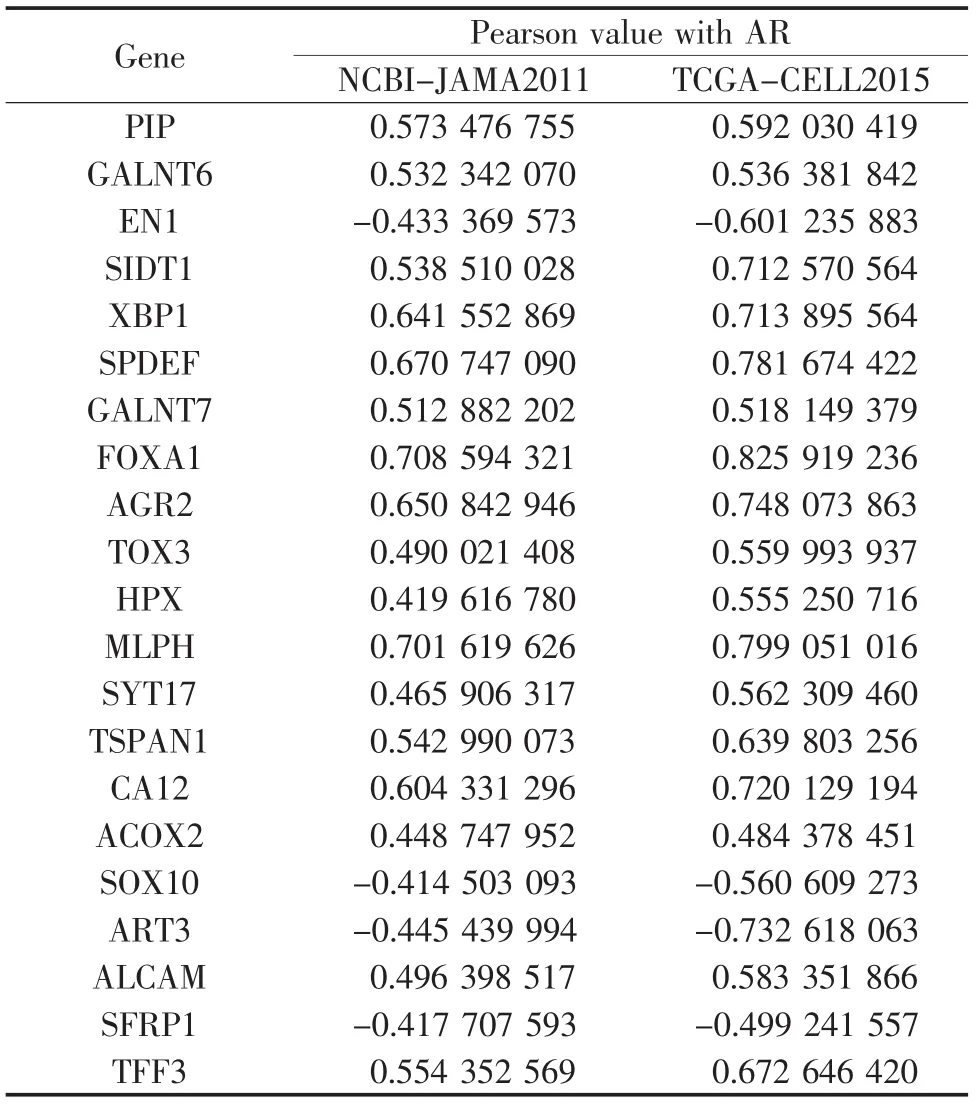
表1 AR關聯基因
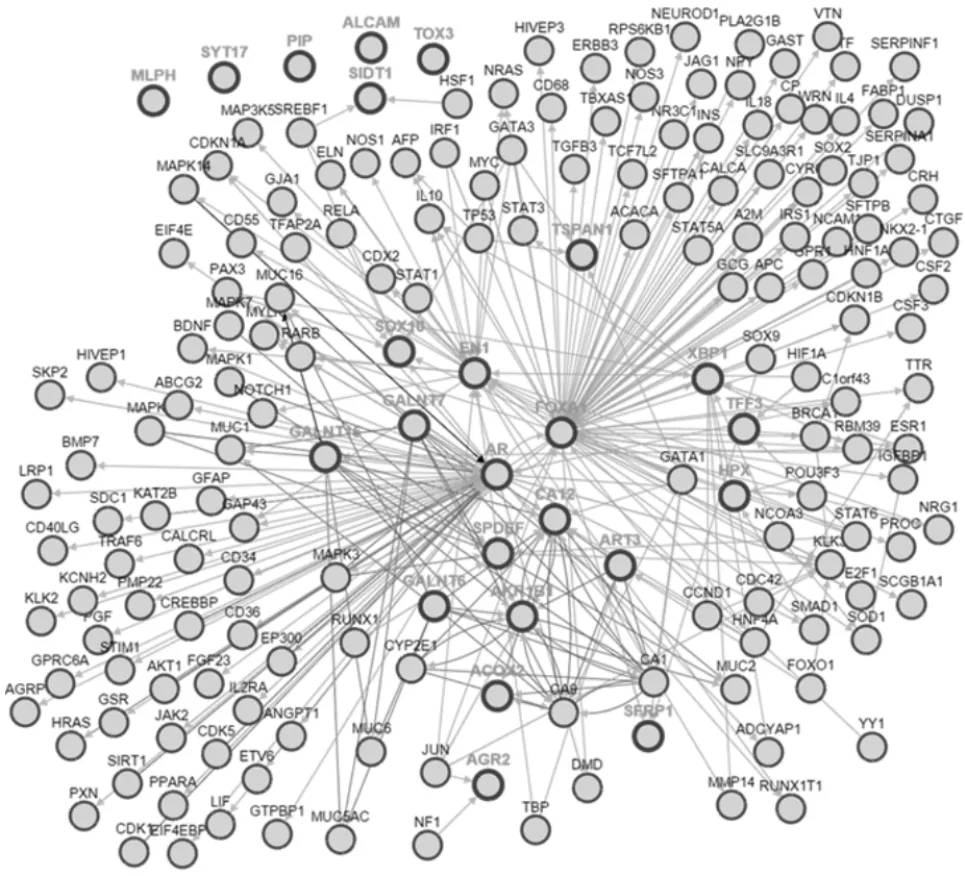
圖1 AR關聯基因調控網絡圖
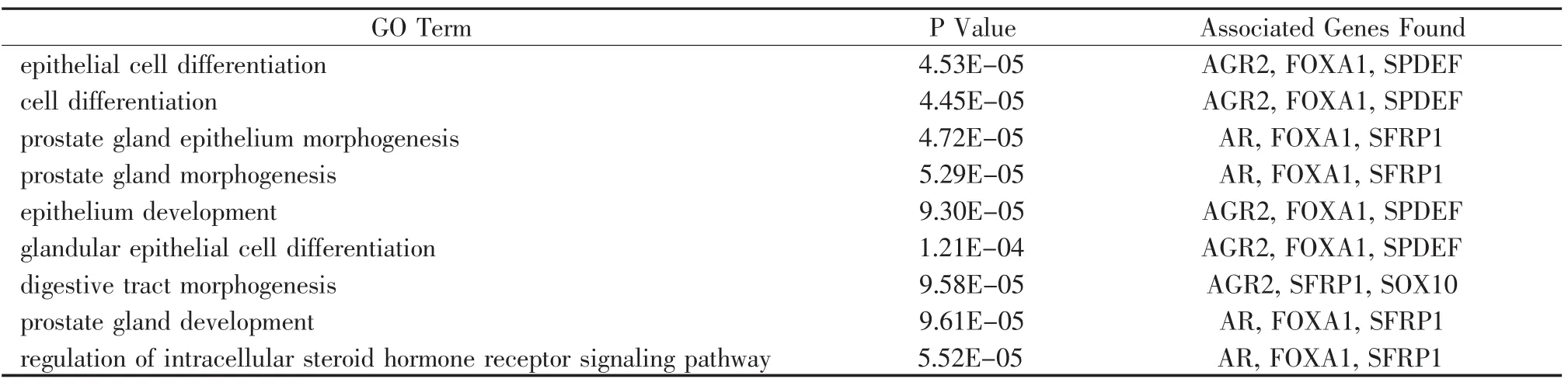
表2 差異表達基因GO生物學過程富集分析結果
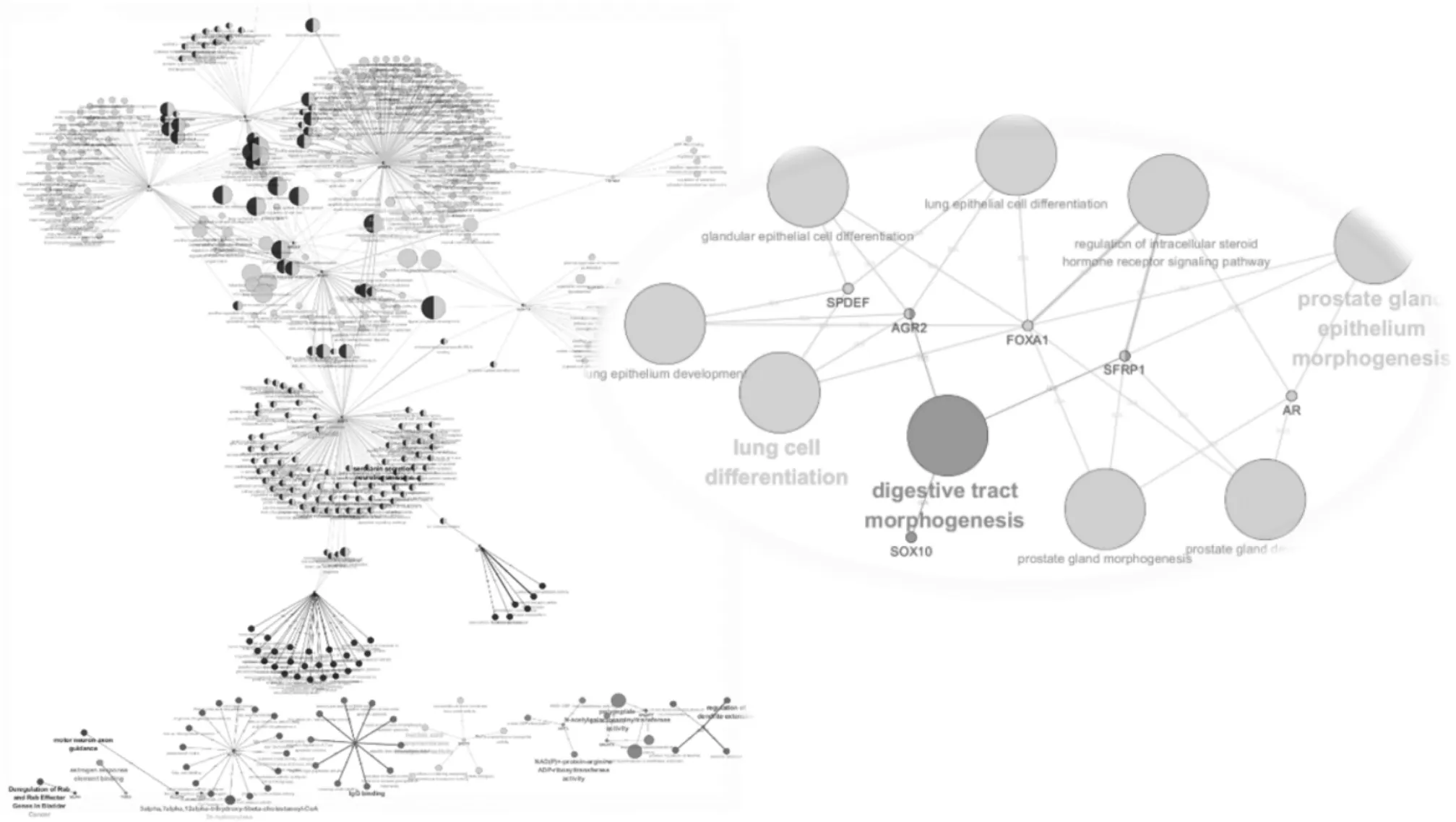
圖2 AR及其關聯基因的功能富集圖
3.1 AR與乳腺癌分型
乳腺癌是一種多因素疾病,其在臨床、病理及分子生物學等方面的特征復雜。Perou C M等[15]在2000年最先對乳腺癌分為以下5個亞型:導管A型(LuminalA)、導管B型(Luminal B)、Her-2過表達型、基底細胞樣型(basal-like型)和正常乳腺基因表達型(normal-like group)。2006 年 Bryan B B 等[16]首次明確提出三陰乳腺癌(triple negative breastcancer,TNBC),指ER、PR和人表皮生長因子受體2(human epidermal growth factor receptor-2,Her-2) 均表現為陰性的乳腺癌。TNBC相對非三陰乳腺癌有明顯不同的臨床病理特征,如發病年齡相對較早、組織學分級惡性程度比例高、局部容易出現復發、有著較高遠處轉移率、預后不良、死亡率高、治療方案有限,效果欠佳等。AR在乳腺癌組織中有較高的表達率。Qi J P等[17]報道AR的陽性表達率為77%,ER、PR的陽性表達率分別為61%、60%,AR的陽性表達率均高于ER、PR的陽性表達率,并且與ER、PR表達呈正相關(P<0.000 1)。研究還發現腫瘤越小陽性表達率越高,與腫瘤較大者比較差異有統計學意義。Ogawa Y等[18]應用免疫組織化學的方法檢測了227例原發性乳腺癌中AR的表達,發現AR陽性率為62.6%,同時檢測了ER、PR、Her-2的表達,經分析比較發現,AR與ER和PR均呈正相關,但與Her-2表達無關,在所有病例中18.5%為三陰性乳腺癌,其中有43%表現為AR陽性。目前認為雄激素和雄激素受體在乳腺癌的發生過程中扮演了重要角色,以AR為靶向的治療方法應該以ER-/PR-/AR+乳腺癌患者為研究對象,并且這種類型腫瘤的其他特征也需要深入探討。目前有學者將TNBC合并AR陰性的患者定義為TNBC的一個亞型或稱為四陰乳腺癌(quadruple-negative breast cancer,QNBC),由于QNBC缺乏有效的治療靶點,故QNBC將是未來乳腺癌治療的挑戰[19-20]。
3.2 AR及其關聯基因在乳腺癌中的信息學分析
本文通過對2個數據庫分析篩選出21個與AR 相關的基因,其中 MLPH,SYT17,PIP,ALCAM,TOX3在網絡圖中缺乏與AR存在強的直接的相互作用證據,提示這些基因可能是尚未明確的與乳腺癌相關的基因。MLPH是色素相關基因,新近研究發現該基因在TNBC中下調,并與ER的表達呈正相關,但該文沒有直接分析MLPH與AR的相關性[21]。SYT17為人突觸囊泡蛋白ⅩⅦ基因,免疫組化提示SYT17在乳腺組織中有高的表達,但未有SYT17與乳腺癌相關的文獻報道。泌乳素誘導蛋白(PIP)是一個敏感度較高的腫瘤標記物,在乳腺癌中過度表達,反映乳腺上皮細胞特異性改變,是臨床上乳腺癌微轉移標記物之一[22]。活化白細胞黏附分子(ALCAM)在乳腺癌中高表達,可促使細胞黏附能力減弱,腫瘤遠處轉移[23];基因芯片分析發現ALCAM與AR具有相關性,但未進一步闡明其機制[24]。TOX3基因多態性與乳腺癌相關,但沒有發現TOX3與AR相關[25-26]。GO分析是廣泛使用的基因注釋方法,包括生物過程(biological process)、分子功能(molecular function)和細胞組件(cellular component)。本研究中GO分析發現差異表達基因富集到了9個生物過程,這些基因主要參與調控細胞死亡、凋亡、遷移和免疫效應過程等,提示AR在乳腺癌發病中可能的作用機制。
總之,本文利用生物信息學的方法對乳腺癌數據進行挖掘,探討了AR在乳腺癌發病中的生物學效應,為進一步闡明其機制及實驗研究提供了方向。本文的后續工作為發現和驗證更多的AR關聯基因,了解AR在乳腺癌作用中的信號通路和分子機制,為乳腺癌的個體化診斷和治療提供科學依據。
[1]石建偉,唐智柳,蔡美玉,等.2008-2012年我國女性乳腺癌流行狀況的系統性綜述[J].中國婦幼保健,2014(10):1 622-1 626.
[2]Reiazi R,Norozi A,Etedadialiabadi M.A literature survey on cost-effectiveness of proton beam therapy in the management of breast cancer patients[J].Iran J Cancer Prev,2015,8(6):e4 373.
[3]Grogg A,Trippel M,Pfaltz K,et al.Androgen receptor status is highly conserved during tumor progression of breast cancer[J].BMC Cancer,2015(15):872.
[4]Ciriello G,Gatza M L,Beck A H,et al.Comprehensive molecular portraits of invasive lobular breast cancer[J].Cell,2015,163(2):506-519.
[5]Hatzis C,Pusztai L,Valero V,et al.A genomic predictor of response and survival following taxane-anthracycline chemotherapy for invasive breast cancer[J].Jama,2011,305(18):1 873-1 881.
[6]Shannon P,Markiel A,Ozier O,et al.Cytoscape:a software environment for integrated models of biomolecular interaction networks[J].Genome Res,2003,13(11):2 498-2 504.
[7]Bindea G,Mlecnik B,Hackl H,et al.ClueGO:a cytoscape plug-in to decipher functionally grouped gene ontology and pathway annotation networks[J].Bioinformatics,2009,25(8):1 091-1 093.
[8]Cerami E G,Gross B E,Demir E,et al.Pathway commons,a web resource for biological pathway data[J].Nucleic Acids Res,2011(39):D685-D690.
[9]Kanda T,Jiang X,Yokosuka O.Androgen receptor signaling in hepatocellular carcinoma and pancreatic cancers[J].World J Gastroenterol,2014,20(28):9 229-9 236.
[10]Jasavala R,Martinez H,Thumar J,et al.Identification of putative androgen receptor interaction protein modules:cytoskeleton and endosomes modulate androgen receptor signaling in prostate cancer cells[J].Mol Cell Proteomics,2007,6(2):252-271.
[11]Hu D G,Hickey T E,Irvine C,et al.Identification of androgen receptor splice variant transcripts in breast cancer cell lines and human tissues[J].Horm Cancer,2014,5(2):61-71.
[12]Barbaro M,Oscarson M,Almskog I,et al.Complete androgen insensitivity without Wolffian duct development:the AR-A form of the androgen receptor is not sufficient for male genital development[J].Clin Endocrinol(Oxf),2007,66(6):822-826.
[13]Takeda H,Chodak G,Mutchnik S,et al.Immunohistochemical localization of androgen receptors with mono and polyclonal antibodies to androgen receptor[J].J Endocrinol,1990,126(1):17-25.
[14]Carreau G,Del Casar J M,Corte M D,et al.Local recurrence after mastectomy for breast cancer:analysis of clinicopathological,biological and prognostic characteristics[J].Breast Cancer Res Treat,2007,102(1):61-73.
[15]Perou C M,Sorlie T,Eisen M B,et al.Molecular portraits of human breast tumours[J].Nature,2000,406(6 797):747-752.
[16]Bryan B B,Schnitt S J,Collins L C.Ductal carcinoma in situ with basal-like phenotype:a possible precursor to invasive basal-like breast cancer[J].Mod Pathol,2006,19(5):617-621.
[17]Qi J P,Yang Y L,Zhu H,et al.Expression of the androgen receptor and its correlation with molecular subtypes in 980 chinese breast cancer patients[J].Breast Cancer(Auckl),2012(6):1-8.
[18]Ogawa Y,Hai E,Matsumoto K,et al.Androgen receptor expression in breast cancer:relationship with clinicopathological factors and biomarkers[J].Int J Clin Oncol,2008,13(5):431-435.
[19]Wu X,Li Y,Wang J,et al.Long chain fatty Acyl-CoA synthetase 4 is a biomarker for and mediator of hormone resistance in human breast cancer[J].PLoS One,2013,8(10):e77 060.
[20]Barton V N,D'Amato N C,Gordon M A,et al.Androgen receptor biology in triple negative breast cancer:a case for classification as AR+or quadruple negative disease[J].Horm Cancer,2015,6(5/6):206-213.
[21]He J,Yang J,Chen W,et al.Molecular features of triple negative breast cancer:microarray evidence and further integrated analysis[J].PLoS One,2015,10(6):e0129842.
[22]Vanneste M,Naderi A.Prolactin-induced protein regulates cell adhesion in breast cancer[J].Biochem Biophys Res Commun,2015,468(4):850-856.
[23]Al-Shehri F S,Abd E A E.Activated leukocyte cell adhesion molecule(ALCAM)in Saudi breast cancer patients as prognostic and predictive indicator[J].Breast Cancer(Auckl),2015(9):81-86.
[24]Doane A S,Danso M,Lal P,et al.An estrogen receptor-negative breast cancer subset characterized by a hormonally regulated transcriptional program and response to androgen[J].Oncogene,2006,25(28):3 994-4 008.
[25]Chen Q,He Y,Liu C,et al.Associations between TOX3 rs3803662 polymorphisms and immunological markers of breast cancer[J].Zhonghua Yi Xue Za Zhi,2015,95(34):2 783-2 786.
[26]He Y,Liu H,Chen Q,et al.Relationship between five GWAS-identified single nucleotide polymorphisms and female breast cancer in the Chinese Han population[J].Tumour Biol,2016,37(7):9 739-9 744.
(編輯:張世霞)
Bioinformatics study of androgen receptor in patients with breast cancer
Li Bing1,Du Gang2,3,Wang Jinhua3,4
(1.Coal Ocupational Disease Prevention and Control Center,Coal Industry Department of Shanxi Province,Taiyuan Shanxi 030012;2.The First Affiliated Hospital of Jinan University,Guangzhou Guangdong 510632;3.Center for Health Informatics and Bioinformatics,New York University School of Medicine,New York,NY,USA;4.Laura and Isaac Perlmutter Cancer Center,New York University School of Medicine,New York,NY,USA)
Objective:To explore the role of Androgen receptor(AR)and its expression-correlated genes in breast cancer.Methods:2 gene expression datas of breast cancer were downloaded from The Cancer Genome Atlas(TCGA)and NCBI.The AR expression-correlated genes were filtered and analysed by the plug-in of ClueGO in the Cytoscape platform.Results:A total of 21 genes were identified with a high correlation with AR by pearson value >0.40 or <-0.40.Among those genes,4 genes showed a negative correlation with AR,and 17 genes showed a positive correlation with AR.Functional enrichment analysis was performed using ClueGO,and the enrichment biological processes including epithelial cell differentiation,cell differentiation,prostate gland epithelium morphogenesis,prostate gland morphogenesis,epithelium development glandular epithelial cell differentiation,digestive tract morphogenesis.We also found the genes of MLPH,SYT17,PIP,ALCAM,TOX3 were separated from the gene network,and it implied those genes had seldom reported about their correlation with AR and should be considered as objective genes in further study.Conclusion:AR play an important role in breast cancer,deep understanding of AR function could be an enhancement for the precision medicine of breast cancer.
breast cancer;androgen receptor;bioinformatics
R737.9
:A
:1671-0258(2017)03-0060-05
李兵,主治醫師,E-mail:20610015@qq.com
猜你喜歡
中老年保健(2022年6期)2022-08-19 01:41:48
當代陜西(2021年17期)2021-11-06 03:21:36
民用飛機設計與研究(2020年4期)2021-01-21 09:15:02
中國生殖健康(2019年2期)2019-08-23 08:11:42
中國生殖健康(2019年6期)2019-01-06 09:20:12
電子制作(2018年18期)2018-11-14 01:48:24
祝您健康(2018年5期)2018-05-16 17:10:16
學苑創造·A版(2018年11期)2018-02-01 06:29:20
讀者(2017年5期)2017-02-15 18:04:18
山東工業技術(2016年15期)2016-12-01 05:31:22