皇冠梨糖度可見/近紅外光譜在線檢測模型傳遞研究
2017-10-11 01:34:57徐惠榮李青青
農業機械學報 2017年9期
徐惠榮 李青青
(1.浙江大學生物系統工程與食品科學學院, 杭州 310058; 2.農業部農產品產地處理裝備重點實驗室, 杭州 310058)
皇冠梨糖度可見/近紅外光譜在線檢測模型傳遞研究
徐惠榮1,2李青青1
(1.浙江大學生物系統工程與食品科學學院, 杭州 310058; 2.農業部農產品產地處理裝備重點實驗室, 杭州 310058)
在水果內部品質檢測分級實際生產中往往存在多通道測量,由于儀器不同或加工精度不同而存在多通道間檢測模型不具通用性問題,應用多種模型傳遞方法研究了在線檢測條件下兩個不同可見/近紅外光譜儀間的皇冠梨糖度預測模型傳遞及預測比較分析。結果表明:從儀器的光譜數據經直接校正算法(DS)和基于平均光譜差值校正的DS算法(MSSC-DS)轉換后用于主儀器所建模型的預測結果相對較好,預測均方根誤差小于0.5°Brix,可以滿足實際生產。但通過模型轉換后的預測結果均比利用從儀器數據直接建模的預測結果要差(預測均方根誤差為0.381°Brix),因而在實際生產中,需要從成本和分級精度的要求來考慮選擇建模的方式。
皇冠梨; 糖度; 在線檢測; 可見/近紅外光譜; 模型傳遞
引言
可見/近紅外光譜分析技術已被廣泛用于鮮果內部品質的無損檢測[1-16],但在水果內部品質檢測分級生產線實際應用中往往存在多通道測量,面臨由于儀器不同或加工精度不同而存在多通道間檢測模型不具通用性問題[17]。模型傳遞也稱為儀器標準化,是指通過化學計量學方法,建立主、從儀器之間的數學關系,使主儀器上建立的校正模型,能夠在從儀器上有效地預測新樣品,從而減少重新建模所帶來的工作量。模型傳遞最早由OSBORNE等[18]提出,并建立了斜率/偏差算法(Slope/bias,S/B),并由SHENK[19]、WANG等[20]相繼提出了新的模型傳遞算法,即Shenk’s算法和分段直接校正算法(Piecewise direct standardization,PDS),之后,國內外學者在模型傳遞算法上進行了大量的研究[21-33]。近年來,已有少量文獻報道用于水果糖度預測模型的傳遞研究。胡潤文等[31]通過S/B算法和直接校正(Direct standardization,DS)算法實現了臍橙總糖模型在相同型號儀器間的傳遞。SALGUERO-CHAPARRO等[32]采用S/B算法、PDS算法和正交投影轉換法將橄欖脂肪、游離酸含量以及含水率檢測模型從靜態儀器傳遞到了便攜式儀器。吉納玉等[33]采用DS算法實現了蘋果糖度模型在相同型號便捷式近紅外儀器之間的傳遞。
在水果品質在線實時檢測分級中,對水果糖度無損檢測模型穩健性影響的因素還來自樣品相關因素和其他非樣品相關因素[34],本文探討在利用可見/近紅外光譜進行梨糖度在線實時檢測時不同小型光纖光譜儀之間模型傳遞的可行性。
1 材料與方法
1.1 材料
實驗所用樣本為河北省滄州皇冠梨,從杭州水果批發市場購買。選擇大小與果形相近的皇冠梨,對其進行表面清潔并標號后,在實驗室條件(溫度約23℃、相對濕度約70%)下放置1 d,使樣本內外溫度一致,然后在線實時采集梨的可見/近紅外半透射光譜,并測量糖度。
分別采用美國海洋光學公司生產的QE65Pro型和QE65000型微型光纖光譜儀采集同一批水果光譜,兩款光譜儀都采用相同的濱松背照式CCD面陣探測器,可以合并同列垂直像素,大幅提高信噪比(>1 000),QE65Pro型光譜儀配置HC-1型光柵和OFLV-QE-400型濾波器,波長范圍396.8~1 174.0 nm,共1 044像素,并安裝有100 μm狹縫(入口孔徑)。QE65000型光譜儀配置HC-1型光柵和OFLV-QE-250型濾波器,波長范圍247.9~1 040.7 nm,共1 044像素,未安裝狹縫(入口孔徑即為光纖芯徑1 000 μm)。
1.2 儀器與方法
圖1為自行設計的水果內部品質可見/近紅外光譜在線實時檢測系統,配置了基于C++語言自行開發的光譜數據采集記錄軟件。實驗時,輸送帶速度為0.5 m/s。為了減少暗電流及光源隨時間變化的影響,在采集樣本光譜前,先采集暗場光譜(即在關閉光路的情況下采集暗電流值)以及參比光譜(參比采用直徑為75 mm的Teflon球)。水果光譜采集時,水果放置在自由輸送托盤上,由輸送帶傳輸至光照箱正中兩側光源(左、右兩側各裝有一只150 W鹵鎢燈)之間,當托盤底座開口(直徑35 mm)與準直鏡大端接口(直徑25 mm)剛接觸時,光電傳感器通過自行設計的控制電路觸發光譜儀進行光譜采集,積分時間為100 ms。準直鏡經光纖與光譜儀相連,光譜儀將得到的攜帶有水果信息的光譜信號通過USB數據線發送給計算機,進行實時處理并記錄光譜數據。光譜記錄時通過軟件直接采用Boxcar平滑法(平滑點數為6)進行光譜平滑預處理。
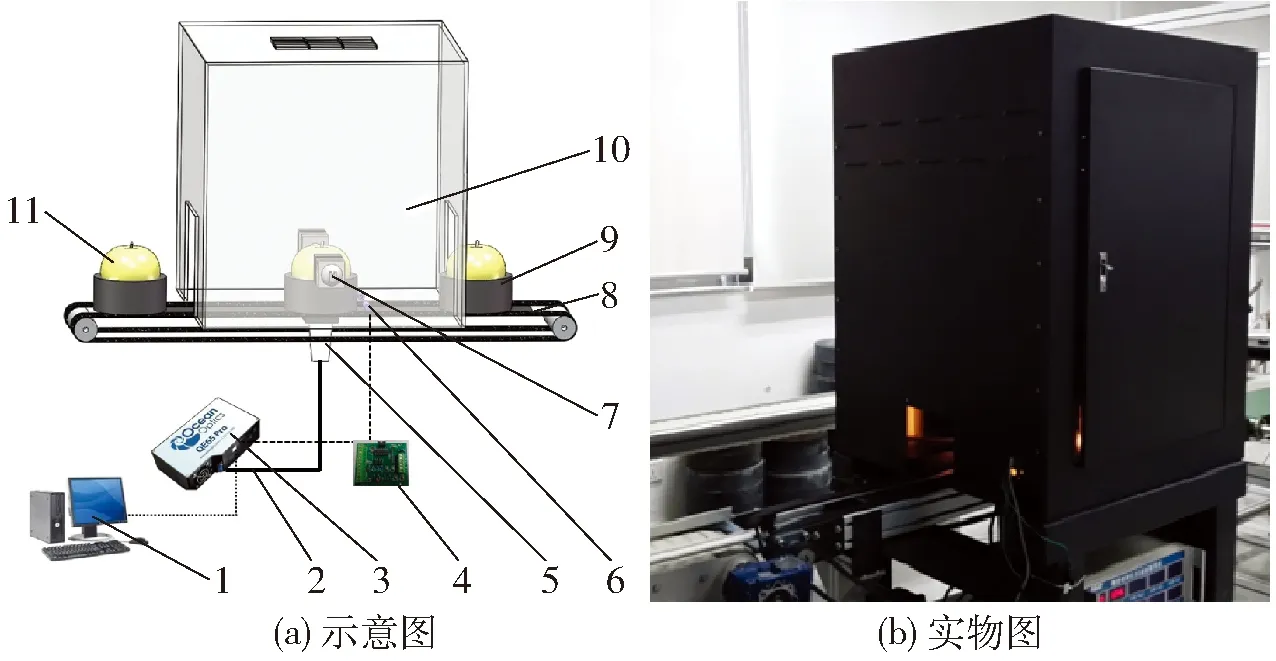
圖1 自由托盤輸送的水果內部品質在線實時檢測系統Fig.1 Free tray based on-line detection system for fruit internal quality1.計算機 2.光纖 3.光譜儀 4.控制電路 5.準直鏡 6.位置傳感器 7.鹵鎢燈 8.輸送帶 9.輸送托盤 10.光照箱 11.皇冠梨
理化分析測定糖度時,參照NY/T 2637—2014,將水果去核切成小塊,放入榨汁機中榨取果汁并進行過濾,用手持式糖量計(PR-101型數字式折射儀,日本ATAGO公司)進行測量,將2次測量平均值作為其糖度。
1.3 模型傳遞方法
1.3.1斜率/偏差算法
S/B算法是基于預測結果的校正,假設主儀器和從儀器上測得的預測值之間存在線性關系,其基本過程如下[18]:
(1)將主儀器上建立的校正模型T直接應用于從儀器,選擇m個樣品,在主儀器和從儀器上分別測得其光譜矩陣Xms和Xss,根據校正模型計算得到成分預測矩陣Cmp和Csp,計算公式為
(1)
(2)假設成分預測矩陣Cmp和Csp之間存在線性關系,并通過最小二乘法計算得到截距wbias和斜率sslop,公式為
Cmp=wbias+sslopCsp
(2)
(3)對于從儀器上測得的未知成分含量的樣品光譜Xss,un,根據式(2)可直接預測成分含量Cpsp,un,即
Cpsp,un=wbias+sslop(Xss,unT)
(3)
1.3.2直接校正算法
DS算法是一種有標傳遞算法,其基本流程如下[20]:在主儀器和從儀器上測得的某一樣品集光譜矩陣分別為Xms和Xss,其維數為m×p,p為波長點個數,可建立兩者轉換運算公式
Xms=XssF+B′s
(4)
式中F——維數p×p的轉換矩陣B′s——維數p×1的背景校正矩陣的轉置
若未知成分含量的樣品在從儀器上測定的光譜為Xss,un,則根據式(4)可轉換得到適合于主儀器所建模型T的光譜數據
Xpss,un=Xss,unF+B′s
(5)
1.3.3分段直接校正算法
PDS算法與DS算法的原理基本相同,不同之處在于,在DS算法中,從儀器樣品光譜矩陣采用的是全波長數據Xss,all(下角標all表示所有波長)來擬合主儀器樣品光譜矩陣Xms的每一個波長點數據Xms,i(下角標i表示第i個波長),而在PDS算法中,采用的是波長點附近一窗口大小為(j+k+1)的光譜段Xss,j+k+1來擬合Xms,i。
1.3.4平均光譜差值校正算法
平均光譜差值校正(MSSC)算法是一種運算簡捷,且在實際應用中易于實現的光譜校正方法,最早被用于消除在線多通道近紅外分析儀各通道間的光譜差異。操作過程如下[17]:
首先選取m個樣本,在各個儀器(通道)上采集光譜,組成校正光譜陣Xi(i=1,2,…,n,n為儀器數或者通道數),每臺儀器的平均光譜向量計算公式為
(6)

(7)
對第i臺儀器(或者通道)測量的光譜進行修正的公式為
(8)
1.4 模型評價指標
在近紅外光譜建模分析中,通常把樣本分成校正集和預測集兩部分,用校正相關系數rcal和校正均方根誤差來評價校正精度,用預測相關系數rpre和預測均方根誤差來評價預測精度,并用相對分析誤差來判斷模型的好壞,該指標是用標準偏差除以預測均方根誤差得到的,MALLEY等[35]提出:高精度模型的相對分析誤差在4以上;成功模型的相對分析誤差在3~4范圍內;比較成功模型的相對分析誤差在2.25~3范圍內;比較有用模型的相對分析誤差在1.75~2.25范圍內。
2 結果與討論
圖2為皇冠梨樣本通過QE65000型光譜儀和QE65Pro型光譜儀采集的550~920 nm波長范圍內的原始光譜及平均光譜。總體上看,兩臺儀器采集的光譜相似,可看出微小的吸光度差異和波長漂移,QE65000型光譜儀采集的數據吸光度略大,且光譜數據噪聲小。
2.1 PLSR建模分析
先對兩個光譜儀各自采集的數據分別進行直接建模分析,剔除異常樣本后,用于各自PLSR建模分析的樣本數分別為199和200個(由于異常樣本不同,兩光譜儀數據并非嚴格一一對應),通過K-Stone算法將樣本集按2∶1的比例劃分為校正集和預測集,劃分后的校正集和預測集樣品外觀形態和糖度檢測結果如表1所示。表2為兩光譜儀皇冠梨糖度PLSR模型校正和預測分析結果,從表中可以看出兩光譜儀數據各自直接建模校正均方根誤差都小于0.3°Brix,預測均方根誤差都小于0.4°Brix,且相對分析誤差大于2.2,所建模型較成功。圖3為兩光譜儀校正集和預測集樣本真實值和預測值的對比分布圖,QE65000型光譜儀模型的預測能力優于QE65Pro型。
2.2 模型傳遞分析
圖4為兩光譜儀采集的皇冠梨光譜數據校正集樣本的前3個主成分分布圖。從圖4中可以看出,兩組數據主成分空間分布有一定的偏差,但整體分布呈線性平移,可見兩光譜儀采集的光譜數據差異有一定的規律可循。
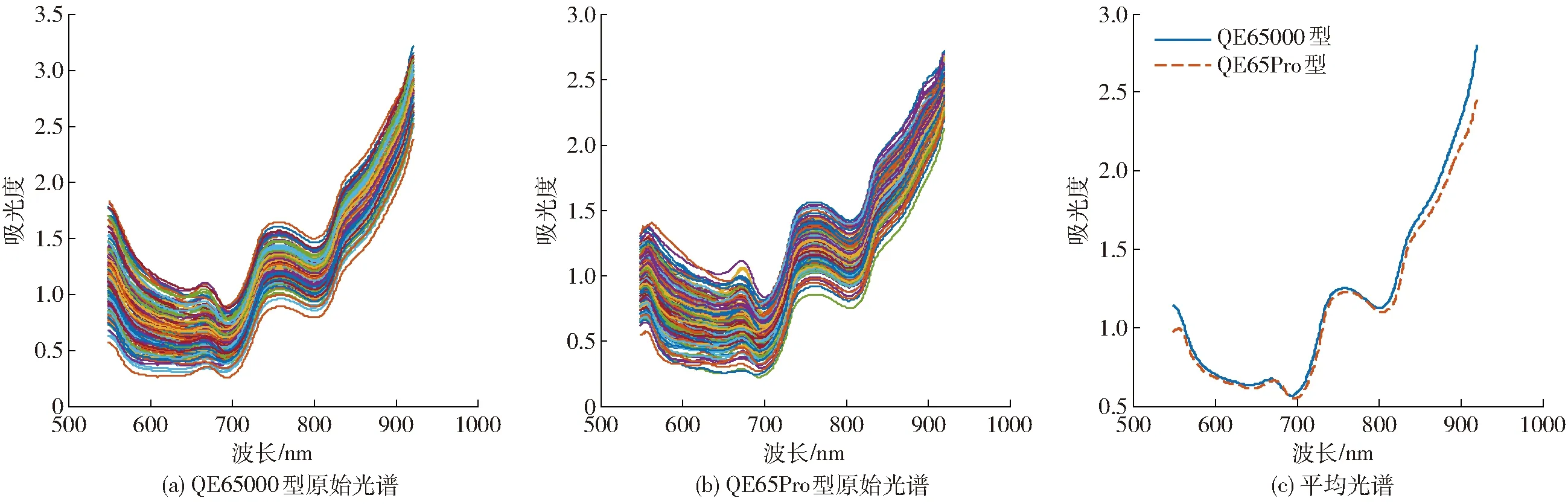
圖2 兩臺儀器采集的原始光譜及其平均光譜Fig.2 Raw and average spectra obtained by two spectrometers

光譜儀樣本集樣本數量參數數值最小值最大值平均值標準偏差質量/g222.00420.00309.9844.63校正集132橫徑/mm74.8892.7482.154.14縱徑/mm65.3090.3377.735.17QE65000型糖度/°Brix9.5013.4011.240.81質量/g230.00420.00310.2542.06預測集67橫徑/mm76.0491.6882.463.80縱徑/mm65.7489.0277.004.92糖度/°Brix9.8013.3011.320.84質量/g225.00420.00308.0944.33校正集133橫徑/mm74.8892.7481.934.08縱徑/mm65.7390.3377.624.87QE65Pro型糖度/°Brix10.0014.0011.260.86質量/g233.00404.00309.1941.76預測集67橫徑/mm75.6190.6782.443.78縱徑/mm65.3089.2376.745.41糖度/°Brix9.5013.4011.280.84

表2 兩光譜儀檢測皇冠梨糖度PLSR模型分析結果Tab.2 Calibration and prediction results of two spectrometers using PLSR model for sugar content of crown pear

圖3 不同光譜儀皇冠梨可溶性固形物PLSR模型的檢測結果Fig.3 Scatter plots of measured and predicted sugar contents obtained by PLSR model
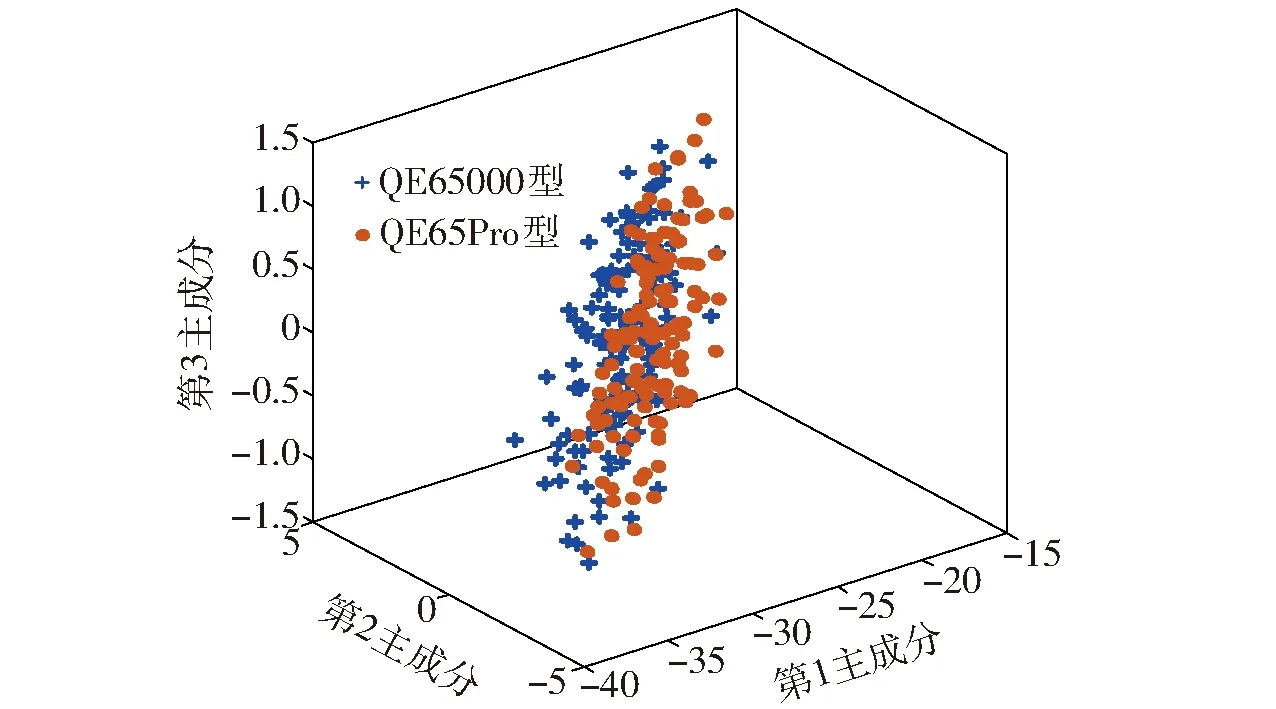
圖4 兩光譜儀校正集樣本的前3個主成分分布圖Fig.4 Distribution diagram of the first three PCs of calibration set of two spectrometers
設QE65000型光譜儀為主儀器,QE65Pro型為從儀器,研究比較了DS、PDS、S/B、MSSC算法對兩光譜儀間皇冠梨糖度在線檢測模型的傳遞。模型傳遞前后的預測結果如表3所示,從表中可以看出,用主儀器所建的校正模型直接預測從儀器的預測集樣本,所得預測均方根誤差為8.482°Brix,而通過DS算法進行模型傳遞后,預測均方根誤差下降到了0.473°Brix,經MSSC光譜差異校正后再進行DS傳遞,預測結果得到了進一步改善,預測均方根誤差為0.453°Brix,已經達到一般生產實際的要求(小于0.5°Brix)。相比之下,其他模型傳遞算法沒有得到明顯的改善。可能原因是DS算法采用了所有波長點的數據進行轉換,提高了光譜曲線的擬合精度,而MSSC算法更進一步減少了兩臺光譜儀數據間的光譜差異。

表3 模型傳遞前后預測結果Tab.3 Prediction results before and after calibration model transfer
3 結束語
應用多種模型傳遞方法(DS、PDS、S/B、MSSC、MSSC-DS、MSSC-PDS、MSSC-S/B)研究了在線檢測條件下(速度0.5 m/s)兩個不同可見/近紅外光譜儀間皇冠梨糖度預測模型傳遞及預測比較分析,結果表明:從儀器的光譜數據經DS和MSSC-DS轉換后用于主儀器所建模型的預測結果相對較好,可以滿足實際生產,且通過光譜校正預處理(MSSC)消除或降低兩光譜差異可以進一步提高預測精度。通過模型轉換后的預測結果均比利用兩光譜儀數據各自直接建模的結果要差,因而在實際生產中,需要從成本和分級精度的要求上來考慮選擇建模的方式。
1 GOLIC M, WALSH K B. Robustness of calibration models based on near infrared spectroscopy for the in-line grading of stone fruit for total soluble solids content [J]. Analytica Chimica ACTA, 2006, 555(2): 286-291.
2 LU Huishan, JIANG Huanyu, FU Xiaping, et al. Non-invasive measurements of the internal quality of intact ‘gannan’ navel orange by VIS/NIR spectroscopy [J]. Transactions of the ASABE, 2008, 51(3): 1009-1014.
3 CAMPS C, CHRISTEN D. Non-destructive assessment of apricot fruit quality by portable visible-near infrared spectroscopy [J]. LWT—Food Science and Technology, 2009, 42(6): 1125-1131.
4 徐惠榮, 陳曉偉, 應義斌. 基于多元校正法的香梨糖度可見/近紅外光譜檢測[J]. 農業機械學報, 2010,41(12): 126-129, 147. XU Huirong, CHEN Xiaowei, YING Yibin. Multivariate approach to determinate sugar content of fragrant pears with temperature variation by visible/NIR spectroscopy [J]. Transactions of the Chinese Society for Agricultural Machinery, 2010, 41(12): 126-129, 147.(in Chinese)
5 XU Huirong, QI Bing, SUN Tong, et al. Variable selection in visible and near-infrared spectra: application to on-line determination of sugar content in pears [J]. Journal of Food Engineering, 2012, 109: 142-147.
6 劉燕德, 施宇, 蔡麗君, 等. 基于CARS算法的臍橙可溶性固形物近紅外在線檢測[J/OL]. 農業機械學報, 2013,44(9): 138-144. http:∥www.j-csam.org/jcsam/ch/reader/view_abstract.aspx?file_no=20130925&flag=1. DOI:10.6041/j.issn.1000-1298.2013.09.025. LIU Yande, SHI Yu, CAI Lijun, et al. On-line NIR detection model optimization of soluble solids content in navel orange based on CARS [J/OL]. Transactions of the Chinese Society for Agricultural Machinery, 2013, 44(9): 138-144.(in Chinese)
7 LI Jiangbo, ZHAO Chunjiang, HUANG Wenqian, et al. A combination algorithm for variable selection to determine soluble solids content and firmness of pear [J]. Analytical Methods, 2014, 6(7): 2170-2180.
8 TRAVERS S, BERTELSEN M G, PETERSEN K K, et al. Predicting pear (cv. Clara Frijs) dry matter and soluble solids content with near infrared spectroscopy [J]. LWT—Food Science and Technology, 2014, 59(2): 1107-1113.
9 SHUXIANG F, ZHIMING G, BAOHUA Z, et al. Using vis/NIR diffuse transmittance spectroscopy and multivariate analysis to predicate soluble solids content of apple [J]. Food Analytical Methods, 2016, 9(5): 1333-1343.
10 MCGLONE V A, MARTINSEN P J, CLARK C J, et al. On-line detection of brownheart in Braeburn apples using near infrared transmission measurements [J]. Postharvest Biology and Technology, 2005, 37(2): 142-151.
11 韓東海, 劉新鑫, 魯超, 等. 蘋果內部褐變的光學無損傷檢測研究[J]. 農業機械學報, 2006, 37(6):86-88, 93. HAN Donghai, LIU Xinxin, LU Chao, et al. Study on optical-nondestructive detection of breakdown apples [J]. Transactions of the Chinese Society for Agricultural Machinery, 2006, 37(6):86-88, 93.(in Chinese)
12 FU Xiaping, YING Yibin, LU Huishan, et al. Comparision of diffuse reflectance and transmission mode of VIS-NIR spectroscopy for detecting brown heart of pear [J]. Journal of Food Engineering, 2007, 83(3):317-323.
13 TEERACHAICHAYUT S, KIL K Y, TERDWONGWORAKUL A, et al. Non-destructive prediction of translucent flesh disorder in intact mangosteen by short wavelength near infrared spectroscopy [J]. Postharvest Biology and Technology, 2007, 43(2): 202-206.
14 SUBEDI P P, WALSH K B, OWENS G. Prediction of mango eating quality at harvest using short-wave near infrared spectrometry [J]. Postharvest Biology and Technology, 2007, 43(3): 326-334.
15 BLAKEY R J. Evaluation of avocado fruit maturity with a portable near-infrared spectrometer [J]. Postharvest Biology and Technology, 2016, 121: 101-105.
16 薛建新, 張淑娟, 孫海霞, 等. 可見/近紅外光譜結合軟化指標快速判定沙果貨架期[J/OL].農業機械學報, 2013,44(8):169-173. http:∥www.j-csam.org/jcsam/ch/reader/view_abstract.aspx?file_no=20130828&flag=1. DOI:10.6041/j.issn.1000-1298.2013.08.028. XUE Jianxin, ZHANG Shujuan, SUN Haixia, et al. Detection of shelf life of malus asiatica using near-infrared spectroscopy and softening index [J/OL].Transactions of the Chinese Society for Agricultural Machinery,2013,44(8):169-173.(in Chinese)
17 褚小立, 袁洪福, 陸婉珍.一種消除在線多通道近紅外分析儀各通道光譜差異的方法[J]. 分析化學, 2005, 33(6):745-750. CHU Xiaoli, YUAN Hongfu, LU Wanzhen. A method to eliminate spectral differences among multi-channels of an on-line near infrared spectroscopy analyzer [J]. Chinese Journal of Analytical Chemistry, 2005, 33(6): 745-750.(in Chinese)
18 OSBORNE B G, FEARN T. Collaborative evaluation of universal calibrations for the measurement of protein and moisture in flour by near-infrared reflectance [J]. Journal of Food Technology, 1983, 18(4): 453-460.
19 SHENK J S. Optical instrument calibration system:US 4,866,644[P]. 1989-09-12.
20 WANG Y D, VELTKAMP D J, KOWALSKI B R. Multivariate instrument standardization [J]. Analytical Chemistry, 1991, 63(23): 2750-2756.
21 BOUVERESSE E, MASSART D L, DARDENNE P. Calibration transfer across near-infrared spectrometric instruments using shenks algorithm-effects of different standardization samples [J]. Analytica Chimica ACTA, 1994, 297(3): 405-416.
22 BLANK T B, SUM S T, BROWN S D, et al. Transfer of near-infrared multivariate calibrations without standards [J]. Analytical Chemistry, 1996, 68(17): 2987-2995.
23 YOON J G, LEE B W, HAN C H. Calibration transfer of near-infrared spectra based on compression of wavelet coefficients [J]. Chemometrics and Intelligent Laboratory Systems, 2002, 64(1): 1-14.
24 褚小立, 袁洪福, 陸婉珍. 普魯克分析用于近紅外光譜儀的分析模型傳遞[J]. 分析化學, 2002, 30(1): 114-119. CHU Xiaoli, YUAN Hongfu, LU Wanzhen. Calibration transfer of spectra from near infrared spectrometers by procrustes analysis [J]. Chinese Journal of Analytical Chemistry, 2002, 30(1): 114-119.(in Chinese)
25 KRAMER K E, MORRIS R E, ROSE-PEHRSSON S L. Comparison of two multiplicative signal correction strategies for calibration transfer without standards [J]. Chemometrics and Intelligent Laboratory Systems, 2008, 92(1): 33-43.
26 KALIVAS J H, SIANO G G, ANDRIES E, et al. Calibration maintenance and transfer using Tikhonov regularization approaches [J]. Applied Spectroscopy, 2009, 63(7): 800-809.
27 邢志娜, 王菊香, 申剛, 等. 近紅外光譜分析模型傳遞簡易方法研究[J]. 分析科學學報, 2011, 27(1): 128-130. XING Zhina,WANG Juxiang, SHEN Gang, et al. A simple and practical model transfer method for the homotype near infrared spectrometers [J]. Journal of Analytical Science,2011, 27(1): 128-130.(in Chinese)
28 王菊香, 李華, 邢志娜, 等. 小波多尺度分段直接校正法用于近紅外光譜模型傳遞的研究[J]. 分析化學, 2011, 39(6): 846-850. WANG Juxiang, LI Hua, XING Zhina, et al. Application of wavelet multi-scale piecewise direct standardization on near infrared analysis calibration [J].Chinese Journal of Analytical Chemistry, 2011, 39(6): 846-850.(in Chinese)
29 史新珍, 王志國, 杜文, 等. 近紅外光譜結合新型模型傳遞方法用于糖料的在線質量監控[J]. 分析化學, 2014, 42(11): 1673-1678. SHI Xinzhen, WANG Zhiguo, DU Wen, et al. On-line quantitative monitoring and control of tobacco flavors by near infrared spectroscopy combined with advanced calibration transfer method [J].Chinese Journal of Analytical Chemistry, 2014, 42(11): 1673-1678.(in Chinese)
30 張曉羽, 李慶波, 張廣軍. 基于穩定競爭自適應重加權采樣的光譜分析無標模型傳遞方法[J]. 光譜學與光譜分析, 2014, 34(5): 1429-1433. ZHANG Xiaoyu, LI Qingbo, ZHANG Guangjun. Calibration transfer without standards for spectral analysis based on stability competitive adaptive reweighed sampling[J]. Spectroscopy and Spectral Analysis,2014, 34(5): 1429-1433.(in Chinese)
31 胡潤文, 夏俊芳. 臍橙總糖近紅外光譜模型傳遞研究[J]. 食品科學, 2012, 33(3): 28-32. HU Runwen, XIA Junfang.Transfer of NIRS calibration model for determining total sugar content in navel orange [J]. Food Science, 2012, 33(3): 28-32.(in Chinese)
32 SALGUERO-CHAPARRO L, PALAGOS B, PENA-RODRIGUEZ F, et al. Calibration transfer of intact olive NIR spectra between a pre-dispersive instrument and a portable spectrometer [J]. Computers and Electronics in Agriculture, 2013, 96: 202-208.
33 吉納玉, 韓東海. 蘋果近紅外預測模型的傳遞研究[J]. 食品安全質量檢測學報, 2014, 5(3): 712-717. JI Nayu, HAN Donghai.Study on near-infrared prediction model transfer for apples [J]. Journal of Food Safety and Quality, 2014, 5(3): 712-717.(in Chinese)
35 MALLEY D F, MCCLURE C, MARTIN P D, et al. Compositional analysis of cattle manure during composting using a field-portable near-infrared spectrometer[J]. Communications in Soil Science and Plant Analysis, 2005, 36(4-6): 455-475.
CalibrationModelTransferbetweenVisible/NIRSpectrometersinSugarContentOn-lineDetectionofCrownPears
XU Huirong1,2LI Qingqing1
(1.CollegeofBiosystemsEngineeringandFoodScience,ZhejiangUniversity,Hangzhou310058,China2.KeyLaboratoryofOnSiteProcessingEquipmentforAgriculturalProducts,MinistryofAgriculture,Hangzhou310058,China)
With the development of social economy and growth of people’s living standand, the demond of fruit quality is ever increasing. Quality detection and grading of postharvest fruit is an integral part of commoditization processing, which is also an effective way to achieve high price with good quality. Visible/NIR spectroscopy with the advantages of rapid, nondestructive and being on-line analyzing, has been widely used in agriculture. In the actual application of visible/NIR spectroscopy for on-line detection of fruit internal quality, multi-channels measurement often exists, in which the prediction model is not universal among multi channels due to different spectrometers or their different manufacture precisions. Calibration model transfer is a key problem in visible/NIR spectral quantitative analysis. Comparative analysis of some calibration model transfer methods, such as direct standardization (DS), piecewise direct standardization (PDS), slope/bias (S/B) between two different visible/NIR spectrometers (master and slave spectrometers, model QE65000 and QE65Pro, Ocean Optics, Inc., USA) in the sugar content on-line detection of crown pears was carried out at conveyor speed of 0.5 m/s. The results showed that the prediction values by DS algorithm and DS algorithm based on the mean spectra subtraction correction (MSSC-DS) were relatively good with low root mean square error of prediction (RMSEP) of less than 0.5°Brix, which can satisfy the industry application. And pre-processing method of MSSC can improve the prediction accuracy of calibration model transfer by eliminating and mitigating the differences between the spectra acquired on master and slave spectrometers. However, the best prediction result on salve instrument after calibration model transfer (RMSEP was 0.453°Brix) was still inferior to that predicted by the model developed directly using slave data (RMSEP was 0.381°Brix). Thus, in the actual application, appropriate modeling selection should be considered from the cost and the accuracy of classification.
crown pears; sugar content; on-line detection; visible/NIR spectroscopy; calibration transfer
O657.33; S661.2
A
1000-1298(2017)09-0312-06
10.6041/j.issn.1000-1298.2017.09.039
2017-03-16
2017-07-02
國家自然科學基金面上項目(31571562)
徐惠榮(1973—),男,教授,博士生導師,主要從事農產品品質無損檢測技術與裝備研究,E-mail: hrxu@zju.edu.cn
猜你喜歡
童話王國·奇妙邏輯推理(2024年5期)2024-06-19 16:03:38
中學生數理化·七年級數學人教版(2021年6期)2021-11-22 07:50:58
中學生數理化·七年級數學人教版(2021年6期)2021-11-22 07:50:58
中學生數理化·七年級數學人教版(2021年6期)2021-11-22 07:50:58
中學生數理化·七年級數學人教版(2020年12期)2021-01-18 06:57:46
中學生數理化·七年級數學人教版(2020年12期)2021-01-18 06:57:46
中學生數理化·七年級數學人教版(2020年10期)2020-11-26 08:24:50
數學物理學報(2020年2期)2020-06-02 11:29:24
光學精密工程(2016年6期)2016-11-07 09:07:19
海峽科技與產業(2016年3期)2016-05-17 04:32:12