巴黎國(guó)際大學(xué)城“中國(guó)之家”,巴黎,法國(guó)
2017-10-20 08:27:36王駿陽(yáng)
世界建筑 2017年10期
關(guān)鍵詞:建筑設(shè)計(jì)
巴黎國(guó)際大學(xué)城“中國(guó)之家”,巴黎,法國(guó)
Maison de la Chine, CIUP, Paris, France
評(píng)論
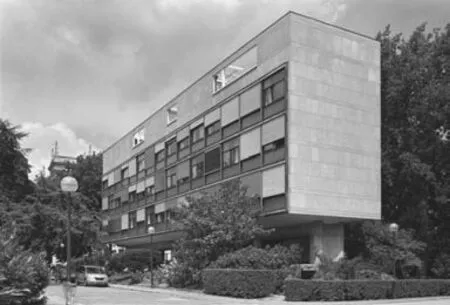
王駿陽(yáng):巴黎大學(xué)城素有小型“國(guó)家聯(lián)盟”之稱,這里已有40多個(gè)國(guó)家的留學(xué)生公寓,其中最為著名的無(wú)疑是勒·柯布西耶于1930-1932年間完成的瑞士學(xué)生公寓。當(dāng)時(shí)的柯布正致力于現(xiàn)代建筑的探索,“新建筑五點(diǎn)”“光明城市”、底層架空、玻璃幕墻,這一切都反映在瑞士學(xué)生公寓的設(shè)計(jì)中。可以說(shuō),無(wú)論從技術(shù)還是美學(xué)角度,該建筑都充滿創(chuàng)新精神,也是巴黎大學(xué)城第一個(gè)具有現(xiàn)代主義特征的建筑。
然而,勒·柯布西耶關(guān)于城市和建筑思想的諸多問(wèn)題也伴隨在這個(gè)建筑之中。首先,“光明城市”能否構(gòu)成一個(gè)好的城市模式?從張永和近年來(lái)在城市問(wèn)題上的發(fā)聲來(lái)看,這是一個(gè)值得質(zhì)疑和反思的模式。不奇怪的是,在“中國(guó)之家”項(xiàng)目中,底層架空和獨(dú)立式建筑單體的“光明城市”模式被傳統(tǒng)的圍合模式所取代,無(wú)論其原型來(lái)自中國(guó)的客家大院還是巴黎的奧斯曼城市街區(qū)(即使底層部分架空仍然在外圍保持基本圍合)。與此同時(shí),一個(gè)巨大的豁口在面向大操場(chǎng)的立面上形成,由此帶來(lái)與傳統(tǒng)原型相異的圍合方式。內(nèi)院中的公共樓梯被巧妙地安排在這個(gè)豁口位置,既為整個(gè)建筑賦予某種紀(jì)念性和公共性的入口,又可形成獨(dú)特的建筑亮點(diǎn)。
勒·柯布西耶最初為瑞士學(xué)生公寓設(shè)計(jì)了一個(gè)玻璃磚加可開(kāi)啟透明玻璃窗的南立面,之后改為玻璃幕墻。如同差不多同時(shí)建成的巴黎救世軍總部大樓一樣,這在實(shí)際使用中導(dǎo)致房間冬冷夏熱的不適,直到1950年代的幕墻改造和遮陽(yáng)處理后,情況才有好轉(zhuǎn)。與此不同的是,“中國(guó)之家”為每個(gè)房間賦予陽(yáng)臺(tái)或凸窗的立面厚度,并以此形成角度各異且足以帶來(lái)立面變化的磚砌花格墻體,在夏季使用空調(diào)不甚普及的巴黎,這無(wú)疑有助于改善室內(nèi)環(huán)境,也對(duì)遮擋南側(cè)公路的交通噪音起到一定作用,盡管這種“雙層表皮”在當(dāng)代建筑中已比比皆是。
屋頂花園是勒·柯布西耶“新建筑五點(diǎn)”的重要元素,但在瑞士學(xué)生公寓只得到十分有限的運(yùn)用。相比之下,“中國(guó)之家”不僅在內(nèi)院屋頂形成花園,而且將它作為整個(gè)建筑的重要元素予以表現(xiàn)。勒·柯布西耶為屋頂花園提出的理由之一是它有助于改善平屋頂?shù)谋馗魺幔@在當(dāng)今不算什么了不起的理由,在“中國(guó)之家”肯定也可以接受。只是頂層屋頂花園如何使用可能會(huì)是一個(gè)不確定的問(wèn)題。非常建筑的解決方案是在屋頂形成環(huán)形光伏跑道。但是面對(duì)已經(jīng)存在的地面大操場(chǎng)和大學(xué)城良好的室外步行系統(tǒng),人們不免還是會(huì)對(duì)這個(gè)跑道的必要性產(chǎn)生懷疑。而且,如果不僅作為一個(gè)勒·柯布西耶式的“建筑漫步”元素,還是真正具有運(yùn)動(dòng)和健身作用(一種現(xiàn)代主義理想),那么這個(gè)跑道似乎又過(guò)于平坦,空間力度不夠。
無(wú)論如何,這是一個(gè)在諸多層面都值得我們期待的項(xiàng)目。
Comment
WANG Junyang:The Cité Internationale Universitaire de Paris is always referred to as a miniature"Association of Nations". It includes more than forty apartment buildings to house exchange students from all over the world. The most famous building is undoubtedly the Pavillon Suisse, designed by Le Corbusier and completed between 1930-1932. At that time, Le Corbusier was ardently exploring modern architecture; the Five Points of Architecture, the"Radiant City", piloti, and glass curtain walls, which are all reflected in the design of the Pavillon Suisse. It can be said that, whether from a technological or aesthetic perspective, this building is full of innovation. It is also the first piece of modernist architecture in the Cité Internationale Universitaire de Paris.
However, several problems in Le Corbusier's ideas on cities and architecture are present in this building.First, could the "Radiant City" actually constitute a good urban model? Considering the views expressed in recent years by Yung Ho Chang regarding urban issues, this model is worthy of criticism and reflection.It is not surprising that in the "Maison de la Chine"project, the piloti and independent building units from the "Radiant City" have been replaced by the traditional courtyard model, regardless of whether the prototype for this model comes from China's Hakka courtyards, or from Haussman's Paris city blocks (even if the ground level is only partially composed of piloti,a peripheral basic enclosure will be maintained). At the same time, a very large opening facing the playground forms a different type of enclosure when compared to traditional prototypes. The public stairs within the courtyard are ingeniously arranged at the opening,giving the building a monumental and public entrance,and also forming a unique architectural highlight.
In his initial plan for the Pavillon Suisse, Le Corbusier designed a southern fa?ade using glass tiles and glass windows that could be open and transparent; later he changed these plans to a glass curtain wall design. Like the Cité de Refuge which was completed at around the same time, this design made rooms cold in the winter and hot in the summer, a problem that did not improve until the 1950s, when the curtain wall was transformed and shading issues were addressed. Unlike this,the "Maison de la Chine" gives each room a fa?ade thickness that is suitable for its balcony or protruding window; this creates a variety of angles in the fa?ade, and is sufficient to make the building's fa?ade look like a lattice-type brick wall structure. Because the use of air conditioning is not very popular in Paris during the summer, this design is undoubtedly helpful for improving interior environment, and also plays a role in blocking the traffic noise from the road south of the building,although this "double-skin" style of fa?ade has become ubiquitous in modern architecture.
The rooftop garden is an important factor in Le Corbusier's Five Points of Architecture, but the application of this concept was quite limited in the Pavillon Suisse. By comparison, the "Maison de la Chine" not only includes a garden in the innercourtyard rooftop, but also makes this garden an important element of the building. One reason Le Corbusier prefers rooftop gardens is that such gardens are helpful for improving the insulation properties of flat rooftops.This is not an remarkable reason in modern times, and can be certainly accepted by the "Maison de la Chine". Instead, the way in which the rooftop garden will be used may be a question.Atelier FCJZ's plan for resolving this issue is to place a ring-shaped photovoltaic walkway on the roof.However, as the building faces a large pre-existing playground, and the complex already has excellent outdoor walking paths, it is questionable whether this walkway is necessary. Furthermore, if the purpose of this walkway is not only to serve as a representation of Le Corbusier's "Architectural Promenade", but also to serve some real sports- or exercise-related purpose(a principle of modernism), then this walkway seems too fl at, and spatially constrained.
Anyway, this project is worthy of our anticipation on many levels.

1

2
項(xiàng)目信息/Credits and Data
客戶/Client: 巴黎國(guó)際大學(xué)城,北京首都創(chuàng)業(yè)集團(tuán)有限公司/The Cité Internationale Universitaire de Paris (CIUP),Beijing Capital Group
地點(diǎn)/Location: 法國(guó)巴黎十四區(qū)/14th Arrondissement,Paris, France
建筑設(shè)計(jì)/Architets: 非常建筑/Atelier FCJZ
主持建筑師/Principal Architect: 張永和/Yung Ho Chang
項(xiàng)目團(tuán)隊(duì)/Project Team: 李啟悠,程藝石,孟瑤/Simon Lee,CHENG Yishi, MENG Yao
合作設(shè)計(jì)/Design Partner: Coldefy & Associates建筑規(guī)劃事務(wù)所(法國(guó))/Coldefy & Associates Architects Urbanists
功能/Function: 留學(xué)生宿舍、文化交流空間/Accommodation for international students, cultural exchange space
面積/Area: 建筑面積/Floor Area: 8287m2; 基地面積/Site Area: 2800m2; 基底面積/Footprint Area: 1520m2
建筑高度/Building Height: 24.3m
設(shè)計(jì)時(shí)間/Design Time: 2017.03
預(yù)計(jì)竣工時(shí)間/Estimated Completion Time: 2020
基地
項(xiàng)目的基地位于法國(guó)巴黎十四區(qū)的國(guó)際大學(xué)城。該大學(xué)城擁有超過(guò)40座以各個(gè)國(guó)家命名和建設(shè)的校舍,并因杜多克設(shè)計(jì)的“荷蘭書院”(1926),勒·柯布西耶設(shè)計(jì)的“瑞士館”(1930),勒·柯布西耶與科斯塔聯(lián)合設(shè)計(jì)的“巴西之家”(1954),以及帕朗設(shè)計(jì)的“伊朗館”(1969)等館舍而在建筑領(lǐng)域所著稱。“中國(guó)之家”在大學(xué)城的南側(cè),北臨園區(qū)綠地和運(yùn)動(dòng)場(chǎng),南靠巴黎外環(huán)路。
使用
這是一棟學(xué)生宿舍樓,主要功能包括300套獨(dú)立寢室及一個(gè)500人的文化活動(dòng)廳。
空間
在勒·柯布西耶的健康生活理念被廣泛接受的今天,我們的方案將宿舍房間組織成圍繞中心庭院的環(huán)形,讓學(xué)生生活在良好的自然環(huán)境中。
景觀
除了中心庭院,我們?cè)诮ㄖ車拔蓓斏隙荚O(shè)計(jì)了園林,中心庭院中的樓梯再串聯(lián)一系列綠化了的平臺(tái),將一個(gè)垂直的景觀體系融入到建筑中去。
材料
中國(guó)的青磚作為主要外立面材料,并通過(guò)鏤空、浮雕等不同的磚的砌筑方式,反映出我們對(duì)細(xì)部和匠藝是重要的建筑形式這一理念的認(rèn)同,同時(shí)利用建筑立面的凹凸變化形式來(lái)調(diào)節(jié)北邊光照不足和南側(cè)噪音污染等問(wèn)題。內(nèi)立面采用木格柵,和外立面的粘土磚一起進(jìn)一步表達(dá)了中國(guó)傳統(tǒng)中以土木(即材料)定義的建筑觀。
團(tuán)隊(duì)
非常建筑事務(wù)所與法國(guó)Coldefy & Associates建筑規(guī)劃事務(wù)所合作贏得此次國(guó)際建筑設(shè)計(jì)競(jìng)賽。設(shè)計(jì)團(tuán)隊(duì)還誠(chéng)邀雕塑家隋建國(guó)先生為景觀設(shè)計(jì)進(jìn)行藝術(shù)上的指導(dǎo)。□

3
Site
The project is located at the Cité Internationale Universitaire de Paris (CIUP) in the 14th Arrondissement of Paris. This university city has more than 40 school buildings named after and constructed by different countries. It is known in the field of architecture due to several famous masterpieces, such as the "Collège Néerlandais" (The Netherlands College, 1926), designed by Willem M. Dudok, the "Pavilion Suisse" (The Pavilion of Switzerland, 1930), designed by Le Corbusier, the"Maison du Brésil" (Home of Brazil, 1954) designed by Lucio Costa and Corbusier, and the "Pavilion de L'Iran",designed by Claude Parent (Pavilion of Iran, 1969). The"Maison de la Chine" is located on the south edge of the university city, with a garden and sports field bordering its north and Paris' outer ring road to its south.
Program
This is a student dormitory, which includes 300 single rooms and a 500-person cultural activity hall as its main program.
Space
Today when Le Corbusier's concept of healthy living is being widely accepted, our design arranged the dormitory rooms in the shape of a ring surrounding a central courtyard, in order to allow student life to unfold in a pleasing natural environment.
Landscape
In addition to the central courtyard, the surrounding area and the rooftop of the building were designed as gardens, while the central staircase located in the central courtyard further links a series of planted platforms together, creating a vertical landscape in the building.
Materials
Chinese grey clay bricks are applied as the main material on the exterior fa?ade; through various brick-laying techniques, we will be able to achieve porosity and relief in the wall so that to demonstrate details and crafts as expressive architectural forms. Simultaneously, the undulation on the building fa?ade is devised to improve on the issues of the insufficient natural lighting on the north and the noise pollution from the south. A wood grating lines the interior fa?ade; together with the clay bricks on the outer fa?ade, this material composition reiterates an ancient Chinese definition of architecture that is "Tu Mu" (earth and wood).
Team
Atelier Feichang Jianzhu from China and Coldefy & Associates Architects and Urban Planners from France collaborated to win this international architectural design competition. The design team also invited sculptor SUI Jianguo, to provide artistic advices on the landscape design.□
4

5

6

7

8

9

10

11
猜你喜歡
北方建筑(2021年6期)2021-12-31 03:03:54
文苑(2020年10期)2020-11-07 03:15:36
現(xiàn)代裝飾(2020年7期)2020-07-27 01:27:42
現(xiàn)代裝飾(2020年6期)2020-06-22 08:43:12
現(xiàn)代裝飾(2020年4期)2020-05-20 08:55:08
流行色(2020年1期)2020-04-28 11:16:38
藝術(shù)啟蒙(2018年7期)2018-08-23 09:14:18
海峽姐妹(2017年7期)2017-07-31 19:08:17
Coco薇(2017年5期)2017-06-05 08:53:16
福建農(nóng)業(yè)科技(2016年10期)2016-03-07 09:46:49