
中文版晚期老年癡呆癥疼痛評估量表在34例認(rèn)知障礙并壓力性損傷患者中的應(yīng)用
2017-11-27 22:02:30李云莉宗允
上海醫(yī)藥
2017年21期
李云莉+宗允
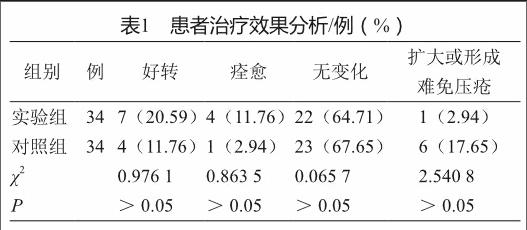
摘 要 目的:探討中文版晚期老年癡呆癥疼痛評估量表(C-PAINAD)在存在認(rèn)知障礙的壓力性損傷(PI)患者中的應(yīng)用效果. 方法:將68名認(rèn)知障礙并PI患者按照入院時間先后順序分為實(shí)驗組和對照組各34例。對照組按我院常規(guī)“預(yù)防壓瘡制度”護(hù)理,只進(jìn)行Braden評分和護(hù)理;實(shí)驗組在此基礎(chǔ)上應(yīng)用C-PAINAD進(jìn)行評估,當(dāng)疼痛評分提示疼痛增加時,則加強(qiáng)PI的預(yù)防措施。結(jié)果:實(shí)驗組患者好轉(zhuǎn)和痊愈比例均高于對照組,擴(kuò)大或形成難免壓瘡比率低于對照組,但組間無統(tǒng)計學(xué)差異(P>0.05)。結(jié)論:C-PAINAD的臨床應(yīng)用能夠準(zhǔn)確反應(yīng)認(rèn)知障礙患者受壓部分的疼痛,使認(rèn)知障礙并PI患者的防治更加靠前,提前干預(yù),一定程度上,可降低壓力性損傷的發(fā)生和進(jìn)展。
關(guān)鍵詞 壓力性損傷 疼痛評估 晚期老年癡呆疼痛評估量表
中圖分類號:R749.16 文獻(xiàn)標(biāo)識碼:B 文章編號:1006-1533(2017)21-0059-02
Application of C-PAINAD in 34 patients with cognitive impairment and stress injury*
LI Yunli, ZONG Yun
(Department of Nursing, The Third Hospital of Nanchang, Nanchang 330002, China)
ABSTRACT Objective: To explore the effects of the C-PAINAD on pressure injury (PI) patients with cognitive impairment. Methods: Sixty-eight patients with cognitive impairment and PI were divided into an experimental group and a control group with 34 cases each based on the time of admission. The control group underwent only Braden score and nursing based on the conventional ‘prevention system care in our hospital while the experimental group was evaluated with the C-PAINAD besides those. The PI preventive measures should be strengthened when the pain score showed pain increase. Results: The ratio of improvement and recovery was higher while the ratio of expansion or formation of inevitable pressure ulcer was lower in the experimental group than in the control group, but there were no statistical differences between the two groups (P>0.05). Conclusion: The clinical application of C-PAINAD can accurately reflect the compression part of the cognitive impairment in patients with pain, cognitive impairment and the early prevention and treatment of PI patients can be carried out, so the early intervention can decrease the occurrence and progression of stress injury to a certain extent.
KEy WORDS stress injury; pain assessment; late age dementia pain assessment scale
疼痛作為體溫、脈搏、呼吸、血壓之后的第五生命體征在臨床壓力性損傷(pressure injury, PI)護(hù)理中未得到足夠關(guān)注。“壓力性損傷”替代了術(shù)語“壓瘡”,更加準(zhǔn)確地描述了壓力引致的皮膚問題,強(qiáng)調(diào)了大多數(shù)PI是可以預(yù)防的。減輕疼痛在預(yù)防PI中具有特殊意義。認(rèn)知或溝通障礙者由于感覺缺失或表達(dá)不利,疼痛易被忽視,因而忽略或錯過預(yù)防PI進(jìn)展的最佳時期,延長PI恢復(fù),造成患者的經(jīng)濟(jì)損失。
中文版晚期老年癡呆癥疼痛評估量表(Chinese pain assessment in advanced dementia scale, C-PAINAD)在評價晚期老年癡呆癥這類認(rèn)知能力嚴(yán)重受損且已失去表達(dá)能力的患者疼痛有良好信度和效充[1]。本文探討C-PAINAD在存在認(rèn)知障礙的壓力性損傷患者中的應(yīng)用效果。
登錄APP查看全文
猜你喜歡
實(shí)用手外科雜志(2022年2期)2022-08-31 09:48:18
保健醫(yī)苑(2022年5期)2022-06-10 07:46:18
中華養(yǎng)生保健(2020年7期)2020-11-16 01:14:02
家庭醫(yī)學(xué)(下半月)(2019年9期)2019-10-12 08:04:18
經(jīng)濟(jì)技術(shù)協(xié)作信息(2018年20期)2019-01-19 02:56:26
中國衛(wèi)生(2016年2期)2016-11-12 13:22:32
中國衛(wèi)生標(biāo)準(zhǔn)管理(2015年13期)2016-01-15 02:58:31
中國當(dāng)代醫(yī)藥(2015年9期)2015-03-01 02:02:15
中國中醫(yī)藥現(xiàn)代遠(yuǎn)程教育(2014年20期)2014-03-01 04:31:38
中國中醫(yī)藥現(xiàn)代遠(yuǎn)程教育(2014年13期)2014-03-01 04:26:34
