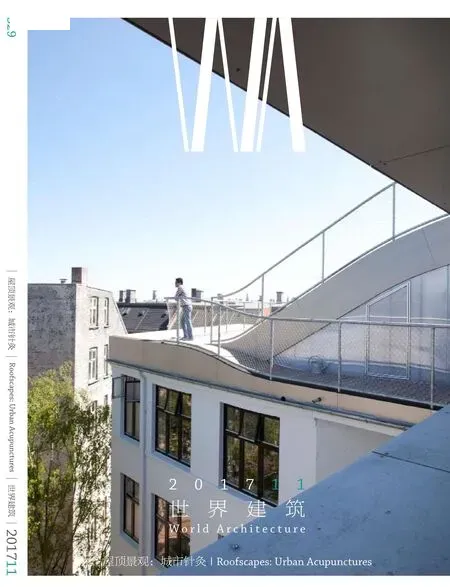
屋頂景觀的潛力
2017-12-25 08:11:48MVRDV
世界建筑 2017年11期
關鍵詞:建筑
MVRDV
尚晉 譯/Translated by SHANG Jin
屋頂景觀的潛力
MVRDV
尚晉 譯/Translated by SHANG Jin
The Potential of the Roofscape
建筑在開門的那一天就“大功告成”的觀念在今天的設計、規劃和施工思想中根深蒂固。不過,這種思路只把建筑和設計視為物的創造,而忽視了社會和技術變革的影響,更不用說使用帶來的變化。建筑是有生命的,每一代使用者都會改造它、改變它。由于資源意味著開支,而對建筑材料可持續利用的需求與日俱增,從頭開始進行設計已成為一種奢望。
但這并不會制約建筑的創造潛力,而是拓寬了現有的可能性,甚至會帶來新的啟發。這包括對未來可適性、復用與保護的考量,并為原有結構增添新的元素。這是一片尤為豐碩的土地。關于建筑垂直性的思想通常局限在摩天樓上——備受社會隔離和遠人尺度等問題困擾的高資本行為。
長期以來,MVRDV一直有意讓這種高密度的垂直建筑融入能給城市和鄉村帶來生機的輕松社交氛圍中。事實上,事務所至今都在堅持這種做法,項目和尺度從建筑(迪登村)到城市(塞盧西亞和米洛德)再到假想城市(垂直村莊)。
設計文化必須超越對固定用途的(大尺度)設計的個人追求。可適性、靈活性和策略性密集化帶來的可能性通常會被人忽視,卻在實際上創造出了激動人心的“寬松”建筑。村莊和屋頂景觀的密集化能將用戶解放出來,從而創造出他們自己多樣化、生機勃勃的環境。
迪登村項目(見本刊p30)是MVRDV首次以屋頂景觀探索城市密集化的一次嘗試。該項目建在鹿特丹的米德蘭住區,是迪登家狹小住宅擴建需求的產物。項目沒有簡單地增加一層或是向后花園擴展,而是在屋頂上疊加了新的用途,營造出村莊般的氛圍。
屋頂上的每個新房間都采用了微縮的典型“住宅”形式。不僅各個入口相互獨立,每個山墻的輪廓也特色鮮明。在室內,房間都包木材或涂暖紅色;在室外,所有地方都涂了天然藍的聚氨酯。每個“住戶”都從特殊的樓梯來到自己的房間,更突出了擴建部分兼顧個人與集體的特征。項目造價很低,因為擴建部分經過優化設計,充分利用了原有的結構和建筑系統。
這種特意追求本土與活力的設計是一種頗具代表性的擴建方式。它既滿足了住戶對創意的需求,又是鹿特丹城市密集化中的話題引子。城市的生長如何能密集化、保持可持續性和可購買性?我們怎樣維系堅強的社會紐帶,讓城市運轉下去?迪登村給出了一種答案:探索屋頂景觀。該項目建成后,周邊四鄰都開始住到自家屋頂上,為鄰里活動創造出新的共享區。

2 空中廣場,米洛德住宅,馬德里/Sky plaza, Mirador project, Madrid(1-3攝影/Photos: Rob't Hart)

3 空中廣場,米洛德住宅,馬德里/Sky plaza, Mirador project, Madrid(1-3攝影/Photos: Rob't Hart)
The idea that a building is "finished" or"complete" on the day it opens its doors is hardwired into existing thinking about design, planning and construction. However, this line of thinking reduces architecture and design to merely the production of objects and ignores the impact of social and technological change, not to mention the evolutions that come as a result of occupancy. Buildings are living objects, mutable and manipulated by each generation of users. With resources at a premium and an increasing need for the sustainable use of building materials, it is a luxury to design from a blank slate.
This does not limit the creative potential of architecture; rather it widens existing possibilities and even illuminates new ones. These may include considering future adaptability, rehabilitation,and conservation, but also the introduction of new elements to existing structure. Here lies particularly rich ground. Ideas regarding verticality in architecture are often limited to skyscrapers –high-capital endeavours that struggle with issues of social isolation and alienating scale.
MVRDV has long been interested in embedding these highly-dense and vertical structures with the informal social atmosphere that makes villages and cities so vibrant. Indeed, the office has done so throughout its lifespan, in projects and scales ranging from the architectural (Didden Village)to the urban (Celosia & Mirador) to the urban hypothetical (The Vertical Village).
Design culture must move beyond the idiosyncratic aspirations of an individual generating(large-scale) purpose-built designs with fixed uses.The possibilities made available by adaptability,flexibility, and strategic densification and are often overlooked, but in fact create enormously exciting"loose-fit" architectures. Densification via the village and the roofscape has the potential to emancipate users to create their own versatile and vibrant environments.
The Didden Village project (see page 30) was one of MVRDV's first investigations into the notion of urban densification via the roofscape. Built in the in the Middelland neighbourhood of Rotterdam,the project is the result of the Didden family's need to expand their cramped family residence. Rather than simply adding an additional floor or expanding into the back garden, the project stacked new program to form a village-like atmosphere on the roof. Each new room takes the form of a miniature and stereotypical "home" on the roof, with discrete entrances and a signature gabled silhouette. Inside,the rooms are clad in wood or painted a warm red;on the outside, everything is draped in technicolour blue polyurethane. Each "resident" reaches their room via specific staircase, further emphasising the individual-yet-collective nature of the addition.Project costs were kept low as the addition was optimised to take advantage of existing structure and building systems.
The deliberately vernacular and vibrant design is an iconic addition that both serves the creative needs of the residents and acts as a conversationstarter for urban densification in Rotterdam.How might cities grow densely, sustainably, and affordably? And how can we maintain the strong social ties that make cities work? Didden Village suggests that one possible answer might lie in exploiting the roofscape. Since the project was constructed, surrounding neighbours have begun to populate their own roofs, creating a new shared zone for neighbourhood activity.

4 垂直村莊模型/Models of Vertical Village
不過,這個案例研究主要是在個體尺度上的。那么這種策略從建筑到城市上會怎樣呢?
在馬德里,米洛德項目是MVRDV作品中大規模密集化與社交氛圍相平衡的早期實例。該項目將傳統的公寓樓沿軸線顛倒過來,得到一種高用地率的建筑基底,并有高出地面的社交空間。在米洛德,傳統西班牙街區中常見的庭院空間成了一種“空中廣場”,仿佛脫離了建筑的體塊。這種“屋頂景觀”是所有住戶共享的集會點,在這個引人矚目的地方可以遠望瓜達拉馬山。
這個方案在當地頗具標志性,但更為重要的是它保留了亟需的開放空間,又沒有破壞低密度住宅的社交性。這種氛圍甚至體現在建筑上,那里有象征街道的縫隙狀連接區。這些縫隙的組合在視覺上和實際上都創造出一種住宅類型群,其結構有如建筑里的小郊區。一個垂直住區由此形成。
不過,雖然這個尺度對于歐洲城市很合適,卻與亞洲城市發展項目關系不大。
垂直村莊是MVRDV與JUT藝術建筑基金合作的項目。它在當代亞洲語境中試驗了社交豐富的高密度建筑設想。幾個世紀以來,東亞城市肌理一直都以小尺度的零散村落為主。這些城中村形成了密集的、社會關系緊密的社區,并孕育著強烈的個性和差異。
在人口與經濟因素的驅使下,亞洲城市在過去幾十年中飛速變化。城市幾乎全都是高樓大廈。許多住區往往千篇一律,更不用提單體公寓樓。這種無休止的“樓房侵襲”——巨大的塔樓、板樓和樓房里盡是重復的住宅單元、樓層平面和立面——湮沒了數百年來形成的村莊氛圍。這些外來建筑可以為人口增長和現代西方生活標準提供快速解決方案,但往往會在這一過程中摧毀本土社區。它們會抑制多樣性、靈活性和因地制宜的思想,并阻礙城市的創新。
那么問題就變成了:我們如何統籌所需用途的體量/密度與培養社會關系和活力的需求?甚至可以問,可能有效實現這一點么?就像迪登村和米洛德那樣,這個答案很可能就在于對建筑的本土自發利用的反思。
垂直村莊探索了在城市尺度上密集化的新理論,而在建筑上植根于本土既成策略。這種發展方式沒有在大片土地上水平展開,而是進行垂直疊加。其核心是一座村莊,具備所有的特質和細微的差別;各種建筑元素經過偏移和錯位給住戶創造了多種多樣的空間。
這個城市村莊的目標是在密集的當代住宅類型中營造一種社區生活感。其中塔樓的住宅類型包括供休閑活動使用的露臺和屋頂花園。這種舒適的生活方式甚至會吸引中上階層,創造出一種更加融合、更少隔閡的社會。住宅甚至可以同小型辦公室和工作空間結合起來,形成全天有人的混合用途建筑。與樓房相反,這種新村莊類型會帶來一種源自個性化表達和特征的建筑。
為了建造這個成功的垂直村莊,就需要一個真正自組織、自發的城市建設方式。這種模式要將個性、多樣性和集體性與密集化的需求結合在一起,取代“樓房侵襲”。這種模式能夠創造出垂直村莊,一種促進人際關系的立體社區。□
This case study, however, functions primarily at the scale of the individual. What does it become when it jumps from being an architectural strategy to an urban one? In Madrid, the Mirador project is an early example of large-scale densification balanced with social atmosphere in MVRDV's portfolio. The project flips the traditional apartment block upwards on its axis, creating a highly-efficient building footprint with social space elevated well above ground level. In Mirador, the courtyard space found in typical Spanish blocks is a "sky plaza" that appears to be cut from the building mass. The "roofscape" is a shared and visible rallyingpoint for all residents, and offers views out to the Guadarrama Mountains.
This scheme is iconic in the area, but is more important in that it preserves much needed open space without sacrificing the social nature of lowdensity residential structures. This atmosphere is even ref l ected in the architecture, which includes slitlike access zones that refer to streets. The assembly of these slits create a visual – and actual – set of domestic typologies that are structured like small suburbs within the building. It creates a vertical neighbourhood.
However, while this scale is appropriate for the European city, it is largely irrelevant for Asian urban development projects.
The Vertical Village, a project developed by MVRDV in collaboration with the JUT Foundation for Arts and Architecture, tests the ideas of sociallyrich density within a contemporary Asian context.For centuries, the urban fabric of East Asian cities has consisted primarily of small-scale and informal villages patchworks. These urban villages form intense, socially connected communities where strong individual identities and differences can be nurtured.
Driven by demographic and economic forces,Asian cities have rapidly changed over the past decades. Cities are overwhelmingly composed of large-block construction. Neighbourhoods, not to mention individual apartment buildings, are often indistinguishable. This relentless "Block Attack" –massive towers, slabs and blocks with repetitive housing units, floor plans and facades– are building over the village atmosphere that has evolved over hundreds of years. These alien buildings may provide a quick solution to population growth and a modern Western standard of living, but they often destroy indigenous communities in the process. They discourage diversity, flexibility, and individually tailored ideas and obstruct urban innovation.
The question becomes: how can we reconcile the mass/density of program required with the need to foster social connection and vibrancy? Is it even possible to effectively do so? Just as in Didden Village and Mirador, the answer likely lies in reexamining the vernacular and unplanned uses of architecture.
The Vertical Village explores a new theory of densification at an urban scale, and is architecturally rooted in the vernacular and established strategies.The development, rather than being spread horizontally over a large area of land, is stacked vertically. At its core, it is a village, with all its idiosyncrasy and nuance; architectural elements shifted and offset to create a variety of spaces for residents.
The urban village aims to foster a sense of community living within a dense and contemporary housing type. In it, housing types within the tower structure can include terraces and roof gardens that accommodate leisure activities. This comfortable lifestyle might even attract the middle and upper classes, leading to a more mixed, and less segregated society. Homes could even be combined with smallscale offices and workspaces to create a humming mixed-use structure that is active at all hours.In contrast to the blocks, this new village type might enable an architecture based on individual expression and identity.
To build the successful Vertical Village, a truly self-organised and initiated manner of city building is required – a model that combines individuality,diversity and collectivity with the need for densification as an alternative to the Block Attack. A model that can generate a Vertical Village – a threedimensional community that brings personal. □

5 垂直村莊渲染圖/Rendering of Vertical Village(4.5圖片來源/Source: MVRDV)
2017-10-18
猜你喜歡
北方建筑(2021年6期)2021-12-31 03:03:54
文苑(2020年10期)2020-11-07 03:15:36
現代裝飾(2020年6期)2020-06-22 08:43:12
現代裝飾(2020年4期)2020-05-20 08:55:08
攝影之友(影像視覺)(2019年2期)2019-03-05 08:27:16
藝術家(2017年3期)2018-01-26 08:54:49
文學自由談(2016年3期)2016-06-15 13:01:16
福建農業科技(2016年10期)2016-03-07 09:46:49
少兒科學周刊·兒童版(2015年6期)2015-11-24 03:49:38
中國工程咨詢(2015年4期)2015-02-14 03:49:56