古跡重繪
——“德意志”視角下的彩飾之辯:希托夫、森佩爾、庫格勒與他們這一代 (下)
2017-12-25 08:12:09荷雅麗李路珂AlexandraHarrerLILuke
世界建筑 2017年11期
關鍵詞:建筑
荷雅麗,李路珂 /Alexandra Harrer, LI Luke
蔣雨彤 譯,李路珂 校 / Translated by JIANG Yutong; Revised by LI Luke
古跡重繪
——“德意志”視角下的彩飾之辯:希托夫、森佩爾、庫格勒與他們這一代 (下)
荷雅麗,李路珂 /Alexandra Harrer, LI Luke
蔣雨彤 譯,李路珂 校 / Translated by JIANG Yutong; Revised by LI Luke
19世紀的一場關于建筑彩飾的論爭顛覆了我們對于古典建筑,特別是古希臘和古羅馬神廟建筑的認知。作為建筑理論領域較為后起的一支力量,“德意志”在這一過程中扮演了特殊的角色。本文詳細回顧了這場論爭的來龍去脈,各派學說如何卷入其中,又如何在特定的社會機制下推動著事實的逐步揭示,最終達到觀念的徹底改變。這一事件直接地影響到現代希臘復興建筑,甚至也波及到西方的中國建筑史編纂學。
19世紀歐洲彩飾之辯,古代希臘建筑,建筑色彩,阿法雅神廟,帕提農神廟,伊格納茨·希托夫,戈特弗里德·森佩爾,弗朗茲·庫格勒,約翰·約阿希姆·溫克爾曼,詹姆斯·弗格森
(上篇請參見世界建筑,201709期,p104)
3.1.5 庫格勒,一次柔化色調的折中嘗試(在森佩爾/希托夫和勞爾–羅謝特之間)
次年(1835),一個來自德國的聲音回應了森佩爾對于無條件接受古典建筑采用彩飾的要求,弗朗茲·特奧多爾·庫格勒(1808–1858)以一種溫和而折中的方式闡釋了彩飾理論:根據考特梅爾關于希臘彩飾的觀點,他提交了一個對于帕提農神廟彩飾的復原設計(《關于希臘建筑和雕塑的彩飾及其局限性》,1835),這一成果在幾年后被森佩爾在《建筑四要素》中給予了回應[1]5。
庫格勒是19世紀德意志在藝術史與詩歌領域的一位主要的權威人物,同時也是普魯士王國的文化部長。他編纂了第一部關于繪畫史和藝術史的全球性調查報告(《繪畫史手冊,從康斯坦丁大帝到現在》,1837;《藝術史手冊》,1842),還有一本非常流行的書《腓特烈大帝的一生》(萊比錫,1840)21)。然而在史學編纂領域,他的光芒往往被他最出色的學生兼搭檔雅各布·布爾卡特(1818–1897)所掩蓋——后者是一位瑞士藝術史家,被譽為“文藝復興歷史的偉大探索者”。
庫格勒試圖在這場彩飾之辯中扮演調停人的角色。他的論文《關于希臘建筑和雕塑的彩飾及其局限性》嘗試在中立的態度下對論爭雙方的觀點進行討論,從而在支持派與反對派之間尋求一種平衡[8]4。然而,值得注意的是,他將論文標題中特意強調了希臘的建筑和雕塑的“局限性”,表明他認為希臘建筑對于色彩的運用實際上是局限于特定條件和特定地域的。
在這場論辯中,庫格勒并不是任何一方的熱情支持者。一方面,他承認考特梅爾的成果以及彩繪在雕塑上的使用,但另一方面他對彩飾在歷史建筑上的普遍性持寬容而非完全接受的態度,認為古典文獻上的相關證據缺乏重要性[8]114。庫格勒觀點的核心在于,古典建筑上的色彩運用應該與材料保持一致,而在潔白的大理石上施以彩飾,是既不必要也不恰當的。因此,他拒絕接受希托夫與森佩爾提出的,建筑與建筑構件上普遍存在彩飾這一觀點[8]819。他激烈地抨擊了希托夫太過艷麗的色彩組合,強調這種做法只適用于個別情況,而不能一概而論。庫格勒強調了彩飾法對于建筑所在地理環境的依賴性,并拒絕接受阿提卡——以雅典城為核心的阿提卡半島,古希臘的歷史中心——存在建筑彩飾的觀點[8]10。此外,他將彩飾的運用限定于早期的建筑之中。概括起來,庫格勒提出了以下幾點:第一,色彩服從形式;第二,一旦某個時期的人們能夠徹底地駕馭“形式”,色彩就變得無關緊要;第三,只有當形式(在美學層面)不夠有力的前提下,色彩才能作為補充。庫格勒沒有評價羅謝特富有爭議的木板彩繪觀點。
3.1.6 勒托,從文獻學角度對希托夫的支持
讓·安東尼·勒托(1787–1848)是一位法國文獻學家,同時也是法蘭西公學院的教授(1831年任歷史學講席教授,1838–1848年任考古學講席教授),1840年成為國家檔案的監管人。勒托最重要的著作是《埃及的希臘與拉丁銘文集》(兩卷本,1842,1848)[3]116。
與此前在這場彩飾之辯中支持派與反對派動輒冗長繁縟的學術探討不同,作為希托夫最好的朋友之一,勒托在1835年以16封寫給希托夫的優美信件表達了他的支持。在《一個藝術品商人寫給一個藝術家的信:關于古希臘和古羅馬的神廟及其他公共或私人建筑裝飾上使用墻面彩繪》(1835)中,勒托生動地描繪了一幅詳實而包羅萬象的古代藝術生活圖景。他引經據典地反對了羅謝特的理論。勒托彬彬有禮卻極盡諷刺之能事,逐字逐句地討論了羅謝特的觀點,向世人展示這位素以學識淵博自居的考古學家卻在自己的領域犯了大量的錯誤。對于古典文獻的細致研究表明,在希臘本土和意大利(殖民地)一樣,墻面彩繪和木板彩繪都是關鍵的設計元素。此外,勒托區分了不同的繪畫方法,并逐個詳細討論。他的討論使得希托夫的理論更加廣為人知,并表明了后者是經得起科學和文獻學檢驗的。
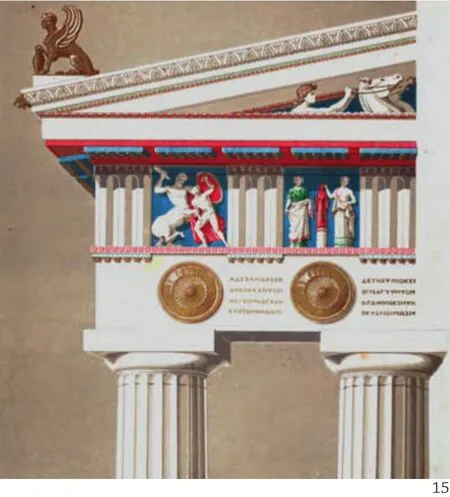
15 帕提農神廟東立面,庫格勒的復原圖(庫格勒,《關于希臘建筑和雕塑的彩飾及其局限性》,圖版1)/East facade of the Parthenon, reconstructed by Kugler (Kugler,über die Polychromie der griechischen Architektur, plate 1)
(See World Architecture 201709, p104 for part one)
3.1.5 Kugler, an attempt at mediation, to soften the tone (between Semper/Hittorff and Raoul-Rochette)
A response to Semper's unconditional demand for the acknowledgment of painted decoration in antiquity came from Germany the following year (1835), when Franz Theodor Kugler (1808 –1858) put forward his moderate, conciliatory interpretation of the polychromy theory: following Quatremère de Quincy's ideas of Greek polychromy,he presented a reconstruction of the polychrome decoration of the Parthenon (über die Polychromie der griechischen Architektur und Skulptur und ihre Grenzen; 1835), which was answered several years later by Semper's Vier Elemente der Baukunst.[1]5
Kugler was one of the leading 19th-century German authorities in art history and poetry and the cultural administrator for the Prussian state.He also compiled the first global survey text of the history of painting (Handbuch der Geschichte der Malerei von Constantin dem Grossen bis auf die neuere Zeit, 1837) and the history of art (Handbuch der Kunstgeschichte, 1842), as well as his immensely popular Geschichte Friedrichs des Grossen (Leipzig,1840).21)And yet, in modern historiography,his achievements are often eclipsed by his most prominent student and collaborator – the Swiss art historian and "great discoverer of the age of the Renaissance" – Jacob Burckhardt (1818 – 1997).
Kugler wanted to play the role of mediator in the polychromy debate: über die Polychromie was intended to strike a balance between supporters and opponents by providing an impartial discussion of the arguments of both sides.[8]4However, it is significant that he gave his work the title "…Greek architecture and sculpture and its limitations"(…Architektur und Skulptur und ihre Grenzen),indicating that the use of colors in Greek architecture was restricted (by conditions) and confined (to a given area).
Kugler did not feel passionately about the subject either way. He acknowledged the work of Quatremère de Quincy and the use of colors on sculpture, but he condoned rather than wholeheartedly accepted the universality of polychromy in historical architecture, attaching little significance to the testimonies of classical texts.[8]114The core of Kugler's argument was that colors were used in antiquity in accordance with the materials used, and the coloring of white marble was unnecessary and inappropriate. As a consequence,he rejected the idea of a universality of polychrome buildings and building parts in the sense intended by Hittorff and Semper.[8]8-9He harshly criticized Hittorff for his too-colorful color scheme, arguing that it could not be applied generally, but only to specific cases. Kugler stressed the dependency between polychromy and the geographic location of buildings, rejecting the idea of the use of polychromy for Attica, the historical heartland of ancient Greece located on the Attic peninsula and centered on the city of Athens.[8]10Moreover, he restricted polychromy to the architecture of older periods. In essence, Kugler argued that: first, color follows form;second, as soon as a period has mastered "form","color" becomes unnecessary; and third, color is used as a supplement to form only if form proves insufficient (in aesthetic expression). He did not comment on Raoul-Rochette's controversial views on wooden panel painting.
3.1.6 Letronne, support for Hittorff from a philologist
Jean Antoine Letronne (1787 – 1848) was a French philologist and professor at the Collège de France (chair of history, 1831; chair of archaeology,1838-1848) and in 1840 he became keeper of the national archives. Letronne's most important work is his Recueil des inscriptions grecques et latines de l'égypte (2 vols, 1842 and 1848).[3]116
Letronne, one of Hittorff's closest friends,demonstrated his support in 1835 in the pleasing form of sixteen letters addressed to Hittorf,avoiding the lengthy and cumbersome scholarly discussion of previous supporters and opponents in the polychromy debate. His Lettres d'un antiquaire à un artiste sur l'emploi de la peinture historique murale dans la décoration des temples et des autres édifices publics et particuliers chez les Grecs et les Romains (1835) gave an extensive and informative picture of the artistic life of the ancients. He disproved Raoul-Rochette's theory with the aid of classical quotations. Politely, but using irony to the full, he went through Raoul-Rochette's arguments point by point, and showed that the pretentious archeological scholar had made substantive errors in his own discipline. Detailed study of classical texts revealed that in Greece as well as in Italy,both wall painting and wood panel painting had been key design elements. In addition, Letronne distinguished between different painting methods and discussed them in detail. His argument publicly acknowledged Hittorff's theory and showed that it stood up to scientific and philological examination.
3.2 Further development and end of debate
Raoul-Rochette was not out of the debate, but his scholarly vanity had been deeply wounded –simply by the fact that someone had contradicted him.[3]119For example, in 1836-1837, he struck back,criticizing Semper for his ideas of "elaboration of form with color" and "not staying truthful to the(building) material", by obscuring the beauty of the material by covering it with a colored coating.22)In this final stage of discussion, the debate was fueled by increasingly rapid statements by its key players,who exchanged opinions on the subject in a harsh,often personally insulting manner (Raoul-Rochette against Letronne and Hittorff; Letronne against Raoul-Rochette and Kugler).23)The polychromy debate gradually degenerated into a conf l ict between philology (Letronne) and archaeology (Rochette),and both sides called upon judges to arbitrate the dispute to resolve the disagreement. As a consequence, the Académie had to make a stand and voice a carefully-formulated explanation – not least because by then, young French architects were allowed to study polychrome architecture in Italy or Greece (as pensionnaires at the French Academy in Rome or the French School in Athens): for example,in 1845 Alexis Paccard (1813 – 1867) reconstructed the Parthenon, and in 1846 Philippe Auguste Titeux(1812 – 1846) the Propylaea. Their observations in Greece proper largely confirmed the findings of Hittorff in the Greek colonies in Italy, although their visual recoveries were sometimes rather more fiction than fact.[3]122-123
3.2 進一步的發展與論戰的終結
羅謝特并沒有退出這場爭辯,但是他作為一個學者的自尊心被深深地傷害了——僅僅因為有人站在了他的對立面[3]119。比方說,在1836–1837年,他回擊了森佩爾,指責他“用色彩表達形式”的觀點“未能堅持(建筑)材料的真實性原則”,因為色彩涂層完全掩蓋了材料的美感22)。這場爭辯到了最后一幕,已經愈演愈烈,變為主角之間日趨緊鑼密鼓的聲明、回應,甚至人身攻擊(羅謝特對陣勒托與希托夫;勒托對陣羅謝特與庫格勒)23)。論爭后來逐漸縮小為文獻學(勒托)與考古學(羅謝特)的對峙,雙方均提出請求仲裁方來解決這場爭議。接下來,學院不得不表明立場,并發表了一份措辭謹慎的聲明——尤其是因為那個時候,年輕的法國建筑師們已經被允許在意大利和希臘研究建筑彩飾(作為羅馬大獎的獲得者,在羅馬法蘭西學院或者雅典法蘭西考古學院學習)。例如,1845年亞歷克西斯·皮卡德(1813–1867)復原了帕提農神廟;1846年菲利普·奧古斯特·蒂特(1812–1846)復原了衛城山門。盡管他們的復原設計大多是虛構大于實際,但他們的在希臘的觀察極大地證實了希托夫在意大利希臘殖民區的發現[3]122-123。
最重要的是,在這個階段,考古學證據日益豐富,甚至引起了倫敦大英博物館館藏埃爾金石雕的化學分析24)。在這些證據面前,爭論內容的實質發生了轉換。就如庫格勒的折中方案所顯示的那樣,爭論的重點變為了探討建筑彩飾的外延和內涵,而非古典建筑的彩飾本身是否存在,因為那時這已經成為一個不爭的事實。
1851年,希托夫終于出版了自1830年起就受到期待的,配有大量插圖的賽林努特的恩培多克勒神廟的完整復原設計,盡管這次依然有反對的聲音(庫格勒)。然而,這場紛爭中的關鍵人物都相繼與世長辭,而反對派的人數也在逐年減少——勒托、羅謝特、庫格勒、希托夫和森佩爾分別在1848年、1854年、1858年、1867年和1879年辭世。這場彩飾之辯前后持續了30多年,直到此時才逐漸歸于尾聲,留給我們一個令人震驚又無可辯駁的事實——古希臘神廟終于亮出它富有色彩的一面。
4 結論
與古典建筑有關的彩飾問題,使德籍或德裔建筑學者們(希托夫、森佩爾和庫格勒)在國際舞臺上收獲了更大的存在感,但也在很長一段時間內禁錮了法、德兩國的專業學者在藝術與建筑史、考古學以及文獻學范疇的學術交流。同時,盡管雅典衛城和古典希臘建筑一直都是現代學者所關注的中心,但由于一些歷史原因,“研究彩飾法的這一代先驅者們沒有關注帕提農神廟(森佩爾和庫格勒除外),而是截取了一些零星證據,用以支持自己的理論。”[4]270——位于埃伊納小島上的阿法雅神廟就是這樣的一個證據,因此具有了某種重要性。
無論如何,對這座無名古建筑的發現和視覺復原,拉開了這場廣泛的跨文化交流的序幕,而這場發生于19世紀的彩飾之辯,徹底改變了今日我們看待古典建筑的方式。
作為總結,我們現在可以回答文章開頭所提的3個問題——即事件的歷史梗概、取得的新知,以及彩飾之辯的世界性意義:
4.1 “彩飾之辯”的歷史梗概
這場學術論爭起源于人們不得不直面一個出人意料且從觀念上難以接受的現象,而后在不斷被揭示的事實依據面前,開始逐漸接受并習以為常。從彩飾法之辯開始(19世紀的第二個10年),直到1830年代中期,古典希臘藝術及建筑存在彩飾的可能性,在學者與普通大眾之中引發了激烈的爭論,而這更加凸顯了辯題的重要性。而后,鑒于有大量確鑿證據證明希臘神廟上存在著使用顏色的痕跡,這場爭論的重點逐步轉移到探討彩飾的外延(時代與地域范圍)、內涵和色彩特性(飽和度、基色、與采光的關系等)。
4.2 “彩飾之辯”的背后
在這里我們可以看到200年前學會的運作機制——實際上現在還是這樣運作的:通過書信、考古發掘報告、普及性小冊子以及帶有大量插圖的專著,進行著學術觀點的精彩交鋒以及激烈的口水戰。
此外,這場紛爭一部分是在巴黎美術學院這個國家(政治)平臺上進行的。巴黎美術學院是19世紀前期法國建筑學理論的誕生地,而在學校核心人物和學生的參與下,這些理論也極大地影響了國際化的現代設計學。彩飾之辯也體現了十九世紀初期巴黎美術學院的內部斗爭和學生反叛——對于這個“在某種程度上偶然而隨意的”建筑彩飾問題的流行,德國建筑理論家漢諾-沃爾特·克魯夫特進行了如下解讀:年輕的浪漫主義者們將這個原本屬于考古學和古物研究的話題當成了“武器”,用以對抗考特梅爾領導的巴黎美術學院所固守的溫克爾曼式古典主義教條25)。
通過這場西方彩飾之辯,我們還可以深刻地領會到19世紀歐洲的思想狀況(思考問題的方式),以及法蘭西與德意志學者的思維模式(態度及看法)。在彩飾這個概念最初進入人們視野的時候,它是不被接受的,因為其概念動搖了西方建筑理論的根基,而這個根基是建立在文藝復興時期(“單色調的高貴”、鑲嵌著古典元素的平坦表面所體現的灰白而平面化的古典主義、伯魯乃列斯基、阿爾伯蒂)和新古典主義時期(形式統領色彩、形式作為圖解溫克爾曼美學概念“高貴的單純與靜謐的偉大”的工具)對古典建筑的隨意解讀之上的26)。
也就是說,直到19世紀,隨著現代考古學正式成為一門學科,新的發掘和勘察不斷動搖著羅馬建筑至高無上的地位,并強調希臘建筑的重要性(“希臘-羅馬之爭”),對于古典建筑的想象被放到了特定信仰、判斷和環境的背景之下。在不可能證實這些構想的情況下(由于無法到達真正的遺址現場,以及實物證據的缺乏),人們得出的往往是與事實相去甚遠的曲解,這是需要克服的一大挑戰。因此,歷經多年,(古典建筑中的)彩飾才得到廣泛的接受。
值得特別注意的是,不論是支持派還是反對派,積極參與這場彩飾之辯的學者們都是各自領域的專家,在各自的職位上取得了卓越而富有開創性的成就。比如庫格勒創造了“加洛林風格”(他是第一個用此術語的人),這在藝術史領域已獲公認。盡管希托夫、羅謝特、森佩爾、庫格勒以及勒托等學者的重要性在西方世界早已被公認,在中文文獻中關于他們的敘述卻很貧乏,僅是粗略地掃過各個領域,并只關注他們學術生涯中某一特定階段的研究。
此外,這場論爭還體現出某些人性的特點——“人非圣賢,孰能無過”,而且人生并不是非黑即白,而是有很多灰色地帶的。也就是說,雖然以今天的我們所掌握的知識來判斷,當時某些學者——例如羅謝特和庫格勒——選擇了“錯誤的”立場,但這并不能削弱他們在當時的聲望和地位,也不會影響他們的職業發展。庫格勒在年僅28歲時就毫不費力地寫出了《關于希臘建筑和雕塑的彩飾及其局限性》(1835),試圖對彩飾法這一熱點議題起到調停作用。但這篇文章實際上暴露了他的某種“本色”,表現了他對于這個問題的消極和懷疑。大約10年后(1840),庫格勒就被吸收進入學術評議會,并被委派到文化部任職,負責監管普魯士的各類藝術。此外,他的作品還為他獲得了國際上的知名度:他的繪畫史研究報告被翻譯成了英文(1842),且多次修訂出版,和詹姆斯·弗格森(1808–1886)的代表作《各國建筑通史:從遠古到現代》(1860–1870)一同,樹立了世界藝術史研究的樣板,并在英語地區非常流行。弗格森的引入,對于本文開端所提出的第三個問題而言尤為有趣。
Most importantly, at this stage, faced with growing archaeological evidence that even led to a chemical testing of the Elgin marbles in the British Museum in London, there was a shift in the content of the debate. Instead of asking whether or not polychromy existed in antiquity, since this had already become an established fact that no one could afford to refute – the shift was towards asking about the extent and nature of the polychromy in architecture, as exemplified by Kugler's proposed compromise solution.
In 1851, Hittorff finally published the complete,lavishly-illustrated edition of the reconstructed Empedocles Temple in Selinunte, which had been awaiting completion since 1830, albeit again not without opposition (Kugler). However, the key players in the conflict were gradually dying off, and the number of opponents shrank from year to year –Letronne passed away in 1848, Raoul-Rochette in 1854, Kugler in 1858, Hittorff in 1867, and Semper in 1879. The polychromy debate had been carried on for more than three decades, and only then did it slowly come to an end, leaving us with the astonishing and undeniable fact that ancient Greek temples had finally shown their colors.
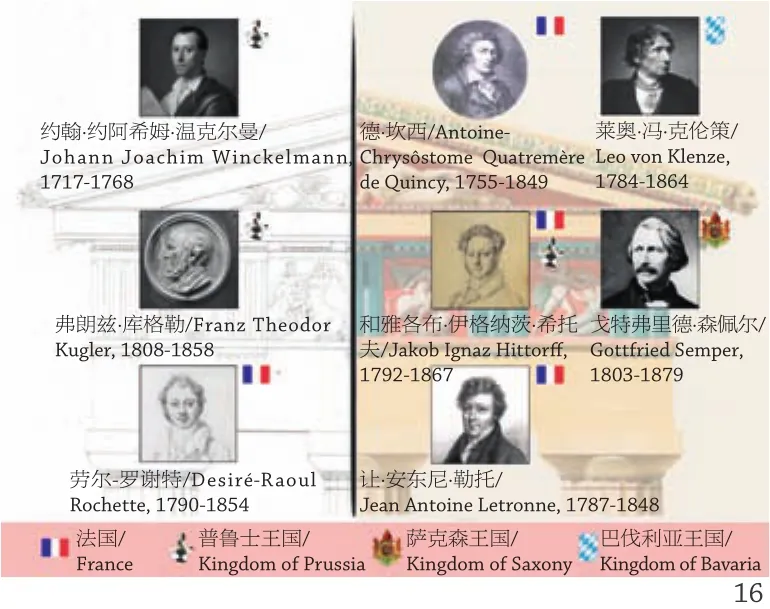
16 法–德彩飾之辯中的關鍵人物(繪制:荷雅麗)/Key players in the German-French polychrome debate (Drawing:Alexandra Harrer)
4 Conclusions
The subject of polychromy in connection with the historical architecture of antiquity established a greater presence of German/German-born architectural scholars on the international stage(Hittorff, Semper, and Kugler), but for a long time"poisoned" academic relations between the French and the German authorities on art and architectural history, archaeology, and philology. And although the acropolis in Athens and the classical architecture of Greece itself have long been the centre of modern scholarly attention, for historical reasons,"the generation of the pioneers of the polychromy question did not focus on the Parthenon (with the exception of Semper [and Kugler]) but used much more scattered evidence to more personal ends"[4]270– the Aphaia Temple on the small island of Aegina was one of them and herein lies some of its importance.
In any case, the discovery and visual recovery of this historically rather insignificant building set the scene for a broad cross-cultural dialogue that revolutionized the way we see antiquity today –the 19th century polychromy issue. To draw a final conclusion, we may now answer the questions posed at the beginning regarding the historical course of events, knowledge gained, and the global significance of the polychromy debate.
4.1 Changes in the course of the polychromy debate
What happened back then was at first a confrontation with the unexpected and virtually unbelievable phenomenon, followed by its gradual habituation (acceptance upon repeated exposure to factual evidence). At the beginning of the polychromy debate (1810s) until the mid-1830s,the mere possibility of colorful classical Greek art and architecture provoked a serious debate among scholars and the general public, which highlights the importance of the question. Then, given the mass of overwhelmingly convincing evidence of traces of color on Hellenistic temples, the debate shifted its focus increasingly in the direction of the extent of the polychromy (time period; geographic region)and the nature and quality of the colors that had been applied (bright or dull; basic color; dependency on light exposure).
4.2 Behind the scene of the polychromy debate
What we can see here is the mechanism of how academia worked two hundred years ago – and in fact still works today: an exciting back and forth of scholarly opinions and a battle of words, expressed in letters, excavation reports, pamphlets, and lavishly-illustrated print publications.
And what is more, the debate was partly fought on the national (political) stage of the Académie des Beaux-Arts, the birthplace of early 19th-century French theory that had considerable inf l uence on modern international design, with its dignitaries and its students became involved. The dispute embodied an internal conflict and student revolt at the Académie des Beaux-Arts in the early 19th century: the German architectural theorist Hanno-Walter Kruft explains the popularity of the "somewhat incidental and arbitrary issue"of architectural polychromy, originally an archaeological and antiquarian issue, which the young Romantics used as "a weapon" to attack the rigid classical norms of the Winckelmann tradition still upheld at the Académie by Quatremère.25)
4.3 “彩飾之辯”與全球建筑史:19世紀的德意志——希臘古典復興與中國建筑史的書寫
關于第三個問題,“德意志”視角下的彩飾之辯對于我們今天理解全球建筑史至關重要。通過這場爭辯,我們能夠窺探德國–希臘之間的緊密聯系,以及其現實意義。不光德籍或德裔學者及建筑師在這場理論爭辯中起到帶頭作用,會說德語的,以及有德意志教育背景的建筑師們還積極地促成了彩飾在當代建筑上的視覺重現27)。
正是在希臘獨立戰爭之后的雅典,德國建筑師馮·加特納 (1791–1847)為希臘的奧托一世大帝(約1832–1862)設計了舊皇宮(1836–1843,現為希臘議會大廈)——奧托大帝是巴伐利亞路德維希一世大帝(1786–1868)的兒子,而路德維希一世大帝就是10年前哈勒爾的贊助人,也是正是他下令在慕尼黑古代雕塑博物館對阿法雅神廟進行復原。在雅典,還有丹麥裔奧地利建筑師特奧費爾·翰森(1813–1891)設計了雅典大學(1859–1885)、扎皮翁宮(1874–1888)以及希臘國家圖書館(1887–1902),在翰森離開希臘之后,這些建筑都是在他的代理人,德裔希臘建筑師恩斯特·齊勒爾(1837–1923)的監理下建成的。這些位于雅典的德意志–希臘復興建筑的柱頭和線腳使用了“具有生動異域風情的金棕櫚葉裝飾,并在重點部位點綴了紅色、綠色和藍色”。[4]260光潔的白色柱子立在深紅色墻面的前方,展現出一種穩健而雅致的古希臘彩飾風味。
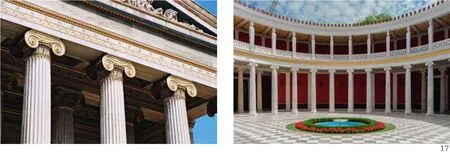
17 雅典的后希臘式(希臘復興式)建筑:雅典大學正立面細部(左,攝影:李路珂)與扎皮翁宮的內庭院(右),均由特奧費爾·翰森設計(圖片來源:www.commons.wikipedia.org)/Neo-Grec architecture in Athens, Academy of Athens (left, photo by LI Luke) and the courtyard of the Zappeion (right, public domain work, www.commons.wikipedia.org), both designed by Theophil Hansen.
此外,出人意料的是,發生于歐洲中部的彩飾之辯對于萬里之外的中國,竟十分有助于理解本國建筑的史學觀念,以及建筑史的書寫。1876年,弗格森出版了名為《印度及東方建筑史》的四卷本著作,在這本書里他以貶抑的語調評論中國的建筑傳統:
“……中國建筑并不值得太多關注。然而有一點,中國是現今唯一還將彩飾作為建筑的重要組成部分的民族,所以中國建筑還是有一定啟發性的:實際上對于他們而言,色彩比形式重要得多;且目前的效果是比較令人愉悅而滿意的。這是因為,在藝術的較低階段,情況無疑總是這樣的。但是,對于較高階段的藝術而言,毋庸置疑,盡管色彩是最有價值的附加之物,它并不像形式那樣具有直指人心的崇高表現力。”
弗格森認為在中國建筑中,色彩是凌駕于形式之上的,是建筑美的決定性因素,這一挑釁式的論斷源于他自己對中國建筑的誤解——他拒絕承認中國建筑結構中比例的作用,以及根據社會等級和禮制意義而調整的顏色等級體系。
雖然弗格森不得不承認古希臘神廟中建筑彩飾的運用(“希臘人在他們的神廟內外施以彩繪”),但在他看來,中國建筑中刻板而千篇一律的色彩組合(既不表達建筑結構,也不適合特定地域條件)必須被視為一種缺乏教養、尚不成熟的表征。更有甚者,弗格森針對西方建筑提出了一套彩飾依賴于特定氣候和地理條件的理論,所以只有在地中海的強烈陽光下,建筑彩飾才是可以允許的(“除了希臘與埃及這樣的國家,僅僅通過在建筑外表面涂繪的方式來運用色彩,這一做法必然是錯誤的”)。然而,若已了解弗格森的語境背后這場剛剛平息不久的西方彩飾之辯,他的這種認知就如同這場辯論本身一樣,是可以被理解和解釋的。□
注釋
20)克魯夫特指出森佩爾抨擊了克倫策對歷史風格的模仿(《建筑理論史》,p311)。
21)他的《繪畫史手冊,從康斯坦丁大帝到現在》與《腓特烈大帝的一生》都有英譯版(《繪畫史手冊》,倫敦,1842年,1911年以前出版了多個英文修訂版;《腓特烈大帝的一生》,倫敦,1844,及其后的數個修訂版)。庫格勒唯一沒有被翻譯的書是《藝術史手冊》,但此書的附圖合集在1880年代于紐約出版了英文版本。
22)羅謝特的數篇論文發表在1836–1837年間的學者報上。
23)勞爾–羅謝特,《學者報》1836–1837年之間的一些文章;《未出版的古典繪畫》,1836;《考古學信件》,1840。勒托,《一個古董商人寫給一個藝術家的信之附錄》,1837。關于人身攻擊,參見范·贊特恩,《建筑彩飾法》,論文部分,p35。
24)埃爾金石雕指的是曾位于帕提農神廟、雅典衛城山門和伊瑞克提翁廟的古希臘雕塑。這些雕塑被埃爾金伯爵七世托馬斯·布魯斯(1766–1841)在1801–1802年間從神廟中移走,并帶回大英帝國。
25)克魯夫特,《建筑理論史》,第312頁。范·贊特恩,建筑彩飾法,p11。范·贊特恩進一步解釋道,對于很多年輕的法國建筑師(雅典法蘭西學院羅馬大獎獲得者)來說,建筑彩飾法不是“循規蹈矩且一成不變的,而僅僅是(直接而多變的)涂鴉藝術的延續和實物的附屬品。”(《帕提農神廟的彩飾》,p271)
26)森佩爾曾辛辣地指出所謂“單色調的高貴”純粹是由伯魯乃列斯基和米開朗基羅開創的,這種做法導致了“現代燕尾服和古董的雜糅”(《初評》,p16)。他主張“認為古典建筑是單色調是野蠻的”(同上,p20),以此抨擊同時代的古典主義觀點。
27)比如希臘建筑師帕納伊斯·克羅斯(1818–1875)就被奧托大帝授予了獎學金并留學慕尼黑。
What we can also gain from the Western polychromy debate is a deep insight into the mentality (a particular way of thinking) of 19thcentury Europe and the mind-set of German and French scholars (their attitude or set of opinions).On its first appearance, the concept of polychromy was deemed to be unacceptable, a concept that undermined the very foundations of Western architectural theory rooted in the free interpretation of antiquity during the Renaissance ("novelty of monochromy"; grey-and-white planar classicism through flat surfaces veneered in classical elements;Brunelleschi, Alberti) and the neo-classicist period(superiority of form over color/form as shaping tool expressed in the aesthetic ideal of "noble simplicity and quiet grandeur"; Winckelmann).26)
That is to say, until the 19th century, which saw the establishment of modern archaeology as an academic discipline, when new discoveries and excavations challenged the primary role of Roman architecture and highlighted the importance of Greece ("Greco-Roman Controversy"), the architecture of antiquity was conceived in the light of individual beliefs, judgments, and circumstances.Without the possibility of verification (due to the inaccessibility of actual ruins and paucity of factual evidence), this had led to a distorted picture of the actual situation that posed quite a challenge to overcome. Consequently, it took many years for polychromy to gain widespread acceptance.
It is noteworthy that the scholars actively engaged in the polychromy debate were all experts in their relevant fields and proved their outstanding and pioneering achievements whatever position they took. Kugler, for example, had coined the concept of "Carolingian style" (being the first to use the term"Carolingian" ), which is taken for granted in the field of art history. Although the significance of scholars such as Hittorff, Raoul-Rochette, Semper,Kugler, and Letronne has long been recognized in the West, Chinese literature on the subject is sparse,spread out across disciplines and focused on studies of particular phases of their career.
Furthermore, there is a human side to this –to err is human, and moreover, life is not just black and white, but many shades in between. That is to say, taking the "wrong" side of the debate in the light of today's knowledge neither diminished the standing of scholars such as Raoul-Rochette and Kugler, who both enjoyed great popularity among their contemporaries, nor did it impair their career development. Kugler, who was 28 when he wrote his half-hearted attempt to mediate in the heated question of polychromy (über die Polychromie,1835), which in fact rather showed his "true colors"(his reluctance and doubts on this matter), was called to the academic senate and appointed to the Ministry of Culture overseeing all the arts of Prussia just a decade later (1840s). Moreover, his work gained him international recognition: his survey text of painting history was translated into English (1842) and published in many revised editions, together with James Fergusson's (1808 –1886) standard work A History of Architecture in all Countries from the Earliest Times to the Present Day (1860 – 1870s) establishing as a genre the global art history survey text popular in the Englishreading world. The relation to Fergusson is especially interesting with regard to the last question posed at the beginning.
4.3 Global significance of the polychromy debate: 19th-century "German" Greek revival architecture and Chinese architectural historiography
The polychromy discussion seen through"German" eyes is significant for our modern understanding of global architectural history.Through the debate, we can unfold the close German-Greek relationship and its practical implications.Not only did German and German – born scholararchitects play a leading role in the course of the theoretical debate, but German – speaking and German – trained architects were also actively engaged in the visual recovery of polychromy in contemporary architecture.27)
It was in Athens, after the Greek War of Independence, that the German architect Friedrich von G?rtner (1791 – 1847) designed the Old Royal Palace(1836 – 1843; now the Hellenic Parliament) for King Otto of Greece (r. 1832 – 1862) – King Otto was the son of King Ludwig I of Bavaria (1786-1868), who was a patron of Haller's and who had commissioned the reconstruction of the Aphaia Temple in the Glyptothek in Munich a decade earlier – and the Danish-born Austrian architect Theophil Hansen (1813 – 1891)designed the Academy of Athens (1859 – 1885), the Zappeion (1874 – 1888), and the National Library of Greece (1887 – 1902), all of which were supervised by the German-born Greek architect Ernst Ziller(1837 – 1923), Hansen's representative when he was away. The German Greek revival architecture in Athens displays capitals and moldings "exotically enlivened with gold palmettes and touches of red,blue and green" and plain white columns standing in front of deep red walls, and presents a conservative and tasteful interpretation of ancient Greek polychromy.[4]260
Furthermore, it might come as a surprise to learn the central-European polychromy discussion is particularly useful for understanding the architectural history and historiography of a country far away from the center of the debate – China. In 1876, Fergusson published a 4th volume entitled The History of Indian and Eastern Architecture,in which he remarked disparagingly on Chinese building traditions:
"… it may be that Chinese architecture is not worthy of much attention. In one respect, however,it is instructive, since the Chinese are the only people who now employ polychromy as an essential part of their architecture: indeed, with them, color is far more essential than form; and certainly the result is so far pleasing and satisfactory, that for the lower grades of art it is hardly doubtful that it should always be so. For the higher grades, however,it is hardly less certain that color, though most valuable as an accessory, is incapable of that lofty power of expression which form conveys to the human mind."[9]688
Fergusson's provocative statement about the Chinese emphasizing color over form as a defining factor for architectural beauty was born of a misconception on his part, denying Chinese construction the effects of proportion and flexible color grading according to social rank and ritual significance.
[1] 范·贊特恩. 1830年代的建筑彩飾法. 紐約:加蘭出版社,1977.
[2] 溫岑茨·布里克曼和安德烈亞斯·舒爾 編. 色彩里的神——古典雕塑的彩飾. 慕尼黑:希爾默出版社,2010.
[3] 卡爾·哈默,雅各布·伊格納茨·希托夫,1792–1867. 斯圖加特:安東·希爾澤曼出版社,1968.
[4] 戴維·范·贊特恩,“帕提農神廟的彩飾”// 帕提農神廟及其對現代的影響. 帕納約蒂斯·圖尼基沃蒂斯編. 雅典:梅麗莎出版社. 1994.
[5] 漢諾-沃爾特·克魯夫特. 建筑理論史:從維特魯威到現在. 羅納德·泰勒英譯. 紐約:普林斯頓建筑出版社,1996. 王貴祥譯. 北京:中國建筑工業出版社,2005.
[6] 富特文勒,《埃伊納:阿法雅圣地》.
[7] 海因茨·奎特茲克,戈特弗里德·森佩爾的美學觀點. 柏林:學術出版社,1962.
[8] 弗朗茲·庫格勒. 關于希臘建筑和雕塑的彩飾及其局限性. 柏林. 1835.
[9] 詹姆斯·弗格森. 印度及東方建筑史. 建筑歷史第1版第4卷. 倫敦. 1876. 赫爾施修訂第3版第3卷. 倫敦.1899.
[10] 詹姆斯·弗格森(1808–1886),各國建筑通史:從遠古到現代. 倫敦. 1865-1867. 赫爾施修訂第3版第1卷. 倫敦. 1893.
參考書目
1. 羅伯特·亞當(1728–1792), 達爾馬提亞斯帕拉托的戴克里先大帝皇宮遺址. 倫敦. 1764.
2. 查爾斯–路易斯·克萊里索(1721–1820),法蘭西古跡之一:尼姆的遺跡. 巴黎. 1778.
3. 查爾斯·羅伯特·科爾雷爾(1788–1863),科爾雷爾,《埃伊納的主神朱庇特廟與位于阿卡迪亞地區的費加里亞附近的巴塞的阿波羅·伊壁鳩魯神廟》.倫敦. 1860.
4. 加布里埃爾·皮埃爾·馬丁·迪蒙(1720–1791), 帕埃斯圖姆,即普林尼所提及的帕埃斯圖姆市1750年現存的3座古代神廟的平面圖、剖面圖、輪廓線圖、立面幾何分析及透視圖。由J·G·蘇夫洛測繪并繪制……于1750年. 巴黎. 1764.
5. 雅各布·伊格納茨·希托夫(1792–1867),賽林努特的恩培多克勒神廟復原及希臘古建筑彩飾. 巴黎.1851.
6. 希臘的彩飾建筑——賽林努特衛城的恩培多克勒神廟的完整復原. 考古研究所年度通訊第2卷,1830:p263-284. 重刊. 美術學會刊第1卷,1830–31:p188-55.
7. 西西里的現代建筑——西西里主要城市中最優美的宗教建筑和最出眾的公共或私人建筑集錦. 18期連載. 巴黎. 1826-1835.
8. 西西里的古代建筑——西西里主要城市和遺址中最值得探究的古跡集錦. 8期連載. 巴黎. 1827–1830.
9. 萊奧·馮·克倫策,阿格里真托的奧林匹亞宙斯神廟. 斯圖加特. 1821. 1827修訂版.
10. 繪畫史手冊 :從康斯坦丁大帝到現在. 柏林.1837;英譯本. 倫敦. 1842
11. 藝術史手冊. 斯圖加特. 1842.
12. 腓特烈大帝的一生. 萊比錫,1840. 英譯本. 倫敦.1844.
13. 讓·安東尼·勒托(1787–1848),埃及的希臘與拉丁銘文集:基于亞歷山大大帝到阿拉伯時期的國家政治史、行政管理和民事宗教機構的關聯性研究.兩卷本. 巴黎. 1842. 1848.
14. 一個藝術品商人寫給一個藝術家的信:關于古希臘和古羅馬的神廟及其他公共或私人建筑裝飾上使用墻面彩繪. 巴黎. 1835.
15. 一個藝術品商人寫給一個藝術家的信之附錄:關于在神廟及其他公共或私人建筑裝飾上使用墻面彩繪. 巴黎. 1837.
16. 喬瓦尼·巴蒂斯塔·皮拉內西(1720–1778). 建筑與透視圖集第一卷,威尼斯建筑師皮拉內西繪制并雕版. 羅馬. 1743.
17. 古代與現代羅馬的景象集. 羅馬. 1745.
18. 安東尼–克里索斯托姆·考特梅爾·德·坎西(1755–1849). 奧林匹亞的朱庇特:重新審視古代雕塑藝術. 巴黎. 1815.
19. 建筑學詞典. 兩卷本. 巴黎. 1789. 1832.
20. 勞爾–羅謝特(1790–1854), 古代壁畫. 學者報.1833年6月. p361–371 .
21. 未出版的古希臘、伊特魯里亞和古羅馬的人物雕塑:1826-1827年間在意大利和西西里收集. 兩卷本.巴黎. 1828. 1833.
22. 未出版的古代繪畫,基于對希臘人和羅馬人在圣殿或宗教建筑的裝飾上運用彩繪的研究,及未出版的古代建筑. 巴黎. 1836.
23. 關于希臘繪畫的考古學信件.巴黎. 1840.
24. 戈特弗里德·森佩爾(1803–1879), 關于古代彩飾建筑與雕塑的初評. 阿爾托納. 1834.
25. 建筑與雕塑中色彩的運用. 柏林. 1834–1836.
26. 建筑四元素. 不倫瑞克. 1851.
27. 論文集. 柏林和斯圖加特. 1884.
28. 詹姆斯·斯圖爾特(1713–1788)和尼古拉斯·雷維特 (1721–1804),雅典的古跡. 四卷本. 倫敦.1762,1787,1784,1816.
29. 約翰·約阿希姆·溫克爾曼(1717–1768), 關于在繪畫與雕塑中模仿希臘藝術作品的思考. 德累斯頓/萊比錫. 1755.
30. 古代藝術史. 德累斯頓. 1764. 第二版. 1776.
31. 邁克·埃斯帕涅,本尼迪克特·薩伏伊和席琳·特勞特曼-沃勒,弗朗茲·西奧多·庫格勒:一位德國藝術史學家和柏林詩人. 柏林:學術出版社. 2010.
32. 基利安·埃克,藝術對于人生的重要性:弗朗茲·庫格勒與第一個藝術史教育機構. 馬爾堡美學年鑒第32期. 2005:p7-15.
33. 亨里克·卡格,19世紀德國藝術史學的前瞻性:弗朗茲·庫格勒,卡爾·施納澤和戈特弗里德·森佩爾.藝術史學刊第9期. 2013:p1-26.
34. 唐納德·戴維·施耐德, 雅各布·伊格納茨·希托夫(1792–1867)的作品和理論. 兩卷本. 紐約:加蘭出版社,1977.
35. 雷內·施耐德,考特梅爾·德·坎西與他的藝術成就(1780–1830). 巴黎. 1910.
36. 渥瑞夫·銳查斯美術館, 雅各布·伊格納茨·希托夫,一位來自科隆的19世紀巴黎建筑師. 科隆:洛切爾出版社,1987.
To Fergusson, who by then had no choice but to acknowledge the polychromy of ancient Greek temples ("the Greeks painted their temples both internally and externally")[10], the rigid undifferentiated color scheme of Chinese buildings(neither necessarily serving to explain or give expression to the construction, nor being adaptive to specific local circumstances) must have seemed a sign of a lack of sophistication, lack of refinement.This is not least the case because for Western architecture, Fergusson established a dependency of colors from the specific climatic and geographic conditions of a place, allowing polychromy only for Mediterranean regions with bright light ("except in such countries as Egypt and Greece, it must always be a mistake to apply color by merely painting the surface of the building externally").[10]And yet, if seen in context, as a backdrop to the only recentlyresolved polychrome debate in the West, it is at least explainable and understandable as that debate was. □
Notes
21) His Handbuch der Geschichte der Malerei was translated into English (Handbook of the History of Painting, London 1842, and many revised English editions to 1911), and also his Geschichte Friedrichs des Grossen (Life of Frederick the Great,London, 1844 and subsequent English editions). The accompanying atlas of illustrations to his Handbuch der Kunstgeschichte, the only work not translated, was published in English in New York in the 1880s.
22) Several papers published in Journal des Savants,1836 – 37.
23) Raoul-Rochette, several articles in Journal des Savants 1836-37; Peintures antiques inédites, 1836;Lettres archéologiques, 1840. Letronne, Appendice aux lettres d'un antiquaire à un artiste, 1837. For the personal attacks see Van Zanten, The Architectural Polychromy, thesis, 35.
24) The Elgin marbles refers to the classical Greek sculptures removed from the Parthenon, the Propylaea,and the Erechtheum at the Athens Acropolis by Thomas Bruce (1766 – 1841), the 7th Earl of Elgin,between 1801 and 1812 and brought back to Great Britain.
25) Kruft, A History of Architectural Theory, 278. Van Zanten, The Architectural Polychromy, 11. Van Zanten further explains that for many young French architects(pensionnaires at the école fran?aise d'Athènes [French School at Athens]) polychromy was not "rule-bound and fixed, but merely the extension of graffiti [i.e.immediate and changing] and the attachment of actual objects." ("The painted decoration of the Parthenon,"271.)
26) Semper once poignantly pointed to the "novelty of monochromy" that only began with Brunelleschi and Michelangelo, leading to "hybrid creations born of modern tail-coats and Antiquity." (Vorl?ufige Bemerkungen, 16). Attacking contemporary Classicism, he perceived it as "barbaric that the monuments should have become monochrome."("Die Monumente sind durch Barbarei monochrom geworden" [Ibid., 20]).
27) The Greek architect Panagis Kalkos (1818-75) for example, received a scholarship by King Otto to study in Munich.
[1] van Zanten, David. The Architectural Polychromy of the 1830's. New York: Garland, 1977.
[2] Brinkmann, Vinzenz and Andreas Scholl (Eds).Bunte G?tter. Die Farbigkeit antiker Skulptur. Munich:Hirmer, 2010.
[3] Hammer, Karl. Jakob Ignaz Hittorff. Ein Pariser Baumeister, 1792 – 1867. Stuttgart: Anton Hiersemann, 1968.
[4] van Zanten, David. "The painted decoration of the Parthenon". In The Parthenon and its Impact in Modern Times, edited by Panayotis Tournikiotis.Athens: Melissa Press, 1994.
[5] Kruft, Hanno-Walter. A History of Architectural Theory: From Vitruvius to the Present. Translated by Ronald Taylor. New York: Princeton Architectural Press, 1996. Translated by Wang Guixiang. Beijing:Zhongguo jianzhu gongye chubanshe, 2005.
[6] Furtw?ngler, Adolf (1853 – 1907) et al. Aegina: Das Heiligtum der Aphaia. Academy of Sciences: Munich,1906.
[7] Quitzsch, Heinz. Die ?sthetischen Anschauungen Gottfried Sempers. Berlin: Akademie Verlag, 1962.
[8] Kugler, Franz. über die Polychromie der griechischen Architektur und Skulptur und ihre Grenzen. Berlin: 1835.
[9] Fergusson James. History of Indian and Eastern Architecture. 1st ed. Vol. 4 of A History of Architecture.London: 1876. Here, rev. 3rd ed. Vol. 3. London: 1899.
[10] Fergusson, James (1808 – 1886). A History of Architecture in all Countries from the Earliest Times to the Present Day. London: 1865 – 1867. Here, rev. 3rd ed. Vol. 1. London: 1893.
Bibliography
1. Adam, Robert (1728 – 1792). Ruins of the Palace of the Emperor Diocletian at Spalatro in Dalmatia.London: 1764.
2. Clérisseau, Charles-Louis (1721 – 1820). Antiquités de la France, prèmiere partie: monumens de Nismes.Paris: 1778.
3. Cockerell, Charles Robert (1788 – 1863). The Temples of Jupiter Panhellenius at Aegina and of Apollo Epicurus Bassae near Phigalaia in Arcadia.London: 1860.
4. Dumont, Gabriel-Pierre-Martin (1720 – 1791).Suite de plans, coupes, profils, élévations géométrales et perspectives de trois temples antiques, tels qu'ils existaient en 1750 dans la bourgade de Poesto, qui est la ville Poestum de Pline [...] ils ont été mesurés et dessinés par J.-G. Soufflot [...] en 1750. Paris: 1764.
5. Hittorff, Jakob Ignaz (1792 – 1867). Restitution du temple d'Empédocle à Sélinonte, ou l'architecture polychr?me chez les Grecs. Paris: 1851.
6. Hittorff, Jakob Ignaz (1792 – 1867). De l' architecture polychr?me chez les Grecs. "Annali dell' instituto di correspondenza archeologica 2 (1830): 263-84.Republished ("De l'architecture polychr?me chez les Grecs et restitution complète du temple d'Empédocle dans l'acropole de Sélinonte") in Journal de la Société Libre des Beaux-Arts 1 (1830 – 1831): 188-55.
7. Hittorff, Jakob Ignaz (1792 – 1867). Architecture moderne de la Sicile, ou recueil des plus beaux monuments religieux et des édifices publics et particuliers les plus remarquables des principales villes de la Sicile. 18 instalments. Paris: 1826 – 1835.
8. Hittorff, Jakob Ignaz (1792 – 1867). Architecture antique de la Sicile, ou recueil des plus intéressants monu- ments d'architecture des villes et des lieux les plus remarquables de la Sicile. 8 instalments. Paris:1827 – 1830.
9. von Klenze, Leo. Der Tempel des Olympsischen Jupiter von Agrigent. Stuttgart: 1821, revised 1827.
10. Kugler, Franz (1808 – 1858). Handbuch der Geschichte der Malerei von Constantin dem Grossen bis auf die neuere Zeit. Berlin: 1837. Translated into English,Handbook of the History of Painting. London: 1842.
11. Kugler, Franz (1808 – 1858). Handbuch der Kunstgeschichte. Stuttgart: 1842.
12. Kugler, Franz (1808 – 1858). Geschichte Friedrichs des Grossen. Leipzig, 1840. Translated into English,Life of Frederick the Great. London: 1844.
13. Letronne, Jean Antoine (1787 – 1848). Recueil des inscriptions grecques et latines de l'égypte,étudiées dans leur rapport avec l'histoire politique,l'administration intérieure, les institutions civiles et réligieuses de ce pays depuis la conquête d'Alexandre jusqu'à celle des Arabes. 2 vols. Paris: 1842 and 1848.
14. Letronne, Jean Antoine (1787 – 1848). Lettres d'un antiquaire à un artiste sur l'emploi de la peinture historique murale dans la décoration des temples et des autres édifices publics et particuliers chez les Grecs et les Romains. Paris: 1835.
15. Letronne, Jean Antoine (1787 – 1848). Appendice aux lettres d'un antiquaire à un artiste sur l'emploi de la peinture historique murale dans la décoration des temples et des autres édifices publics ou particuliers.Paris: 1837.
16. Piranesi, Giovanni Battista (1720 – 1778). Prima parte di architetture e prospettive inventate ed incise da Giovanni Batta Piranesi architetto veneziano. Rome:1743.
17. Piranesi, Giovanni Battista (1720 – 1778). Varie vedute di Roma antica e moderna. Rome: 1745.
18. Quatremère de Quincy, Antoine – Chrys?stome(1755 – 1849). Le Jupiter olympien: l'art de la sculpture antique considéré sous un nouveau point de vue. Paris: 1815.
19. Quatremère de Quincy, Antoine – Chrys?stome(1755 – 1849). Dictionnaire historique de l'architecture. 2 vols. Paris: 1789 and 1832.
20. Rochette, Desiré-Raoul (1790 – 1854). "De la peinture sur mur chez les anciens." Journal des Savants(June 1833): 361 – 71.
21. Rochette, Desiré-Raoul (1790 – 1854). Monuments inédits d'antiquité figurée grecque, étrusque et romaine, recueillis pendant un voyage en Italie et en Sicile, dans les années 1826 et 1827. 2 vol. Paris: 1828,1833.
22. Rochette, Desiré-Raoul (1790 – 1854). Peintures antiques inédites précédées de recherches sur l'emploi de la peintures dans la décoration des édifices sacrés et publics chez les Grecs et les Romains, faisant suite aux monuments inédits. Paris: 1836.
23. Rochette, Desiré-Raoul (1790 – 1854). Lettres archéologiques sur la peinture des Grecs. Paris: 1840.
24. Semper, Gottfried (1803 – 1879). Vorl?ufige Bemerkungen über bemalte Architektur und Plastik bei den Alten. Altona: 1834.
25. Semper, Gottfried (1803 – 1879). Die Anwendung der Farben in der Architektur und Plastik. Berlin: 1834 –1836.
26. Semper, Gottfried (1803 – 1879). Vier Element der Baukunst. Braunschweig: 1851.
27. Semper, Gottfried (1803 – 1879). Kleine Schriften.Berlin und Stuttgart: 1884.
28. Stuart, James (1713 – 1788) and Nicholas Revett(1721 – 1804). Antiquities of Athens. 4 vols. London:1762, 1787, 1784, 1816.
29. Winckelmann, Johann Joachim (1717 – 1768).Gedanken über die Nachahmung der griechischen Werke in der Malerei und Bildhauerkunst. Dresden/Leipzig: 1755.
30. Winckelmann, Johann Joachim (1717 – 1768).Geschichte der Kunst des Altertums. Dresden: 1764.2nd edition 1776.
31. Espagne, Michel, Bénédicte Savoy, and Céline Trautmann-Waller. Franz Theodor Kugler: Deutscher Kunsthistoriker und Berliner Dichter. Berlin: Akademie Verlag, 2010.
32. Heck, Kilian. "Die Bezüglichkeit der Kunst zum Leben: Franz Kugler und das erste akademische Lehrprogramm der Kunstgeschichte." Marburger Jahrbuch für Kunstwissenschaft 32 (2005): 7 – 15.
33. Karge, Henrik. "Projecting the future in German art historiography of the nineteenth century: Franz Kugler, Karl Schnaase, and Gottfried Semper." Journal of Art Historiography 9 (2013): 1 – 26.
34. Schneider, Donald David. The Works and Doctrine of Jacques Ignace Hittorff 1792 – 1867. 2 vols. New York: Garland, 1977.
35. Schneider, Réné. Quatremère de Quincy et son intervention dans les arts (1780 – 1830). Paris: 1910.36. Wallraf-Richartz Museum. Jakob Ignaz Hittorff.Ein Architekt aus K?ln im Paris des 19. Jahrhunderts.Cologne: Locher, 1987.
Repainting Antiquity: The 19th-century Architectural Polychromy Debate Seen through "German" Eyes: Hittorff, Semper, Kugler and Their Generation (2)
The paper investigates the 19th-century dispute over polychromy that revolutionized contemporary understandings of antiquity, especially ancient Greek and Roman temple structures. The Prussian, Bavarian, and German-born French architects discussed in this paper played a key role in this process, despite "Germany" as a nation only becoming a driving force in the formulation of architectural theory at a relatively later stage. The paper places the debate within the larger context of the time, subsequently analyzing conf l icting theories regarding the highly disputed but undeniable fact of polychromatic classical architecture.This re-visioning of the debate surrounding polychromy of antiquity will serve to improve our understanding of modern Greek revival architecture and even more so, our understanding of Western historiography on Chinese architecture.
19th-century European polychromy dispute,ancient Greek architecture, colors, Aphaia Temple,Parthenon, Ignaz Hittorff, Gottfried Semper, Franz Kugler,Johann Joachim Winckelmann, James Fergusson
國家自然科學基金資助項目(批準號:51678325)
清華大學自主科研計劃(批準號:20151080466)
清華大學建筑學院
2017-08-18
猜你喜歡
北方建筑(2021年6期)2021-12-31 03:03:54
文苑(2020年10期)2020-11-07 03:15:36
現代裝飾(2020年6期)2020-06-22 08:43:12
現代裝飾(2020年4期)2020-05-20 08:55:08
攝影之友(影像視覺)(2019年2期)2019-03-05 08:27:16
藝術家(2017年3期)2018-01-26 08:54:49
文學自由談(2016年3期)2016-06-15 13:01:16
福建農業科技(2016年10期)2016-03-07 09:46:49
少兒科學周刊·兒童版(2015年6期)2015-11-24 03:49:38
中國工程咨詢(2015年4期)2015-02-14 03:49:56