
木木美術館入口改造,北京,中國M WOODS Entrance Revitalization, Beijing, China, 2016
2018-01-04 08:51:06建筑設計直向建筑
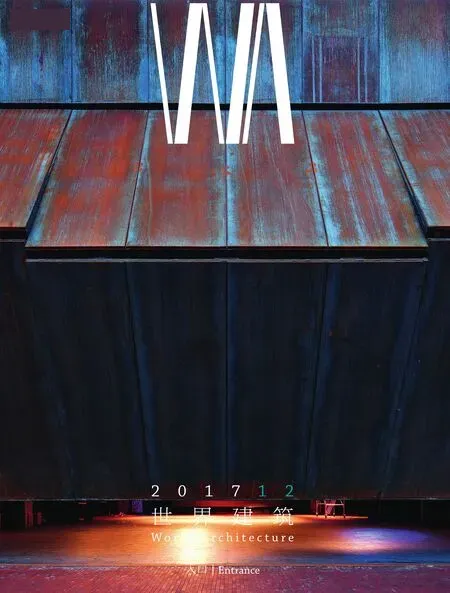
世界建筑 2017年12期
關鍵詞:建筑
建筑設計:直向建筑
Architects: Vector Architects
木木美術館入口改造,北京,中國
M WOODS Entrance Revitalization, Beijing, China, 2016
建筑設計:直向建筑
Architects: Vector Architects

1 外景/Exterior view
木木美術館入口改造是一個位于北京798藝術區的城市更新項目。這個曾經的廢棄工業廠房,在2014年就被轉換成了一個美術館。2016年年初,美術館的運營者希望對這個房子的外觀和入口空間再做改造,以完善到訪者的觀展和活動體驗,并且提升美術館公共形象的識別度。
我們設計的起點,是怎么看待城市的演變。過去20年,中國的城市化經歷了一個迅猛發展的過程,大量舊的房子、街道、街區,甚至地形地貌,都被無情地抹去,代之以嶄新規劃設計的“新面貌”。如今越來越多的人意識到這種做法所帶來的問題,我們生活的周邊空間越來越陌生,越來越千篇一律,我們的情感和我們賴以生存的人居環境越來越疏離。這次我們所面對的廠房,雖然不是一個文物或遺產保護級的建筑,但是我們認為每個時代的建筑,哪怕是再普通的建造,都是城市里非常寶貴的一部分,承載著時間的痕跡。因此我們采取的策略,就是不去改變原有的建筑,而是在它之外,用一層新置入的半透明材料,來制造一種新和舊的疊加。這是利用新材料的半透明性去和舊的建筑共同生成城市的新的狀態,而不是通過對舊建筑的拆除和改建,來制造一個全新的存在。人們在體驗新事物的同時,仍然可以感受到它后面的舊的東西,讀出城市一步一步衍生而來的歷史信息。
這個項目的另一個巨大的挑戰,是從設計到完工的所有步驟需要在40天內完成,同時它的造價也非常有限。由于這些緊張條件的限制,我們選擇了“鍍鋅鐵網”這種材料。一是它具備我們所期望的半透明性,并且擁有一種“輕”的狀態。二是它是一種“自支撐”的受拉材料,這種材料的使用能夠讓我們省去縱向龍骨的建造,而必要的橫向龍骨又能便捷地固定在原建筑的結構上,從而大大降低了建造的成本和時間。此外,金屬網所擁有的半透明性的特質也能給原建筑入口的北立面帶來巨大的變化。在白天它能夠引導陽光,讓原本被覆蓋在陰影之下的北立面變得更加生動。
除了美術館的立面和入口空間,我們也改造了位于街道對面、一個被欄桿圍起來的“消極的”綠化帶。我們將這個封閉的綠化帶打開,植入了一個小型的城市廣場。這個廣場的上方也被同樣材料的金屬網頂棚所覆蓋,和美術館共同形成一種空間的圍合感。此廣場在平時是798社區路人休息和小孩玩耍的公共空間,同時,一些以藝術為媒介的公共活動也會在這個廣場發生。此外,在周日,此地也會策劃固定時間的農夫集市等公共活動。經過改造,這個空間成為了一個非常生動的城市節點,它會給這個街區注入一種新的以文化藝術為依托的生命力,并帶來更積極的街道生活方式。□

2草圖/Sketches

3 草圖/Sketches

4 外景/Exterior view

5 改造前外景/Exterior view before renovation

6 改造前立面/Elevation before renovation

7 改造后立面/Elevation after renovation
M WOODS Entrance Revitalisation is an urban renewal project in Beijing 798 Art Zone. The site was an abandoned industrial warehouse originally and was used as an art museum in 2014. The museum operators expect to have a fa?ade and entrance renovation in order to re fi ne visiting experience, and to improve the recognition of the museum's public image.
In the past two decades, Chinese cities have experienced a rapid development: a substantial amount of old buildings, streets, historical blocks, and even topography were wiped out and replaced by newly"designed" urban appearances. Our living environment becomes more generic but unfamiliar progressively,and this separates our emotion from the settlement we live on. Therefore the key issue of the design is to rethink urban renewal. Although our existing structure is not a historical heritage, such old architecture is still precious, since it re fl ects the trace of time.
Our primary strategy is not to reform the exiting facade, but to add a layer of translucency on it. Hence people are able to sense the old when they experience the new, and read the historical information of the city. Another challenge is time and budget. The project has to be implemented within 40 days from design to construction. Due to this critical condition,we choose the "galvanised iron wire mesh" as main material. By taking the advantage of its light weight and self-support quality, a big number of stud works were eliminated. In addition, translucency and re fl ectivity of the metal mesh turns the fa?ade of an entrance into a more lively condition, since the mesh can bring sunlight to where it is in shadow.
We revitalised not only the M WOODS entrance but also a "negative" greenbelt which is enclosed by a fence across the street. We opened it up, and embedded a small plaza there. そis plaza is under a metal mesh canopy with same material as the entrance, unifying surrounded space with the museum. It becomes a public resting area and children's playground in 798 Zone.Meanwhile, some public art activities will take place occasionally here, besides a regular Sunday Farmer's Market. After revitalisation, this area becomes a vivid city node which enlivens the block with culture and arts, and brings out a more energetic urban lifestyle.□

8 改造前平面/Plan before renovation

9 改造后平面/Plan after renovation

10外景/Exterior views

11 外景/Exterior views

12 改造前剖面/Section before renovation

13 改造后剖面/Section after renovation
評論
胡戎叡:作者采用新舊并存、使人能從城市環境生長的年輪上閱讀到更多信息的基本構思,并圍繞“盡可能尊重與保留歷史信息”的主導思想來選擇相應的建筑手法。在這個作品中,加法與層化的手法最為突出。基于新舊并存的出發點,作者以半透明的金屬網疊加在舊建筑立面之上,舊的立面若隱若現;入口周邊以黑色線腳鑲邊并延伸至入口門洞內壁,形成類似剖斷面一般的形式,突出了新舊分層并置的層化效果。而黑色線腳以及界面勾勒出入口的輪廓,很好地強調了入口空間。另外,對建筑對面的公共綠化加以改造并在上方覆蓋金屬網的做法,不但改善了室外公共空間的品質,還借機巧妙地擴大了美術館入口空間的領域感。
張路峰:舊工業建筑改造設計最容易用力過度,把原有建筑“裝修”得面目全非。此案很好地示范了如何使舊廠房改頭換面而又保持原有信息。金屬網起到了“面紗”的作用,通過視覺上的透明和半透明對原有立面信息進行了篩選,消隱了大部分要素,只留下一門一窗,而門洞里的黑色使入口得以強化。“面紗”延伸到街道對面的場地,也給觀賞建筑的立面效果提供了一個固定的視點。“面紗”的巧妙運用極大地改變了原有建筑的性格,使得工業廠房的僵硬表情變得含蓄而優雅,具有了藝術空間的氣質。
Comments
HU Rongrui: The designer adopted the basic conception of the coexistence of old and new, which enables people to read more information from the growth rings of the urban environment, and chose the corresponding architectural techniques around the dominant idea of"respecting and retaining historical information as much as possible". In this work, addition and strati fi cation are the most prominent techniques. Based on the starting point of the coexistence of old and new, the designer overlaid the translucent metallic mesh on the old building fa?ade so that the old fa?ade became diminish;the outline of the entrance is embellished with black mouldings which extend to the interior wall inside the entrance, creating a form similar to cross section, and highlighting the effect of the new and old on different layers justspoxed. Black mouldings and fa?ades outlined the contours of the entrance, emphasizing the entrance space well. In addition, the improvement of the public green space across to the building and the covering of the metal mesh on the top of it not only improved the quality of the outdoor public space, but also skilfully expanded the sense of the territory of the entrance space of the art gallery. (Translated by CHEN Yuxiao)
ZHANG Lufeng: The renovation of old industrial buildings tends to be overdone, which easily makes them totally different from the original. This case illustrates very well how to change the appearance of the old factory building while maintaining the original characters. Serving as a "veil", the metal mesh screens the original fa?ade information according to visual transparency or semi-transparency. It blanks most of the elements and leaves only a door and a window, while the entrance is highlighted by the black in the doorway.The "veil" extends to the site across the street, providing visitors with a viewpoint to watch the building facade effect. The ingenious use of the "veil" has greatly changed the character of the original building, making the rigid expression of the industrial factory building veiled and elegant with artistic temperament.

14 入口/Entrance

15 門廳/Lobby

16 展陳空間/Exhibition space
項目信息/Credits and Data
業主/Client: 木木美術館/M WOODS
主持建筑師/Principal Architect: 董功/DONG Gong
項目建筑師/Project Architect: 孫棟平/SUN Dongping
項目成員/Design Team: 魯胤希,丁昆/LU Yinxi, DING Kun駐場建筑師/Site Architect: 孫棟平/SUN Dongping
結構師/Structural Consultant: 紀立新/JI Lixin
結構/Structure: 鋼結構/Steel Structure
材料/Material: 鍍鋅鐵網,耐候鋼板,竹鋼/Galvanised iron wire mesh, weathering steel plate, laminated bamboo slate
設計周期/Design Period: 2016.01-2016.02
建設周期/Construction Period: 2016.02-2016.03
攝影/Photos: 夏至/XIA Zhi
猜你喜歡
北方建筑(2021年6期)2021-12-31 03:03:54
文苑(2020年10期)2020-11-07 03:15:36
現代裝飾(2020年6期)2020-06-22 08:43:12
現代裝飾(2020年4期)2020-05-20 08:55:08
攝影之友(影像視覺)(2019年2期)2019-03-05 08:27:16
藝術家(2017年3期)2018-01-26 08:54:49
文學自由談(2016年3期)2016-06-15 13:01:16
福建農業科技(2016年10期)2016-03-07 09:46:49
少兒科學周刊·兒童版(2015年6期)2015-11-24 03:49:38
中國工程咨詢(2015年4期)2015-02-14 03:49:56
- 世界建筑的其它文章
- 傳統文化與地景建筑的結合
——上海顧村規劃展示館設計TheCombination of Traditional Culture and Landscape Architecture: The Design of Shanghai Gucun Planning Exhibition Hall - 改進建筑60秒Sixty Second Idea to Improve Architecture
- 古建新衣
——歐洲城市如何通過創新性建筑系統翻新實現改變New Skin – Old Building: How European Cities are Changing そrough Innovative Retro fi t Building Systems - 地下空間的開放與流動:海牙地下電車隧道案例解析Open and Flowing Underground Space: Case Study of Hague Souterrain Tram Tunnel
- 定遠營古民居建筑形制初探Discussion on the Architectural Form of Ancient Dwellings in Dingyuanying
- 成都來福士,成都,中國CapitaLand Raのes City Chengdu, Chengdu, China, 2012