Introduction by Guest Editor
2018-02-13 19:57:35
建筑遺產 2018年3期
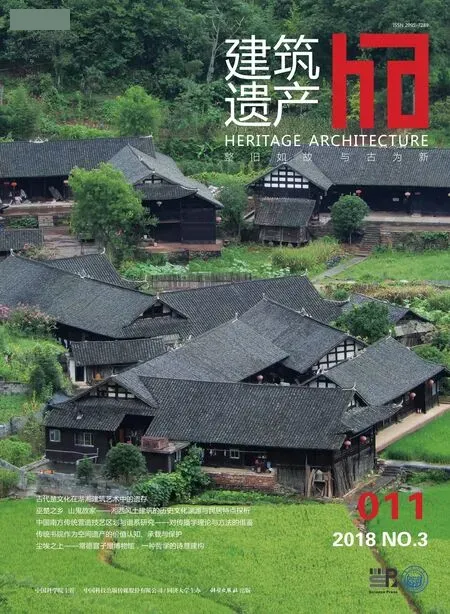
Miluo, located in Hunan Province in China, is the place where the famous patriotic poet Qu Yuan committed suicide by wading into the Miluo River.The government of Miluo has planned to construct a complex of memorial buildings for Qu Yuan.Given that Professor Chang Qing is supervising the building of the Quzi Academy under this project, the theme of ‘Vernacular Architecture in the Huxiang Area’, which explores the contemporary meanings of this ancient architecture, was selected for this issue ofHeritage Architecture.
An examination of vernacular architecture in the Huxiang area must be grounded in a study of the Chu culture, as Hunan was part of the Chu state in ancient times, and Qu Yuan’s poems are representative of this culture.Most of the articles in this issue focus on the relationship between Chu culture and the vernacular architecture in the Huxiang area, which is analysed from different perspectives.Whereas the geographical concept of Huxiang is clear, from a cultural perspective, the popular perception that Huxiang culture is the same as the local culture of Hunan is inaccurate.In fact, Hunan’s culture can be categorised into sub-cultures corresponding to distinct historical phases, each demonstrating different characteristics.Consequently, they cannot be packed together into the unitary concept of Huxiang culture.
Hunan is located at the border separating the Han settlement in the central plains and the settlements of ethnic minorities in southern China (nanman), with early Chu culture evolving as a hybrid of the cultures of these two distinct groups.Though the Chu state existed only during the era of the Western and the Eastern Zhou dynasties, its cultural influence endured throughout the era of the Eastern Han and the Three Kingdoms, and its decline was not evident until the onset of the Sui and Tang dynasties.Because of its remote location, Hunan developed more slowly than areas in the central plains.Famous poets of the Tang Dynasty who stayed in Hunan were in relegation, indicating that Hunan was still poor and undeveloped during this period.
The acceleration of Hunan’s development began in the era of the Song Dynasty.During this period, the central plains were subject to persistent invasions by tribes from the north—first the Liao, followed, successively, by the Jin, the Western Xia, and the Mongolians.Because a state of war frequently prevailed in the central plains, the political, economic and cultural centre shifted southward in conjunction with the migration of the population.Consequently, Hunan advanced considerably to become an economic and cultural hub within southern China.Phrases like ‘the harvest of Hu and Guang feeds the whole world’ and ‘Dongting the land of fish and rice’ became widespread during this period.The bookWenxiantongkao Xuexiaokaorecords testify to this flourishing culture and education, revealing that two out of the four major academies of the Song Dynasty were located in Hunan and that most of the academies across the entire country were in Jiangxi, Zhejiang and Hunan.Four out of the five Wuyue Mountains, which symbolised national unity, were lost during this period, leaving only Nanyue (the southern mountain) in Hunan under the control of the central government.For this reason, Nanyue became a religious centre in southern China, where both Buddhists and Daoists gathered.Zhou Dunyi, the founder of neo-Confucianism, was born in Hunan, and the philosophical theories of the Huxiang School were prominent.Strictly speaking, Huxiang culture began during this period, and the phase of Chu culture should not be termed Huxiang culture, even though it also belonged to the Huxiang area.
Because of the distinctiveness and long duration of the history and culture of the Huxiang area, its customs and architecture are of particular interest.It is plausible that its remote location accounts for the endurance of ancient relics of art and civilisation in towns and villages in the Huxiang area.Bygone ancestral halls and temples and traditional villages reflecting different styles all emanate from the particular vernacular culture that evolved in the Huxiang area, reflecting its mystique.As our surviving cultural heritage, these relics are deserving of our best efforts devoted to their study and conservation.(Translated by Gu Xinyi, proofread by Li Yingchun)