Innovative Technology Turns Bamboo Forests into Valuable Assets
2018-05-21 16:39:52BystaffreporterLIUYI
CHINA TODAY 2018年4期
By staff reporter LIU YI
BAMBOO, an indigenous plant of China, has been eulogized for thousands of years as a symbol of virtuous and noble character in the country. For Lou Yiping, World Bamboo Ambassador awarded by the World Bamboo Organization, bamboo provides a way of reducing poverty and combating climate change.
Dr. Lou is the director of the Center for China-Africa Agriculture and Forestry Research (CAFOR) at Zhejiang Agriculture and Forest University. He began to work on bamboo in 1984 after graduation. He first worked on bamboo forest management and ecology at the Chinese Academy of Forestry. In 1999 he joined the International Network for Bamboo and Rattan (INBAR), the first-ever intergovernmental organization headquartered in China, researching the plants on a much wider scope – environmental benefits, sustainable operation, forest certification, community-based sustain- able development, poverty reduction, and biodiversity conservation.
In 2012 Lou was nominated director of the CAFOR, which was co-founded by Zhejiang Agriculture and Forest University and INBAR, aiming to promote agricultural science and technology from China to African countries to help local people get rid of poverty, especially by using bamboo resources.
Lou turned to research on bamboos role in combating climate change by increasing carbon sequestration in bamboo forests around the year 2002. After 15 years of arduous work, Lou and his team made breakthroughs in four key technologies in calculating bamboo forests capacity in carbon sequestration, stabilization, and emission reduction. They also researched on the measuring methods and characteristic parameters of bamboo forests as carbon sinks, and created five methodologies in this field that have become national and international standards. Their achievements have ironed out kinks holding back the bamboo forest carbon sink from entering the carbon trade market.
In January 2018 the innovative technologies of bamboo forest carbon sink monitoring and emission reduction won Lou and his team the second prize of the 2017 National Scientific and Technological Progress Awards.
A Primary Productive Force
“To have a stronger nation and a better life, the key is advanced science and technology,” said President Xi Jinping at the National Scientific Innovation Conference in 2016. The bamboo forest carbon sink monitoring and emission reduction technology brings real economic benefits to farmers.
Bamboo is a kind of woody grass, with about 1,400 species in the world and 500 species in China. A close relative of rice and wheat, it has a short growth cycle with high output and economic value. Some kinds of bamboo shoots could grow to be one-meter-high young bamboo overnight, and grow into full size within a couple of months and mature in no more than three to five years to be ready for logging.
Bamboo is widely used as construction material, containers boarding, flooring, paper making, and daily necessities like chopsticks and toothpicks. New industries such as bamboo fiber products, healthy food, and tourism also saw rapid growth in recent years. As bamboo is thin and elastic, it needs manual labor during its primary processing, said Lou, who has engaged in bamboo value chain development for rural communities. The labor-intensive industry provides abundant job opportunities for poor rural communities in the forest regions, he said.
In the context of climate change, however, bamboo goes far beyond traditional economic significance. The evergreen plant has deep, well developed rhizome-root systems that render it having a good soil fixation capacity. This property allows bamboo to effectively prevent soil erosion, help protect natural forests and biodiversity. Bamboo grows well in different elevations, climates, and land forms, so it also helps to increase the volume of forest resources and as a best substitute to wood products to reduce the pressure of timber consumption from natural forests.
These characteristics in mitigating climate change serve as the foundation of Lous award-winning technology, which, in short, aims to tap the potential market values of bamboo forests as carbon sink through scientific accounting and monitoring methodologies.
Carbon sink refers to forests function of capturing carbon dioxide and storing it in soil and plants, so as to reduce the density of greenhouse gases and mitigate global climate change. In light of the theory, the international carbon trade system has been established. It was confirmed by the United Nations Framework Convention on Climate Change (UNFCCC) and the Kyoto Protocol, and came into effect in 2005. Each country has been allocated with a corresponding quota of carbon dioxide emission. The one exceeding its own quota needs to buy quota from other countries.
For its great potential in carbon sequestration, bamboo forest is the most likely type of forest to access the emission reduction market. Lack of related technologies, however, impeded access, which in turn hindered the development of bamboo forest carbon market.
The aforementioned situation and problems underscore the value of Lou and his teams innovation. The team verified the characteristics of the bamboo forest as a carbon source and a carbon sink, and calculated the carbon reserve and spatial allocation. The research systematically clarifies the disputes on bamboo forests role in carbon sequestration, making it clear that they are a huge potential and capacity of carbon sink. For the first time in the world, the team raised five key methodologies, getting round the bottleneck of bamboo forests entering the carbon trade market.
The methodologies effectively bridge international rules with the real market. A gateway has been built for traditional bamboo planting to enter the carbon market. In 2015, Chinas first bamboo forest carbon sink was established in Tongshan, Hubei Province, which generated 194,000 tons certified emission reduction. Lou and his team also helped five counties in Zhejiang Province develop more than 20,000 hectares of bamboo forest carbon sink, which led to a total of 4.3 million tons certified emission reduction. Lous team also facilitated the establishment of Chinas first forestry carbon sink experiment zone and the worlds first bamboo forest carbon sink pilot zone respectively in Linan and Anji of Zhejiang Province, which have also entered the carbon trade market.
Planting bamboo could get extra income through the carbon trade system, while economic benefits will attract more companies and organizations to participate. It is expected to develop an amplifying link between the economy, society, ecological security, and sustainable development.
International Poverty Alleviation
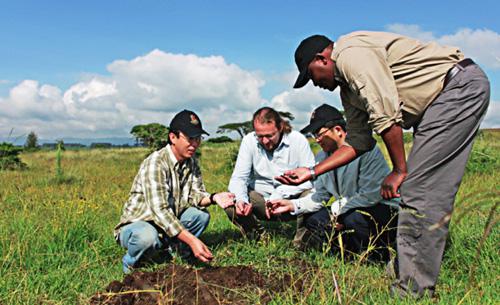
Bamboo forests carbon accounting and monitoring technologies have been promoted in Zhejiang, Anhui, Fujian, Jiangxi, and other main bamboo producing areas in China. They have also been introduced to other countries like Ethiopia and Kenya as an important way of international aid.
Worldwide, the area of bamboo forests totals 32 million hectares, and there are three main bamboo producing regions – China and Southeast Asia, South America, and Africa. In terms of bamboo utilization and processing, China leads the world, as the biggest bamboo products exporter. As of 2015, accord- ing to incomplete statistics, the output value of the Chinese bamboo industry stood at RMB 200 billion (US $30.8 billion). This is why the INBAR set up its headquarters in China. It celebrated its 20th anniversary in 2017, receiving a congratulatory message from Chinese President Xi Jinping.
Under-utilization is the root of the lack of recognition of bamboos value. For example, in the African continent, as many as 36 countries have natural bamboo forests with a total area of 1.5 million hectares, most of which, however, are overlooked and never developed. Besides funding shortages, these countries dont have national policies or strategic plans on using bamboo resources to start up and coordinate the development between governmental and private sectors. Farmers also need necessary training and capacity building. Therefore, it is impossible to create a value chain from farmers to the market.
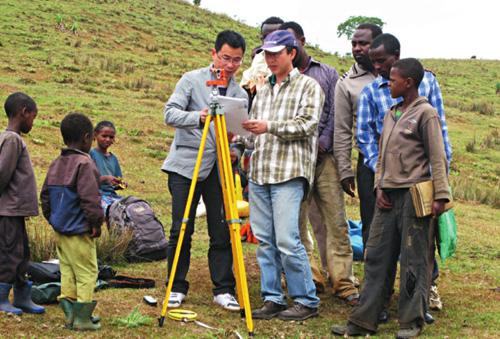
As director of the Center for ChinaAfrica Agriculture and Forestry Research, Lou has actively participated in international cooperation, includ- ing designing the bamboo industry development roadmap for Rwanda, Kenya, and Cameroon. The Rwandan government attached great importance to the bamboo industry in recent years. With financial support from the EU, UN Food and Agricultural Organization, and the African Development Bank, Lous team carried out field investigations and got a clear picture of the status quo and problems. They then formulated a 10-year strategic policy and five-year action plan for Rwanda, as well as drafted specific documents that are required for related research and pilot projects.
In 2014 Lou carried out country-specific research on the African agricultural and forestry resources, industrial chains, and policies, a project sponsored by Chinas Ministry of Agriculture and Ministry of Science and Technology. The research provided information and technological support for the nations aid policy makers, and also for companies who are likely to invest in Africa.
Since the Belt and Road Initiative was put forward, Lou and his team have expanded research and training to 31 countries along the Belt and Road, including Southeast Asian countries like East Timor, Vietnam, and Bhutan. Through field research and holding training sessions, Lou and his team made strenuous efforts in planning and developing the bamboo industry for these countries.
Traditionally, bamboo has been a raw material in China, and an underutilized plant in Africa. But scientific and technological advancement turns it to a commodity that benefits farmers and facilitates sustainable development of society. Because of science and technological innovation, green hills and clear waters can attain the same if not more value than precious metals as gold and silver in the days of old.