
北京天橋藝術中心,北京,中國
2018-05-25 09:51:18黃捷
世界建筑 2018年5期
北京天橋藝術中心項目周邊環境比較獨特,與往常設計的觀演類建筑不同。一般的地方性劇場和文化中心大部分選址于自然環境優美的新區或者周邊環境具獨特優勢的舊城區,周邊環境對設計的限制性不高。而天橋項目選址于北京城的中軸南端,地處代表著天橋百年文化的城市中心區域,結合著北京的中軸線申遺計劃,該項目代表的不僅是地方性的建筑,更是一個建筑與一座城的文化思考,設計具時代的責任感。
歷史上的“老天橋”是北京傳統民俗文化的經典代表,在中國非物質文化遺產中占重要地位。然而,隨著城市的演變,天橋絕活銷聲匿跡。我們的設計愿景正是在城市的演變過程中恢復“老天橋”獨有的文化魅力,將當地的文化與民俗特色相互交融。設計通過建筑空間手法,以地域文化特色反映城市改變及現代性,增進民俗文化的交流,讓更多的天橋絕活得以重生,重現天橋民俗盛景。
天橋藝術中心主要建設內容包括1600座大劇場、1000座中劇場、400座小劇場、300座多功能廳4個核心藝術劇場。觀演建筑功能獨特、技術復雜、專業繁多,在設計上有一定的技術共通性;但我們更希望在設計每一個作品時發掘其地域文化的獨特性。同時,在設計中建立建筑與城市之間的結構關系,通過藝術文化的手法打造市民樂于共享的城市公共空間。□
項目信息/Credits and Data
設計團隊/Design Team: 李敏茜,黃皓山,許菲茵,梁耀昌,戴卓,黃泰赟,邊建烽,符景明,李衛勇,莊信,李源波,張慎,羅志焱,田小婷,葉軍王,紅玉,倪毅,陳廣權,譚秉廉,曾愈安,呂章建,葉曼蓉/LI Minqian,HUANG Haoshan, XU Feiyin, LIANG Yaochang, DAI Zhuo,HUANG Taiyun, BIAN Jianfeng, FU Jingming, LI Weiyong,ZHUANG Xin, LI Yuanbo, ZHANG Shen, LUO Zhiyan, TIAN Xiaoting, YE Junwang, HONG Yu, NI Yi, CHEN Guangquan,TAN Binglian, ZENG Yu'an, LYU Zhangjian, YE Manrong
建筑面積/Floor Area: 75,000m2
建成時間/Completion: 2015.07
攝影/Photos: 張廣源/ZHANG Guangyuan

1 天橋內街入口/Tianqiao inner street entrance
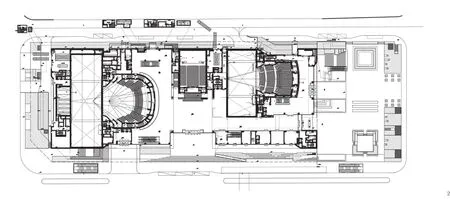
2 首層平面/Ground fl oor plan
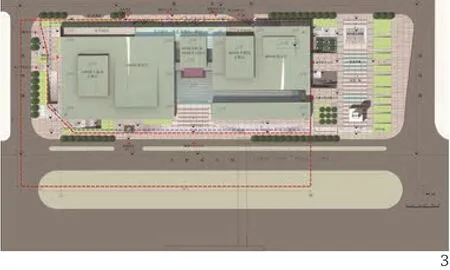
3 總平面/Site plan

4 東南主入口/Main entrance

5 外景/Exterior view

6 剖面/Sections

7 剖面/Sections
The surrounding environment of the Beijing Tianqiao Art Centre project is unique and different from performance-oriented buildings conventionally designed. Most of the local theatres and cultural centres are located in new districts with beautiful natural environment or in the old urban areas with unique advantages in surrounding environment.And the surrounding environment does not restrict design. The Tianqiao Project is located at the southern end of the central axis of Beijing City and the urban centre represents centuries-old culture of Tianqiao, combined with Beijing Axis Plan for the Development of the Middle East Area. The project represents not only the local architecture but also a re fl ect of the culture of a city. It's a design combining a sense of responsibility with the times.
The history of "Old Tianqiao" is a classic representative of the Beijing traditional custom culture, plays an important role in China's intangible cultural heritage. However, with the evolution of the city, Tianqiao skills vanished. Our design vision is restored in the evolution of the city and the "Old tianqiao" unique traditional cultural.The design successfully recreates the city landscape of the site, approach to reflect traditional cultural characteristics of urban change and modernity.
The project houses a 1600-seat theatre,a 1000-seat theatre, a small theatre in multipurpose halls and four core theatres. The building has unique features with complex technology, and many specialties. While it has certain technical commonality, we also hope to explore the uniqueness of its regional culture. In the design, the structural relationship between buildings and cities is established, and with art and culture, the public space that the citizens are willing to share is created.□
猜你喜歡
湖北教育·綜合資訊(2022年4期)2022-05-06 22:54:06
金橋(2022年2期)2022-03-02 05:42:50
北方建筑(2021年6期)2021-12-31 03:03:54
文苑(2020年10期)2020-11-07 03:15:36
現代裝飾(2020年6期)2020-06-22 08:43:12
小天使·一年級語數英綜合(2018年9期)2018-10-16 06:30:16
讀者·校園版(2018年13期)2018-06-19 06:20:12
Coco薇(2016年2期)2016-03-22 16:58:59
讀者(2016年7期)2016-03-11 12:14:36
少兒科學周刊·兒童版(2015年6期)2015-11-24 03:49:38
