
Observation on lower-reinforcing and upperreducing acupuncture method for hyperplasia of mammary gland and its influence on estradiol and progesterone
2018-06-28 09:27:58WangYafang王亞芳ZhangYan張琰LuWang魯望SunChenping孫霃平ShenHanbing沈含冰GuoMenghu郭夢虎ZhaoHaiyin趙海音
Wang Ya-fang (王亞芳), Zhang Yan (張琰), Lu Wang (魯望), Sun Chen-ping (孫霃平), Shen Han-bing (沈含冰),Guo Meng-hu (郭夢虎), Zhao Hai-yin (趙海音)
1 Longhua Hospital, Shanghai University of Traditional Chinese Medicine, Shanghai 200032, China
2 School of Acupuncture and Tuina, Shanghai University of Traditional Chinese Medicine, Shanghai 201203, China
Hyperplasia of mammary gland (HMG) pertains to Ru Pi (nodules of breast) in traditional Chinese medicine. It is the most common breast diseases and often affects both sides. Normally, HMG has a long duration and a high relapse rate. It is clinically manifested as breast lump and pain, accompanied by agitation and irritability,soreness and aching pain in waist and knees, dizziness,tinnitus, and dysmenorrhea. The lumps are scattered,the distending pain is periodic and associated with menstruation and emotions. HMG causes severe impact on women’s health, thus it is crucial to seek a safe and effective treatment for HMG. Our study observed the clinical effect of lower reinforcing and upper reducing acupuncture method for HMG and its influence on estradiol (E2) and progesterone (P). The report is now given as follows.
1 Clinical Materials
1.1 Diagnosis criteria
Conforming to the modifiedDiagnosis and Clinical Efficacy Evaluation Criteria for Hyperplasia of Mammary Glandstipulated at the Eighth Meeting of the Mammary Gland Diseases Committee, China Traditional Chinese Medicine Surgery Association (2002)[1].
Symptoms and signs: Distending, stabbing or dull pain that radiates to the axilla or shoulder-back region;related to menstruation or emotion change; with a duration of consecutive 3 months or intermittent 3-6 months without alleviation; single or multiple lumps with varied sizes or shapes on one or bilateral sides, and the lump can disperse to the whole breast and show no obvious border, but without adhesion to deep tissues;lump is movable and may hurt after palpation; lump can change with menstruation and emotion; may be accompanied by nipple discharge or itching.
Exclusion items: Breast development in children before the first menstruation, gynecomastia and malignant tumor of breast.
Assistant examination: Molybdenum target X-ray,B-ultrasonography, fiber optic ductoscopy of mammary gland, fine needle aspiration cytology or histological examination or infrared thermal imaging scan.
Diagnosis can be made with one of the items in symptoms and signs and without exclusion items, and also with the help of the assistant examination.
1.2 Inclusion criteria
Conforming to the diagnostic criteria above; aged between 20-55 years; informed consent and good compliance.
1.3 Exclusion criteria
Being diagnosed with mastitis, benign or malignant tumor of mammary gland or benign mammary gland tumor alone; complicated condition which cannot determine the pattern; during gestation or lactation or having severe irregular menstrual periods or functional uterine bleeding; with severe organic diseases of heart,liver, kidney or hemopoietic system; with mental disorders; used hormone agents within the past half a year; gynecomastia or breast development in children before the first menstruation.
1.4 Statistical methods
All data were analyzed with SPSS version 18.0 software. Measurement data conforming to normal distributionxwere described as mean ± standarddeviation (±s), paired samplet-test was used for intra-group comparison, and independent samplet-test was used for between-group comparison; data not conforming to normal distribution were described as median (interquartile range) [M(IQR)], and nonparametric test was used for comparison. Rank-sum test was used for between-group comparison. Chi-square test was used for non-ratio comparison. APlevel less than 0.05 indicated a statistical significance.
1.5 General data
A total of 124 HMG patients who applied to join the trial between January 2014 and December 2016 were included, and all cases were bilateral onset. The patients all conformed to the inclusion criteria and were diagnosed by B-ultrasonography. The patients were aged between 22 and 50 years with a disease duration of 3 months to 10 years. They were randomized by random number table into a treatment group and a control group, with 62 cases in each group. The differences in general data between the two groups showed no statistical significances (allP>0.05),indicating that the two groups were comparable(Table 1).
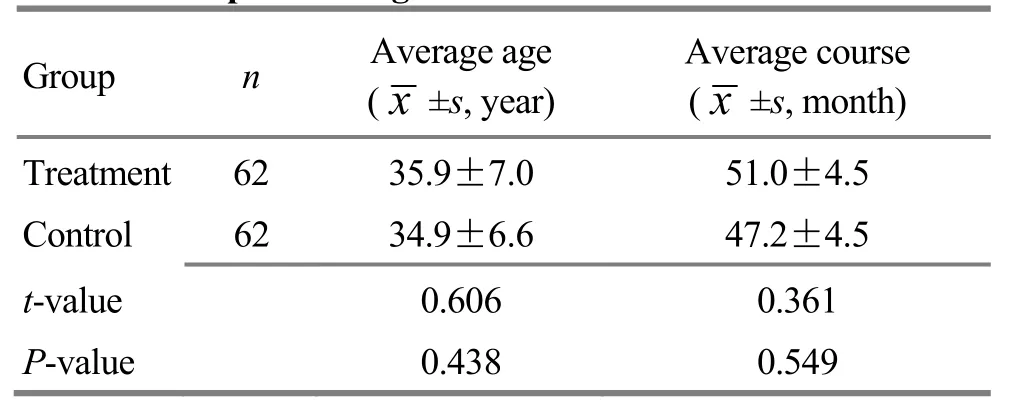
Table 1. Comparison of general data
2 Treatment Methods
2.1 Treatment group
Acupoints: Jianjing (GB 21), Danzhong (CV 17),Zhongwan (CV 12), Qihai (CV 6), Guanyuan (CV 4),Sanyinjiao (SP 6), Taixi (KI 3) and Taichong (LR 3).
Method: Patients took a supine position and exposed the manipulation area. After routine sterilization,filiform needles of 0.25 mm in diameter and 40 mm in length were used. The practitioner used the right hand for manipulation. Applied transverse insertion method to Danzhong (CV 17) to insert 0.5 cun and perpendicular insertion to Zhongwan (CV 12) to insert 0.8 cun. Upon qi arrival, applied open-closed and twirling reducing method, in which thumb rotated backward and index finger rotated forward, and the method was done for several times. During manipulation, took a large rotating angle, a heavy force and a high frequency, and waggled handle to expel qi at needle withdrawal. Then perpendicularly punctured Qihai (CV 6) and Guanyuan (CV 4) for 0.8 cun. Upon qi arrival, took even reinforcing-reducing manipulation,namely performing mild lifting-thrusting and twirling methods for several times with the same range of rotation. Then perpendicularly punctured Sanyinjiao(SP 6) and Taixi (KI 3) for 0.5 cun, and obliquely punctured Taichong (LR 3) for 0.5 cun. At qi arrival, took open-closed and twirling reinforcing manipulations,namely rotating thumb forward and index finger backward for several times during twirling with the right hand. Took a small range, light force and low frequency manipulation. Then pressed the hole with a dry cotton ball immediately after withdrawing the needle. The reinforcing and reducing methods were done following qi arrival and the needles were retained for 20 min, and the manipulation was done at the moment when qi arrived, 10 min during retaining and before needle withdrawal respectively for a total of 3 times.
2.2 Control group
Acupoints: Same acupoints as in the treatment group.
Methods:Used the same needles as in the treatment group. Took even reinforcing-reducing manipulation upon qi arrival, and retained the needles for 20 min.The manipulation was done at the moment when qi arrived, 10 min during retaining and before needle withdrawal respectively for a total of 3 times.
Patients in both groups started treatment about 10 d before menstruation (for those who had irregular period, started the treatment 10 d after the last menstruation), and the treatment was done 20 min each time, every other day. Took 5 times of treatment in each menstruation for consecutive three menstruation cycles, for a total of 15 times.
3 Therapeutic Efficacy Evaluation
3.1 Observation items
3.1.1 E2and P levels
The levels of E2and P were tested in both groups.
Schedule for the first test: After inclusion and before treatment, during 1-3 d after the last menstruation cycle.
Schedule for the second test: After the whole treatment was finished, during 1-3 d after the last menstruation cycle.
All tests were done at about 9 a.m. at empty stomach after a 30-minute rest. The venous blood of patients was collected by personals in the Laboratory Department in our hospital and was used for examination.
3.1.2 Degree and score of breast pain
The breast pain severity was graded and scored according to the following criteria.
Level 0 (6 points): no pressing or spontaneous pain;level 1 (12 points): pressing pain without spontaneous pain; level 2 (18 points): spontaneous pain, mainly premenstrual and paroxysmal onset; level 3 (24 points):persistent spontaneous pain, without affecting normal life; level 4 (30 points): persistent spontaneous pain,radiating to axilla or shoulder-back region, affecting normal life.
3.1.3 Degree and score of lump
The hardness of lump was graded and scored according to the following criteria.
Level 1 (3 points): soft like normal gland; level 2 (6 points): tough like the tip of the nose; level 3 (9 points):hard like forehead.
The lump scale was graded and scored according to the following criteria.
1 quadrant of breast was scored 1.5. Level 1 (3 points):limited to quadrant 1 and 2; level 2 (6 points): reached quadrant 3 and 4; level 3 (9 points): reached quadrant 5 and 6; level 4 (12 points): reached quadrant 7 and 8.
The lump size (the maximum diameter of the lump)was graded and scored according to the following criteria.
Level 1 (3 points): <2 cm; level 2 (6 points): 2.1-5 cm.3.1.4 Grading for the systemic concomitant score
Grading for the emotion change. Invalid: 3 points;improved: 2 points; back to normal: 1 point.
Grading for menstruation disorder. Invalid: 3 points;improved: 2 points; back to normal: 1 point.
Grading for soreness of waist and knees. Invalid: 3 points; improved: 2 points; back to normal: 1 point.
Grading for hypochondrium distention. Invalid: 3 points; improved: 2 points; back to normal: 1 point.
Grading for blood stasis symptom. Invalid: 3 points;improved: 2 points; back to normal: 1 point.
The total symptoms score was the aggregation of the breast pain score, lump grading and systemic concomitant scores. The total score ranged from 20 to 72 points, and a higher score indicated a more serious condition.
3.2 Therapeutic efficacy evaluation
The therapeutic efficacy evaluation criteria in this study were based on theCriteria of Diagnosis and Therapeutic Effects of Diseases and Syndromes in Traditional Chinese Medicine[2]and theDiagnosis and Clinical Efficacy Evaluation Criteria for Hyperplasia of Mammary Glandstipulated at the Eighth Meeting of the Mammary Gland Diseases Committee, China Traditional Chinese Medicine Surgery Association(2002)[1]. The total score was used to calculate the improvement rate and for therapeutic efficacy evaluation.
Improvement rate = (Total score before treatment -Total score after treatment) ÷ Total score before treatment × 100%.
Cure: The improvement rate ≥90%.
Marked effect: The improvement rate ≥70%, but<90%.
Effective: The improvement rate ≥30%, but <70%.Invalid: The improvement rate <30%.
3.3 Results
3.3.1 The total score of breast pain, lump and systemic concomitant symptoms
After treatment, the scores of breast pain, lump and systemic concomitant symptoms in both groups dropped obviously when compared with those before treatment, and intra-group comparisons showed statistical significances (allP<0.01); after treatment, the D-value of total score in the two groups showed a statistical significance, indicating a better improvement in the treatment group (Table 2).
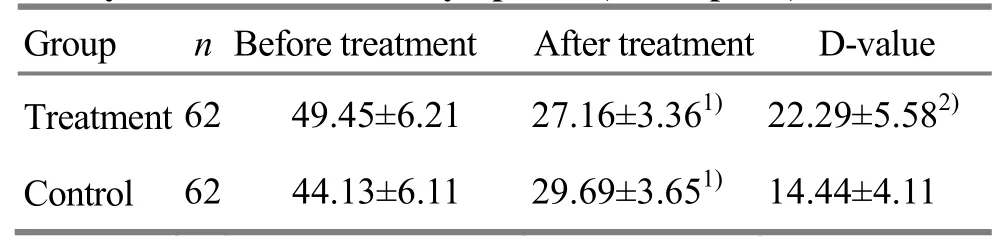
Table 2. Comparison of the total score of breast pain, lump and systemic concomitant symptoms (x±s, point)
3.3.2 Clinical efficacy
After treatment, the total effective rate was 91.9% in the treatment group, obviously higher than 72.6% in the control group, and the between-group comparison showed a statistical significance (P<0.01), (Table 3).
3.3.3 Levels of E2, P and E2/P value
Before treatment, most HMG patients’ E2and P levels did not exceed the normal range or were even lower than normal. After treatment, the levels of E2, P and E2/P value of HMG patients in both groups showed no statistical significance when compared with those before treatment (P>0.05), (Table 4).

Table 3. Comparison of the clinical efficacy (case)

Table 4. Comparison of the levels of E2, P and E2/P value [M (IQR)]
4 Discussion
HMG pertains to Ru Pi (nodules of breast) in traditional Chinese medicine. The basic pathogenesis is over- thought harming the spleen, over-anger harming the liver and qi stagnation. The onset of HMG is closely related to emotion change, affecting the liver and spleen. Some scholars hold that the axis of kidney qi-Tian Gui-Conception and Thoroughfare Vesseluterus-breast is a female physical regulation system,and kidney qi works as the center, influencing the development of HMG[3-4]. Modern researches and clinical experiences have shown that HMG patients are deficiency in root and excess in manifestations, and the deficiencies of kidney, Conception Vessel and Thoroughfare Vessel act as the root; liver depression, qi stagnation, blood stasis and congealing phlegm are the manifestations, which usually coexist and interact as both cause and effect. Based on visceral and channel theory, the main organs linking with HMG are liver and kidney, and the main meridians are the Conception and Thoroughfare Vessels[5-9].
Modern medicine holds that HMG is connected with imbalance of sex hormones, and regulated by hypothalamic-pituitary-ovarian axis.
Our previous study has investigated the infrared thermal specialty of HMG-related acupoints[10-16],revealing that the acupoints in HMG patients of different patterns were in different deficiency-excess states. The infrared thermal temperature of HMG patients showed a decreasing tendency from proximal to distal part. The temperature of acupoints on trunk including Danzhong (CV 17), Qimen (LR 14), Zhongwan(CV 12), Qihai (CV 6), and Guanyuan (CV 4) was higher than that in normal people, and the temperature of acupoints on lower limbs including Taixi (KI 3) and Taichong (LR 3) was lower than that in normal people.Such results indicated that HMG patients were in an upper-excess and lower-deficiency state. Therefore, we chose acupoints including Danzhong (CV 17), Zhongwan(CV 12), Qihai (CV 6), Guanyuan (CV 4), Taichong (LR 3),Taixi (KI 3) and Sanyinjiao (SP 6) in this study. Based on the treatment principle of treating the deficiency by reinforcing and treating the excess by reducing, we used open-closed and twirling reducing manipulations at Danzhong (CV 17) and Zhongwan (CV 12), and even reinforcing-reducing manipulation at Qihai (CV 6) and Guanyuan (CV 4), and open-closed and twirling reinforcing manipulations at Sanyinjiao (SP 6), Taixi (KI 3)and Taichong (LR 3). We also took the ordinary treatment as the control to compare the clinical efficacy.The result showed that lower-reinforcing and upper-reducing method can improve clinical symptoms and signs in HMG patients, and the clinical efficacy of such method was superior than that of even reinforcing-reducing manipulation.
Hormone changes in animal experiment may not be consistent with that in HMG patients, because animal experiment usually uses man-made model stimulated by hormones or other exterior methods, and the elevated E2level may be caused by exterior factors[17-20].To observe the relationship between HMG and levels of E2and P and E2/P value, we tested such indicators before and after treatment. The result showed that the hormone levels of HMG patients were in normal range before treatment. After treatment, hormone levels showed no obvious change. Therefore, hormone imbalance is the mechanism of HMG animal model, and the regulation of hormone levels is one of the treatment approaches. While in real life, a large number of HMG patients have a normal menstruation and their hormone levels are also in a normal range. Therefore,HMG symptoms may not be caused by hormone imbalance alone. Abnormal sensitivity to hormone or other factors in HMG patients’ mammary gland might be the mechanism. Therefore, acupuncture treatment can reduce lump and pain in HMG patients, while it showed no obvious regulating effect on hormone levels.So, the condition of HMG may not be directly related to the levels of E2and P and E2/P value. The occurrence,development and outcome of HMG may be related to the sensitivity of mammary gland to E2and P. The mechanism of acupuncture treatment may not be connected with the regulation of the levels of E2and P and E2/P value, but with the adjustment of qi and blood,and decrease the sensitivity of mammary gland to E2and P. Thus, a further investigation is required to reveal the mechanism of acupuncture for the treatment of HMG.
Moreover, there were no cured or marked effect cases after treatment in the two groups, and the possible reason may be the short treatment course. The whole treatment course was 3 menstruation cycles (15 times). The primary clinical effects were mainly manifested as alleviation of breast pain and systematic concomitant symptoms. Lumps tended to soften while not decreased in size. Therefore, the insignificant changes in lump size further accounted for the low improvement rate and the failure to reach the criteria of cured or marked effect. Thus, a longer course of treatment is needed in further research to better evaluate the clinical efficacy of acupuncture treatment for HMG.
Conflict of Interest
The authors declared that there was no potential conflict of interest in this article.
Acknowledgments
This work was supported by the Project of Shanghai Education Commission (上海市教委項目, No.2014YSN34); National Basic Research Program of China(973 Program, 國家重點基礎研究發展計劃項目, No.2015CB554505).
Statement of Informed Consent
Informed consent was obtained from all individual participants in this study.
Received: 15 September 2017/Accepted: 16 October 2017
[1] Lin Y, Tang HJ. Contemporary Mastology in Traditional Chinese Medicine. Beijing: People’s Medical Publishing House, 2003: 101-109.
[2] State Administration of Traditional Chinese Medicine.Criteria of Diagnosis and Therapeutic Effects of Diseases and Syndromes in Traditional Chinese Medicine. Nanjing:Nanjing University Press, 1994: 131-132.
[3] Tian Y, Lin Y. Treatment of mammary hyperplasia from meridian differentiation. Xiandai Zhongxiyi Jiehe Zazhi,2005, 14(11): 1417-1419.
[4] Bi LJ. Regulating Chong Vessel and Conception Vessel in treating cystic hyperplasia of breast. Gansu Zhongyi, 2010,23(5): 30-31.
[5] Wang SW, Zhang JQ. The key of treating hyperplasia of mammary gland is on supplementing kidney. Hebei Zhongyi, 2007, 29(7): 607.
[6] Ma JP. Explore the way of treatment of hyperplasia of mammary glands through treating insufficiency of kidney yang. Zhejiang Zhongyi Zazhi, 2005, 40(2): 50-51.
[7] Zhang Q. Experience of Pan Li-qun with treating hyperplasia of mammary gland by supplementing kidney,fortifying spleen and harmonizing stomach methods.Zhongguo Yiyao Zhinan, 2010, 8(21): 107-108.
[8] Wen H, Pan LQ. Summary of clinical experience in treating hyperplasia of mammary gland. Guangming Zhongyi, 2010, 25(3): 376-377.
[9] Li JZ, Fu J, Fan YH. Acupuncture on Qihai (CV 6) in the treatment of various diseases caused by qi dysfunctions.Shaanxi Zhongyi, 2006, 27(6): 711-712.
[10] Wang YF, Shen XY, Ying J, Zheng JJ, Hu SF, Zhao L,Deng HP, Zhang HM. Pathologic analysis on hyperplasia of mammary gland with different syndromes based on infrared radiation temperature of acupoints. J Traditional Chin Med, 2012, 32(3): 382-387.
[11] Zheng JJ, Zhao Y, Wang YF, Hu SF, Lu P, Shen XY. The infrared radiation temperature characteristic of acupoints of mammary gland hyperplasia patients. Evid-based Compl Alt Med, 2013, 2013: 567987.
[12] Ying J, Shen XY, Ding GH, Chen HF, Zhang HM, Shen CP,Hu SF. Study on surface infrared radiation spectrums of Danzhong (CV 17) in the patient of hyperplasia of mammary glands. Zhongguo Zhen Jiu, 2008, 28(7): 499-502.
[13] Feng XX, Ge LB, Shen XY, Shang YY, Sun CP, Hu SF,Ying J. Study on surface infrared radiation spectrum of Guanyuan (CV 4) in the patients with different syndromes of hyperplasia of mammary glands. Liaoning Zhongyi Zazhi, 2011, 38(9): 1714-1716.
[14] Ying J, Shen XY, Ding GH, Cheng YQ, Zhang HM, Shen CP, Hu SF. Compare the infrared radiation spectrum of Qimen (LR 14) with non-acupoint of patients with hyperplasia of mammary gland. Liaoning Zhongyi Zazhi,2008, 35(8): 1145-1147.
[15] Huang JH, Xia QG, Feng XX, Ge LB, Shen XY, Hu SF,Ying J. Study on surface infrared radiation spectrum of Guanyuan (CV 4) between breast cancer patients after mastectomy and patients with hyperplasia of mammary glands. Zhonghua Zhongyiyao Xuekan, 2012, 30(9): 1948-1950.
[16] Ying J, Shang YY, Li H, Chen HF, Hu SF, Sun CP, Shen XY. Body surface infrared radiation spectrum at the acupoints in patients with hyperplasia of mammary glands.Nanjing Zhongyiyao Daxue Xuebao, 2010, 26(3): 174-177.
[17] Zhang RP, Zhai HW. Clinical observation on treatment of hyperplasia of mammary gland for the influence on E2and P level. Zhongguo Yiyao Daokan, 2013, 15(S): 119-120.
[18] Jing RX, Liang LH, Li X, Xiao HL, Zhang SC, She YF.The effect of Weici combined with electric acupuncture on the expression levels of E2/P, prolactin, testosterone, ER and mammary gland tissue morphous in rats with mammary gland hyperplasia. Hebei Yiyao, 2014, 36(7):965-968.
[19] Yin XQ, Wang YC, Tu Q, Huang YJ, Huang WB, Jin T,Zhou JL. Effects of different acupuncture point selections of moxibustion on hormone levels in rats with mammary gland hyperplasia. Hubei Zhongyiyao Daxue Xuebao, 2015,17(6): 4-7.
[20] Bai DY, Yi W, Li YH, Wang SX, Liu C, Liao MX. Effect of Chinese medicine point application on estrogen receptor and progesterone receptor expression in experimental rat model with hyperplasia of mammary glands. Guangzhou Zhongyiyao Daxue Xuebao, 2016, 33(6): 827-830.
 Journal of Acupuncture and Tuina Science2018年3期
- Journal of Acupuncture and Tuina Science的其它文章
- Influence of acupuncture on pulmonary function of patients with asthma: a review
- Clinical observation on electroacupuncture at four sacral points for overactive bladder syndrome
- Clinical observation on electroacupuncture plus hydro-acupuncture for low back pain caused by compression fractures
- Observation on clinical efficacy of warm needling therapy for chronic lumbar strain
- Observation on clinical effects of acupuncture plus external medicine application forcervical radiculopathy
- Effect of acupoint sticking at Shenque (CV 8) for preventing spleen-stomach disharmony caused by venous analgesia pump