Measuring liquid-phase diffusion coefficient of aqueous sucrose solution using double liquid-core cylindrical lens
2018-09-03 02:57:56SONGFangxiMENGWeidongXIAYanCHENYanPUXiaoyun
中國(guó)光學(xué) 2018年4期
關(guān)鍵詞:擴(kuò)散系數(shù)測(cè)量
SONG Fang-xi, MENG Wei-dong,3, XIA Yan, CHEN Yan, PU Xiao-yun,2*
(1.Department of Physics and Astronomy,Yunnan University,Kunming 650091,China;2.International Joint Research Center for Photoelectronics Energy Materials,>Yunnan University,Kunming 650091,China;3.Key Laboratory of Quantum Information of Yunnan Province,Kunming 650091,China)
Abstract: Based on the consideration of the high resolution of the spatial resolution of the refractive index of the double liquid-core cylindrical lens(DLCL), the liquid-phase diffusion coefficients of different concentrations of aqueous sucrose solution are measured at room temperature(25 ℃) using two methods. Method 1:equivalent RI(refractive index) method is used to calculate the liquid phase diffusion coefficient by recording the time-dependent change of a specific refractive index layer during diffusion. Method 2:instantaneous diffusion analytical method is used to determine the liquid diffusion coefficient by reading the relationship between image width and diffusion position in an instantaneous diffusion image. The front liquid core of the DLCL serves as a diffusion cell and a main imaging element, and the rear liquid core serves as an aplanatic auxiliary system. The spherical aberration at a particular thin liquid layer can be reduced as needed with a DLCL, and the spherical aberration advantage within a certain range of refractive index can also be reduced. Both methods have the characteristics of high measurement accuracy. The relative errors between the measured results and the literature values of the two methods are less than 1.3% and 3.9%, respectively, indicating that the measurement system is stable and reliable and the measurement results are accurate when the liquid-phase diffusion coefficient is measured with a DLCL.
Key words: double liquid-core cylindrical lens;diffusion coefficient;diffusion imaging;spherical aberration;refractive index
1 Introduction
引 言
The diffusion coefficient is an important basic data for the study of mass transfer process, calculation of mass transfer rate, and chemical design and development. It is widely used in fields of chemical, pharmaceutical, food, biological and environmental protection fields[1-4]. Since the average distance between liquid molecules is much smaller than that of gas molecules, and the liquid molecules do not have regular arrangments like solids, the theoretical description and experimental measurement of the liquid phase diffusion coefficient are far more difficult than gas and solids. The liquid phase diffusion data of different systems is quite lacking[5-6]. At present, the liquid phase diffusion coefficient is mainly obtained by experimental methods. By measuring the concentration-dependent spatial and temporal distribution of the solution due to the diffusion process, the liquid phase diffusion coefficient is calculated according to Fick′s law[7]for describing the diffusion process. From the experimental method to measure the diffusion coefficient, the diaphragm pool method[8], optical interference method[9]and Taylor dispersion method[10]are widely used. In addition, measurement methods such as nuclear magnetic resonance[11], dynamic light scattering[12], fluorescent molecular tracing[13]and radioactive element tracing[14]can also be used. Diaphragm cell method[8]is a classical steady-state measurement method. This method measures the initial and steady state solution concentrations in the upper and lower parts of the diffusion cell, so the measurement time is longer.Optical interference method[9]measures interference fringes formed when target light and reference light meet in space, and inverts the spatial and temporal distribution information of diffusion solution concentration carried by the target light through fringes. The measurement accuracy of this method is high, but its requirements for the experimental environment are extremely demanding. The Taylor dispersion method[10]is to inject trace solute into the solvent flowing in the capillary. The solute diffuses in the solvent to form a Gaussian distribution of the solution concentration along the capillary axis. The diffusion coefficient is calculated by measuring the concentration distribution curves at different times. The method is fast, but the measurement accuracy is low. The NMR method[11]has the characteristics of anti-interference, fast speed,etc., but it is only suitable for measuring some special substances. The dynamic light scattering method[12]is suitable for the measurement of the diffusion coefficient of a polymer solution. There are other methods such as fluorescent molecular tracing[13]and radioactive element tracing[14]. However, they are not widely used. In order to solve these problems, according to the imaging principle of the liquid-core cylindrical lens focal plane, we proposed the equivalent RI(refractive index) method[15-16]and the instantaneous diffusion image analytical method[16-17]to measure the liquid-phase diffusion coefficient by analyzing the diffusion image. Spherical aberration is the main factor influencing the imaging quality of diffused images. The ability of the DLCL[18]to reduce the spherical aberration improves the imaging quality of the diffused image,and it is the key to accurately measure the liquid-phase diffusion coefficient. The front liquid core of the DLCL serves as a diffusion cell and the main imaging element, and the rear liquid core serves as an aplanatic auxiliary system[19-20]. In this paper, DLCL is used to reduce the spherical aberration at certain thin liquid layers as needed, and it can reduce the advantage of spherical aberration within a certain refractive index range. In this paper, the diffusion coefficients of different concentrations of aqueous sucrose solution at room temperature(25 ℃) are measured by combining the above two methods.
擴(kuò)散系數(shù)是研究傳質(zhì)過(guò)程、計(jì)算傳質(zhì)速率及化工設(shè)計(jì)與開發(fā)的重要基礎(chǔ)數(shù)據(jù),廣泛應(yīng)用于化工、醫(yī)藥、食品、生物及環(huán)保等領(lǐng)域[1-4]。由于液體分子的平均間距遠(yuǎn)比氣體分子小, 又不及固體那樣有規(guī)則排列, 所以液相擴(kuò)散系數(shù)的理論描述和實(shí)驗(yàn)測(cè)量遠(yuǎn)比氣體及固體困難, 不同體系的液相擴(kuò)散數(shù)據(jù)相當(dāng)缺乏[5-6]。目前,液相擴(kuò)散系數(shù)主要依靠實(shí)驗(yàn)方法獲得,通過(guò)測(cè)量溶液由于擴(kuò)散過(guò)程形成的濃度隨空間和時(shí)間的分布,根據(jù)描述擴(kuò)散過(guò)程的Fick定律[7]計(jì)算出液相擴(kuò)散系數(shù)。從測(cè)量擴(kuò)散系數(shù)的實(shí)驗(yàn)方法來(lái)看,廣泛采用的是膜池法[8]、光干涉法[9]和泰勒分散法[10]。此外,還有核磁共振[11]、動(dòng)態(tài)光散射[12]、熒光分子示蹤[13]和放射性元素示蹤[14]等測(cè)量方法。膜池法[8]是一種經(jīng)典的穩(wěn)態(tài)測(cè)量法,需要測(cè)量擴(kuò)散池上下兩個(gè)部分初始及穩(wěn)態(tài)時(shí)的溶液濃度,測(cè)量時(shí)間較長(zhǎng)。光干涉法[9]是測(cè)量目標(biāo)光和參考光在空間相遇時(shí)形成的干涉條紋,通過(guò)條紋反演出目標(biāo)光攜帶的擴(kuò)散溶液濃度的空間和時(shí)間分布信息,該方法的測(cè)量精度較高,但其對(duì)實(shí)驗(yàn)環(huán)境的要求極為苛刻。泰勒分散法[10]是將微量溶質(zhì)注入在毛細(xì)管中流動(dòng)的溶劑中,溶質(zhì)在溶劑中的擴(kuò)散形成溶液濃度沿毛細(xì)管軸向的高斯分布,通過(guò)測(cè)量不同時(shí)刻濃度的分布曲線計(jì)算出擴(kuò)散系數(shù),該方法測(cè)量速度快,但測(cè)量精度較低。核磁共振法[11]具有抗干擾,測(cè)速快等特點(diǎn),但只適用于測(cè)量一些特殊物質(zhì)。光散射法[12]適用于測(cè)量高分子溶液的擴(kuò)散系數(shù)。另外,還有熒光分子示蹤[13]和放射性元素示蹤[14]等方法,但它們的使用并不廣泛。為了解決這些問(wèn)題,我們根據(jù)液芯柱透鏡焦平面成像原理,提出了等折射率薄層移動(dòng)法[15-16]和瞬態(tài)圖像分析法[16-17],通過(guò)分析擴(kuò)散圖像測(cè)量液相擴(kuò)散系數(shù)。球差是影響擴(kuò)散圖像成像質(zhì)量的主要因素,雙液芯柱透鏡(DLCL)[18]減小球差的能力提高了擴(kuò)散圖像的成像質(zhì)量,是精確測(cè)量液相擴(kuò)散系數(shù)的關(guān)鍵。DLCL的前液芯作為擴(kuò)散池和主要成像元件,后液芯作為消球差輔助系統(tǒng)[19-20]。本文利用DLCL可以按需減小特定液體薄層處的球差以及能夠在一定的折射率范圍內(nèi)同時(shí)減小球差的優(yōu)勢(shì),結(jié)合兩種方法分別測(cè)量了室溫(25 ℃)下不同濃度蔗糖水溶液的擴(kuò)散系數(shù)。
2 Experimental setup
實(shí)驗(yàn)裝置
The experimental setup is shown in Fig.1. Monochromatic parallel light(center wavelengthλ=589 nm) is normally incident on the DLCL after slit width limiting. The front liquid core of the DLCL serves as a diffusion cell and the main imaging element, and the rear liquid core serves as an abatement assistant system. As an image acquisition system, a CMOS industrial camera is fixed on a one-dimensional electronic displacement stage with a minimum division value of 1 μm and connected to a computer. The diffusion process can be observed on a computer in real time.
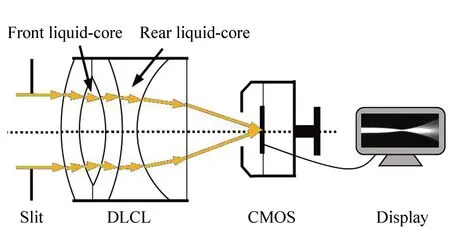
Fig.1 Schematic diagram of the experimental setup 圖1 實(shí)驗(yàn)裝置圖
實(shí)驗(yàn)裝置如圖1所示。單色平行光(中心波長(zhǎng)λ=589 nm)經(jīng)狹縫限寬后垂直入射到DLCL上,DLCL的前液芯作為擴(kuò)散池和主要成像元件,后液芯作為消球差輔助系統(tǒng)。CMOS工業(yè)相機(jī)作為圖像采集系統(tǒng),固定在一個(gè)最小分度值為1 μm的一維電子位移臺(tái)上并與計(jì)算機(jī)相連,在計(jì)算機(jī)上可實(shí)時(shí)觀測(cè)擴(kuò)散過(guò)程。
3 Measuring principle
測(cè)量原理
3.1 Imaging principle
成像原理
The imaging principle is shown in Fig.2. A single solution with a refractive index ofniis injected into the front liquid core of DLCL, and a liquid with refractive indexn′ is injected into the rear liquid core. The monochromatic parallel light passes through the lens perpendicular to theZaxis and the CMOS in the image focal plane of the cylindrical lens system will acquire a sharp focal line parallel to theZaxis, as shown in Fig.2(a). Two different refractive index solutions are injected in the front liquid core one after another. After diffusion, the liquid forms a concentration gradient distribution of the refractive index along the axis of the cylindrical lens. Select a thin liquid layer refractive indexnc, move CMOS to the image focal plane of the thin layer of refractive index, after the monochromatic parallel light passes through the cylindrical lens system, CMOS will collect a “beam waist” like diffusion image, as shown in Fig.2(b). On the imaging plane, only the thin layer of liquid corresponding to the refractive indexni=ncis clearly imaged; when the refractive indexni=n1
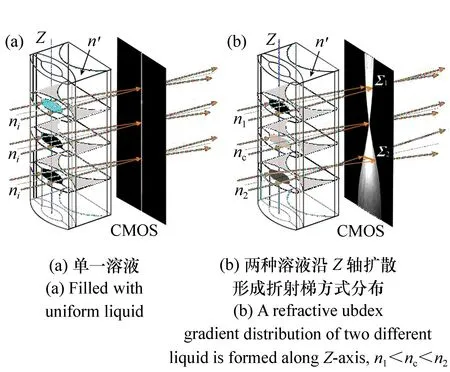
Fig.2 Imaging principle of DLCL 圖2 雙液芯柱透鏡成像原理圖
成像原理如圖2所示。在DLCL的前液芯中注入折射率為ni的單一溶液,后液芯注入折射率為n′的液體,單色平行光垂直于Z軸通過(guò)透鏡后,位于柱透鏡系統(tǒng)像方焦平面的CMOS將采集到一條平行于Z軸的明銳焦線,如圖2(a)所示。在前液芯內(nèi)先后注入兩種不同折射率的溶液,經(jīng)擴(kuò)散后,液體沿柱透鏡軸向形成折射率的某種濃度梯度分布。選定某一液體薄層折射率nc,移動(dòng)CMOS到該折射率薄層的像方焦平面上,單色平行光經(jīng)過(guò)柱透鏡系統(tǒng)后,CMOS將采集到“束腰”狀的擴(kuò)散圖像,如圖2(b)所示。在成像平面上只有折射率ni=nc對(duì)應(yīng)的液體薄層處清晰成像;當(dāng)折射率ni=n1
3.2 Method for calculating the spatial distribution of refractive index
折射率空間分布的計(jì)算方法
The refractive index of the front liquid core of DLCL isni, the refractive index of the rear liquid core isn′, and the focal length of the cylindrical lens system isfi. Based on the Gaussian formula of paraxial imaging,fiandnisatisfy the following recurrence relations[21-22]:
DLCL的前液芯液體折射率為ni,后液芯液體折射率為n′,柱透鏡系統(tǒng)的焦距為fi,基于近軸成像高斯公式,fi和ni滿足如下遞推關(guān)系[21-22]:
(1)

(2)

(3)

(4)

(5)
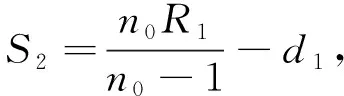
(6)
WhereRianddiare defined as shown in Fig.3,R1=|R4|=45.0 mm,R2=|R3|=27.9 mm,R5=21.5 mm,R6=∞, respectively represent the curvature radius of the DLCL glass surfaces;d1=d4=4.0 mm,d2=d3=3.0 mm,d5=3.2 mm,d6=12.0 mm respectively represent the distance between each surface of the lens and the distance from each surface to the center of the lens; the solid lens that makes up DLCL is K9 glass, the refractive indexn0=1.516 3. The focal length is measured by experiment. Substituting it into formulas (1)-(6), the refractive indexniof the liquid to be measured in the front liquid core can be inversely solved.
式中,Ri及di的定義如圖3所示,R1=|R4|=45.0 mm,R2=|R3|=27.9 mm,R5=21.5 mm,R6=∞,分別表示DLCL各玻璃曲面的曲率半徑值;d1=d4=4.0 mm,d2=d3=3.0 mm,d5=3.2 mm,d6=12.0 mm,分別表示透鏡各個(gè)面之間及距透鏡中心的距離;組成DLCL的固態(tài)透鏡材料為K9玻璃,折射率n0=1.516 3。用實(shí)驗(yàn)方法測(cè)量出焦距fi,代入式(1)~(6)即可反解出前液芯中待測(cè)液體的折射率ni。
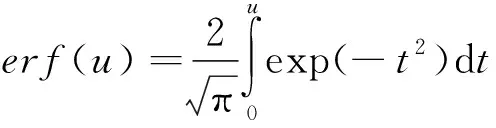
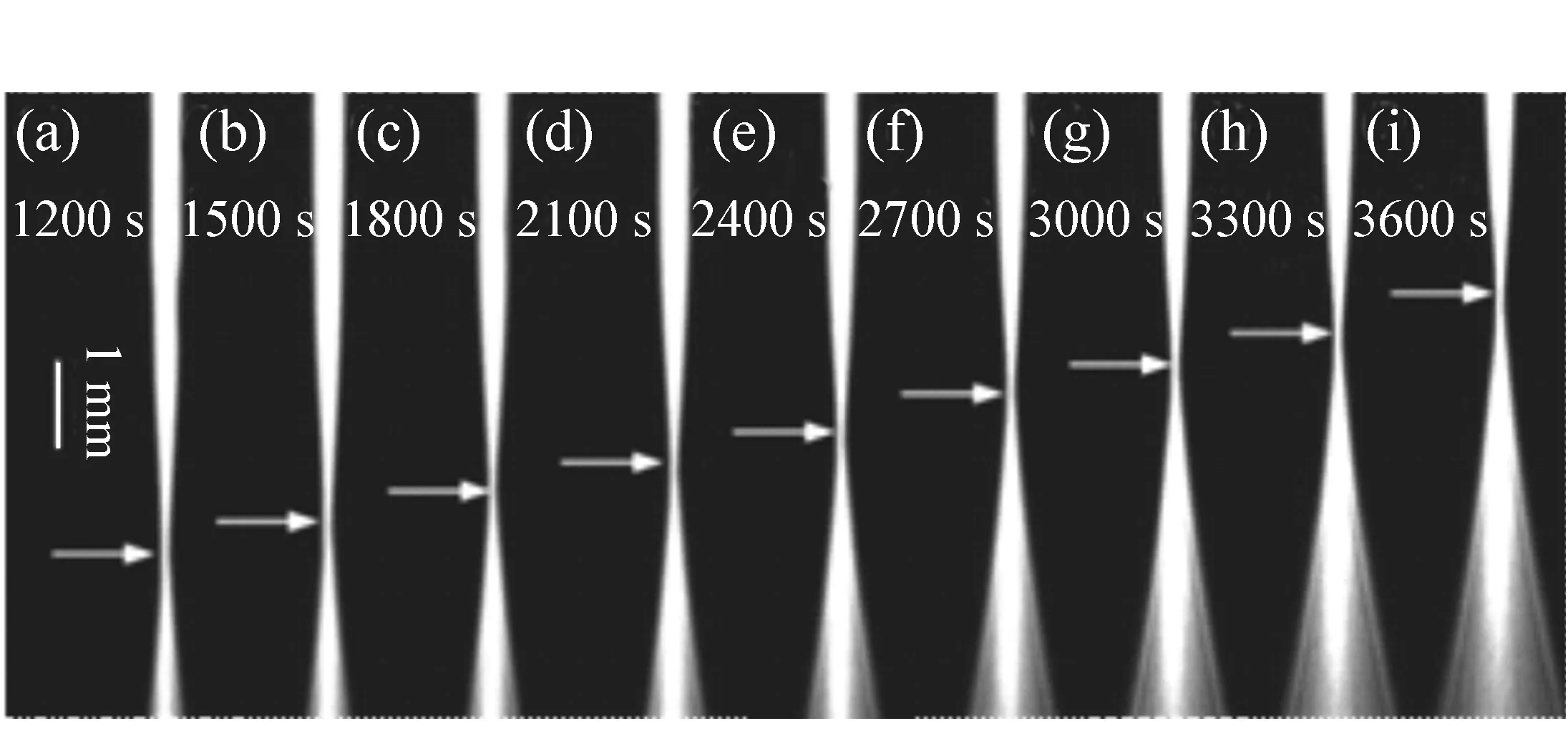
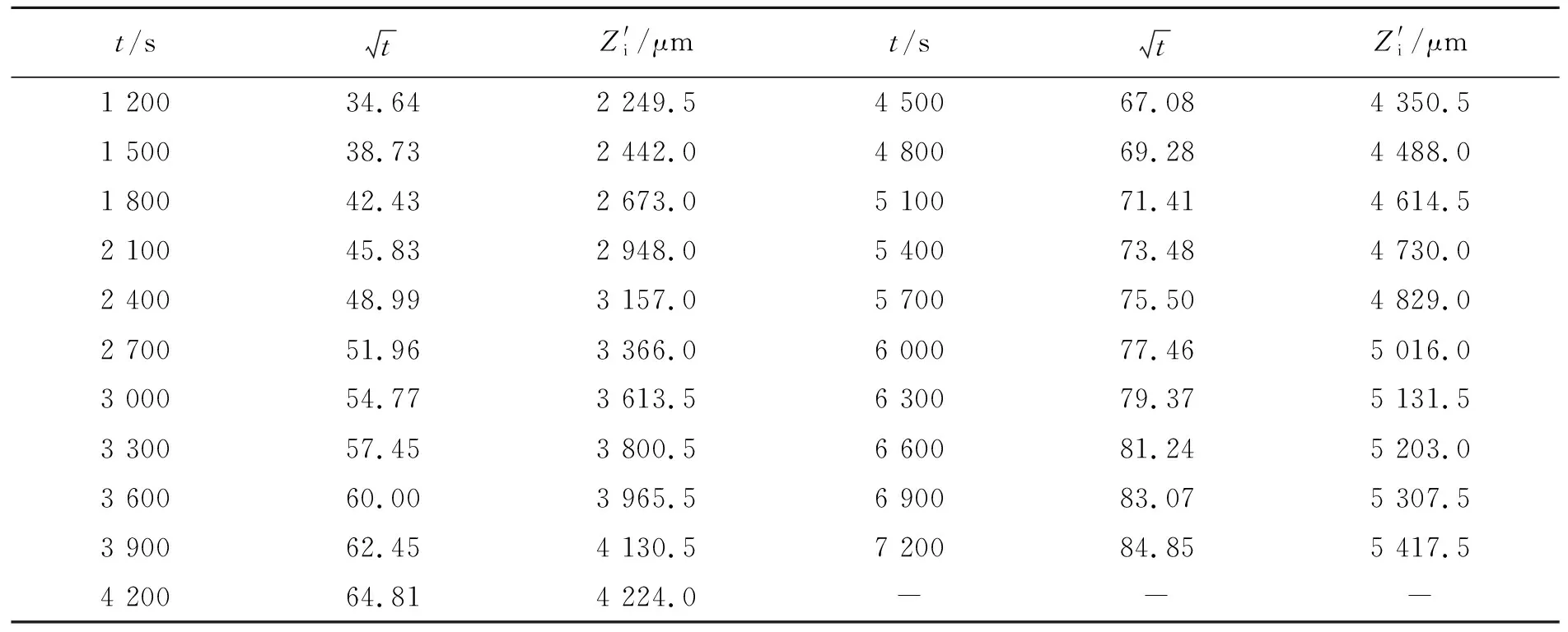
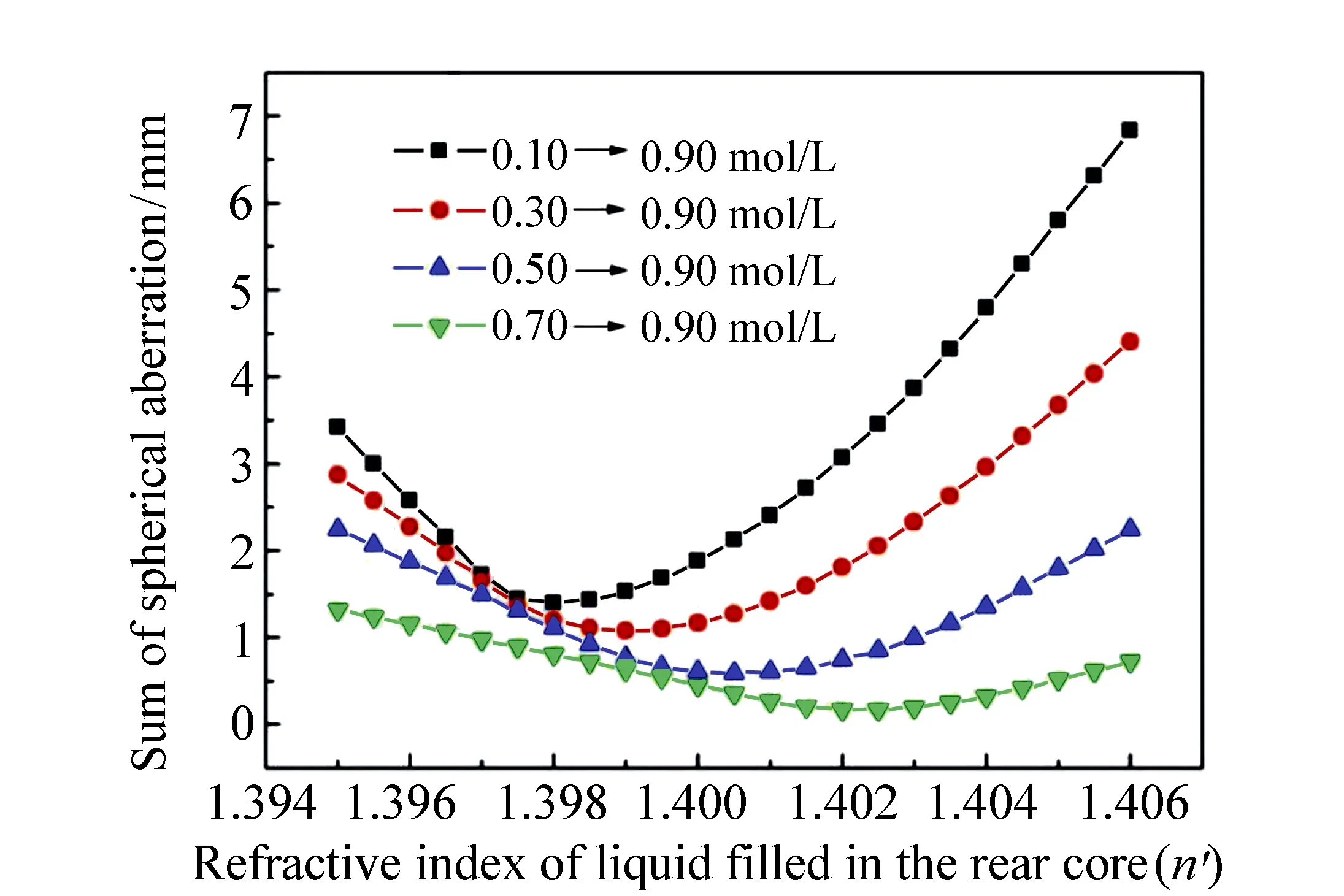
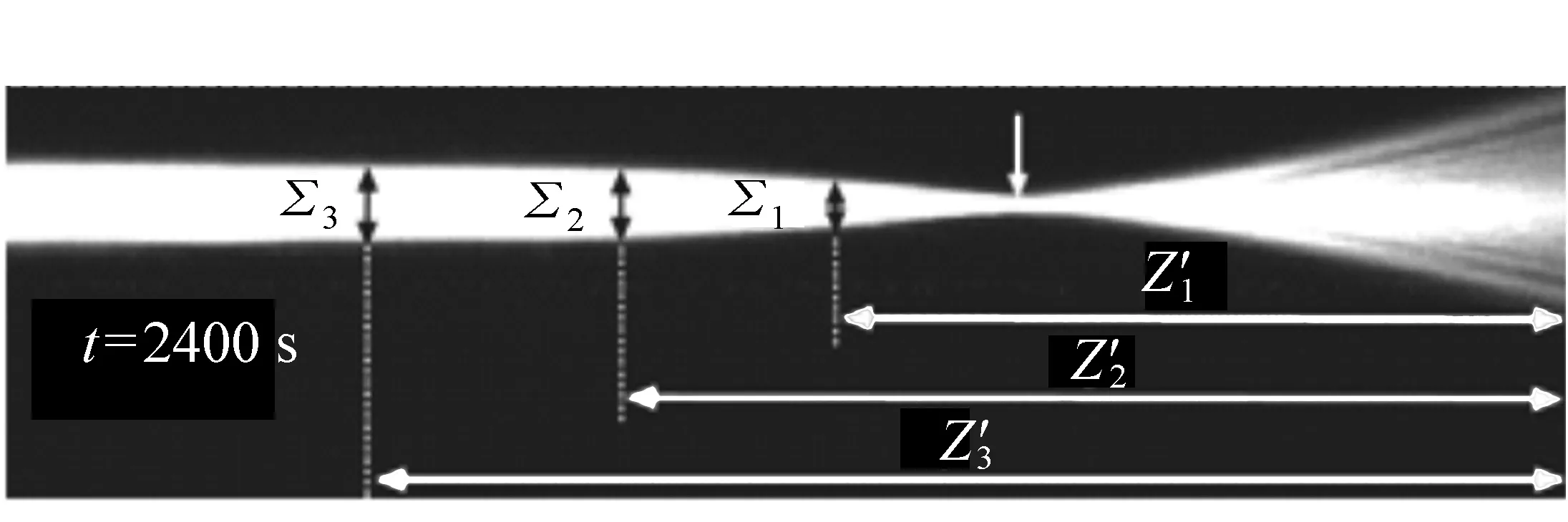
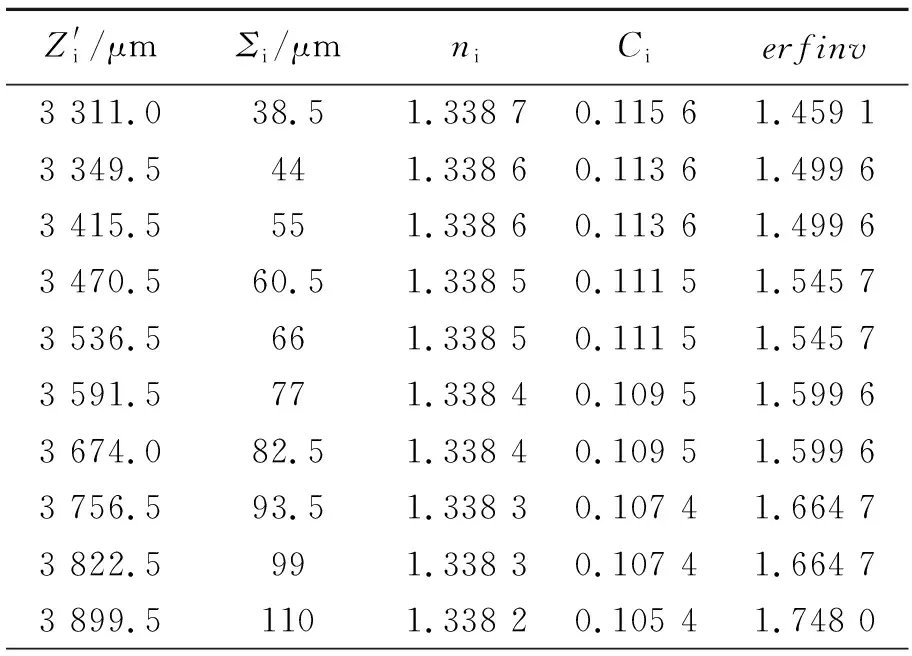
Taking “under focus” imaging as an example, a top view of the DLCL imaging light path is shown in Fig.3. When monochromatic parallel light with a width ofhpasses through the cylindrical lens system perpendicularly and if the refractive index of the thin liquid layer isni=nc, the monochromatic parallel light passes through the cylindrical lens and is clearly imaged on the imaging plane. The focal length of the cylindrical lens system isfc; When the refractive index of the thin liquid layerisni Fig.3 Top view of DLCL and corresponding imaging light path 圖3 雙液芯柱透鏡及其成像光路俯視圖 以“欠聚焦”成像為例,DLCL成像光路俯視圖如圖3所示。當(dāng)寬度為h的單色平行光垂直通過(guò)柱透鏡系統(tǒng),液體薄層折射率ni=nc時(shí),單色平行光經(jīng)柱透鏡后在成像平面上清晰成像,柱透鏡系統(tǒng)焦距為fc;液體薄層的折射率ni (7) The widthΣiof a certain position of an image is measured by an experimental method, and the focal lengthfiof the corresponding thin liquid layer can be calculated according to formula (7). Substitutingfiinto formulas (1)-(6), the refractive indexniof the thin liquid layer can be calculated. 由實(shí)驗(yàn)方法測(cè)量出圖像某一位置的寬度Σi,即可根據(jù)式(7)算出對(duì)應(yīng)液體薄層的焦距fi,將fi代入式(1)~(6)即可算出液體薄層的折射率ni。 液相擴(kuò)散系數(shù)的計(jì)算方法 The diffusion of the two solutions along the cylindrical lens axis(Z-axis) is considered as a one-dimensional free diffusion process, assuming that the two diffusion solutions are A and B respectively, and the concentration of A in B isC, and the diffusion process ofCalongZaxis follows Fick′s second law[7]: 將兩種溶液沿柱透鏡軸向(Z軸)的擴(kuò)散看做一維自由擴(kuò)散過(guò)程,假設(shè)兩種擴(kuò)散溶液分別為A和B,A在B中的濃度為C,C沿Z軸的擴(kuò)散過(guò)程遵循Fick第二定律[7]: (8) WhereC(Z,t) represents the concentration atZat timet, andDis the diffusion coefficient. Before diffusion(t<0), the initial concentrations of the two solutions at both sides of the contact interface(Z=0) areC1andC2, respectively, and the solution of equation (8) satisfies: 式中,C(Z,t)表示t時(shí)刻位置Z處的濃度,D是擴(kuò)散系數(shù)。擴(kuò)散開始前(t<0),兩種溶液在接觸界面(Z=0)兩邊的初始濃度分別是C1和C2,式(8)的解滿足: (9) (10) 3.3.1 Equivalentrefractive index thin layer transfer method 等折射率薄層移動(dòng)法 For a fixed diffusion system, the time from the start of diffusion to the recording of a certain diffuse image is denoted ast. The inverse error function 對(duì)一固定擴(kuò)散體系,從擴(kuò)散開始到記錄某一幅擴(kuò)散圖像的時(shí)間記為t。選定折射率為nc的液體薄層后,反誤差函數(shù) (11) 3.3.2 Refractive index spatial distribution instantaneous method 折射率空間分布瞬態(tài)法 (12) 測(cè)量結(jié)果與分析 The diffusion coefficients of aqueous sucrose solution of 0.10, 0.30, 0.50 and 0.70 mol/L are measured at room temperature. First, different concentrations of aqueous sucrose solution are prepared, and the refractive index is measured with Abbe refractometer. The linear relationship between the aqueous sucrose concentration and the refractive index is fitted:C=f(n)=20.5082n-27.3387, linear correlation coefficient isR2=0.999 9. 實(shí)驗(yàn)測(cè)量了室溫下濃度分別為0.10、0.30、0.50和0.70 mol/L的蔗糖水溶液的擴(kuò)散系數(shù)。首先配置不同濃度的蔗糖水溶液,用阿貝折射儀測(cè)量其折射率,擬合出蔗糖水溶液濃度和折射率之間滿足線性關(guān)系:C=f(n)=20.5082n-27.3387,線性相關(guān)系數(shù)R2=0.999 9。 等折射率薄層法測(cè)量結(jié)果 For the equivalent refractive index thin layer method, it is necessary to collect a plurality of diffusion images within a certain diffusion time, and the diffusion coefficient is calculated by recording the relationship of the focal position with time. Accurate judgment of the position of the clear imaging point of the thin layer of this refractive index is required by this method, and it is also required to reduce the spherical aberration at the thin layer of the refractive index. After the diffusion solution is injected into the front liquid core of DLCL and a refractive index thin layer (close to the refractive index of the liquid to be measured[23]) is selected, the relationship between the spherical aberration of the DLCL system and the refractive index of the rear liquid core is calculated at different refractive index thin layers. The calculation result is shown in the following figure. 等折射率薄層法需要在一定的擴(kuò)散時(shí)間內(nèi)采集多幅擴(kuò)散圖像,通過(guò)記錄焦點(diǎn)位置隨時(shí)間的變化關(guān)系計(jì)算擴(kuò)散系數(shù)。此方法需要準(zhǔn)確判斷折射率薄層清晰成像點(diǎn)的位置,要求在該折射率薄層處減小球差。在DLCL的前液芯中注入擴(kuò)散溶液,選定折射率薄層(靠近待測(cè)液體折射率[23])后,計(jì)算不同折射率薄層處DLCL系統(tǒng)球差與后液芯液體折射率的關(guān)系,計(jì)算結(jié)果如圖4所示。 Fig.4 Relationship between the refractive index thin layer spherical aberration and the refractive index of the rear liquid core 圖4 不同折射率薄層球差與后液芯液體折射率的關(guān)系 The diffusion coefficients of aqueous sucrose solution of 0.10, 0.30, 0.50 and 0.70 mol/L are measured. The selected thin layers of refractive index are 1.3387, 1.3481, 1.3580, and 1.3676, respectively. If the calculated system spherical aberration is the minimal, the refractive index of the corresponding rear liquid core is 1.3973, 1.3973, 1.3985, and 1.4008, respectively. 測(cè)量濃度分別為0.10、0.30、0.50和0.70 mol/L蔗糖水溶液的擴(kuò)散系數(shù),所選定的折射率薄層分別為1.338 7、1.348 1、1.358 0和1.367 6,計(jì)算得到系統(tǒng)球差最小時(shí),對(duì)應(yīng)的后液芯液體折射率分別為1.397 3、1.397 3、1.398 5和1.400 8。 Taking the diffusion coefficient of a 0.10 mol/L aqueous sucrose solution as an example, a 25 mm-high 0.90 mol/L aqueous sucrose solution is slowly injected with a digital syringe in the front liquid core of the DLCL and allowed to stand for 600 s to reduce liquid disturbance. Then, 0.10 mol/L aqueous sucrose solution is slowly injected, and corresponding best aplanatic liquid(n′=1.397 3) is injected into the rear liquid core. Adjust the displacement platform of the CMOS imaging system so that it is located on the focal plane of the selected thin liquid layer(nc=1.338 7). In order to reduce the effect of turbulence on the measurement of the liquid diffusion coefficient, a diffusion image is to be collected every 300 s after standing for 1 200 s. The diffusion image of 0.10-0.90 mol/L aqueous sucrose solution is shown in Fig.5(only some experimental images are listed). 以測(cè)量0.10 mol/L蔗糖水溶液的擴(kuò)散系數(shù)為例,在DLCL的前液芯中,用數(shù)字注射器緩慢注入25 mm高的0.90 mol/L蔗糖水溶液,靜置600 s以減小液面擾動(dòng)后,再緩慢注入0.10 mol/L蔗糖水溶液,后液芯注入對(duì)應(yīng)的最佳消球差液體(n′=1.397 3)。調(diào)節(jié)CMOS成像系統(tǒng)位移平臺(tái),使其位于所選液體薄層(nc=1.338 7)的焦平面上,為了減小紊流對(duì)測(cè)量液相擴(kuò)散系數(shù)的影響,靜置1 200 s后每隔300 s采集一幅擴(kuò)散圖像。0.10→0.90 mol/L蔗糖水溶液的擴(kuò)散圖像如圖5所示(僅列出部分實(shí)驗(yàn)圖像)。 Fig.5 Diffusion images of 0.10→0.90 mol/L aqueous sucrose solution 圖5 0.10→0.90 mol/L蔗糖水溶液擴(kuò)散圖像 Tab.1 Data record of equivalent refractive index location over time With this method, the diffusion coefficients of other aqueous sucrose solutions is measured. The results are shown in Tab.2. 用此方法測(cè)量其他濃度蔗糖水溶液的擴(kuò)散系數(shù),結(jié)果如表2所示。 Tab.2 Data of the equivalent refractive index method of aqueous sucrose solution for different concentrations 瞬態(tài)法測(cè)量結(jié)果 For instantaneous method, a diffusion image at a certain moment is acquired, and the liquid-phase diffusion coefficient is quickly calculated by recording the width characteristics of the image at different locations. The experimental error of this method is mainly caused by the influence of spherical aberration on the image width, so it is necessary to reduce the spherical aberration over the entire refractive index range of the diffusion system. The diffusion solution is injected into the front liquid core of DLCL. Based on the refractive index range of the liquid of the front liquid core, the relationship between the sum of the spherical aberration of the DLCL system and the refractive index of the rear liquid core is calculated. The calculation results are shown in the following figure. 瞬態(tài)法只需在某一時(shí)刻采集一幅擴(kuò)散圖像,通過(guò)記錄不同位置處圖像的寬度特征快速計(jì)算出液相擴(kuò)散系數(shù)。此方法的實(shí)驗(yàn)誤差主要由球差對(duì)圖像寬度的影響造成,所以要求在擴(kuò)散體系的整個(gè)折射率范圍內(nèi)減小球差。在DLCL的前液芯中注入擴(kuò)散溶液,根據(jù)前液芯液體的折射率范圍,計(jì)算不同擴(kuò)散體系DLCL系統(tǒng)球差之和與后液芯液體折射率的關(guān)系,計(jì)算結(jié)果如圖6所示。 Fig.6 Relationship between the sum of spherical aberrations of different diffusion systems and the refractive index of the rearliquid core 圖6 不同擴(kuò)散體系球差之和與后液芯液體折射率的關(guān)系 The refractive index ranges of 0.10→0.90 mol/L, 0.30→0.90 mol/L, 0.50→0.90 mol/L and 0.70→0.90 mol/L aqueous sucrose solution for different diffusion systems are 1.338 1-1.376 6, 1.347 5-1.376 6, 1.357 5-1.376 6 and 1.367 4-1.376 6, respectively. The corresponding optimal liquid core refractive indexes are calculated to be 1.398 0, 1.399 0, 1.400 5 and 1.402 3, respectively. 不同擴(kuò)散體系0.10→0.90 mol/L、0.30→0.90 mol/L、0.50→0.90 mol/L和0.70→0.90 mol/L蔗糖水溶液的折射率范圍分別為1.338 1~1.376 6、1.347 5~1.376 6、1.357 5~1.376 6和1.367 4~1.376 6,計(jì)算得到對(duì)應(yīng)的最佳后液芯液體折射率分別為1.398 0、1.399 0、1.400 5和1.402 3。 Fig.7 Transient diffusion image of 0.10→0.90 mol/L aqueous sucrose solution 圖7 0.10→0.90 mol/L蔗糖水溶液的瞬態(tài)擴(kuò)散圖像 Tab.3 Refractive index spatial distribution data at 2400 s This method measures the diffusion coefficient of other concentrations of aqueous sucrose solution. The measurement results are shown in Tab.4, and the inverse error function is represented byxin the fitting result. 此方法測(cè)量其他濃度蔗糖水溶液的擴(kuò)散系數(shù),測(cè)量結(jié)果如表4所示,反誤差函數(shù)在擬合結(jié)果中用x表示。 Tab.4 Data of transient methods for different concentrations of aqueous sucrose solution 誤差分析 The experimental error of the instantaneous diffusion image analytical method is mainly caused by the influence of spherical aberration on the image width. Taking the diffusion coefficient of a 0.10 mol/L aqueous sucrose solution as an example, the refractive index of the liquid thin layer isnc=1.338 9, and the spherical aberration of the image in the refractive index rangeni=1.338 1~1.338 9 is calculated to be less than 2.0 μm, which is less than the size of one pixel. Calculate the diffusion coefficient by randomly adding -5.5 μm, 0, and to the image width(Σi) in Tabl.3. The diffusion coefficientDrdm=4.71×10⁻⁶cm2/s is randomly calculated. The relative error between the diffusion coefficientDrdmand the diffusion coefficientD=5.02×10⁻⁶cm2/s calculated by directly reading the image width is -6.2%. 瞬態(tài)法實(shí)驗(yàn)誤差主要由球差對(duì)圖像寬度的影響造成。以測(cè)量0.10 mol/L蔗糖水溶液的擴(kuò)散系數(shù)為例,液體薄層折射率nc=1.338 9,計(jì)算出折射率范圍ni=1.338 1~1.338 9內(nèi)圖像的球差小于2.0 μm,小于一個(gè)像元的大小。對(duì)表3中圖像寬度(Σi)隨機(jī)加上-5.5 μm、0和5.5 μm,計(jì)算其擴(kuò)散系數(shù)。隨機(jī)計(jì)算得到擴(kuò)散系數(shù)Drdm=4.71×10⁻⁶cm2/s,與直接讀取圖像寬度計(jì)算得到的擴(kuò)散系數(shù)D=5.02×10-6cm2/s的相對(duì)誤差為-6.2%。 結(jié) 論 In this paper, the diffusion coefficient of aqueous solutions of different concentrations of aqueous sucrose solution at room temperature is measured using DLCL which is independently designed and processed. The front liquid core of the DLCL serves as a diffusion cell and a main imaging element, and the rear liquid core serves as an aplanatic auxiliary system. According to the refractive index of the liquid in the front liquid core, the solution of the appropriate refractive index is added in the rear liquid core, so that the cylindrical lens system can eliminate spherical aberration at different refractive index positions, or simultaneously decrease spherical aberration in a larger refractive index range. Based on this advantage, the liquid diffusion coefficients are measured by combining the equivalent refractive index thin liquid layer method and the instantaneous diffusion image analytical method. The relative errors between the measured results and the literature values of the two methods are less than 1.3% and 3.9%, respectively. Finally, the error analysis of the two methods is performed. The experimental error of the first method is mainly raised by the reading error of the focus position, and the reading error may cause a relative deviation of 1.0%. The experimental error of the second method is mainly caused by the influence of spherical aberration on the image width, and the spherical aberration of one pixel may cause a relative deviation of 6.2% when reading the image width. The results show that the measurement system is stable and reliable, and the measurement result is accurate when the liquid-phase diffusion coefficient is measured with DLCL. The capability of DLCL to reduce the spherical aberration improves the imaging quality of the diffusion image and plays a key role in accurately measuring the liquid diffusion coefficient. 本文利用自主設(shè)計(jì)加工的DLCL測(cè)量了室溫下不同濃度蔗糖水溶液的擴(kuò)散系數(shù)。DLCL的前液芯作為擴(kuò)散池和主要成像元件,后液芯作為消球差輔助系統(tǒng)。根據(jù)前液芯中液體的折射率,在后液芯中放入適當(dāng)折射率的溶液,可實(shí)現(xiàn)柱透鏡系統(tǒng)在不同折射率位置處消球差,或在較大的折射率范圍內(nèi)同時(shí)減小球差。利用這一優(yōu)勢(shì),結(jié)合等折射率薄層移動(dòng)法和瞬態(tài)圖像分析法測(cè)量液相擴(kuò)散系數(shù),兩種方法的測(cè)量結(jié)果與文獻(xiàn)值的相對(duì)誤差分別小于1.3%和3.9%。最后對(duì)兩種方法進(jìn)行了誤差分析,第一種方法的實(shí)驗(yàn)誤差主要由焦點(diǎn)位置的讀數(shù)誤差引起,讀數(shù)誤差可能引起1.0%的相對(duì)偏差。第二種方法的實(shí)驗(yàn)誤差主要由球差對(duì)圖像寬度的影響引起,讀取圖像寬度時(shí)一個(gè)像元的球差可能引起6.2%的相對(duì)偏差。結(jié)果表明,用DLCL測(cè)量液相擴(kuò)散系數(shù)時(shí),測(cè)量系統(tǒng)穩(wěn)定可靠,測(cè)量結(jié)果準(zhǔn)確,DLCL減小球差的能力提高了擴(kuò)散圖像的成像質(zhì)量,是精確測(cè)量液相擴(kuò)散系數(shù)的關(guān)鍵。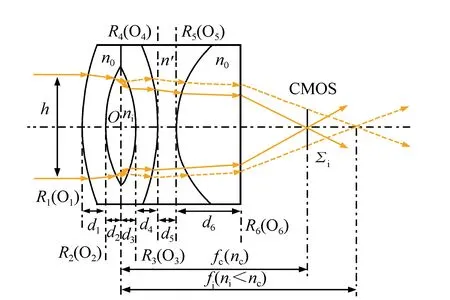
3.3 Method for calculating the liquid phase diffusion coefficient





4 Measurement results and analysis
4.1 Measurement results of equivalent refractive index method



4.2 Instantaneous method measurement results


4.3 Error analysis
5 Conclusion
猜你喜歡
中學(xué)生數(shù)理化·八年級(jí)物理人教版(2019年9期)2019-11-25 07:33:02中學(xué)生數(shù)理化·八年級(jí)物理人教版(2019年3期)2019-04-25 06:20:54數(shù)學(xué)物理學(xué)報(bào)(2018年4期)2018-09-14 03:41:02中學(xué)生數(shù)理化·八年級(jí)物理人教版(2018年3期)2018-05-31 08:52:45數(shù)學(xué)小靈通(1-2年級(jí))(2017年10期)2017-11-08 08:39:45少兒科學(xué)周刊·兒童版(2016年1期)2016-03-14 03:52:21上海金屬(2015年5期)2015-11-29 01:13:59上海金屬(2015年6期)2015-11-29 01:09:09數(shù)學(xué)物理學(xué)報(bào)(2015年2期)2015-02-28 16:06:39上海金屬(2013年4期)2013-12-20 07:57:07