
時光變遷 南濱百年
2018-09-10 00:34:05劉丁睿
重慶與世界 2018年2期
關(guān)鍵詞:重慶
劉丁睿
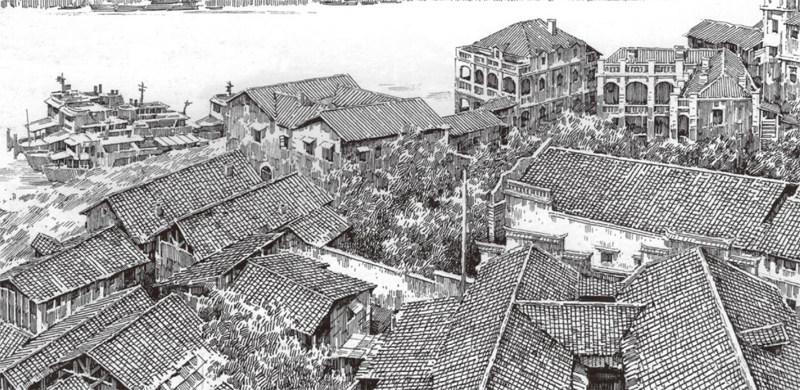
重慶南岸濱江,在清代乾隆年間即聚集了“巴渝十二景”中的海棠煙雨、黃葛晚渡等四景。如今的南濱路還有慈云寺、千佛寺、大佛寺等寺廟建筑群,以及安達(dá)森洋行、法國水師兵營、美國大使館等歷史建筑。近年來,以南濱路為主體輻射打造的南濱路文化產(chǎn)業(yè)園,還發(fā)展了眾多新潮的文化場所,如長江美術(shù)館、原·美術(shù)館、施光南大劇院、重慶國際馬戲城等,形成集現(xiàn)代會展、出版創(chuàng)意、文藝演展、休閑觀光、旅游美食文化于一體的文化產(chǎn)業(yè)聚集區(qū)。在“2018中國文化產(chǎn)業(yè)學(xué)院獎”評選活動中,南濱路文化產(chǎn)業(yè)園榮獲“2017中國年度文化產(chǎn)業(yè)園”的最佳業(yè)態(tài)融合獎。百年南濱見證了東西方文明的交融,見證了中華民族的榮辱興衰,見證了重慶從這里走向世界。
在滄桑中巨變,煥發(fā)時代光彩。逆進(jìn)時光,讓我們再一次回望南濱……
The southern bank of the Yangtze River of Chongqing has been noted for the four scenic spots out of the “Twelve Views of Chongqing” since the reign of Qianlong Emperor in Qing Dynasty: Hai Tang Yan Yu (Chinese: 海棠煙雨; literally: "Misty rain of Haitang Creek") and Huang Ge Wan Du (Chinese: 黃葛晚渡; literally: "The night view at Huang Ge Ferry"). Today, Nanbin Road are still the place where temple compounds (like Ciyun Temple, Temple of the Thousand Buddha, Dafo Temple) and historical buildings (like Andassen Foreign Firm, the French naval barracks, the United States embassy,etc.) stand. In recent years, the Nanbin Road Cultural Industrial Park, with Nanbin Road as the main body, has also incubated many trendy cultural sites such as the Yangtze River Fine Arts Museum, Yuan·Fine Art Museum, the Shi Guangnan Grand Theater, and Chongqing International Circus Center. In all, a cultural industry integration area no shortage of modern convention and exhibition, publishing creativity, art performances, leisure and tourism, gourmet culture has been built. In the "2018 China Academy Award of Cultural Industry ", Nanbin Road Cultural Industry Park won the "2017 China Cultural Industry Park Award" for the best industry integration. Over the one hundred years, Nanbin Road witnessed the blend of Eastern and Western civilizations, the rise and fall of the Chinese nation, and Chongqing going global starting from here.
Changing for the better through the vicissitudes, she is glowing gloriously.Turning back the time, let us glance back again at Nanbin Road......
位于南岸區(qū)南濱路慈云寺旁的安達(dá)森洋行,始建于19世紀(jì)90年代重慶開埠初期。在抗戰(zhàn)時期它曾是故宮文物的“臨時避難所”,被喻為南濱路上的“故宮”,是故宮文物南遷的“功臣”。
安達(dá)森是瑞典人,重慶開埠以后,他來到重慶南岸海獅支路2號買地建房開設(shè)洋行,主要經(jīng)營鬃毛、臘肉及百貨等。“九·一八”事變后,日軍占領(lǐng)東北,為確保北京文物的安全,故宮文物被迫南遷。1938年5月,故宮文物全部運到重慶后分三處保藏:第一處為川康銀行,即現(xiàn)渝中區(qū)打銅街郵局大樓二樓倉庫,共存放3830箱;第二處是南岸王家沱吉時洋行倉庫,存放1814箱;第三處就是安達(dá)森洋行的4個倉庫,共存放3694箱文物。
1939年4月,日軍飛機(jī)反復(fù)轟炸重慶。每當(dāng)天空出現(xiàn)飛機(jī),洋行老板安達(dá)森就會安排將瑞典國旗掛上房頂旗桿以求安全,最終安達(dá)森洋行幸免被炸,藏于此洋行的故宮文物因此毫發(fā)無損。
2018年1月19日,故宮博物院、重慶市文化委員會、重慶市南岸區(qū)政府在重慶簽約,將在安達(dá)森洋行舊址建設(shè)故宮文物南遷紀(jì)念館,展示南遷史實。目前,重慶市正對安達(dá)森洋行舊址進(jìn)行修繕保護(hù),預(yù)計2019年初向公眾開放。
安達(dá)森洋行
洋行占地面積10000平方米,建筑面積3200平方米,有5棟倉庫建筑,土木結(jié)構(gòu)建筑,各倉庫均采用人字坡小青瓦屋面,大梁穿斗結(jié)構(gòu),筑土為墻,石質(zhì)基座。
Swedish Andassen Foreign Firm
The historic site of the foreign firm covers an area of 10000 square meters, with a construction area of 3200 square meters. Its five warehouse buildings were constructed in civil engineering structure, the roof of each warehouse being built in gable slope with Chinese style blue tiles, with its crossbeam being built in bucket-piercing structure. The soil was mixed to build the wall while the foundation bed was stone-based.
法國水師兵營
水師兵營的布局屬于群落式,最早布局以樓宇、山門、演兵場,以及直至江邊的梯道組成,屬于典型帶內(nèi)庭、回廊的圈院圍合式建筑,仿歐洲中世紀(jì)城堡式主體風(fēng)格,被稱作水兵的“香榭麗舍”。
French Navy Barracks
The layout of the Navy's barracks is block-based. The earliest layout consisted of the buildings, the mountain gate, the performance ground, and the stairways up to the river. It can be categorized as the European medieval castle style with its typical enclosing building with a vestibule and a cloister— that is why it is known as the "Champs Elysees" among the then-sailors.
1902年,法國海軍軍官虎爾斯特率領(lǐng)測量隊乘法國軍艦,在重慶南岸區(qū)建立了法國水師兵營,人稱奧當(dāng)軍營。這棟年過百歲的“高齡”中西合璧建筑,位于南濱路彈子石謙泰巷142號,見證了重慶開埠以來的百年變遷。
鴉片戰(zhàn)爭后,英國政府與清政府簽訂了中英《煙臺條約續(xù)增專條》,把重慶列為通商口岸,取得了開埠的特權(quán)。法國水師兵營是當(dāng)時供法軍艦士兵和軍官居住的營房、儲存食物的倉庫、修理車間和物資補(bǔ)給站,同時作為法國在長江上游的控制站,擔(dān)負(fù)著長江航道水上警察的任務(wù)。
1940年,因日機(jī)轟炸重慶,位于重慶市區(qū)的法國大使館曾一度遷至此辦公。重慶解放后,法國水師兵營被政府收歸國有。
2015年12月,南岸區(qū)文管所發(fā)布消息,對南濱路法國水師兵營啟動修繕,2016年3月,該建筑的修繕工作正式啟動。2017年12月,市文化委發(fā)布消息,法國水師兵營舊址修繕工程竣工,市文物局組織專家對其進(jìn)行驗收,達(dá)到《全國重點文物保護(hù)單位工程竣工驗收管理暫行辦法》合格標(biāo)準(zhǔn)。
19世紀(jì)90年代,美國在重慶開設(shè)了領(lǐng)事館,先后在渝中區(qū)中四路、李子壩正街40號、健康路1號、南岸建設(shè)崗特1號(望耳樓80號和建業(yè)崗50號)、龍門浩棗子灣等地辦公,這是美國與重慶外交關(guān)系的開端。
抗日戰(zhàn)爭時期,中國對外關(guān)系之犖犖大者當(dāng)為美國。1937年11月,國民政府遷都重慶。1938年8月,美國駐華大使詹森率美國駐華大使館人員遷渝。
從“七七”事變到太平洋戰(zhàn)爭爆發(fā),從中立到全面援助、支持中國,從詹森到高思到赫爾利,駐華大使頻頻換人;從史迪威到魏德邁,中國戰(zhàn)區(qū)美軍總司令兼中國戰(zhàn)區(qū)總參謀長前后易將;從威爾基到馬歇爾,總統(tǒng)特使兩抵重慶;副總統(tǒng)華萊士親臨陪都。正是在這里,見證了中美兩國在抗日戰(zhàn)爭和世界反法西斯戰(zhàn)爭中的長期合作和重要貢獻(xiàn)。
1946年5月,隨著國民政府還都南京,美國駐華大使館由重慶遷回南京。
猜你喜歡
故事作文·低年級(2023年12期)2023-12-25 02:50:32
環(huán)球人文地理(2022年8期)2022-09-21 03:49:42
公民導(dǎo)刊(2022年4期)2022-04-15 21:03:14
當(dāng)代黨員(2022年6期)2022-04-02 03:14:56
意林·全彩Color(2019年11期)2019-12-30 06:08:38
當(dāng)代黨員(2019年19期)2019-11-13 01:43:29
重慶行政(公共人物)(2018年5期)2018-11-06 07:42:18
城市地理(2016年6期)2017-10-31 03:42:32
重慶文理學(xué)院學(xué)報(社會科學(xué)版)(2017年5期)2017-10-23 01:30:02
今日重慶(2017年5期)2017-07-05 12:52:25
