Where在中國法律與聯合國法律文本中的用法對比研究
——語料庫視角
2018-11-02 01:06:08齊桂紅
中國人民警察大學學報 2018年9期
齊桂紅
(中國人民警察大學,河北 廊坊 065000)
一、引言
法律語言是一種極為正式的書面語言,具有強制性與權威性,表達的內容必須清楚、無誤,無歧義且句式復雜。詞語使用準確主要表現在措辭講究,使用的詞語包括同義詞、拉丁詞語、古體詞、獨特代詞等。句式復雜,例如長句、定語從句、同位語從句、被動句、否定句等的使用比較常見。研究這些特點對專業外語教學十分有益,而使用語料庫方法,不僅可以從表層對語言進行分析,更可以從深層次對語言進行研究,分析總結語言使用規律。
Where與shall,may,otherwise等詞一樣是法律英語文本中使用頻次較高的重要詞語。由于該詞在法律文本中的使用,與普通英語使用時的含義和用法也有很多差別。對這樣一個特殊的詞語在中外法律文本中的用法、譯法等的研究非常必要。
二、where在中國法律英譯本與聯合國法律英文本中頻次等的比較
自建語料庫的中國法律英譯本主要包括《中華人民共和國出境入境管理法》《中華人民共和國外國人入境出境管理條例》《中華人民共和國國籍法》《中華人民共和國護照法》《中國公民因私事往來香港地區或者澳門地區的暫行管理辦法》《中國公民往來臺灣地區管理辦法》等法律法規。聯合國法律共計15部,包括公約、議定書等。對where一詞的統計使用的是AntConc以及Office系統中自帶統計等工具。我們把中國法律英譯文本及聯合國移民法律英語文本的英漢詞匯總數、字符數以及where一詞的頻次及其在英文文本中的占比進行了統計,結果見表1(where的合成詞如whereby,wherever等不計在內)。
通過表1,我們了解到:選取的6部中國法律法規的漢語詞匯總數為2.79萬,漢語字符數為2.86萬;中國法律法規英譯本的詞匯總數為2.21萬,英文字符為11.58萬;聯合國法律的中文詞匯總數為12.4萬,中文字符數為12.85萬;聯合國法律英語文本詞匯總數為8.85萬,英文字符數為45.92萬。where一詞在中國法律英譯文本中出現了107次,在詞匯中占比為4.84‰,字符比為0.9‰;where在聯合國法律英語文本中出現了114次,在詞匯中占比為1.49‰,字符中占比為0.287‰。
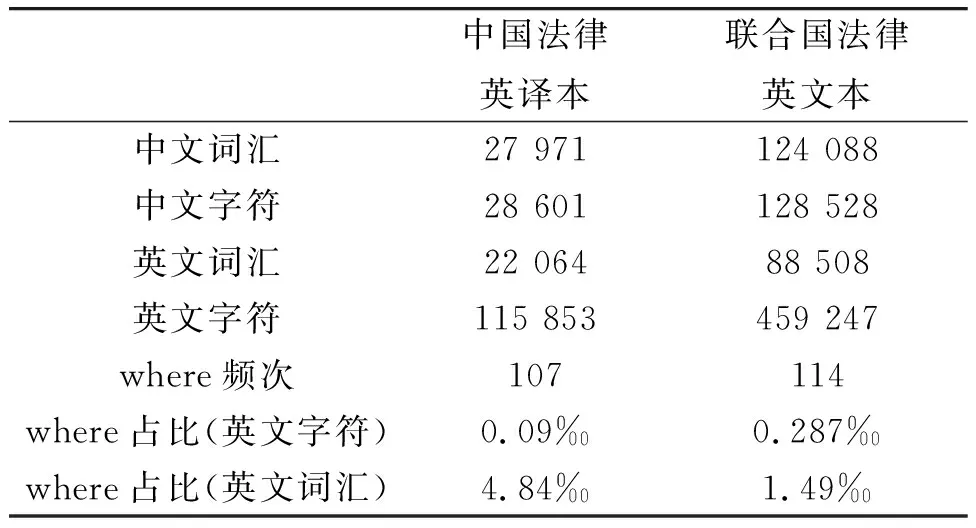
表1 中國法律英譯本及聯合國法律英文本詞匯總數/字符數以及where頻次等的統計
通過表1,我們看到where在中國法律英譯本中比在聯合國法律英語文本中少用7次,但中國法律中英文本無論是詞匯總數還是字符數都遠遠低于聯合國法律英漢文本,即where一詞在聯合國法律英語文本中出現的次數要低于中國法律英譯文本。
為了更明確where在中國法律英譯本及聯合國法律英文本中使用的具體情況,我們先來看一下where的用法與含義。
三、where一詞在中國法律英譯本以及聯合國移民法律英文本中的用法
(一)在中國法律英譯本中的用法
1.連詞,表地點
法律英語中where一詞作地點狀語與普通英語中的用法及含義一致。例1:受理國籍申請的機關,在國內為當地市、縣公安局[注]《中華人民共和國國籍法》第15條。。Nationality applications at home shall be handled by the public security bureaus of the municipalities or counties where the applicants reside. 例2:外國船員及其隨行家屬登陸港口所在城市的[注]《中華人民共和國出境入境管理法》第23.1條。。Foreign seamen and their accompanying family members disembark at cities where the ports are located. 例3:免辦簽證入境的外國人需要超過免簽期限在中國境內停留的,外國船員及其隨行家屬在中國境內停留需要離開港口所在城市,或者具有需要辦理外國人停留證件其他情形的,應當按照規定辦理外國人停留證件[注]《中華人民共和國出境入境管理法》第34條。。Where visa-exempt foreigners need to stay in China longer than the visa-free period, or foreign seamen and their accompanying family members need to leave the cities where the ports are located, or under other circumstances in which foreigners’ stay permits should be applied for, they shall apply for such permits in accordance with relevant regulations.
2.連詞,表條件,譯為“……的”
where一詞在法律英語中作連詞相當普遍,其中之一就是表示條件,相當于“in the case in which”。例1:外國人申請辦理簽證需要提供中國境內的單位或者個人出具的邀請函件的,申請人應當按照駐外簽證機關的要求提供[注]《中華人民共和國出境入境管理法》第19條。。Where foreigners applying for visas need to provide written invitations issued by entities or individuals within China, the applicants shall provide such invitations in accordance with the requirements of the visa-issuing authorities abroad. 例2:外國人入境后,所持的普通簽證、停留居留證件損毀、遺失、被盜搶或者有符合國家規定的事由需要換發、補發的,應當按照規定向停留居留地縣級以上地方人民政府公安機關出入境管理機構提出申請[注]《中華人民共和國出境入境管理法》第35條。。Where ordinary visas, stay or residence permits held by foreigners need to be reissued due to damage, loss, theft, robbery or other reasons in compliance with relevant State regulations after foreigners enter China, those foreigners shall apply for a reissue with the exit/entry administrations of public security organs under local people’s governments at or above the county level in the places of stay or residence in accordance with relevant regulations. 例3:國家工作人員因本法第5條規定的原因出境申請普通護照的,還應當按照國家有關規定提交相關證明文件[注]《中華人民共和國護照法》第6條。。Where a State functionary applies for an ordinary passport for any of the reasons as specified in Article 5 of this Law, he shall present the relevant certification documents according to relevant State regulations.
由上述例句可以看出,漢語中凡有“……的”的這種語句,英文均譯為where句式,用來表達事件存在的條件。
3.連詞,表條件,譯為“……時”
中文條款為“……時”,這種表述只出現了兩次,英文均譯為where引導,仔細分析,這也應屬于一種條件。例1:護照持有人所持護照的登記事項發生變更時,應當持相關證明材料,向護照簽發機關申請護照變更加注[注]《中華人民共和國護照法》第10條。。Where a registered item in a passport is to be altered, the holder of the passport shall submit an application with the relevant certification documents to the issuing authority for having the alteration noted. 例2:公安機關的工作人員在執行本辦法時,如有利用職權索取、收受賄賂或者有其他違法失職行為,情節輕微的,可以由主管部門酌情予以行政處分[注]《中國公民因私事往來香港地區或者澳門地區的暫行管理辦法》第29條。。Where any functionary of a public security organ, while executing these Measures, by taking advantage of his/her position and powers, has asked for and accepted bribery, committed other illegal acts or abuse of his/her office, if the case is not so serious, an administrative sanction may be imposed on the offender by the competent authority at its discretion.
(二)where 在聯合國法律英文本中的用法
1.連詞,表地點
在聯合國法律英文本中,表地點的where很多。例1: Any person in custody pursuant to paragraph I of this article shall be assisted in communicating immediately with the nearest appropriate representative of the State of which he is a national, or, if he is a stateless person, with the representative of the State where he usually resides[注]《聯合國禁止酷刑和其他殘忍、不人道或有辱人格的待遇或處罰公約》第6.3條。. 按照本條第1款被拘留的任何人,應得到協助,立即與距離最近的本國適當代表聯系,如為無國籍人,則與其通常居住國的代表聯系。例2:No State Party shall expel, return (refouler) or extradite a person to another State where there are substantial grounds for believing that he would be in danger of being subjected to torture[注]《聯合國禁止酷刑和其他殘忍、不人道或有辱人格的待遇或處罰公約》第3條。. 如有充分理由相信任何人在另一國家將有遭受酷刑的危險,任何締約國不得將該人驅逐、遣返或引渡至該國。例3:Paragraph 2 of the present article shall not be held to preclude, in States where imprisonment with hard labour may be imposed as a punishment for a crime, the performance of hard labour in pursuance of a sentence to such punishment by a competent court[注]《聯合國保護所有移徙工人及其家庭成員權利國際公約》第11.3條。. 在苦役監禁得作為對犯罪的一種處罰的國家,本條第2款的規定不應視為排除按照主管法庭關于此項刑罰的判決而執行的苦役。
2.連詞,表條件,譯為“如果/若”
where一詞表示條件的在聯合國法律英文本中,最為常見。例1:Where a person referred to in paragraph 1 of this article located in one State Party can provide substantial cooperation to the competent authorities of another State Party, the States Parties concerned may consider entering into agreements or arrangements, in accordance with their domestic law, concerning the potential provision by the other State Party of the treatment set forth in paragraphs 2 and 3 of this article[注]《聯合國打擊跨國有組織犯罪公約》第26.5條。. 如果本條第1款所述的、位于一締約國的人員能給予另一締約國主管當局以實質性配合,有關締約國可考慮根據其本國法律訂立關于由對方締約國提供本條第2款和第3款所列待遇的協定或安排。例2:Where there is reason to doubt the genuineness of the passport, the original should be sent to the authority concerned[注]《海員身份證件公約》附件II3.12.3。. 如有理由懷疑護照的真實性,應將原件寄給有關機關。例3:Where the grounds for measures taken pursuant to article 8 of this Protocol prove to be unfounded, the vessel shall be compensated for any loss or damage that may have been sustained, provided that the vessel has not committed any act justifying the measures taken[注]《聯合國打擊跨國有組織犯罪公約關于打擊陸海空偷運移民的補充議定書》第9.2條。. 如果證明根據本議定書第8條所采取的措施并無事實根據,則應對該船只可能已受到的任何損失或損害進行賠償,前提是該船只并未從事任何可證明所采取措施有理的行為。
3.作連詞,表條件,譯為“當……時”
where的此種用法雖然漢語中譯為“當……時”,事實上還是表示條件的,這種句子在聯合國法律英文本中占有一定的比例。例1:Where, under the legislation in force in the State of employment, the assets of a migrant worker or a member of his or her family are expropriated in whole or in part, the person concerned shall have the right to fair and adequate compensation[注]《保護所有移徙工人及其家庭成員權利國際公約》第15條。. 在根據就業國現行法律,移徙工人或其家庭成員的財產全部或部分被沒收時,當事人應有權獲得公平和適當的賠償。例2:Where the central authority transmits the request to a competent authority for execution, it shall encourage the speedy and proper execution of the request by the competent authority[注]《聯合國打擊跨國有組織犯罪公約》第18.13條。. 中心當局在將請求轉交某一主管當局執行時,應鼓勵該主管當局迅速而妥善地執行請求。例3:States Parties shall afford one another the widest measure of mutual legal assistance in investigations, prosecutions and judicial proceedings in relation to the offences covered by this Convention as provided for in article 3 and shall reciprocally extend to one another similar assistance where the requesting State Party has reasonable grounds to suspect that the offence referred to in article 3, paragraph 1(a) or (b), is transnational in nature, including that victims, witnesses, proceeds, instrumentalities or evidence of such offences are located in the requested State Party and that the offence involves an organized criminal group[注]《聯合國打擊跨國有組織犯罪公約》第18.1條。. 締約國應在對第3條規定的本公約所涵蓋的犯罪進行的偵查、起訴和審判程序中相互提供最大程度的司法協助;在請求締約國有合理理由懷疑第3條第1款(a)或(b)項所述犯罪具有跨國性時,包括懷疑此種犯罪的被害人、證人、犯罪所得、工具或證據位于被請求締約國而且該項犯罪涉及一有組織犯罪集團時,還應對等地相互給予類似協助。
四、分析
通過上述例句,我們可以看出:①中國法律英譯本中where一詞的主要用法(表地點、條件)與聯合國法律英語文本的主要用法相一致;②在表示“當……時”之意時,中國法律英譯本與聯合國法律英文本均表示條件。若對表示條件的where進行仔細分析,我們發現在聯合國法律英文本中能夠清楚地確定where一詞的含義,即意為“in the case in which”,或意為“on the occasion when”抑或意為“if”等。中國法律英譯本中where表示條件的英文句子中,大多與漢語原文中的“……的”相對應,且多數情況下where的含義為in the case in which。
雖然在本文第三部分,我們了解了where在中國法律英譯本以及聯合國法律英文本中使用的場合,但是與聯合國的15部法律相比,中國的這6部法律中竟出現如此高的頻率仍令人費解。在總計100多次的頻率中,表示地點、條件以及包括譯為“當……時”表示條件的使用次數到底各是多少呢?為此,本文對中國及聯合國的法律就上述幾種情況作了統計,如表2所示。
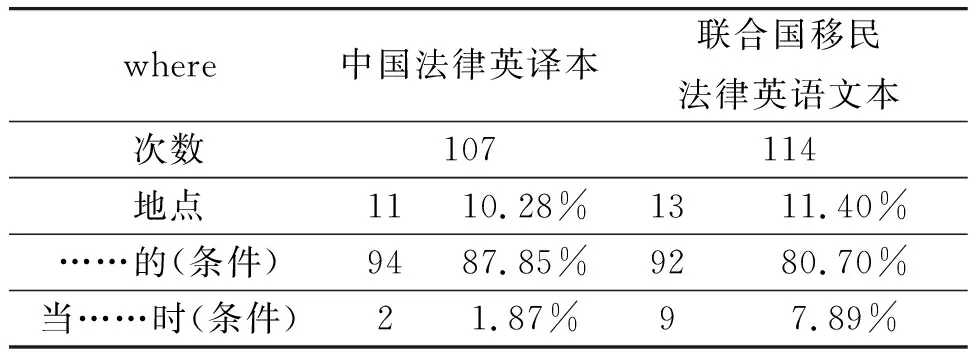
表2 where在中國法律英譯本及聯合國法律英語文本中使用情形統計
從表2我們發現,首先,在兩種法律英文文本中where一詞用作地點的數量相當,幾乎無差異。其次,where意為“……的”表示條件的用法在中國法律英譯本中以及聯合國法律英文本中的使用頻率最高,分別為87.85%和80.70%,但是中國法律英譯本比聯合國法律英文本高出7個百分點,對此種用法進行詳細分析就顯得很必要。第三,意為“當……時”表示條件的用法在中國法律文本中只出現了兩次,而在聯合國法律英文本中此種用法為7次,占總數的7.89%。
從表1中我們知道中國的6部法律與聯合國的15部法律相比,從漢字字符或從英文字符的角度看,中國的6部法律是聯合國15部法律的22.5%或25.23%。這兩種法律文本在語言詞匯、字符上的差距如此之大,在中國法律英譯本中where卻出現如此高的頻率,但表2并不能清楚地說明使用高的原因,因此還需對中國法律英譯本以及聯合國法律英文本的第二種表示條件情況的where進行比較分析,找出中文原文本與英譯文本之間的對應關系。
我們知道漢語中的“的”字結構,可以指“情形”,同時根據前后文斷定還可以用來指“人”,因此我們把這兩種情況對照原條款進行統計,包括使用和不使用where的都計算進來,并把其他表示條件的句子也包括其中,如表3所示。
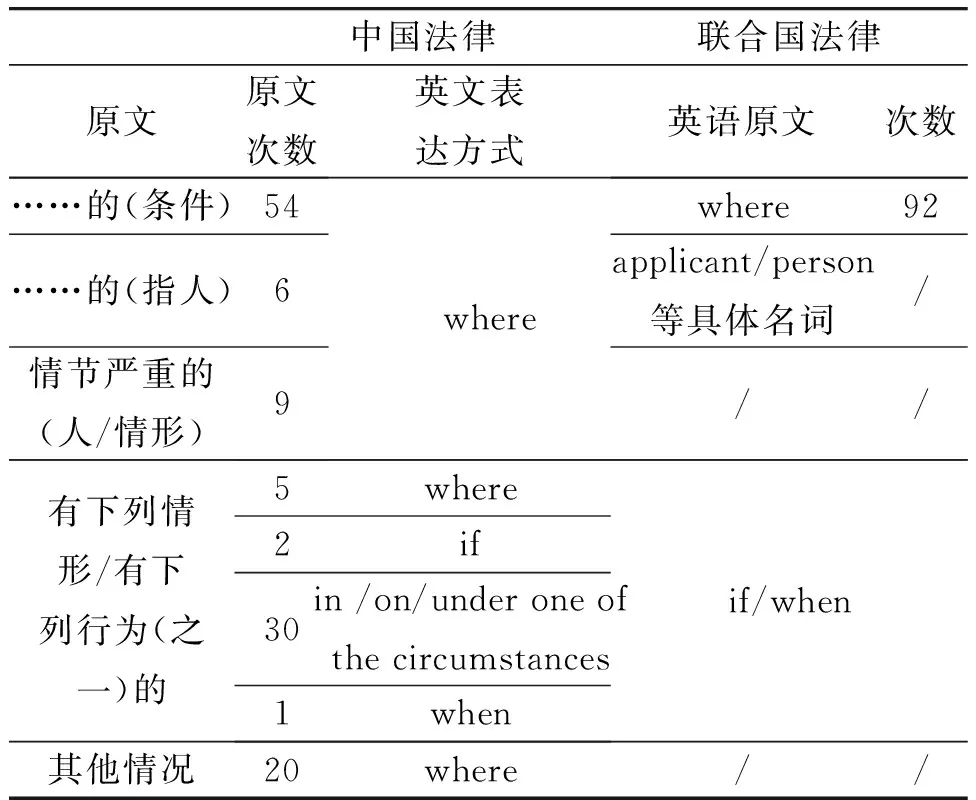
表3 where在中國法律英譯本中譯法統計以及聯合國where所指統計
從表3我們可以看出,在中國法律英譯本中where出現的次數多,原因主要有:①在表示條件時,譯者毫無疑問用了where來表達,這也與聯合國法律英文本中表示條件的用法相一致。②中國法律原文中,“的”字結構表示人的句子也被譯者用where來表示,作為一種條件;而聯合國的法律英文本中多使用applicant,person等詞來表示。③中國法律中“……情節嚴重的”這種句式既可以用來指人,又可以用來指情形的,也被譯者用where來表示條件了;在聯合國法律英文本中缺乏這一表述。④“有下列情形/下列行為的”這種表達方式,在中國法律英文本中where用了5次,其他情況譯者根據原文用if來表示條件共計2次,多數句子使用了“in/on/under one of the circumstances”這種結構。在聯合國的法律英文本中多使用if或者when表示具體情形。⑤在中國法律英譯本中where在其他情形中用了20次,這20次是中文原條款中既無“……的”,又無“……情節”的表述,是譯者為了方便敘述使用的。
通過上述分析,可以看到:
第一,中國法律的英譯文本在很大程度上能夠體現原文的精神,比較好地詮釋了條款含義。就where一詞的使用與譯法,可以看出譯者對該詞使用熟稔,較好地掌握了該詞使用的具體情形。
第二,通過對照中國法律漢英兩種文本,看到譯者能夠根據不同情形選擇適當語言進行條款的翻譯,如“有下列情形(之一)的”,做到了靈活處理。
第三,我們也發現了一些問題,主要是:
譯者并未根據原條款的含義確定使用相應的詞語,無論是哪種情形的“……的”字結構,均使用where加以表述。這就造成了where的過多運用,畢竟法律語言講究準確,譯文也不應例外。在譯文通順同時,譯者還應做到“法人法語”[1],盡可能使譯文精準。
雖然譯者能夠根據不同情形準確使用where,但對照聯合國英文,本文認為譯者更應注重對條款規定的理解與準確把握,在靈活使用其他一些詞語方面還應加強與提高,如the applicant,person等具體詞語的使用,使一些表示人員的句子含義更為清楚,以及表示條件、目的的詞語如when,if以及for the purpose of等的使用。
由于不熟悉法律或者法律背景知識不足,譯文出現了“語用層面上的表達‘失格’”[2]。在有的法律譯文中,出現了“紕漏”[1]。例如《中華人民共和國出境入境管理法》第49條規定,外國人有下列情形之一的,由公安部決定取消其在中國境內永久居留資格:①對中國國家安全和利益造成危害的;②被處驅逐出境的;③弄虛作假騙取在中國境內永久居留資格的;④在中國境內居留未達到規定時限的;⑤不適宜在中國境內永久居留的其他情形。譯文給出的是“Where foreigners fall under any of the following circumstances, the Ministry of Public Security shall decide to cancel their permanent residence status in China: ① Endanger China’s national security or interests;② Are deported;③ Obtain permanent residence status in China by fraudulent acts; ④ Fail to reside in China for the prescribed time limit;⑤ Other circumstances in which foreigners are not eligible to reside in China permanently.”從句意看,意思表達基本到位,可是句子結構并不完整。后面四個動詞詞組以及一個名詞詞組與前面句子并不存在邏輯關系,造成了句子結構的錯誤。如果要使四個動詞詞組與前面句子發生聯系,要么在主句最后加上表示分款動作的邏輯主語who,要么在動詞詞組前加上邏輯主語they,并將⑤分款的表述進行改動,使句意及句子結構完整。這種分句與主句無邏輯關系的譯文在此部法律英文本中還有不少,如第28條、31條、59條、61條、62條等。
中文原條款中的中心詞發生位移。如在《中國公民往來臺灣地區管理辦法》第8條規定本辦法第7條第4項所稱的證明是指:①前往定居,須提交確能在臺灣定居的證明;②探親、訪友,須提交臺灣親友關系的證明;③旅游,須提交旅行所需費用的證明。譯文是:① Where a person wishes to settle down, the person shall present the certification testifying that he is actually able to settle down in Taiwan. ② Where a person wishes to visit relatives and friends, the person shall present the certification testifying to the kinship or relationship between the applicant and his relatives or friends. ③ Where a person wishes to travel to Taiwan, the person shall present the certification testifying to the necessary travelling expenses. 中文原條款中共列舉了幾種證明,中心詞應為證明,可是在譯為英文后,“證明”這一關鍵詞并未得到凸顯,譯文并未令讀者清楚何種形式的“證明”,而是將其變成一種條件。就此條文而言,譯文不十分理想,未能準確表達原條款的意義。
造成上述問題的原因很復雜,有可能是譯者在翻譯的過程中粗心所致,也有可能是時間倉促造成的[3]。我國法律規定中,一些規定概括性較強,如“情節嚴重的,處以××天拘留”,到底何種情形為嚴重的,譯者不清楚,因而只能使用不會錯的語句,這樣便出現句子不完整、啰嗦的情況。再有因語言習慣,中國法律條文并未明確指出是人還是情形,這就給譯者帶來了很多不便,造成理解上的偏差,故而出現了無論是哪種情況,看到“……的”就用where來表達,也造成了在中國法律英譯文本出現頻率高于聯合國法律英語文本的現象,致使譯文不準確、語用錯誤等情況。
五、結束語
語料庫對語言翻譯使用規律提供了很好的技術支撐,對于研究語言深層含義具有其他方法不可替代的作用。隨著我國經濟的不斷發展,會有越來越多的人出入我國國邊境,還會有越來越多的外國人來我國工作、學習和定居。高質量的法律條文翻譯是管理人口流動不可缺少的組成部分,也是外國人了解中國法律的途徑之一。作為法律語言的研究者與譯者,均應承擔起這一責任,只有靈活掌握法律英語中特殊詞語的使用,才能使法律語言既莊重又不失其靈活韻味。
猜你喜歡
法律方法(2021年3期)2021-03-16 05:57:02
制造技術與機床(2019年10期)2019-10-26 02:48:08
電子制作(2018年18期)2018-11-14 01:48:06
鄱陽湖學刊(2016年6期)2017-01-16 13:05:41
中國遠程教育(2016年6期)2016-12-07 10:07:02
財經(2016年19期)2016-08-11 08:17:03
中國遠程教育(2016年5期)2016-06-29 10:13:42
山東青年(2016年1期)2016-02-28 14:25:30
小學教學參考(2015年20期)2016-01-15 08:44:38
中國衛生(2015年1期)2015-11-16 01:05:56