熱電材料與器件研究進展
2019-04-02 05:06:50朱鐵軍
無機材料學報 2019年3期
朱鐵軍
?
熱電材料與器件研究進展
朱鐵軍
(浙江大學 材料科學與工程學院, 杭州 310027)
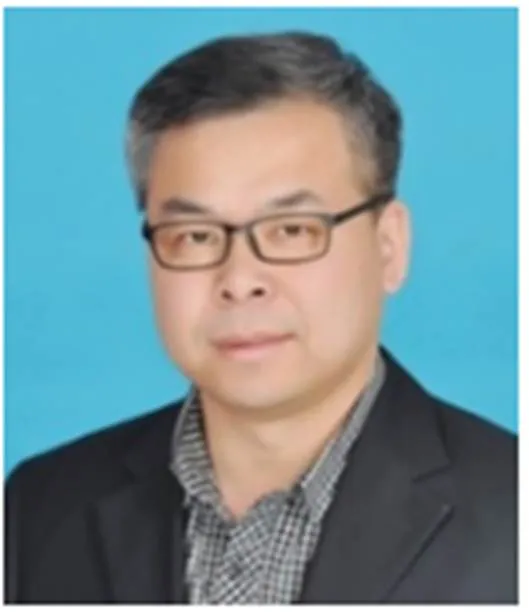
朱鐵軍,博士,浙江大學求是特聘教授,中國材料研究學會熱電材料及應用分會副理事長,長期從事熱電材料輸運機制及新材料開發的研究。E-mail: zhutj@zju.edu.cn
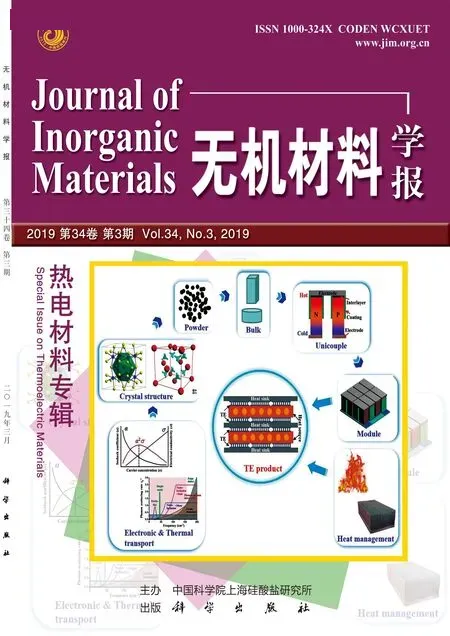
隨著人類社會對氣候變化的關注程度不斷增強和對化石能源的過分依賴, 更加刺激了世界范圍內開發新能源技術的行動。熱電技術是最簡單的可以實現熱能和電能直接相互轉化的技術, 能把太陽能、地熱、機動車和工業廢熱轉化成電, 反之也能作為熱泵實現制冷。熱電器件具有全固態、重量輕、結構緊湊、響應快、無運動部件和有害工質等優點。模塊化的特點使其易與其他能量轉換技術聯用, 這是21世紀能源應用非常重要的特征, 因為沒有單一的技術能夠滿足世界能源的需求。
熱電轉換技術的核心問題主要是尋求高熱電優值()的材料。高優值熱電材料應該具有“聲子玻璃–電子晶體”的特點, 即具有低的熱導率、高的電導率和溫差電動勢(Seebeck系數)[1], 但是這些特點在一個簡單的晶體材料中難以同時滿足, 因為三個熱電參數之間相互耦合, 優化一個參數就會導致其他參數的惡化[2]。在復雜的晶體材料中, 不同的結構模塊可以分別對熱電輸運起主導作用, 有利于熱電性能的解耦和優化, 填充型方鈷礦、Cu2Se基離子導體、BiCuSeO和新型Zintl化合物等都是實現這類調控的典型例子[3-5]。
在過去的十幾年間, 追求高優值熱電材料的努力一度使納米結構熱電材料成為焦點[2-3]。這方面的研究最初來源于一個猜想:低維材料比塊體材料具有更強的熱電性能。事實上, 納米結構對電性能的改善非常有限, 僅僅提供了更多散射不同波長聲子(降低熱導率)的可能性, 包括質量波動、晶界、應變等在不同溫度區間起作用的多重散射機制, 使人們可以在多尺度層面上增強聲子散射, 比電子散射更有效。
盡管增大熱電優值一直是熱電學研究的中心任務, 但近年來熱電材料的環境相容性和原料成本也引起了越來越多的關注。好的熱電材料不僅應該具有高的熱電優值, 還需要由無毒、來源豐富的元素組成, 具有優良的化學穩定性和熱穩定性, 滿足實用的要求。目前用于熱電發電和制冷的性能優異的熱電材料大多是半導體碲化物, 如Bi2Te3, PbTe和GeTe-AgSbTe2等[3,6]。碲有毒, 在地殼中的豐度僅在十億分之一的數量級。因此開發不含Pb和Te的高性能熱電材料具有重要意義。在這樣的原則下, 半赫斯勒熱電半導體和Mg基化合物成為非常有前景的實用型熱電材料[7]。
目前熱電材料已經形成了一個龐大的家族, 包括半導體、氧化物和聚合物, 結晶形式從單晶到多晶再 到納米復合物。進一步改善材料性能需要深入理解熱電輸運機制及其影響因素[8], 而后者依賴于熱電參數的可靠測量[9]。近年來材料基因組計劃的啟動加速了新材料的發現和優化設計, 基于機器學習的大數據挖掘和高通量計算與表征, 有望加快新型高效熱電材料的篩選。然而, 面向應用的熱電模塊和系統的設計、組裝與評價技術等則相對滯后, 盡管已經取得了顯著進展, 但仍然不能滿足工業應用的要求[10]。為了實現熱電技術的規模化應用, 仍需要熱電研究者的不斷努力。
[1] SLACK G A . CRC Handbook of Thermoelectrics. ed. DM Rowe, Boca Raton. FL: CRC Press, 1995: 407.
[2] ZHU T J, LIU Y T, FU C G,Compromise and synergy in high efficiency thermoelectric materials., 2017, 29(14): 1605883–1–26.
[3] SHI X, CHEN L, UHER C. Recent advances in high performance bulk thermoelectric materials., 2016, 61(6): 379–415.
[4] LIU R, TAN X, LIU Y C,BiCuSeO as state-of-the-art thermoelectric materials for energy conversion: from thin films to bulks.., 2018, 37(4): 259–273.
[5] LIU H L, SHI X, XU F F,Copper ion liquid-like thermoelectrics., 2012, 11(5): 422–425.
[6] FU T, YUE X, WU H,Enhanced thermoelectric performance in large size PbTe bulk materials with figure of merit> 2 by multi-functional alloying, 2016, 2: 141–149.
[7] FU C G, BAI S Q, LIU Y T,Realizing high figure of merit in heavy band-type half-Heusler thermoelectric materials.., 2015, 6: 8144–1–7.
[8] XIN J Z, TANG Y L, LIU Y T,Valleytronics in thermoelectric materials., 2018, 3: 9.
[9] WEI T R, GUAN M J, YU J J,How to measure thermoelectric properties reliably., DOI:10.1016/j.joule.2018.10.020–1–10.
[10] ZHANG Q H, HUANG X Y, BAI S Q,Thermoelectric devices for power generation: recent progress and future challenges.., 2015, 18(2): 194–213.
Recent Advances in Thermoelectric Materials and Devices
ZHU Tie-Jun
(School of Materials Science and Engineering, Zhejiang University, Hangzhou 310027, China)
The increasing concern on climate change and over-reliance on fossil fuels have spurred an urgent action worldwide in developing alternative energy technologies.Thermoelectricity is the simplest technology applicable for direct heat-electricity energy conversion. Heat from different sources such as solar heat, geothermal heat, and waste heat from automobiles or other industrial processes can be directly converted into clean electricity by a thermoelectric device. A thermoelectric device can also work in reverse as a heat pump.Thermoelectric devices are of all solid-state assembly, lightweight and compact, rapid responsiveness. They possess the absence of moving parts or hazardous working fluids, and have the feasibility for miniaturization. The modular aspects of thermoelectricity make it easy to work in tandem with other energy conversion or alternative energy technologies. This is a very important feature because no single technology can meet the world’s energy needs in 21stcentury, We need a combination of many technologies.
The fundamental issue of thermal-electrical energy conversion is primarily the pursuit of thermoelectric materials with high figure of merit. The highmaterials should be a “Phonon-Glass Electron- Crystal” (PGEC) that simultaneously possesses a high Seebeck coefficient, a high electrical conductivityand a low thermal conductivity[1]. It is difficult to satisfy these criteria in a simple crystalline bulk material since all the three quantities that governare inter-related, and a modification to any of these quantities often adversely affects the others[2]. In complex crystal systems composed of building modules with different compositions, structural symmetries and TE functions, sometimes called “hybrid crystal”, the electrical and thermal transport can be decoupled and optimized. The filled skutterudites, Cu2Se based ion conductors, BiCuSeO and novel Zintl-phase compounds provide examples of such control[3-5].
Over the past decade, the efforts of pursuing highmaterials in thermoelectric study have culminated into a new paradigm,nanostructured thermoelectric materials[2-3]. This direction started ten years ago with the speculation that low dimensional materials would have enhanced properties over those of similar materials in bulk form. The nanomaterials can provide several opportunities for phonon scattering,., the mass fluctuation alloying, grain boundary, strain fields, which cover wide ranges of phonon wavelength and temperature. The multiscale complexity can be tuned so as to scatter phonons more than electrons.
While improving thevalues has always been the central task of thermoelectric study, in recent years increasing attention is being paid to the environmental friendliness and the availability of the specific thermoelectric materials. This requires not only a good thermoelectric material with a highvalue but also it is comprised of non-toxic and abundantly available elements with high chemical and thermal stability. It is noted that most state-of-the-art thermoelectric materials are semiconducting tellurides, such as Bi2Te3, PbTe and GeTe-AgSbTe2compounds that are widely used for thermoelectric power generation and refrigeration[3,6]. Tellurium is toxic and its abundance is only on the order of one billionth on earth. Hence it is highly desirable and urgent to identify and develop Te- and Pb-free high performance thermoelectric materials. In this spirit, the half-Heusler semiconductors and Mg-based compounds are outstanding among the most promising candidates[7].
Thermoelectric materials have been developed into a big family, including semiconductors, oxides and polymers, possessing various crystalline forms from monocrystals and polycrystals to nanocomposites. Further performance improvement needs the better understanding of thermoelectric transport mechanisms and related impacting factors[8], which has to be based on the reliable measurements of thermoelectric parameters[9]. Recently, The Materials Genome Initiative is speeding up the discovery and design of materials based on big data and high-throughput methods including calculations and characterization, which is promising for the screening of novel thermoelectric materials. However, the design principle, assembly methods and testing technique of thermoelectric module and system, although developing quickly, still lag relatively behind and fail to meet the needs of industrial applications[10]. Many challenges still lie ahead and continuous efforts have to be done in the future.
1000-324X(2019)03-0233-03
10.15541/jim20180800