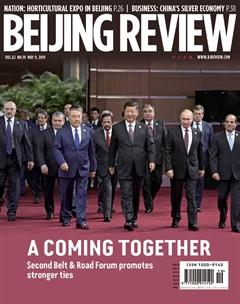
A NEW STAGE
2019-05-21 14:59:48ByYuLintao
Beijing Review 2019年19期
By Yu Lintao
Despite some governments and people in the West conjuring up arguments of “neocolonialism” or a “debt trap” to smear the Belt and Road Initiative, the China-proposed blueprint for common development of the world is becoming increasingly welcome. The success of the second gathering of world leaders to discuss the development of the initiative in Beijing showed that.
The Second Belt and Road Forum for International Cooperation (BRF) held on April 25-27 gathered some 5,000 participants from more than 150 countries and 90 international organizations, including heads of state and government and leaders from the UN and the International Monetary Fund(IMF). The number was much more than the participation in the First BRF two years ago.
Chinese President Xi Jinping proposed to build the Silk Road Economic Belt and the 21st-Century Maritime Silk Road, collectively known as the Belt and Road Initiative, in 2013.
The Belt and Road Initiative is about jointly meeting various challenges and risks confronting mankind and delivering win-win outcomes and common development, Xi said at the opening ceremony of the Second BRF.
“The Belt and Road cooperation embraces the historical trend of economic globalization, responds to the call for improving the global governance system and meets peoples longing for a better life,” he added.
In its sixth year of development, more and more people have become familiar with the Belt and Road Initiative and realize they need to engage with it, Kerry Brown, Director of the Lau China Institute at Kings College, London, told Beijing Review. He noted that becoming part of the initiative conforms to the interests of other participating countries, and is a tangible way to engage with China, the second largest economy in the world. Though some countries still dont, they are in the minority.
During the forum, cooperation agreements worth over $64 billion were signed at a CEO conference. To date, 126 countries and 29 international organizations have signed agreements with China under the framework of the Belt and Road Initiative, with Italy and Luxembourg the latest signatories.
Expanding partnership
German Economy Minister Peter Altmaier said during the Second BRF that EU countries have signaled their willingness to participate in the initiative and are planning to sign a memorandum of understanding as a group. This belies the forecast by naysayers that the initiative will only develop into an alliance of developing nations.
Former French Prime Minister Jean-Pierre Raffarin said the European recognition of the Belt and Road Initiative has improved vastly from questioning to understanding it. The countries that stay outside the initiative may lose a historic opportunity for further development, he added.
Yang Jian, Deputy President of the Chinese think tank Shanghai Institutes for International Studies (SIIS), called the initiative an engine of development in a world faced with common challenges such as uncertainties and instability.
“The reason why the Belt and Road Initiative is gaining wider and wider recognition is that besides promoting the development of participating countries, it has also contributed to the recovery of the world economy after the global financial crisis, and conforms to the UN Sustainable Development Goals,” Yang told Beijing Review.
Also, the third-party market cooperation that the Belt and Road Initiative advocates enables developed countries to play a vital role, he said. With the participation of more Western developed countries, the misunderstanding over the initiative will be dispelled. Effective resource allocation and deep market integration among developed and developing countries in Belt and Road construction will create a winwin situation, Yang said.
In an interview with the Chinese media before heading to Beijing, Ueli Maurer, President of the Swiss Confederation, said the Belt and Road Initiative is a rare, longterm plan that has created a new dimension for the development of the world economy.
Globalization is the key to global development, and to achieve globalization, infrastructure construction at various levels is indispensable. The Belt and Road Initiative is a future-oriented project that will contribute to globalization. Everyone can benefit from improving and upgrading infrastructure, he said.
According to Patrick Mendis, a visiting professor at Peking University, by its design and nature, the Belt and Road Initiative is the new accelerator for greater cooperation and collaboration among people and nations.
“For European countries, China has already established itself as a reliable partner for mutual benefits,” Mendis told Beijing Review.
For a better world
The Belt and Road Initiative was launched to enhance cooperation and connectivity. Under it, a connectivity framework consisting of six corridors, six connectivity routes and multiple countries and ports has been put in place. East Africa has its expressway, the Maldives saw its first inter-island bridge come up, Belarus is producing sedans, and the number of freight trains between China and Europe is on the rise.
Tajik President Emomali Rahmon called the Belt and Road Initiative a multi-faceted“bridge” that can help unlock the transit potential of his landlocked country and enable it to access markets worldwide.
“The Belt and Road Initiative implies creating a new model of international cooperation by strengthening the existing mechanisms, as well as seeking and implementing new mechanisms, with the aim of stimulating the economic development of the countries involved,” Rahmon said.
During the Second BRF, Pakistani Prime Minister Imran Khan said in todays world of geopolitical uncertainty, rising inequality and trade barriers, the Belt and Road Initiative offers a model of collaboration, partnership, connectivity and shared prosperity. He called the ChinaPakistan Economic Corridor not a transaction but a transformation of Pakistani society.
Malaysian Prime Minister Mahathir Mohamad told the media that he fully supports the Belt and Road Initiative. “In the promotion of relations between countries, the distance as well as the speed of travel is very important. With this scheme, I am quite sure more ships will be passing near Malaysia and Southeast Asian countries and therefore it will increase trade between Southeast Asia and China,” he said. “I am sure my country, Malaysia, will benefit from the projects.”
Over the past years, Belt and Road cooperation has expanded from the Eurasian continent to Africa, the Americas and Oceania, opening up new space for the world economy with better-than-expected results. Chinas development achievements have been shared with other Belt and Road participating countries as its huge demand for imports and increasing outbound investment has generated enormous growth opportunities.
Chinas direct foreign investment in other countries participating in the Belt and Road Initiative has exceeded $80 billion. The total trade volume between China and those countries topped $6 trillion in the 2013-18 period, during which more than 244,000 jobs were created locally.
For instance, in Kenya, the Chinese-funded and built Standard Gauge Railway linking Nairobi and Mombasa, called the “project of the century,” has created 50,000 local jobs and boosted the countrys economic growth by 1.5 percent. According to a World Bank study, the Belt and Road Initiative will increase the GDP of East Asian and Pacific developing countries by 2.6 percent to 3.9 percent on average.
Belt and Road 2.0
In his speech, Xi announced a package of proposals to advance high-quality development of the Belt and Road Initiative, calling on the international community to join hands to work out a “meticulous painting” of the initiative.
The principle of extensive consultation, joint contribution and shared benefits should be upheld, Xi said, stressing open, green and clean approaches, as well as high-standard goals for improving livelihoods and sustainable development.
Observers said the Belt and Road Initiative is entering a new stage of development.
“The first stage was setting the framework, docking strategies and building partnerships with other participating countries. Now, the new stage of development means implementation with concrete steps and appropriate approaches. That is what we call from blueprint to meticulous painting,”Zhai Kun, a professor at Peking University, told Beijing Review.
Since the participants have different levels of development and different infrastructure systems, it is quite natural that the Belt and Road Initiative will evolve from time to time in order to attract different stakeholders, the professor said.
Mendis said the best organizations in the world are the “learning organizations”that adapt and change accordingly. “As the best corporate practice, the governance of the Belt and Road Initiative must then adjust and refine its policies and actions to meet the needs of changing circumstances on the grounds,” he added.
Yang of the SIIS said Xis new proposals will dispel misgivings about the initiative. The open, green and clean approaches as well as sustainable development of the Belt and Road construction that Xi stressed will help alleviate fears about the initiative being a debt trap or a form of neocolonialism. It will also improve transparency of Belt and Road projects.
IMF Managing Director Christine Lagarde hailed the Chinese Government for taking positive steps with a new debt sustainability framework and green investment principle for Belt and Road projects.
“Debt sustainability and green sustainability will strengthen Belt and Road Initiative sustainability,” Lagarde said.
Klaus Schwab, founder and Executive Chairman of the World Economic Forum, who attended the First BRF as well, told the media that when the First BRF took place, the Belt and Road Initiative was “still a child growing up.” But “now the initiative has become an adult, which means that it has become an important factor in the global economy. It has grown up,” he emphasized. n