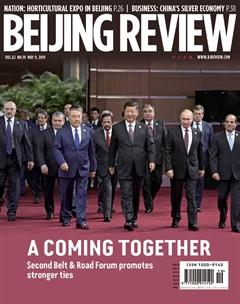
THOUGHT POWER
2019-05-21 14:59:48ByGeLijun
Beijing Review 2019年19期
By Ge Lijun

When she was in university, one of the research subjects of Gulnar Shaimergenova, Director of the China Studies Center (CSC) in Kazakhstan, was how to export wheat to Southeast Asia.
Kazakhstan is known for its high-quality wheat, with an annual production of 20 million tons, of which two thirds is exported. However, the landlocked country struggled to find an export route to Southeast Asia. Countries such as Viet Nam, which could be export destinations, are far away, so there were no trade ties with them. The absence of sea ports also seriously impeded the development of Kazakhstan.
“I was working at Nazarbayev University in 2013, so I had the privilege of witnessing Chinese President Xi Jinping propose to jointly build an economic belt along the Silk Road,” Shaimergenova said in a documentary that was screened at the Second Belt and Road Forum for International Cooperation(BRF) in Beijing last month.
She was referring to the Chinese president outlining part of the vision for the Belt and Road Initiative in the Kazakh university for the first time during his visit to the Central Asian country in 2013.
In his speech on September 7, Xi mentioned the Silk Road Economic Belt, an initiative to resurrect and expand the old Silk Road trade routes. The other component of the Belt and Road is the 21st-Century Maritime Silk Road.
Shaimergenova was excited to hear about the proposal. And with the successful operation of the China-Europe freight rail, a network of new freight lines running from Chinese cities to Asian and European countries and expanding the reach of landlocked nations like Kazakhstan, she has seen the actual impact of the Belt and Road Initiative on her country.
In 2015, because of her leading role in Belt and Road studies, Shaimergenova was invited to set up the CSC and serve as its director. What the initiative can do for Kazakhstan in the future has become the main focus of her research now.
Today, an increasing number of foreign think tanks are analyzing the impact of the initiative on their own countries and working with Chinese think tanks to perfect the cooperation mechanism and innovate its form. Think tank exchanges have become a driving force for the construction of the Belt and Road.
New force
The CSC, a non-profit think tank, works to promote China-Kazakhstan cooperation and provide practical advice for the latter to synergize with the Belt and Road Initiative.
After it was launched, a delegation was sent to China to explore new export routes for Kazakh wheat. They visited Lianyungang, Tianjin, Shanghai and other cities with major ports and their reports to the Kazakh Government outlined ways to reduce transport costs and custom clearance procedures for deeper cooperation with China.
On February 5, 2017, a train with over 1,200 tons of Kazakh wheat arrived at the Port of Lianyungang. The next day, it was loaded and shipped to Viet Nam, the first time Kazakh wheat was sold in the Southeast Asian market via China.
One year after the Belt and Road Initiative was proposed, Kazakhstan introduced its own development policy, Bright Path, to upgrade its transport infrastructure and open more routes for export. The China-Europe freight trains passing through Kazakhstan are an example of the successful alignment of the two policies.
Two years after the wheat export program started, the CSC is collaborating with think tanks from China, the United States and Australia, holding roundtables and submitting regular reports on the Belt and Road Initiative to the Kazakh Government.
“Chinas promotion of such a global initiative will usher in the Asian age,”Shaimergenova said. “It symbolizes the rise of Asia and provides us with an Asian vision of common progress by drawing on one anothers strengths.”
There are more than 300 think tanks on Belt and Road studies in China, more than 50 foreign ones, according to Xinhua News Agency. The Africa Policy Institute in Kenya helps African small and medium-sized enterprises align with the initiative and boost Africas development.
The subjects the think tanks are working on have diversified, covering macro and micro perspectives such as the vision, value, policy synergy, benefit assessments and risk control of the initiative.
At the Forum on Think Tank Exchanges held during the Second BRF on April 25, Jiri Paroubek, former Prime Minister of the Czech Republic, said with a new global economic and political order emerging in the international arena, the Belt and Road Initiative will be one of the forces to promote the new order. “In an era of uncertainty, reliable, comprehensive and profound research is a must and the establishment and collaboration of think tanks are therefore essential,”he added.
Exchanges among think tanks can not only offer suggestions for top-level designs and help to carry out practical cooperation in various fields, but also boost people-to-people exchanges and provide a solid foundation of public opinion for countries to strengthen mutual understanding.
B.R. Deepak, Chairman of the Center of Chinese and Southeast Asian Studies in New Delhi, India, said the exchanges among think tanks will contribute wisdom for development, help promote dialogue among civilizations and bring various economies and regions closer.
Brain gain
Progress has been made in exchanges among think tanks in recent years. In 2017, the Chinese Academy of Social Sciences established the China-CEE Institute in Budapest, Hungary, to provide intellectual support for innovative cooperation under the Belt and Road Initiative and the 16+1 framework, which consists of China and 16 Central and Eastern European countries. It was the first Chinese think tank independently registered in Europe.
The Chinese Academy of Sciences has, so far, set up nine overseas centers in Uzbekistan, Kenya, Nepal, Brazil and other countries, carrying out scientific and technological cooperation and providing solutions to improve local peoples livelihoods. With the support of its three universities and 105 research institutes, the academy has also trained nearly 5,000 hi-tech professionals for the participating countries.
Over the past two years, Chinese and foreign think tanks have jointly organized more than 120 international conferences at home and abroad themed on Belt and Road cooperation. On April 24, 16 think tanks jointly initiated the Belt and Road Studies Network to build a platform for institutional academic exchanges on the initiative.
“The experience of developed countries may fail while applied by developing countries. What we need is to learn from the successful experience of developing countries, summarize the lessons of failure, and then put forward new theories or ideas for future development,” said Justin Yifu Lin, Dean of the Institute for New Structural Economics, Peking University. The new network can provide one of the best platforms for generating such theories and ideas. At the same time, the new ideas it puts forward can help developing countries to take into account their own national conditions and achieve their development goals, he added.
Communication is not limited to think tanks, but extends to cooperation between think tanks and enterprises. To date, 36 centrally administered state-owned enterprises in China have established cooperative relations with more than 110 think tanks and international organizations abroad. They jointly carry out research, plan brand promotion, issue reports and hold seminars so that the enterprises can better serve the areas where they operate.
For example, Chinese train maker CRRC and China Eastern Airlines have long-term cooperative relations with consultancies such as the SCI Verkehr, a German consultancy for mobility services.
Chinese think tanks can also provide advice for foreign organizations. Lins Institute for New Structural Economics and the Uzbekistan Development Bank have signed a cooperation agreement. The institute will provide policy advice for the construction and development of an industrial park in Uzbekistan.
Zeng Peiyan, Chairman of the China Center for International Economic Exchanges, said think tanks should explore the laws and internal logic of the development of the Belt and Road, and provide guidance for future practice. They should also create a platform for the world to understand the initiative and clarify and eliminate misunderstandings about it.