THE WAY FORWARD
2019-05-21 14:59:48ByJonTaylor
Beijing Review 2019年19期
By Jon Taylor
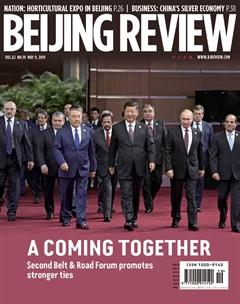
Chinese President Xi Jinping welcomed leaders and delegates from over 150 countries to the Second Belt and Road Forum for International Cooperation (BRF) in Beijing on April 25-27. In his keynote address to the forum on April 26, Xi unveiled what some have termed the “Belt and Road 2.0,” which addressed various critiques of the Belt and Road Initiative—particularly those from the United States—and clearly underscored the belief that the initiative is not only alive and well, but is also gaining support.
Addressing concerns
Xis speech, titled Working Together to Deliver a Brighter Future for Belt and Road Cooperation, provided an optimistic view of his vision for China and the initiative for expanding the nations global footprint in the decades ahead.
Three remarks stood out regarding how to move the Belt and Road Initiative forward: one, a promise that all Belt and Road participants would benefit from the initiative by vowing to get rid of unfair subsidies for Chinese companies; two, a promise to address the issue of corruption by proclaiming zero tolerance and announcing the Beijing Initiative for Clean Silk Road; and three, a promise to make Belt and Road projects environmentally sustainable by formulating the Green Investment Principles for the Belt and Road Development.
The initiative was first proposed by Xi in 2013 with the stated aim of developing both a global transportation system and a trade infrastructure mechanism using Chinese expertise and financing. It has been a positive force for promoting global trade and infrastructure development, but has also seen some controversy since its launch.
As is the case with any new policy or initiative, there have been a few shortcomings. Xis speech not only addressed these issues, but also demonstrated that China can and will make improvement in order to address any current or future concerns. Xi tried to allay any doubts about the initiative by noting that “we need to pursue open, green and clean cooperation” and emphasizing that “everything should be done in a transparent way.”
Xis speech highlighted the reasons for the initiative as well as a keen awareness that in its sixth year, there is a need to demonstrate long-term success and provide concrete results for both Chinese investors and Belt and Road participating countries. Xis goal is laudable and has laid down a challenge to Chinese businesses and countries participating in the Belt and Road Initiative to raise the quality of projects.
Xi noted that the initiative needs to focus on project execution, engage in resultsoriented implementation and promote high-quality cooperation. His emphasis on these issues suggests that China is addressing these concerns by taking specific steps to exert more control over the Belt and Road Initiative. For example, the Ministry of Finance of China has signed bilateral cooperation agreements on accounting and audit supervision with related departments of other countries to strengthen cross-border accounting and audit regulatory cooperation. Xis call for enhancing transparency and anti-corruption supervision will provide momentum for the next stage of the initiative, which will likely see greater multilateral market cooperation, with developed nations such as Italy and Switzerland assisting in building and developing infrastructure in one or more Belt and Road participating countries.
Global development
Xi also pointed out that the Belt and Road Initiative will not become “an exclusive club.” His meaning is quite clear: China views the initiative as a way to make a substantial and lasting contribution to global peace, common security, domestic affluence and worldwide prosperity. While some Westerners scoff at the impact of the initiative on these issues, Xi genuinely sees the Belt and Road Initiative as a global development program and will continue to wholeheartedly put Chinas money, resources and energy into building it. Despite Western criticism, many developing countries welcome the Belt and Road Initiative because they have a real need for infrastructure development but a dearth of funding.
More than 150 countries and interna- tional organizations have signed Belt and Road cooperation documents with China and the vision is included in the documents of major international organizations such as the United Nations, the Group of 20, the Asia-Pacific Economic Cooperation and the Shanghai Cooperation Organization. The Belt and Road Initiative has already reshaped the global economic and geopolitical landscape.
It makes sense for nations to partner up in order to engage in both regional collaboration and infrastructure financing. Given Chinas development success, less developed nations see the Belt and Road Initiative as a means to jump-start their own development plans, increase trade and enhance prosperity.
Since its inception in 2013, the Belt and Road Initiative has received strong support from much of the international community. Its activities as originally envisioned by Xi—policy engagement, infrastructure development, trade expansion, financial connectivity and people-to-people diplomacy—are here to stay. The U.S. is finding that it is losing its ability to influence nations regarding the Belt and Road Initiative, as evidenced by Italy and Switzerlands positive engagement with it. Perhaps the U.S., rather than opposing the growth of Chinas economic engagement with the rest of the world, in the spirit of multilateral cooperation should have at least sent a delegation to observe the Second BRF. Sadly, in keeping with U.S. President Donald Trumps continued trade war efforts against China and his administrations opposition to the Belt and Road Initiative, the U.S. was one of a handful of nations that had no representation whatsoever at the forum.
Xis speech at the Second BRF provided a roadmap by which the initiative can become less of a political target in the future. His pledge that China will not devalue the renminbi, his vow to strengthen macroeconomic policy coordination, his observations regarding Chinas role in global trade, his commitment to enhancing intellectual property rights protection, his promise to expand the opening of Chinas economy, and his call for further green growth indicate that the Belt and Road Initiative is looking toward both inclusion and further expansion.