農林廢棄物高效循環利用模式與效益分析
2019-07-23 06:14:28叢宏斌趙立欣孟海波姚宗路賈吉秀袁艷文霍麗麗吳雨濃
農業工程學報 2019年10期
叢宏斌,趙立欣,孟海波,姚宗路,賈吉秀,袁艷文,霍麗麗,吳雨濃
農林廢棄物高效循環利用模式與效益分析
叢宏斌,趙立欣※,孟海波,姚宗路,賈吉秀,袁艷文,霍麗麗,吳雨濃
(1. 農業農村部規劃設計研究院農村能源與環保研究所,北京 100125;2. 農業部農業廢棄物能源化利用重點實驗室,北京 100125)
中低慢速熱解技術將生物質在絕氧或低氧環境中加熱分解,生產生物炭、熱解油和不可冷凝氣體產物,是農林廢棄物高效利用的重要途徑。該文基于生物質熱解炭氣聯產技術,構建了農林廢棄物能源化資源化高效循環利用應用模式,秸稈炭用于還田,木質炭成型后用于供暖,熱解氣用于居民炊事和熱水,熱解油回用燃燒為系統加熱,木醋液稀釋后用作殺蟲劑。前南峪熱解聯產示范工程年運行5 500~6 000 h的條件下,可處理各類農林廢棄物2 500 t,生產生物炭700 t(其中秸稈炭約150 t、木質炭550 t),生產熱解氣20余萬 m3,木質型炭和熱解氣可滿足全村386戶居民冬季取暖和全年炊事熱水用能需求,秸稈炭與人畜糞便復混,全部用于還田。原料收購采用生物炭兌換方式,本村居民5 t農林廢棄物原料兌換1 t炭基肥或木質型炭,熱解氣以0.9元/m3的價格出售給本村農民,工程運行可持續、可復制,具有良好的社會環境效益。項目可實現農林廢棄物的高值利用,改善農村用能結構,促進農業可持續發展。
廢棄物;熱解;循環利用;工程;適用性
0 引 言
中國具有豐富的農林廢棄物(剩余物)資源,據統計,農作物秸稈和林業三剩物(采伐剩余物、造材剩余物和加工剩余物)資源量分別達到9億和3億t[1-3]。目前,農林廢棄物利用方式主要有肥料化、原料化、能源化、飼料化和基料化等[4-6],實現農林廢棄物資源高效循環利用是增加農林業附加值、促進農林業綠色發展、改善農村能源結構、提升農村人居環境的重要內容和途徑[7-9]。
生物質熱解多聯產依托生物質中低溫慢速熱解技術,通過熱解氣凈化提質和聯產技術集成,可生產清潔燃氣、生物炭、熱解油、醋液、電力和熱水等多種產 品[10-13]。熱解氣清潔、可再生,是農村地區散煤替代的重要能源[14-15]。生物炭可改良土壤、培肥地力[16-18],也可經混配成型加工高品質能源產品[19]。熱解多聯產是農林廢棄物綜合利用的重要途徑之一,能夠進一步提升農林廢棄物資源開發利用綜合效益,具有良好的推廣應用前景[10,20-22]。
經過多年技術攻關,課題組研發了生物質連續熱解聯產成套裝備,并作為技術依托單位,在河北省邢臺縣前南峪村建立了熱解聯產示范工程。本文通過對前南峪示范工程的實證分析,探討以熱解聯產為紐帶的農林廢棄物高效循環利用技術路徑,并通過對項目運營模式和運行效果的分析研判,以期為技術成果的推廣應用提供經驗借鑒。
1 農林廢棄物循環利用技術與模式
1.1 熱解炭化與炭氣聯產技術
熱解炭化作為生物質熱化學轉化技術,指生物質原料在絕氧或低氧環境中經加熱升溫引起分子內部分解形成生物炭、熱解油和不可冷凝氣體產物的過程,屬生物質中低溫慢速熱解技術[23-25]。
連續熱解炭氣聯產技術工藝主要包括連續熱解、熱解氣凈化、燃氣燃油回用等工藝過程[13],其工藝流程如圖1所示。連續熱解工藝主要包括密封進料、均勻布料、連續熱解、保溫炭化等工段。熱解氣凈化工藝主要包括除塵、多級組合冷凝、靜電捕焦和油洗等;燃氣燃油回用工藝通過燃氣/燃油回用燃燒,減少生產過程中的外部能源消耗并保障清潔生產。生物質連續熱解炭氣聯產成套裝備采用外加熱回轉熱解技術,回轉反應器尺寸為1 100 mm×11 750 mm,原料處理能力350~500 kg/h,加熱系統采用雙段火控溫技術,反應室采用微正壓 設計[13]。
1.2 示范村現狀與需求
前南峪村地處太行山脈,位于河北省邢臺縣漿水鎮,共386戶,1 300余人,全村共有耕地49.7萬m2,宜林山場553.3萬m2,年產農作物秸稈和林業剩余物等農林廢棄物2 500余t。村集體經營的前南峪生態觀光旅游區是國家AAAA級景區,前南峪村是首批“全國小康建設示范村”,經濟條件與人文環境良好。
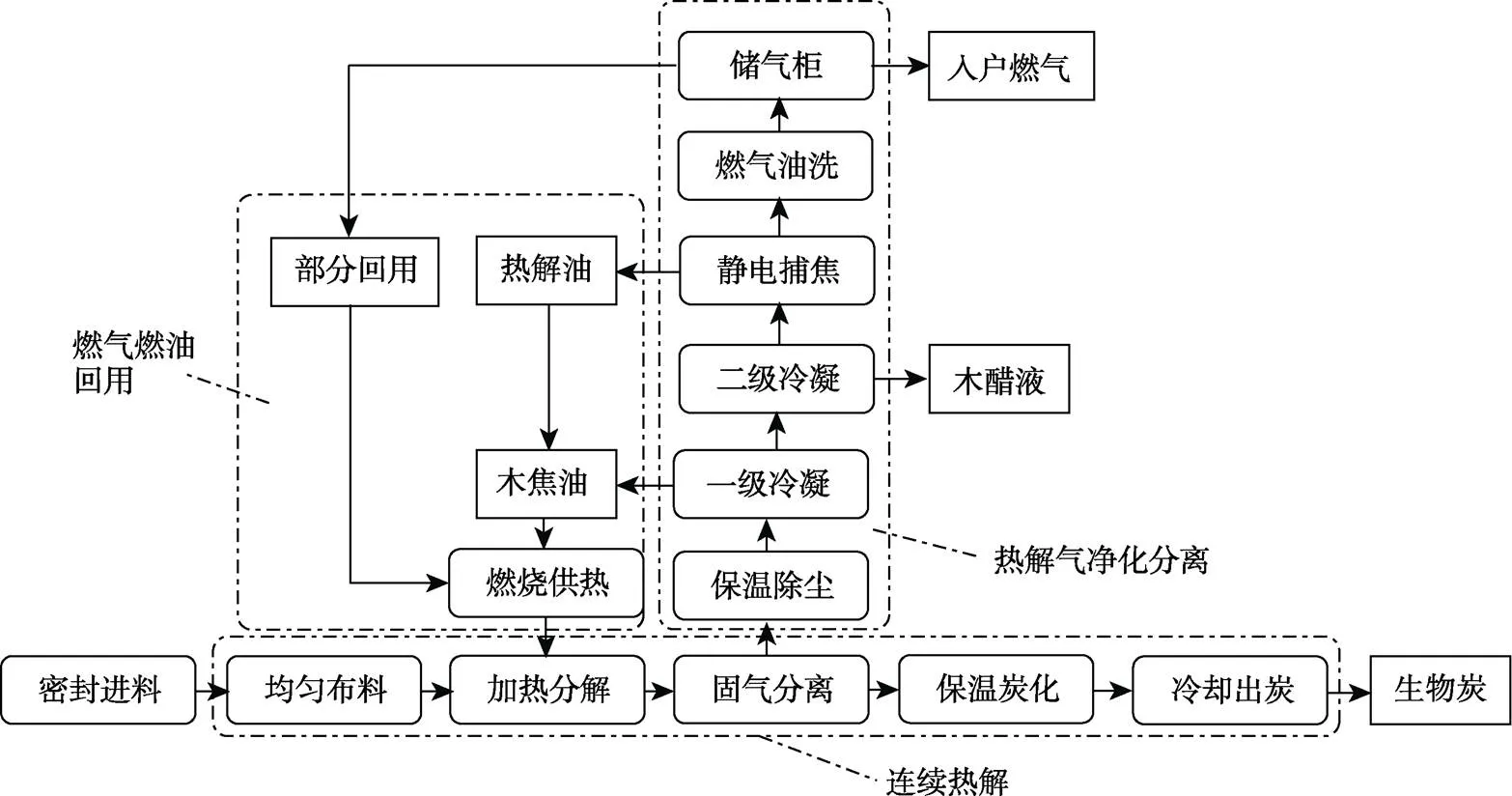
圖1 生物質連續熱解炭氣聯產工藝路線圖
為充分利用當地豐富的秸稈、樹枝、果殼等農林廢棄物資源,2010年,該村投資建成了前南峪秸稈氣化站,配套建設氣化爐2套,單套產氣能力500 m3/h;儲氣柜2個,單柜容積1 000 m3,另外,有木材切片機1臺。目前,項目總體運行情況良好,但燃氣水洗后的焦油和污水處理比較困難。
1.3 高效循環利用模式(前南峪模式)
以生物質連續熱解炭化技術為核心,農林廢棄物高效循環利用模式如圖2所示。農林種植產生的秸稈和果樹剪枝等廢棄物經預處理后,進行熱解轉化;熱解氣凈化處理后,經儲氣柜存儲和管道輸送,作為居民炊事和熱水用能。生物炭包括秸稈炭和木質炭,秸稈炭與人畜糞便復混,全部用于還田,促進循環和有機農業發展;木質炭經混配成型加工后生產機制炭,作為燒烤炭或取暖炭使用。焦油回用為系統加熱,木醋液稀釋后作為農用殺蟲劑等。該技術模式具有以下特點:
1)生產清潔。熱解氣經多級凈化后,實現氣液有效分離,并將熱解油回用燃燒利用,生產過程清潔,對環境不造成任何污染。
2)利用高效。秸稈炭肥料化利用,木質炭能源化利用,燃氣作為清潔能源直接供戶,實現了農林廢棄物的能源化資源化綜合高效利用。
3)就地循環。原料經熱解轉化后,產品全部本地消納,農林廢棄物在自然村內小循環,降低了收儲運成本,符合農林廢棄物就地循環利用原則。
4)契合產業。機制炭作為旅游區燒烤炭,項目與村集體旅游開發緊密結合,同時,該模式還回應了北方冬季清潔取暖、農業可持續發展等當今社會重大關切。
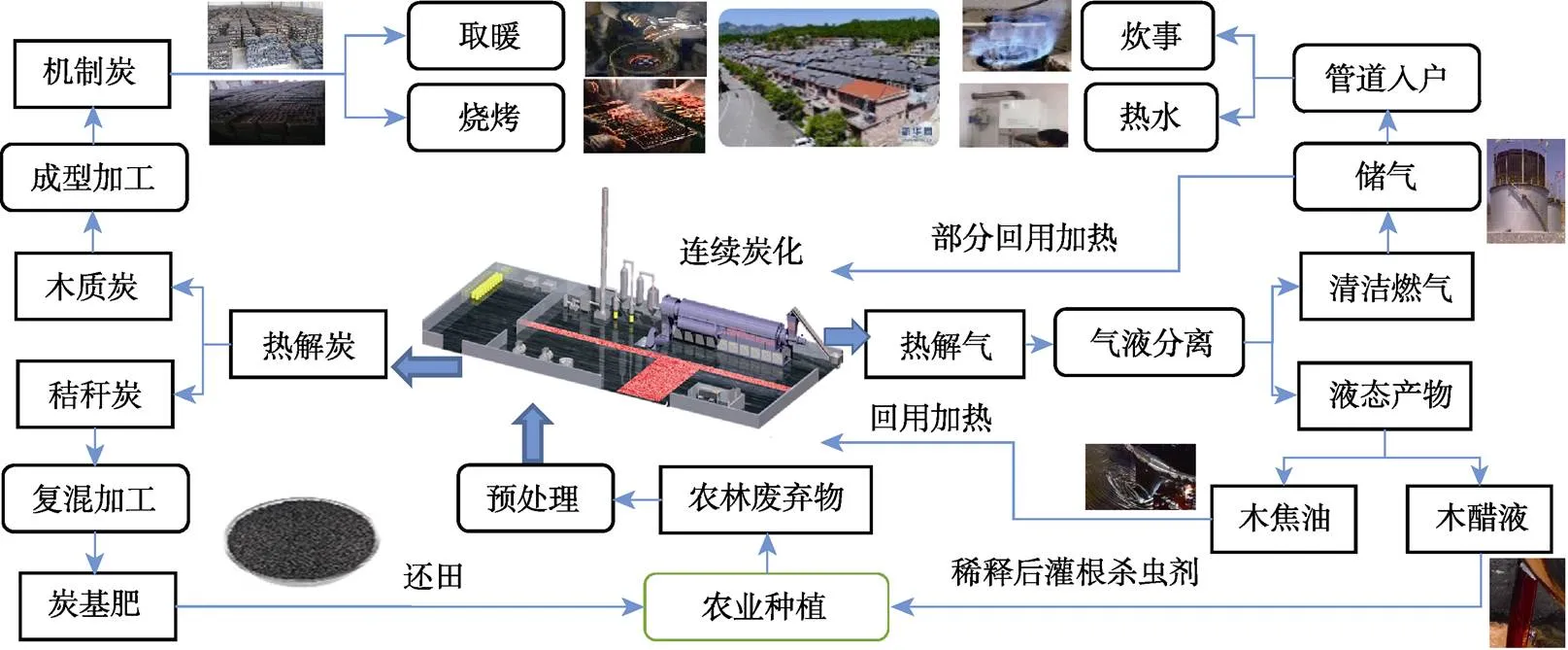
圖2 以熱解聯產為紐帶的農林廢棄物高效循環利用模式(前南峪模式)
2 工程運行與效益分析
2.1 建設與運營方式
前南峪熱解示范工程建設與運營采用“五方共治”模式(如圖3所示)。政府與村委會作為本項目的建設投資主體,其中,連續熱解、燃氣凈化設備和生產車間由政府投資,原料預處理設備、儲氣柜、燃氣管道等是村委會已有固定資產,作為村委會投資內容。農業農村部規劃設計研究院是本項目的技術依托單位,為項目建設和運行提供技術支持。項目建設完成后,村委會作為法人單位,將項目移交專業公司運營。
在原料供應方面,公司、村民、村委會簽訂三方協議,村民用5 t原料置換1 t炭基肥或機制木炭;燃氣入戶并由運營公司計量收費,收費標準為0.9元/m3。運營公司負責項目日常維護和設備檢修、保養等并承擔全部費用,相應地支配項目營運收益。研究院對項目全程跟蹤并提供技術服務。公司對項目運營安全性負主體責任,村委會負監管責任。全村居民積極參與工程運行,項目建設與運營受全村居民監督。

圖3 項目建設與運營模式圖
2.2 經濟性分析
項目建設投資、運行成本和經營收入明細如表1所示,本工程年運行5 500~6 000 h,年消納各類農林廢棄物2 500 t,年產生物炭700 t(其中秸稈炭150 t、木質炭550 t),扣除回用加熱用氣,年產清潔燃氣20余萬 m3。生產原料全部用生物炭按1:5的比例跟村民置換,熱解氣以0.9元/m3向本村居民出售。燃料主要指系統點火啟動用柴油,平均每月點火3~4次,每次柴油成本300~400元。每處理1噸原料,包括預處理、熱解和成型等各環節總耗電量約46 kW·h。
本項目新增投資200萬元,作為公益性示范項目,主要由政府承擔。項目調試完成并正常運行后,作為“交鑰匙”工程交付運營公司使用。項目年運行費用約44.7萬元,營業收入約62.0萬元,利稅約17.3萬元,項目運營可為公司帶來一定的經營收益,因此,項目自身具有持續性運行能力。
2.3 環境與社會效益
示范工程年消納各類農林廢棄物資源2 500 t,可取代1 000 t左右標準煤,通過項目點散煤替代,能夠有效減排CO2、SO2,煙塵等污染物,具有良好的環境效益。同時,避免了廢棄物的隨意堆棄,有效提升了村容村貌和人居環境。生物炭就地還田,可改良土壤、增肥地力,促進當地生態觀光農業開發。

表1 項目投資與經濟數據
注:項目年產木質炭550 t,其中350 t用于置換原料,200 t作為商品炭出售。出廠價參考www.1688.com,河北省南部電網工商業用電平段到高峰電價為0.67~1.06元·(kW·h)-1。
Note:The project produces 550 t of charcoal annually, of which 350 t is used for replacement of raw materials, and 200 t is sold as commercial charcoal. Price was obtained from www.1688.com; Electricity price of commercial power consumption in south of Hebei Province was 0.67-1.06元·(kW·h)-1.
通過本項目的實施,可直接帶動本村6名勞力就地就業,直接增加居民收入18萬元,另外,木質型炭和炭基肥的應用,節本增效方面為村民帶來的間接經濟收益可達到120余萬元。同時,木質型炭與熱解氣為村民提供了新型能源,使用清潔方便,改善了項目村能源消費結構,提升農民生活品質。
3 適用性與應用前景
3.1 適用性分析
清潔供暖方面,中央財經領導小組第十四次會議上,習近平總書記強調,推進北方地區冬季清潔取暖等6個問題,都是大事,關系廣大人民群眾生活,是重大的民生工程、民心工程[26]。農業綠色發展方面,當前農業資源利用的弦繃得越來越緊,生態環境的承載能力越來越接近極限,迫切需要轉變農業發展方式,切實推進農業生態環境保護與治理,促進農業可持續發展[27-29]。熱解多聯產是農林廢棄物綜合利用的重要途徑之一,契合農村供暖、炊事清潔用能和農業綠色發展的現實需求,符合農林生物質資源化、能源化高效綜合利用理念[30-31],可顯著提升農林廢棄物資源開發綜合效益。
熱解技術應用推廣具有先進性與可行性,經過相關科研機構與企業多年攻關,在物料有序輸送、系統高效換熱、燃氣凈化提質、副產物高效利用等關鍵技術環節取得重要進展,熱解工程生產清潔,運行安全、可靠,已基本具備產業化應用技術裝備條件。另外,此類技術建設項目投資與運行成本較低,操作簡便,適合在廣大農村地區推廣使用。
3.2 推廣前景探討
中國農村除類似“前南峪村”的傳統自然村落占多數外,隨著全國農村地區經濟社會發展水平不斷提高,近年來,新型農村社區和農業產業園區數據急劇增加。遵循農林廢棄物“因地制宜、就地利用”原則,在實踐探索的基礎上,提出了以生物質熱解聯產技術為紐帶,適應新型農村社區和農業產業園區應用需求的具有廣闊應用前景農林廢棄物高效循環利用模式。
圖4a為基于新型農村社區集中供氣供暖的農林廢棄物高效循環應用模式,主要用于為新型農村社區提供炊事取暖清潔用能。熱解氣經凈化分離后經管道入戶,為居民提供炊事熱水用能。生物質熱解后分離出的液相產物包括木焦油與木醋液,木焦油全部回用燃燒為炭化和干燥系統提供熱源,木醋液稀釋后農用作為殺蟲劑。生物炭包括秸稈炭與木質炭,其中秸稈炭經復混加工后生產炭基肥就地利用,木質炭混配成型后制作機制炭,通過生物質型炭專用爐具為居民集中供暖。

圖4 農林廢棄物循環利用推廣應用模式
圖4b為基于農業產業園區炭汽聯產的農林廢棄物高效循環應用模式,主要用于為農業產業園區提供生產生活用能。高溫熱解氣直接進入燃氣鍋爐生產蒸汽,蒸汽經供暖管道輸送作為農產品加工用能。生產的生物炭包括秸稈炭與木質炭,其中秸稈炭經復混加工后生產炭基肥就地利用,木質炭混配成型后制成的機制炭作為商品對外出售。
4 結 論
1)以生物質熱解炭氣聯產技術為紐帶,結合村鎮現實需求,構建了農林廢棄物能源化資源化高效循環利用應用模式,秸稈炭用于還田,木質炭成型后用于供暖,熱解氣用于居民炊事和熱水,熱解油回用燃燒為系統加熱,木醋液稀釋后用作殺蟲劑,實現了農林廢棄物的能源化資源化高值循環利用。
2)前南峪熱解聯產示范工程年處理各類農林廢棄物2 500 t,生產生物炭700 t、熱解氣20余萬 m3,木質型炭和熱解氣可滿足全村386戶農民冬季取暖和全年炊事熱水用能需求,秸稈炭與人畜糞便復混,全部用于還田,原料收購采用生物炭兌換方式,工程具有可持續運營能力和顯著的社會環境效益。
3)結合鄉村資源稟賦和現實需求,在實踐探索的基礎上,提出適應傳統自然村落、新型農村社區和農業產業園區的可持續、可復制、可推廣的農林廢棄物循環利用模式,具有良好的適應性和廣闊的應用前景,本研究為熱解聯產技術的推廣應用提供了基礎支撐。
[1] 農業部新聞辦公室. 我國主要農作物秸稈綜合利用率超過80%[EB/OL]. [2017-07-27]. http://jiuban. moa. gov. cn/zwllm /zwdt/ 201605/t20160526_5151375. htm.
[2] 任繼勤. 秸稈生物質能利用對節能減排的貢獻潛力研究[J]. 北京交通大學學報:社會科學版,2018,17(4):79-87.
[3] 段新芳,周澤峰,徐金梅,等. 我國林業剩余物資源、利用現狀及建議[J]. 中國人造板,2017,24(11):1-5. Duan Xinfang, Zhou Zefeng, Xu Jinmei, et al. Utilization situation and suggestion of forestry residues resources in China[J]. China Wood-Based Panels, 2017, 24(11): 1-5. (in Chinese with English abstract)
[4] 陳超玲,楊陽,胡林,等. 中國各省市區秸稈資源管理政策發展述評[J]. 中國農業大學學報,2017,22(11):1-16. Yang Chaoling, Yang Yang, Hu Lin, et al. Review of the development of crop residue management policy in provincial regions in China[J]. Journal of China Agricultural University, 2017, 22(11): 1-16. (in Chinese with English abstract)
[5] 中華人民共和國統計局. 中國統計年鑒2016[M]. 北京:中國統計出版社,2016.
[6] 祖梁. 中國秸稈資源化利用現狀及對策建議[J]. 世界環境,2018(5):16-18.
[7] 和祥生. 農村能源工作對生態環境建設的重要影響和作用探析[J]. 綠色科技,2017(4):109-110
[8] 叢宏斌,趙立欣,王久臣,等. 中國農村能源生產消費現狀與發展需求分析[J]. 農業工程學報,2017,33(17): 224-231. Cong Hongbin, Zhao Lixin, Wang Jiuchen, et al Current situation and development demand analysis of rural energy inChina[J]. Transactions of the Chinese Society of Agricultural Engineering (Transactions of the CSAE), 2017, 33(17): 224-231. (in Chinese with English abstract)
[9] 徐紹峰. 為何改善農村人居環境是鄉村振興頭場硬仗[N]. 金融時報,2019-01-17(011).
[10] 叢宏斌,趙立欣,孟海波,等. 生物質熱解多聯產在北方農村清潔供暖中的適用性評價[J]. 農業工程學報,2018,34(1):8-14. Cong Hongbin, Zhao Lixin, Meng Haibo, et al. Clean heating mode based on biomass pyrolytic poly-generation technology and its applicability evaluation in northern China[J]. Transactions of the Chinese Society of Agricultural Engineering (Transactions of the CSAE), 2018, 34(1): 8-14. (in Chinese with English abstract)
[11] 何緒生,耿增超,佘雕,等. 生物炭生產與農用的意義及國內外動態[J]. 農業工程學報,2011,27(2):1-7. He Xusheng, Geng Zengchao, She Diao, et al. Implications of production and agricultural utilization of biochar and its international dynamics[J]. Transactions of the Chinese Society of Agricultural Engineering (Transactions of the CSAE), 2011, 27(2): 1-7. (in Chinese with English abstract)
[12] Shrestha G, Traina S J, Swanston C W. Black carbon’s properties and role in the environment: A comprehensive review[J]. Sustainability, 2010, 2(1): 294-320.
[13] 叢宏斌,姚宗路,趙立欣,等. 生物質連續熱解炭氣油聯產中試系統開發[J]. 農業工程學報,2017,33(18):173-179. Cong Hongbin, Yao Zonglu, Zhao Lixin, et al. Development of carbon, gas and oil poly-generation pilot system based on biomass continuous pyrolysis[J]. Transactions of the Chinese Society of Agricultural Engineering (Transactions of the CSAE), 2017, 33(18):173-179. (in Chinese with English abstract)
[14] 叢宏斌,姚宗路,趙立欣,等. 自燃連續式生物質熱解炭氣油聯產系統燃氣凈化分離技術工藝研究[J]. 可再生能源,2015,33(9):1393-1397. Cong Hongbin, Yao Zonglu, Zhao Lixin, et al. Research on gas separation and purification technology for continuous pyrolysis system with biomass spontaneous combustion[J]. Renewable Energy Resources, 2015, 33(9): 1393-1397. (in Chinese with English abstract)
[15] 周衛紅,陳冠益,馬隆龍,等. 農村生物質氣化燃氣分散供暖經濟和環境效益分析[J]. 農業工程學報,2014,30(14):213-218. Zhou Weihong, Chen Guanyi, Ma Longlong, et al. Economic and environmental benefits analysis of decentralized heating using biomass gasification gas in rural area[J]. Transactions of the Chinese Society of Agricultural Engineering (Transactions of the CSAE), 2014, 30(14): 213-218(in Chinese with English abstract)
[16] Cong Hongbin, Mas?ek Ondr?ej, Zhao Lixin, et al. Slow pyrolysis performance and energy balance of corn stover in continuous pyrolysis-based poly-generation systems[J]. Energy Fuels, 2018, 32(2): 3743-3750.
[17] Ma?ek O, Brownsort P, Cross A, et al. Influence of production conditions on the yield and environmental stability of biochar[J]. Fuel, 2013, 103(1): 151-155.
[18] 叢宏斌,趙立欣,姚宗路,等. 玉米秸稈連續干餾條件下能量平衡分析[J]. 農業工程學報,2017,33(7):206-212. Cong Hongbin, Zhao Lixin, Yao Zonglu, et al. Energy balance analysis of corn straw continuous distillation[J]. Transactions of the Chinese Society of Agricultural Engineering (Transactions of the CSAE), 2017, 33(7): 206-212. (in Chinese with English abstract)
[19] 嚴偉,陳智豪,盛奎川. 適宜炭化溫度及時間改善生物質成型炭品質[J]. 農業工程學報,2015,31(24):245-249.Yan Wei, Chen Zhihao, Sheng Kuichuan. Carbonization temperature and time improving quality of charcoal briquettes[J]. Transactions of the Chinese Society of Agricultural Engineering (Transactions of the CSAE), 2015, 31(24): 245-249. (in Chinese with English abstract)
[20] Ning S, Hung M, Chang Y, et al. Benefit assessment of cost, energy, and environment for biomass pyrolysis oil[J]. Journal of Cleaner Production, 2013, 42(6): 141-149.
[21] Park S W, Jang C H, Baek K R, et al. Torrefaction and low-temperature carbonization of woody biomass: Evaluation of fuel characteristics of the products[J]. Energy, 2012, 45(1): 676-685.
[22] 李飛躍,汪建飛. 中國糧食作物秸稈焚燒排碳量及轉化生物炭固碳量的估算[J]. 農業工程學報,2013,29(14):1-7. Li Feiyue, Wang Jianfei. Estimation of carbon emission from burning and carbon sequestration from biochar producing using crop straw in China[J]. Transactions of the Chinese Society of Agricultural Engineering (Transactions of the CSAE), 2013, 29(14): 1-7. (in Chinese with English abstract)
[23] 劉標,陳應泉,何濤,等. 農作物秸稈熱解多聯產技術的應用[J]. 農業工程學報,2013,29(16):213-219. Liu Biao, Chen Yingquan, He Tao, et al. Application of cogeneration technology of gas-liquid-solid products pyrolyzed from crop straw[J]. Transactions of the Chinese Society of Agricultural Engineering (Transactions of the CSAE), 2013, 29(16): 213-219. (in Chinese with English abstract)
[24] 潘根興,張阿鳳,鄒建文,等. 農業廢棄物生物黑炭轉化還田作為低碳農業途徑的探討[J]. 生態與農村環境學報,2010,26(4):394-400. Pan Genxing, Zhang Afeng, Zou Jianwen, et al. Biochar from agro-byproducts used as amendment to cropland: An option of low carbon agriculture[J]. Journal of Ecologyand Rural Environment, 2010, 26(4): 394-400. (in Chinese with English abstract)
[25] 叢宏斌,趙立欣,姚宗路,等. 我國生物質炭化技術裝備研究現狀與發展建議[J]. 中國農業大學學報,2015, 20(2):21-26. Cong Hongbin, Zhao Lixin, Yao Zonglu, et al. Research status of biomass carbonization technical equipment and its development proposals in China[J]. Journal of China Agricultural University, 2015, 20(2): 21-26. (in Chinese with English abstract)
[26] 解讀中央財經領導小組第十四次會議[EB /OL]. [2018-12-02] http://finance. people. com. cn/n1/2016/ 1222/c1004-8967815. html.
[27] 張慧利,蔡潔,夏顯力. 水土流失治理效益與生態農業發展的耦合協調性分析[J]. 農業工程學報,2018,34(8):162-169.Zhang Huili, Cai Jie, Xia Xianli. Coupling coordinative degree analysis on benefit of water and soil erosion control and development of ecological agriculture[J]. Transactions of the Chinese Society of Agricultural Engineering (Transactions of the CSAE), 2018, 34(8): 162-169. (in Chinese with English abstract)
[28] 徐華. 四大行動推進農業綠色發展[N]. 河北日報,2017-02-28(009).
[29] 李世勇. 提高糧食生產能力全力推進農業生態綠色發展[N]. 哈爾濱日報,2018-11-29(008).
[30] 鄭驚鴻. 生物質能源產業對接精準扶貧前景廣闊[N]. 農民日報,2016-06-25(003).
[31] 王俊. 農村能源清潔化路徑幾多[N]. 中國電力報,2017- 02-18(002).
High-efficiency recycling mode of agroforest wastes and its benefit analysis
Cong Hongbin, Zhao Lixin※, Meng Haibo, Yao Zonglu, Jia Jixiu, Yuan Yanwen, Huo Lili, Wu Yunong
(1.,,100125,2.,,100125,)
China has abundant agroforestry residue resources. According to the statistics, the amount of crop straw and forestry residue reached 900 million and 300 million tons, respectively. At present, the use of agroforestry residues mainly includes fertilizer, raw material, energy, and feed. Realizing the efficient recycling of agroforestry waste resources is an important way to increase the added value of agroforestry, promote the green development of agroforestry, improve the rural energy structure, and enhance the rural human settlement environment. Biomass pyrolysis poly-generation based on slow pyrolysis technology of biomass, through pyrolysis gas purification and co-production technology integration, produces a wide range of products in clean gas, biochar, pyrolysis oil, vinegar, electricity and hot water. Biomass pyrolysis gas is clean and renewable, and it is an important energy source for the replacement of bulk coal in rural areas. Biochar can improve soil, and can also be processed to produce high quality energy products. Biomass pyrolysis poly-generation is one of the important ways to comprehensively utilize agricultural and forestry wastes, which can further enhance the comprehensive benefits of the development and utilization of agricultural and forestry waste resources, and have a good prospect for popularization and application. Based on the biomass pyrolysis carbon gas co-production technology, this paper constructs an energy-efficient resource efficient recycling application model for agriculture and forestry waste. Straw biochar is used for returning to the field, and wood charcoal for heating after molding. The pyrolysis gas is used for residents' cooking and hot water. The pyrolysis oil is burned for system heating, and the wood vinegar is diluted for insecticide. Under the conditions of 5 500 to 6 000 hours of operation, the Qiannanyu Pyrolysis Poly-generation Demonstration Project processes 2 500 t of various agricultural and forestry wastes annually, produces 700 t of biochar (including 150 t of straw biochar and 550 t of wood biochar), and produces more than 200 000 m3of pyrolysis gas. The woody charcoal and pyrolysis gas can meet the requirements of 386 farmers in the village for winter heating and hot water for the whole year. The straw biochar is mixed with human and animal manure, all of which are used for returning to the field. The raw material purchase adopts the method of woody charcoal exchange, 5 t agricultural and forestry wastes are exchanged for 1 t carbon base fertilizer or woody charcoal for heating, and the pyrolysis gas is sold to the villagers at the price of 0.9 yuan/m3. The project is sustainable, reproducible and has significant social and environmental benefits, and it realizes a high value utilization of agroforestry waste, improves the energy structure of rural areas, and promotes the sustainable development of agriculture.
wastes; pyrolysis; recycling; project; applicability
10.11975/j.issn.1002-6819.2019.10.025
TK6; S216.2
A
1002-6819(2019)-10-0199-06
2018-12-04
2019-04-28
現代農業產業技術體系專項資金(CARS-02)
叢宏斌,高級工程師,主要從事農村能源與生物質能源技術與政策方面的研究。Email:dabinc123@163.com
趙立欣,研究員,主要從事生物質能資源開發利用技術與政策研究。Email:zhaolixin5092@163.com
叢宏斌,趙立欣,孟海波,姚宗路,賈吉秀,袁艷文,霍麗麗,吳雨濃. 農林廢棄物高效循環利用模式與效益分析[J]. 農業工程學報,2019,35(10):199-204. doi:10.11975/j.issn.1002-6819.2019.10.025 http://www.tcsae.org
Cong Hongbin, Zhao Lixin, Meng Haibo, Yao Zonglu, Jia Jixiu, Yuan Yanwen, Huo Lili, Wu Yunong. High-efficiency recycling mode of agroforest wastes and its benefit analysis[J]. Transactions of the Chinese Society of Agricultural Engineering (Transactions of the CSAE), 2019, 35(10): 199-204. (in Chinese with English abstract) doi:10.11975/j.issn.1002-6819.2019.10.025 http://www.tcsae.org
猜你喜歡
今日農業(2022年1期)2022-11-16 21:20:05
今日農業(2022年3期)2022-11-16 13:13:50
今日農業(2022年2期)2022-11-16 12:29:47
中等數學(2022年2期)2022-06-05 07:10:50
中學生數理化·七年級數學人教版(2021年11期)2021-12-06 05:38:48
今日農業(2021年14期)2021-11-25 23:57:29
今日農業(2021年13期)2021-08-14 01:38:18
今日農業(2020年15期)2020-12-15 10:16:11
小學生學習指導(低年級)(2020年6期)2020-07-25 02:31:36
小學生學習指導(低年級)(2018年9期)2018-09-26 05:59:44