
Laparoscopic appendectomy for elemental mercury sequestration in the appendix: A case report
2019-08-14 01:37:08GregorNoranebronPrimoSeverJanGrosekAleToma
World Journal of Clinical Cases 2019年9期
Gregor Nor?i?, ?an ?ebron, Primo? Sever, Jan Grosek, Ale? Toma?i?
Abstract
Key words: Mercury poisoning; Appendix; Mercury ingestion; Mercury retention;Appendectomy; Case report
INTRODUCTION
Mercury is a heavy metal which compounds occur in different chemical dispositions including elemental, inorganic and organic forms[1,2]. Its human toxicity is wellestablished and varies with the form of mercury, the dose and the type of exposure[1].Acute ingestion of elemental mercury is considered non-toxic due to the negligible absorption by intact gastrointestinal (GI) mucosa (oral bioavailability of 0.04%)[3].However, after ingestion of even small amounts of elemental mercury, sequestration in the appendix is possible and subsequent local complications can occur[3,4]. Due to limited data in the literature the optimal management of patients is still not clear.
In the present report, we describe the clinical presentation, management, and outcome of mercury sequestration in appendix following elemental mercury ingestion in a suicidal attempt. The management approach is discussed in the context of available literature.
CASE PRESENTATION
Chief complaints
A 57-year-old Caucasian female was found unconscious near her house by her brother several hours after application of approximately 4 pens of long-lasting insulin detemir and ingestion of elemental mercury in a suicidal attempt.
History of present illness
Besides being treated for depression she had already threatened to commit suicide before.
History of past illness
Background medical history was remarkable for depression, type 2 diabetes, arterial hypertension and dyslipidemia. She had also undergone two previous abdominal surgical procedures - bariatric gastric by-pass operation and GI cyst removal.
Physical examination upon admission
The patient was noted to be unconscious (GCS 6) by the paramedics, with respiratory rate of 12/min, heart rate of 89/min, blood pressure of 162/72 mmHg and unmeasurable pO2saturation in peripheral blood. She was brought to hospital in severe hypothermia with body core temperature of only 28.4 °C.
Laboratory examinations
The laboratory blood tests were performed showing elevation of mercury levels in the blood (elemental blood mercury being 136.10 μg/L; normal value is up to 5 μg/L).
Imaging examinations
X-ray of abdomen was performed and showed several radiopaque foreign bodies,mostly in GI tract (Figure 1).
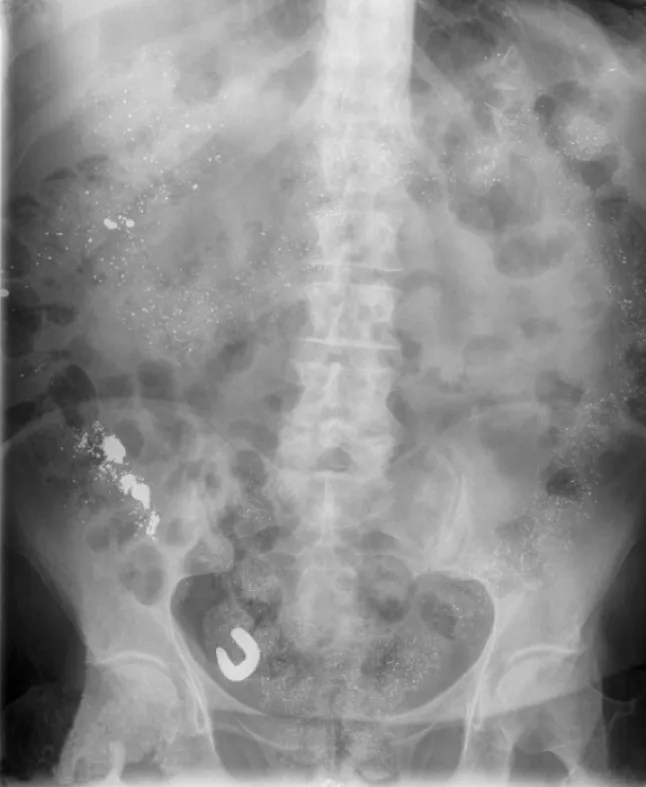
Figure 1 Abdominal X-ray 16 d after the elemental mercury ingestion showing a lot of radiopaque particles along gastrointestinal tract, mostly in colon with obvious sequestration in the appendix.
FINAL DIAGNOSIS
Intentional self-poisoning, elemental mercury ingestion, foreign bodies in GI tract with retention in appendix, insulin poisoning, hypoglycemia, depression, suicidal attempt.
TREATMENT
After admission to ICU in general hospital, a gastric lavage was performed and osmotic laxatives (Moviprep?) were administered. Due to discovered elemental mercury ingestion and subsequent elevation of blood mercury levels the patient was transferred to the National Center for Clinical Toxicology and Pharmacology for potential treatment with chelating agents. Treatment with metal-chelating agent dimercaprol (200 mg every 4 h) was commenced and administered for 8 d. The expected rise of mercury in urine and fall of mercury in blood occurred (elemental mercury in urine was 52.12 μg/L and in blood 81.53 μg/L).
In the meantime, the majority of the ingested elemental mercury had been already eliminated from the GI tract with stools stimulated by several enemas (Figure 2).However, a certain amount of elemental mercury was still sequestrated in the appendix despite all conservative measures.
Due to the risk of developing appendicitis and possible continuous absorption of sequestrated elemental mercury with its potential toxic effects, the decision to perform appendectomy was made by an interdisciplinary team of specialists. Laparoscopic appendectomy was subsequently performed 29 d after elemental mercury ingestion, with special care taken to avoid intraperitoneal spillage of mercury during the procedure. At the end of the surgical procedure, an intraoperative x-ray of the abdomen was performed to exclude any elemental mercury retained at the stapler line. Following removal of the appendix, dissection of the specimen was performed,revealing a copious collection of elemental mercury inside its lumen (Figure 3).Histopathology report described a 6 cm long appendix with mild chronic and focally purulent appendicitis with elemental mercury in its lumen. The surgery itself and postoperative course were uneventful. The patient was dis-charged home three days after the operation.
西媒對《戰斗宣言》的編譯,正是比較巧妙地運用了上述敘事技巧,對這一原本用于我國內宣的材料進行新的敘事建構,通過巧妙地翻譯敘事,營造出他們期望的新聞價值,從而實現其妖魔化我軍的目的。
OUTCOME AND FOLLOW-UP
The surgery itself and postoperative course were uneventful. The patient was discharged home three days after the operation.
DI SCUSSION
We report a case of elemental mercury ingestion in a suicidal attempt with subsequent retention of mercury in the appendix. In order to prevent complications from the retained mercury, laparoscopic appendectomy was performed. Histopathology report of the removed appendix described a mild chronic and focally purulent appendicitis approximately 1 mo after the mercury ingestion.
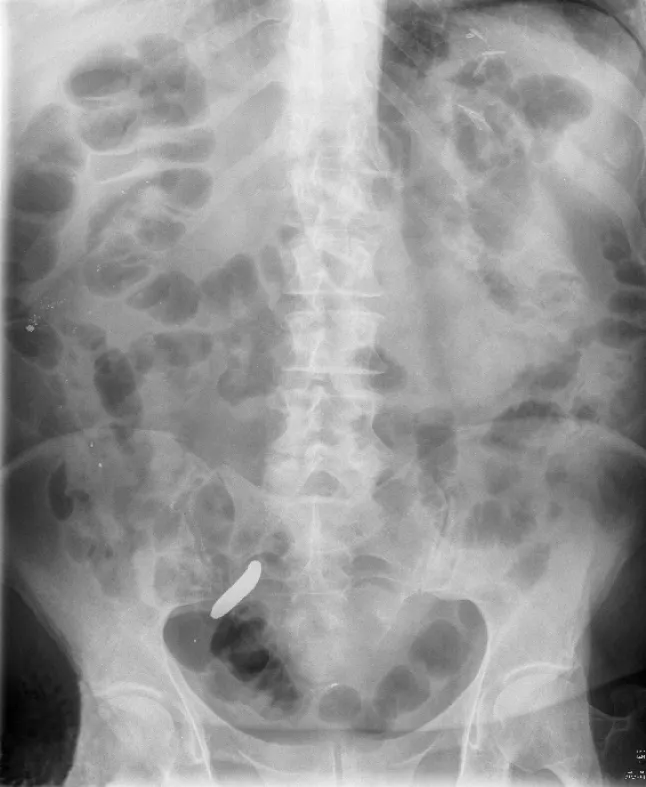
Figure 2 X-ray of the abdomen after several enemas showing almost no remnant of elemental mercury in gastrointestinal tract except sequestration of mercury in the appendix.
In a recently published paper by Michielanet al[3], a review of similar case reports was performed. Including their own case, they found only 10 described cases of elemental mercury sequestration in the appendix after oral ingestion. The clinical consequences of oral ingestion of mercury are largely unknown since the vast majority of systemic toxicity is associated with the inhalation route[4]. Acute ingestion of elemental mercury is even considered non-toxic due to negligible absorption by intact GI mucosa (oral bioavailability of 0.04%)[3]Furthermore, most foreign bodies that enter the GI tract are eliminated in four to six days[5]. However, due to the vertical anatomy at the coecal region, foreign bodies heavier than other bowel contents are capable of entering the lumen of the appendix (elemental mercury for instance) where the peristalsis is insufficient to push it back into the GI tract[4-6].
Despite oral bioavailability of elemental mercury being close to nil, there are still several reasons to justify the measures for removal of mercury sequestrated in the appendix. The first is the possible interaction of mercury with gut bacteria which might lead to the conversion of elemental mercury into organic mercury compounds[7]. Unlike elemental mercury, the bioavailability of organic mercury compounds is high via the GI route as they can be absorbed almost completely[8,9]with subsequent systemic toxicity. The second reason to consider is possible local complications such as development of acute appendicitis with consequent perforation and spillage of mercury into the abdominal cavity. To date, there are only two case reports describing acute inflammation of the appendix due to elemental mercury retention, with both papers published over 50 years ago[10,11]. To the best of our knowledge, the index case report is the third describing appendicitis consequent on retained elemental mercury.
Different conservative and surgical approaches of management of elemental mercury sequestrated in appendix have been reported in the literature. In general,conservatives measures such as whole bowel irrigation and endoscopic irrigation are recommended as first line of treatment[3]. Besides irrigation methods, the Trendelenburg position (30°) combined with left lateral decubitus position has also been reported to be successful in one patient[12]; although this approach failed to remove the mercury from the appendix in other patients[3]. Moreover, one report also described a complete spontaneous elimination of appendiceal mercury within 7 mo without any associated complication[13]. We believe that the effectiveness of the conservative methods may be significantly influenced by the variations in the anatomy and location of the appendix. Meanwhile, since conservative measures are often unsuccessful, surgery remains a compelling option to prevent possible associated complications of retained mercury in the appendix.
Nevertheless, the question of whether or not to perform appendectomy in an asymptomatic patient remains open[3], since surgery itself bears risks of potential complications. Remarkable in this regard is the potential perforation of the appendix during the procedure and spillage of elemental mercury into the peritoneal cavity causing life-threatening peritonitis. However, in the hands of the experienced surgeon, the rate of complications of laparoscopic appendectomy is very low.
Given the paucity of evidence regarding the optimal treatment of patients with retained ingested mercury, it is prudent to recommend that the choice of treatment strategy should be determined on a case-by-case basis by a multidisciplinary team(MDT) including toxicologists, gastroenterologists and abdominal surgeons[3]. Based on the presumed amount of retained mercury and the patient's overall clinical circumstances, the MDT should carefully weigh the potential complications of retained mercury against the potential risks and benefits of surgical intervention for each patient.

Figure 3 Specimen of the appendix after laparoscopic appendectomy. A: Intact specimen; B: After the incision elemental mercury showed and spilled out of the lumen of the appendix.
CONCLUSION
Since conservative measures are often unsuccessful for elemental mercury sequestration in appendix, surgery seems feasible and safe option. Given the limited evidence the choice of treatment should be determined on a case-by-case basis by a MDT. More case reports are needed to determine optimal treatment strategy.
ACKNOWLEDGEMENTS
The authors would like to acknowledge Dr. Ugwoke, Chiedozie Kenneth for the proofreading of the final manuscript.
猜你喜歡
華人時刊(2022年7期)2022-06-05 07:33:58
今日農業(2021年4期)2021-11-27 08:41:35
今日農業(2021年1期)2021-11-26 07:00:56
阿來研究(2021年1期)2021-07-31 07:38:26
新世紀智能(高一語文)(2020年9期)2021-01-04 00:42:46
甘肅教育(2020年12期)2020-04-13 06:24:46
作文周刊·小學一年級版(2018年17期)2018-09-10 02:39:46
家庭影院技術(2017年9期)2017-09-26 03:41:34
幼兒教育·父母孩子版(2016年12期)2017-05-24 13:11:53
小天使·一年級語數英綜合(2017年4期)2017-04-18 17:47:11
 World Journal of Clinical Cases2019年9期
- World Journal of Clinical Cases的其它文章
- Coexistence of breakpoint cluster region-Abelson1 rearrangement and Janus kinase 2 V617F mutation in chronic myeloid leukemia: A case report
- Crizotinib-induced acute fatal liver failure in an Asian ALK-positive lung adenocarcinoma patient with liver metastasis: A case report
- Rare variant of pancreaticobiliary maljunction associated with pancreas divisum in a child diagnosed and treated by endoscopic retrograde cholangiopancreatography: A case report
- Adult-onset mitochondrial encephalopathy in association with the MT-ND3 T10158C mutation exhibits unique characteristics: A case report
- Nerve coblation for treatment of trigeminal neuralgia: A case report
- Management of the late effects of disconnected pancreatic duct syndrome: A case report