
China’s FTZs,Magnets for Foreign Investment
2020-03-23 09:34:34ByQIUHAIFENG
CHINA TODAY 2020年3期
By QIU HAIFENG
A groundbreaking ceremony was held for the long-term base of Cambridge UniversityNanjing Center of Technology and Innovation in Nanjing Jiangbei New Area on September 10, 2019. This is the first time Cambridge has set up a collaborative research facility outside the U.K. By now, the centers first research projects have been launched.
When commenting about the reason for choosing Nanjing as the location for the base, Stephen Toope, vice chancellor of the University of Cambridge, said that the economic vitality there and the convenience brought by the establishment of the free trade zone are the cornerstones for promoting innovation. Nanjings research and innovation environment and talent services are very attractive, he added.
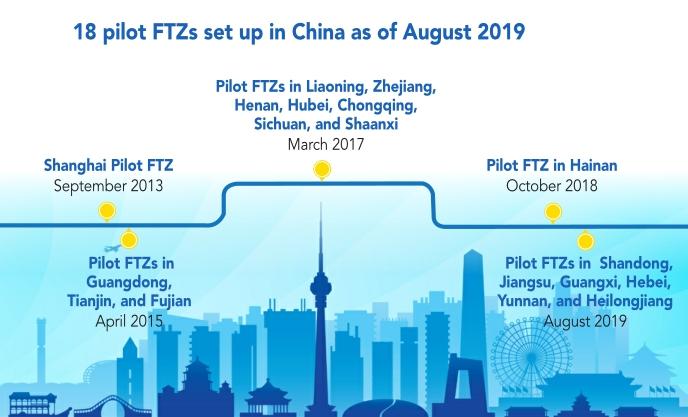
Since the establishment of the first pilot free trade zone (FTZ) in Shanghai at the end of September 2013, as of August 2019, China had established a total of 18 pilot FTZs.
Attracting Foreign Investors
Since its unveiling on August 30, the three sections of the Jiangsu FTZ have all received much foreign investment. At the opening ceremony of the Suzhou section, the first batch of 32 enterprises signed contracts for new projects.
“The Suzhou section is a new opportunity both for the Suzhou Industrial Park and for Bosch,” said Andreas, general manager of Bosch Automotive Products (Suzhou) Co., Ltd., a subsidiary of Germanys Bosch.
In the Lianyungang section, Jiangsu Dongda Food Co., Ltd., a joint venture, indicated what attracted it to the Lianyungang section of the Jiangsu FTZ was the development prospects.
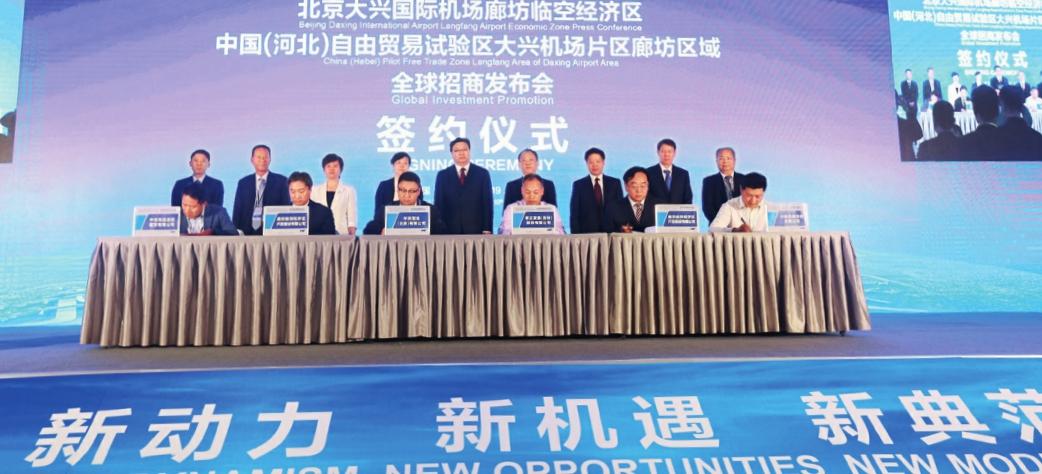
The same story has been repeated in five other new FTZs. In the Guangxi FTZ, about 10 foreign enterprises including the Deutsche Post DHL Group and Praxair of the U.S. entered the FTZ on the opening day. In the Hebei FTZ, a large number of companies from France, Russia, Germany, South Korea, Japan, India, and the U.S. have come to find out how they can invest or develop international business there. In the Shandong FTZ, many hi-tech companies from overseas have settled there, including a China-South Korea science and innova- tion incubation cooperation base, and a robot research institute co-built with Nobel Prize laureates. In the Yunnan FTZ, an amount of over US $110 million of foreign investment was introduced. In the Heilongjiang FTZ, a Sino-Russian timber processing and trading center is presently under construction, and a trade hall was set up in Harbin by a Korean trade and investment revitalization commune, and the list goes on and on.
“The six new pilot FTZs aim to further expand opening-up in the coastal and border areas, and will accelerate the replication and promotion of the pilot FTZs experience, extend their reach to more Belt and Road partner countries, and promote domestic reform and opening-up. During this process, the six pilot FTZs need to attach more importance to deepening economic and trade cooperation with neighboring countries and regions based on their respective geographical advantages. They need to take advantage of this as an opportunity to realize new heights of opening-up and build stronger growth drivers, and thus be able to reach more countries,”said Zhang Jianping, deputy director of the academic committee of Chinese Academy of International Trade and Economic Cooperation.
More Investment in the Future
Policies like preferential tax and special supervision at the customs have helped to facilitate the import, manufacturing, and export of goods, creating an internationally competitive business environment in pilot FTZs.
The six FTZs established in August 2019 focus on opening wider to the outside world, while promoting institutional innovation and improving the business environment. Wang pointed out that on the basis of fully learning from the successful experience and focusing on investment, trade, finance, in-process and after-process supervision, and other aspects, the Ministry of Commerce has set tasks for a systematic and integrated pilot reform for each new FTZ.
“The Yantai section of the Shandong FTZ has confirmed 16 items for institutional innovation, rolled out measures to optimize government services so as to realize cross-border approval of business licenses for investors from Japan and South Korea. By far, the minimum time needed for investors from Japan or South Korea to obtain a license is five days, all done without leaving their countries,” said Tan Ying, an official of the Yantai Economic & Technological Development Area.
According to Zhang Hua, director of Jinan Municipal Bureau of Financial Supervision and Administration, Jinan, capital of Shandong Province, has launched a pilot plan for financial reforms, including 20 measures that cover four aspects: attracting foreign financial institutions; promoting two-way cross-border investment and financing; improving financial services; and establishing and improving the financial risk prevention and control system.
To be specific, the measures include: encouraging local corporate banks to cooperate with equity-investment institutions and provide enterprises with“equity + debt” investment and financing services; and carrying out reforms and innovations in fund management to expand financing channels for enterprises.
In the Service Center of the Kunming section of the Yunnan FTZ, an efficient review and approval service system has been put in place. Meanwhile, preferential policies such as tax, rent allowances, and a complete warehousing and logistics system have all greatly reduced operating costs.
Jiang Yanmin, head of operations of Sanofi China R&D Center, a leading global pharmaceutical and health company, received the first business license at the opening ceremony of Jiangsu FTZ Suzhou Section. “It took less than 24 hours for us to get the business license. The FTZ speed is amazing!”
Jiang said Sanofi plans to invest 20 million annually in the new research institute in Suzhou over the next five years and conduct cutting-edge biomedical research in the fields of oncology, immunity, and metabolism. With the opening of the Suzhou section of the FTZ, the company expects greater convenience in terms of application of medical research achievements, connection with the international market, and the import and export logistics of biological products. She is confident of the companys future development in Suzhou.
In Zhang Jianpings opinion, the next step that should be taken is to speed up the implementation of the new Foreign Investment Law and make it transparent. In addition to this, pilot FTZs need to make new breakthroughs to facilitate trade and investment, especially in financial management and customs supervision. They need to continue to improve their business environment to play an exemplary role. “Chinas pilot FTZs are a new highland and platform for reform and opening-up. It is also an important institutional measure for helping build new growth and innovation drivers for Chinas opening-up.”
