Unit 3 How do you get to school?
2020-06-19 08:33:22
時代英語·初中 2020年1期
關鍵詞:學校
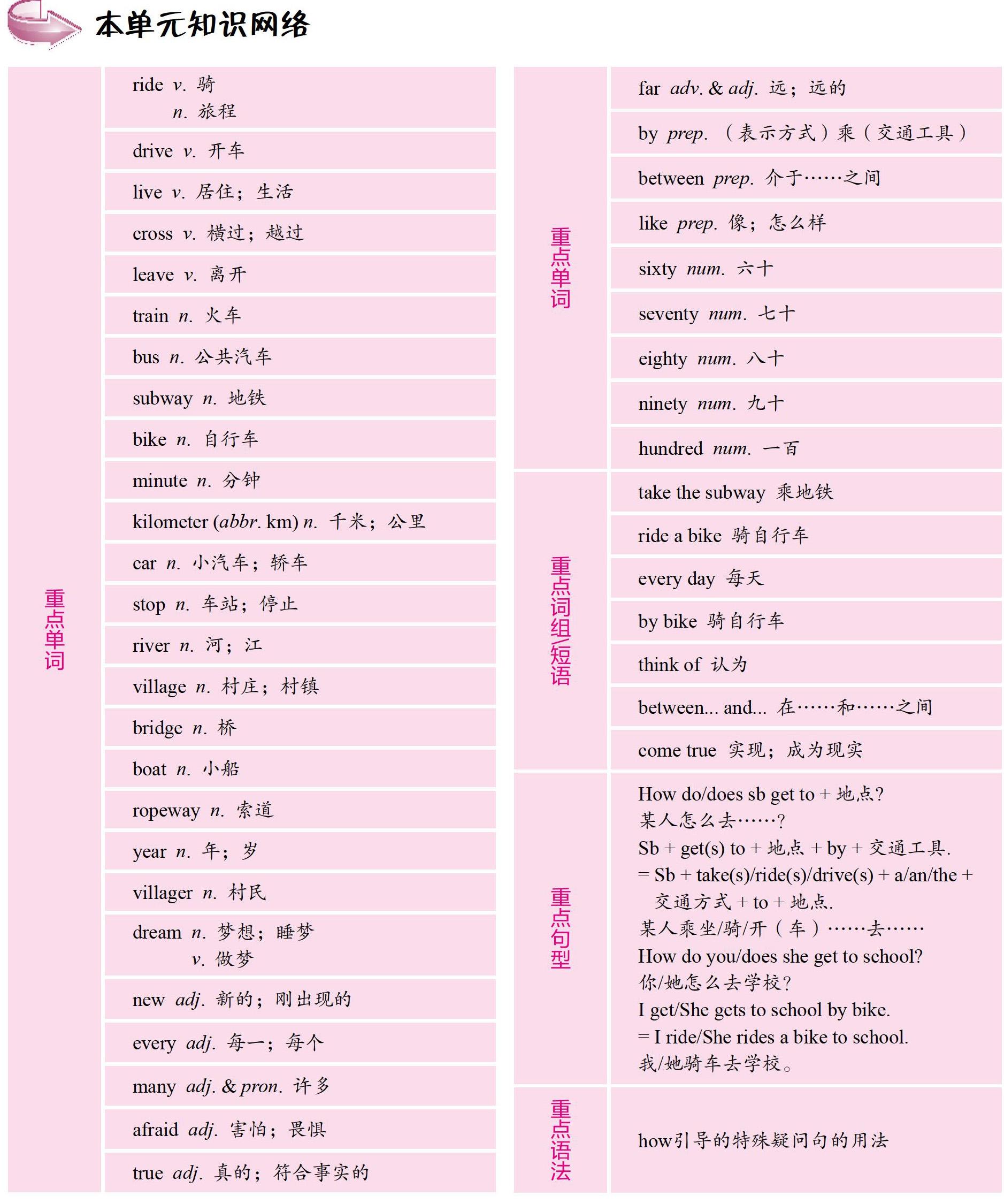
Section A
1. —How does Mary get to school?
瑪麗怎么去學校?
—She takes the subway.
她乘坐地鐵。
(1)How do/does sb get (to)...?是用來詢問對方或他人如何到達某地的常用句型。
其常用回答有如下幾種:
Sb walk(s) to school/Sb get(s) to school on foot.
某人步行去學校。
Sb ride(s) a bike to school/Sb get(s) to school by bike.
某人騎自行車去學校。
(2)get to意為“到達”,get為不及物動詞,若加賓語,后面需接介詞to。
注意:get后接home,here,there,downstairs,upstairs等副詞時,其后不加to。
I usually get home at six thirty every evening.
我通常每天晚上六點半到家。
(3)take ?v. ?意為“乘坐;搭乘”,后接表示交通工具的名詞。
take the bus ?乘公共汽車 take the boat ?乘船
take the subway ?乘地鐵
表示乘坐交通工具的幾種表達方式:
(1)take + a/the + 交通工具
take a/the bus ?乘公共汽車
(2)in/on + a/the + 交通工具
in/on a train ?乘火車
(3)by + 交通工具
by bus/taxi ?乘公共汽車/出租車
注意:步行 ?on foot
by sea = by ship ?乘船 by rail = by train ?乘火車
by air = by plane ?乘飛機
2. one hundred and five 105
hundred ?num. ?一百
“數詞 + hundred + 名詞復數”意為“幾百……”
“hundreds of + 名詞復數”意為“成百上千的……”
She has five hundred books.
她有500本書。
There are hundreds of people on the square.
廣場上有成百上千的人。
thousand(千),million(百萬),billion(十億)與hundred的用法一樣。
3. —How far is it from your home to school?
從你家到學校有多遠?
—Im not sure... about 10 kilometers?
我不確定……大約10千米?
how far意為“多遠”,用來詢問距離,指路程的遠近。
How far is it from the hospital to the bank?
從醫院到銀行有多遠?
如何回答how far的提問:
(1)有具體的數字時,應與away from連用,口語away可省略;
(2)沒有具體數字時,應用far或near作答;
(3)也可以用“時間 + walk/ride/drive”回答。
—How far is your home from your school?
你家離學校有多遠?
—Its about three kilometers (away) from my school.
我家離學校大約3千米。
—Its not very far.
不是很遠。
—Its about 25 minutes walk/a 25-minute walk.
步行大約25分鐘。
注意:far不與具體的時間相連。
4. —How long does it take you to get to school?
你到學校花多長時間?
—About 15 minutes by bike.
騎自行車大約15分鐘。
(1)how long意為“多久,多長時間”,用以詢問某個動作所持續的時間,謂語動詞應為持續性動詞,答語多為表示一段時間的名詞短語。
—How long will you stay there?
你要在那待多久?
—About a week.
大約一周。
(2)It takes sb some time to do sth為固定句型,意為“做某事需要花費某人多長時間”。take在此句型中意為“花費”,it是形式主語,真正的主語是后面的不定式to do sth。如:
It takes me about an hour to do my homework every day.
我每天大約花一個小時做家庭作業。
GRAMMAR FOcuS
how引導的一般現在時的特殊疑問句
在一般現在時的特殊疑問句中,可用how來提問交通方式;用how long提問時間的長短,即時間段;用how far提問距離。
(1)how用來提問交通方式:
—How do you go to work every day?
你每天怎樣去上班?
—I take a bus to work. (= I go to work by bus.)
我乘公共汽車去上班。
(2)how long用來提問時間的長短,意為“多長時間”。
How long does it take you to walk to school?
你走路去學校要花多長時間?
(3)how far用來提問距離,意為“多遠”。其回答可以用長度單位或時間表示。
—How far is it from your home to the shop?
從你家到商店有多遠?
—Its two kilometers. ( = Its 10 minutes ride. / It takes
10 minutes to get there by bike.)
兩千米。(騎自行車10分鐘。)
活學活用
按要求完成句子。
1. She usually goes to school by bus.(對畫線部分提問)
____ ?____ she usually go to school?
2. She lives about five kilometers from school.(對畫線部分提問)
____ ?____ does she live from school?
3. She needs about 10 minutes to get to school.(對畫線部分提問)
____ ?____ does she need to get to school?
4. 看這部電影要花費你多長時間?(完成譯句)
____ ?____ ?____ it ____ you to watch the movie?
Section B
1. So these students go on a ropeway to cross the
river to school.
所以這些學生靠滑鐵索來過河上學。
cross ?v. ?橫過,越過
Be careful when you cross the road.
過馬路時,要小心。
比較:cross和across
cross ?v. ?橫過,越過
Make sure theres no traffic before you cross the road.
在你過馬路前要確保沒有車輛。
across ?adv. & prep. ?橫穿,橫過;從一邊到另一邊(指從表面穿過)
She helps the old lady across the road.
她扶這位老太太過馬路。
2. But he is not afraid.
但是他不怕。
afraid ?adj. ?害怕;畏懼
(1)be afraid ?恐怕;害怕
Im afraid I will be late for class.
我恐怕上課要遲到。
(2)be afraid of sth ?害怕某物
I am afraid of cats.
我怕貓。
3. Can their dream come true?
他們的夢想能成真嗎?
(1)true ?adj. ?真正的;真實的
Is it true that you dont like this picture?
你真的不喜歡這幅畫嗎?
(2)come true ?實現
Wish your dream come true.
希望你夢想成真。
活學活用
閱讀短文,從方框中選擇適當的詞,并用其正確形式填空(每詞限用一次)。
for take be minute by
I work in a bank (銀行) from Monday to Friday. My house is near a park. It takes me about ten ? ?5 ? ?to walk to the park. I usually go to work ? ?6 ? ?train. I usually get up at 6:30 am and take the train at 7:00 am. It usually ? ?7 ? ?me about thirty minutes to get to the bank. The train ? ?8 ? ?quick. I am never late ? ?9 ? ?work.
單項選擇
( ) 1. Taotao is ___ boy.
A. a 11-year-old B. an 11-year-old
C. a 11 years old ? D. an 11 year old
( ) 2. —Thank you so much for helping me.
—___ .
A. Youre welcome B. Dont say so
C. Thats right ? D. Yes, I am
( ) 3. There is no ___ and they have to cross the river by boat.
A. bus B. train C. bridge D. subway
( ) 4. It takes me fifteen minutes ___ from my home to the bus station.
A. walk ? B. walking
C. to walk D. walks
( ) 5. I think her dream of being a doctor can ___ .
A. go back ? B. come true
C. come on D. get to
單詞拼寫
1. They d_____their car to Shanghai.
2. This skirt is a little old and Ill buy a n_____one for you.
3. Look! There is a boat on the r_____.
4. S_____minutes make an hour.
5. Many v_____never leave the village. They love their village.
用所給詞的適當形式填空
1. Do the _____(bus) stop here?
2. I need 20 minutes_____(ride) to school.
3. Can you tell me where your father_____(work)?
4. Its my dream _____(have) a new computer.
5. There are five _____(hundred) students in our school.
按要求完成句子
1. They take the train to school.(對畫線部分提問)
_____do they_____to school?
2. It takes about 20 minutes to go there by bus.(對畫線部分提問)
_____does it_____to go there by bus?
3. It is 5 kilometers from my home to school.(對畫線部分提問)
_____ is it from_____home to school?
4. They go to work by subway.(改為同義句)
They usually_____to work.
5. The boys go to the zoo by bike.(改為同義句)
The boys_____to the zoo.
6. 你認為這本書怎么樣?(完成譯句)
What do you _____ the book?
7. 我坐在琳達和簡之間。(完成譯句)
I sit_____ Linda _____Jane.
8. 我和家人下周將動身前往倫敦。(完成譯句)
My family and I will_____ London next week.
9. does, school, Anna, far, live, from, how(連詞成句)
__________?
10. about, ten, minutes, to, school, get, to, needs, Tom(連詞成句)
__________.
補全對話
A: Hi, Peter.
B: Hey, Mary._____1
A: Yes, I walk to school every day. My home is not far from school.
B: Wow! How long does it take?
A: _____2 Is your home far from our school?
B: Yes, very far.
A:_____3
B: Its about 15 kilometers.
A:_____4
B: I take a bus to the subway station. Then I take the subway to get to school.
A: Oh, thats a long trip. When do you usually get up?
B: _____5
A: Oh, so early.
A. How far is it?
B. About ten minutes.
C. How do you get to school?
D. I usually get up at half past six.
E. Do you walk to school every day?
1._____ ?2._____ ? ? ?3._____? ? ?4._____ ? ? ? ?5._____
閱讀理解
A
In England, people dont often talk much. You can get on a bus or a train, and everyone sits looking out of the window. Often they read books or newspapers. But they dont talk much. When you meet English people, they often talk about one thing—the weather. So when you meet someone in England, you can say, “Nice weather for the time of year!” “It is a little cold today,” someone may answer. “But it will be warm in the afternoon,” You can say. If you talk like this, the English people will think, “How friendly you are!”
( ) 1. English people dont often ___ .
A. take a bus B. talk much
C. eat much D. read newspapers
( ) 2. What do English often do on a train?
A. They read. B. They play.
C. They sleep. D. They sit.
( ) 3. What would the English people say when they meet somebody?
A. How are you? B. Nice weather!
C. How do you do? D. Nice to meet you!
( ) 4. If you talk to English people about the weather, they ?will think you are ___ .
A. friendly B. happy
C. relaxed D. shy
( ) 5. What is TRUE about English people?
A. They are very busy.
B. They like to take a bus.
C. They like their weather.
D. They often talk about weather.
B
My name is Joe. Im a student in No. 3 Middle School. I have a brother and a sister. They are Tony and Mary. We are in different schools. Every morning, we get up at half past six. At seven oclock, we have breakfast with our parents. Then we go to school. Tony school is about two kilometers from our home. So he goes to school by bike. He thinks its healthy. He needs about ten minutes to get to school. Mary is in No. 6 Middle School. How does she go to school? She takes a bus first. Then she has to take the subway. It takes her forty minutes to get to school every day.
I usually walk to school because my school is only about one kilometer from my home. I need about ten minutes to get to school. So Im never late for school.
( ) 6. The word “different” means “___” in Chinese.
A. 普通的 B. 不同的
C. 高級的 D. 常規的
( ) 7. What does Tony think of riding a bike?
A. Clean. B. Fast.
C. Cool. D. Healthy.
( ) 8. How does Joe go to school?
A. By bike. B. By bus.
C. By subway. D. On foot.
( ) 9. How far is it from Joes home to his school?
A. About one kilometer. B. Two kilometers.
C. About ten kilometers. D. Fifteen kilometers.
( ) 10. The passage tells us that ___ .
A. Tony takes a bus to school
B. Joe is never late for school
C. Tony is in No. 3 Middle School
D. Mary goes to school by subway first
完形填空
Chris is 12 years old. He1in a village in England. The school in his village is not far2his home, so Chris often goes to school on foot. Chris usually gets up at about 7:00 in the morning. It is not3 . So he has a quick breakfast. He4for school at about 7:50. It takes him about 10 minutes to5to school. He gets to school at about6oclock. Sometimes Chris rides his bike to school. School starts at 8:10. His favorite subject is math. He thinks numbers are7 .
Chris has a8 . He hopes (希望) to go to a big city like London some day. So he can take the subway. “I9take the subway. It must be fun,” he says.
Can his dream10 ? “Sure, it can,” says Chris.
( ) 1. A. lives B. works C. teaches D. plays
( ) 2. A. on B. in C. from D. at
( ) 3. A. late B. early C. busy D. good
( ) 4. A. goes B. comes C. leaves D. gets
( ) 5. A. take B. ride C. fly D. walk
( ) 6. A. six B. eight C. nine D. ten
( ) 7. A. quick B. right C. free D. interesting
( ) 8. A. habit B. bridge C. dream D. friend
( ) 9. A. never B. often C. usually D. always
( ) 10. A. have fun B. come true C. have time D. come in
選詞填空
閱讀短文,從方框中選擇適當的詞,并用其正確形式填空(每詞限用一次)。
piano when car play I
three drive like because dream
Hey, Im Jin Yu. I have many1 . My first dream is to have a2 . Then I can3it to school. I dont like taking the bus4there are always lots of people on the bus, and it takes5a long time to get to school. My second dream is to have a6 . I like music and I think its fun 7the piano. I want to be a pianist (鋼琴家)8Lang Lang some day. My9dream is to buy a big house for my parents. Our house is too small. Well, I want to know10my dreams can come true.
1. _____?2. _____?3._____?4._____ ?5. _____
6. _____ ?7._____ ?8._____ ?9. _____ ?10._____
書面表達
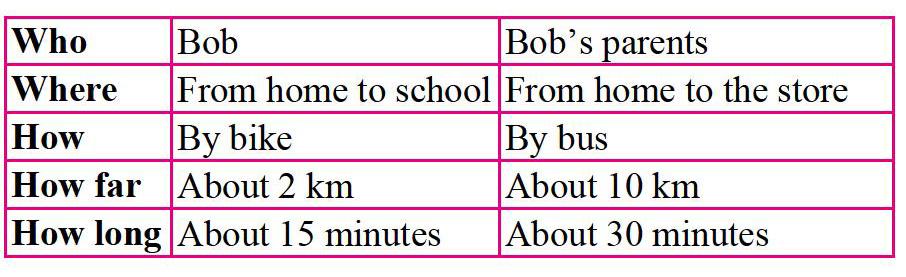
假如 Bob 是你的同學,他的父母在同一家服裝店上班。請你根據下面表格中的內容,用英語寫一篇短文,描述Bob上學及其父母上班的情況。
要求:
1﹒必須包括表格內所有信息;
2﹒詞數60左右,可適當發揮。
猜你喜歡
雪豆月讀·低年級(2022年11期)2022-12-12 03:33:20
閱讀(高年級)(2022年9期)2022-10-08 01:20:16
小學生必讀(中年級版)(2022年9期)2022-02-16 09:53:02
意林(2021年11期)2021-09-10 07:22:44
小讀者(2020年2期)2020-03-12 10:34:12
快樂語文(2018年36期)2018-03-12 00:55:56
文學少年(有聲彩繪)(2017年9期)2017-10-23 01:34:46
留學生(2016年6期)2016-07-25 17:55:29
小天使·一年級語數英綜合(2016年5期)2016-05-14 12:21:05
小朋友·聰明學堂(2014年7期)2015-01-15 12:07:06