基于WebofScience數(shù)據(jù)庫(kù)兒童及青少年腫瘤護(hù)理的文獻(xiàn)計(jì)量學(xué)分析
2020-09-22 11:24:10楊璐王國(guó)蓉鄭瑩瑩
醫(yī)學(xué)信息 2020年16期
楊璐 王國(guó)蓉 鄭瑩瑩


摘要:目的? 了解兒童與青少年腫瘤護(hù)理的研究進(jìn)展,為后續(xù)國(guó)內(nèi)研究提供參考。方法? 采用文獻(xiàn)計(jì)量法和可視化分析法,以Web of Science數(shù)據(jù)庫(kù)為數(shù)據(jù)源,時(shí)間范圍為2010~2019年,對(duì)兒童及青少年腫瘤護(hù)理的年發(fā)文量、國(guó)家分布、機(jī)構(gòu)分布及合作網(wǎng)絡(luò)、作者分布及合作網(wǎng)絡(luò)、期刊分布、高被引文獻(xiàn)、高頻關(guān)鍵詞等指標(biāo)進(jìn)行分析。結(jié)果? 2010~2019年共檢索1127篇相關(guān)文獻(xiàn),發(fā)文量呈逐年上升趨勢(shì)。共54個(gè)國(guó)家參與發(fā)文,發(fā)文量最多的是美國(guó)(437篇);220個(gè)機(jī)構(gòu)參與發(fā)文,以杜克大學(xué)(美國(guó),20篇)發(fā)文最多。根據(jù)Pajek繪制機(jī)構(gòu)網(wǎng)絡(luò)圖顯示,共46個(gè)節(jié)點(diǎn),176條連線,形成3個(gè)合作團(tuán)體,分別為美國(guó)與加拿大機(jī)構(gòu),其次是瑞典機(jī)構(gòu),中國(guó)香港地區(qū)機(jī)構(gòu)。利用Bibexcel提取作者數(shù)據(jù),作者h(yuǎn)指數(shù)以Miaskowski C最高(h=9)。根據(jù)Pajek繪制作者合作網(wǎng)絡(luò)圖顯示,共49個(gè)節(jié)點(diǎn),111條連線,形成5個(gè)合作團(tuán)體,分別為美國(guó)作者、瑞典作者、中國(guó)作者團(tuán)體集中在香港地區(qū)和臺(tái)灣地區(qū)、巴西作者。共102本期刊參與發(fā)文,發(fā)文最多的期刊是JOURNAL OF PEDIATRIC ONCOLOGY NURSING,引用率較高前10篇文獻(xiàn)包括5項(xiàng)質(zhì)性研究,1項(xiàng)橫斷面研究,1項(xiàng)縱向研究和3項(xiàng)干預(yù)研究,以Coyne I等發(fā)表的“Children's participation in shared decision-making: Children,adoles”被引頻次最高,為77次。高頻關(guān)鍵詞前3位分別是“兒童/children”(523次)“腫瘤/cancer”(520次)、“兒童腫瘤/childhood cancer”(390次),根據(jù)詞網(wǎng)絡(luò)聚類分析顯示,共形成3個(gè)關(guān)鍵詞聚類,分別是兒童與青少年腫瘤患者癥狀管理、信息支持與臨床決策、照顧者負(fù)擔(dān)。結(jié)論? 兒童與青少年腫瘤護(hù)理研究已形成較成熟的研究團(tuán)隊(duì),研究領(lǐng)域逐漸細(xì)化。中國(guó)發(fā)文量較高,尚未形成國(guó)際影響力,仍需要與國(guó)際團(tuán)隊(duì)加強(qiáng)國(guó)際合作交流,提升研究質(zhì)量。
關(guān)鍵詞:腫瘤護(hù)理;文獻(xiàn)計(jì)量學(xué);發(fā)文量
Abstract:Objective? To understand the research progress of children and adolescent tumor care, and provide reference for follow-up domestic research.Methods? Bibliometric methods and visual analysis methods were used. The Web of Science database was used as the data source. The time range was 2010~2019. The annual publication volume, national distribution, institutional distribution and cooperation network, author distribution and Analysis of indicators such as cooperative network, journal distribution, highly cited documents, and high-frequency keywords.Results? A total of 1127 related documents were retrieved from 2010 to 2019, and the number of articles published showed an upward trend year by year. A total of 54 countries participated in the publication of articles, with the United States (437 articles) with the largest amount of articles; 220 institutions participated in the publication of articles, with Duke University (US, 20 articles) publishing the most. According to the agency network diagram drawn by Pajek, there were a total of 46 nodes and 176 connections, forming 3 cooperative groups, namely the United States and Canada institutions, followed by the Swedish institutions and the Hong Kong regional institutions. Using Bibexcel to extract author data, Miaskowski C has the highest author h index (h=9). According to the author cooperation network diagram drawn by Pajek, there were a total of 49 nodes and 111 connections, forming 5 cooperative groups,The groups of American authors, Swedish authors, and Chinese authors were concentrated in Hong Kong and Taiwan, and Brazilian authors. A total of 102 journals participated in the publication of articles. The journal with the most publications is JOURNAL OF PEDIATRIC ONCOLOGY NURSING. The top 10 articles with a high citation rate include 5 qualitative studies, 1 cross-sectional study, 1 longitudinal study and 3 intervention studies. "Children's participation in shared decision-making: Children, adoles" published by Coyne I et al. has been cited the highest, 77 times. The top 3 high-frequency keywords were "children" (523 times), "tumor/cancer" (520 times), and "childhood cancer" (390 times). According to the word network clustering analysis, a total of the clusters of 3 keywords were the symptom management of children and adolescent tumor patients, information support and clinical decision-making, and caregiver burden.Conclusion? Child and adolescent tumor nursing research has formed a more mature research team, and the research field was gradually refined. China has issued a relatively high volume of papers and has not yet formed an international influence. It still needs to strengthen international cooperation and exchanges with international teams to improve the quality of research.
Key words:Cancer care;Bibliometrics;Number of publications
全球每年約30萬(wàn)兒童及青少年新患腫瘤[1],腫瘤是導(dǎo)致兒童及青少年死亡的第3大原因,占總死亡人數(shù)的9.1%[2]。全球疾病負(fù)擔(dān)研究(the global burden of cancer,GBD)報(bào)道[3],兒童及青少年腫瘤是全球第六大腫瘤負(fù)擔(dān),中國(guó)兒童腫瘤負(fù)擔(dān)居全球第2位,給患者、家庭、社會(huì)帶來(lái)嚴(yán)重傷害和經(jīng)濟(jì)負(fù)擔(dān)。兒童青少年發(fā)育不成熟,在腫瘤治療中易受到身心傷害。而父母作為患兒的代言人和照顧者,承受繁重的照顧任務(wù)和心理壓力。隨著醫(yī)學(xué)發(fā)展,兒童與青少年腫瘤患者預(yù)后改善[4],同時(shí)拓寬了護(hù)理研究領(lǐng)域。護(hù)士作為與患者及家屬接觸最頻繁的群體[5],參與從治療到康復(fù)的全過程,護(hù)理質(zhì)量與腫瘤治療效果息息相關(guān)。針對(duì)患兒身心特點(diǎn)以及家庭需求,為其提供優(yōu)質(zhì)護(hù)理,國(guó)際涌現(xiàn)諸多研究成果。本研究通過文獻(xiàn)計(jì)量與可視化分析,了解當(dāng)前兒童青少年腫瘤護(hù)理的研究現(xiàn)狀,旨在為我國(guó)相關(guān)護(hù)理研究提供參考,現(xiàn)報(bào)道如下。
1材料與方法
1.1資料來(lái)源與檢索策略? 計(jì)算機(jī)檢索Web of Science核心數(shù)據(jù)庫(kù),檢索詞為(Pediatric* OR Child* OR Adolescent* OR Adolescence OR Teen*)AND(Cancer OR Oncology OR Tumor* OR Neoplas*),研究方向?yàn)椤癗ursing”,文獻(xiàn)類型為“Article”,檢索時(shí)間截止2020年3月15日,文獻(xiàn)時(shí)間限定為2010~2019年。檢索出文獻(xiàn)1614條,最后共納入1127篇文獻(xiàn)。
1.2方法? 利用Bibexcel、Excel2017提取題錄信息,對(duì)數(shù)據(jù)進(jìn)行去重、排序,統(tǒng)計(jì)發(fā)文量、國(guó)家與機(jī)構(gòu)分布頻次、作者h(yuǎn)指數(shù)、期刊分布頻次、高頻關(guān)鍵詞。使用Pajek、Vosviwer軟件對(duì)作者合作網(wǎng)絡(luò)、機(jī)構(gòu)合作網(wǎng)絡(luò)、關(guān)鍵詞聚類進(jìn)行可視化分析,尋找學(xué)術(shù)影響力大的團(tuán)隊(duì)和作者,把握研究熱點(diǎn)。
2結(jié)果
2.1年發(fā)文量? 2010~2019年共檢索到1127篇相關(guān)文獻(xiàn),發(fā)文量呈逐年上升趨勢(shì),見圖1。
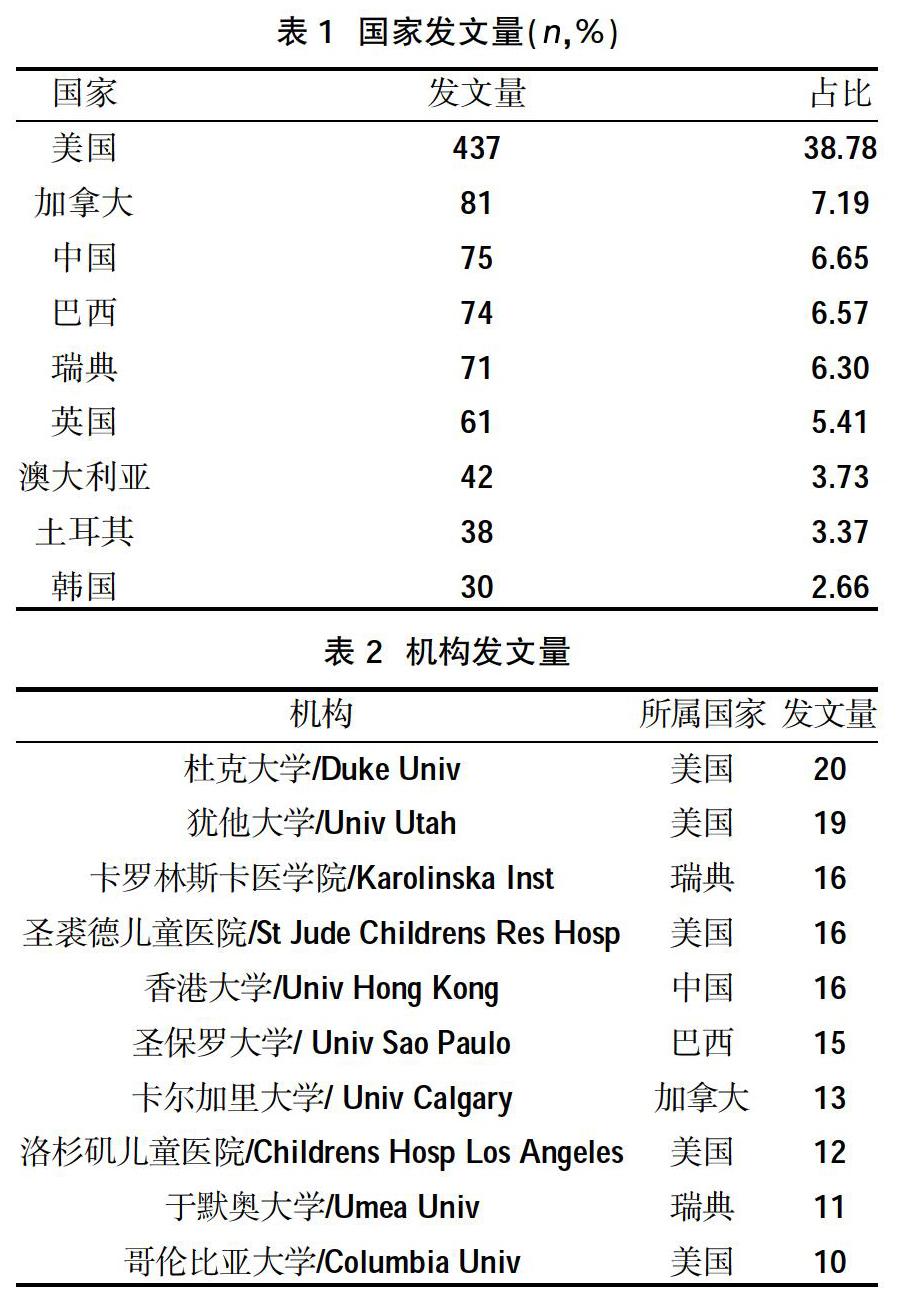
2.2國(guó)家分布? 共54個(gè)國(guó)家參與發(fā)文,發(fā)文量最多的是美國(guó),其次是加拿大,中國(guó)發(fā)文量居第3位,排名前9的發(fā)文量國(guó)家見表1。
2.3機(jī)構(gòu)分布及合作網(wǎng)絡(luò)
2.3.1機(jī)構(gòu)發(fā)文量? 共220個(gè)機(jī)構(gòu)參與發(fā)文,以杜克大學(xué)(美國(guó))發(fā)文最多,見表2。
2.3.2機(jī)構(gòu)合作網(wǎng)絡(luò)? 根據(jù)Pajek繪制機(jī)構(gòu)網(wǎng)絡(luò)圖,共46個(gè)節(jié)點(diǎn),176條連線,形成3個(gè)合作團(tuán)體,美國(guó)與加拿大機(jī)構(gòu)合作密切,其次是瑞典機(jī)構(gòu)合作網(wǎng)絡(luò),中國(guó)香港地區(qū)合作。美國(guó)杜克大學(xué)連線最多,中心性高(中心性0.49),其次是美國(guó)阿拉巴馬大學(xué)伯明翰分校(中心性0.47)和加拿大多倫多兒童醫(yī)院(中心性0.47);中國(guó)學(xué)者發(fā)文多,但機(jī)構(gòu)在圖譜中出現(xiàn)較少并處于邊緣狀態(tài)。
2.4作者分布及合作網(wǎng)絡(luò)
2.4.1作者h(yuǎn)指數(shù)? 作者h(yuǎn)指數(shù)指作者影響力大小,指該作者發(fā)表的Np篇論文中有h篇論文每篇至少被引用h次,一般認(rèn)為h指數(shù)≥6提示該作者學(xué)術(shù)影響大。利用Bibexcel提取作者數(shù)據(jù),匹配國(guó)家、機(jī)構(gòu),進(jìn)行去重排序后計(jì)算得出排名前10位的作者,見表3。
2.4.2作者合作網(wǎng)絡(luò)? 使用Pajek繪制作者合作網(wǎng)絡(luò)圖,包括49個(gè)節(jié)點(diǎn),111條連線。共5個(gè)合作團(tuán)體,分別為美國(guó)作者團(tuán)體、瑞典作者團(tuán)體、中國(guó)作者團(tuán)體集中在香港地區(qū)和臺(tái)灣地區(qū)、巴西作者團(tuán)體。
2.5期刊分布? 共102本期刊參與發(fā)文,發(fā)文最多的期刊是JOURNAL OF PEDIATRIC ONCOLOGY NURSING,見表4。
2.6高被引文獻(xiàn)? 引用率較高前10篇文獻(xiàn),包括5項(xiàng)質(zhì)性研究,1項(xiàng)橫斷面研究,1項(xiàng)縱向研究,和3項(xiàng)干預(yù)研究,見表5。
2.7關(guān)鍵詞分析? 使用Bibexcel提取關(guān)鍵詞數(shù)據(jù),使用Excel2017進(jìn)行去重、排序,得出前10位高頻關(guān)鍵詞見表6。
將數(shù)據(jù)導(dǎo)入Vosviewer軟件繪制關(guān)鍵詞網(wǎng)絡(luò),進(jìn)行聚類分析,共形成3個(gè)關(guān)鍵詞聚類,分別為兒童與青少年腫瘤患者癥狀管理(白血病、幸存者、癥狀、生活質(zhì)量、化療、疲乏、結(jié)局、信度、效度)、信息支持與臨床決策(父母、家庭、生活、臨終關(guān)懷、質(zhì)性研究、經(jīng)歷、信息、需求、照顧、影響、支持、感知、交流)、照顧者負(fù)擔(dān)(調(diào)整、疼痛、焦慮、抑郁、干預(yù)、管理、母親、兒童、社會(huì)支持、壓力),見圖2。
3討論
3.1兒童與青少年腫瘤護(hù)理研究現(xiàn)況? 本研究結(jié)果顯示,兒童與青少年腫瘤護(hù)理相關(guān)發(fā)文量呈上升趨勢(shì)。從國(guó)家、機(jī)構(gòu)、作者合作發(fā)文來(lái)看,美國(guó)發(fā)文量最高,其中美國(guó)杜克大學(xué)是發(fā)文量最多的機(jī)構(gòu)。目前以美國(guó)、加拿大、瑞典等國(guó)家構(gòu)成研究主體,內(nèi)部機(jī)構(gòu)、作者合作次數(shù)多,形成一定合作規(guī)模,提示國(guó)內(nèi)學(xué)者及時(shí)關(guān)注這些團(tuán)隊(duì)的研究動(dòng)態(tài)。雖然中國(guó)發(fā)文量較高,但中國(guó)機(jī)構(gòu)在網(wǎng)絡(luò)圖譜中出現(xiàn)次數(shù)少,并處于邊緣狀態(tài),提示中國(guó)應(yīng)加強(qiáng)對(duì)外交流與合作,提升研究水平和影響力。中國(guó)發(fā)文量最多的機(jī)構(gòu)是香港大學(xué),作者h(yuǎn)指數(shù)和文獻(xiàn)引用次數(shù)較高,可加強(qiáng)合作。
3.2兒童與青少年腫瘤護(hù)理研究熱點(diǎn)
3.2.1通過高被引文獻(xiàn)分析研究基礎(chǔ)? 研究發(fā)現(xiàn)[9],腫瘤患兒與家庭面臨治療副作用、痛苦情緒、生活秩序混亂、社會(huì)挑戰(zhàn)等多種壓力,應(yīng)對(duì)家庭及患者早期干預(yù)。被引次數(shù)最多的Coyne I等[8]研究,結(jié)果發(fā)現(xiàn)7~16歲的患者對(duì)疾病信息需求高,希望參與共同決策,而不僅限于父母作代言人。因此要鼓勵(lì)兒童及青少年表達(dá)意愿,配合治療。Gibson F等[9]構(gòu)建了適用于不同年齡段患兒的信息溝通共享模式,使腫瘤服務(wù)真正滿足兒童的需要。Crawshaw MA等[12]對(duì)10例青少年腫瘤患者訪談后發(fā)現(xiàn),由于青春期心理特征是獨(dú)立、給外界積極的形象,青少年對(duì)于腫瘤治療會(huì)有“失控”感,易感到挫折、憤怒,從而不配合治療。Hildenbrand AK等[13]報(bào)道了兒童與青少年腫瘤患者化療期間癥狀軌跡,隨著時(shí)間推移情緒負(fù)擔(dān)增加。疲乏是在腫瘤治療過程中最常見的癥狀之一,Yeh CH等[16]為期6周的一項(xiàng)隨機(jī)對(duì)照試驗(yàn)顯示,家庭有氧運(yùn)動(dòng)可減輕急性淋巴細(xì)胞白血病患兒的疲乏,但該方案仍需大樣本試驗(yàn)。Zupanec S等[17]研究發(fā)現(xiàn),睡眠障礙與腫瘤患兒疲乏呈正相關(guān),說(shuō)明睡眠障礙也是護(hù)理干預(yù)的潛在目標(biāo)之一。在疼痛方面,Nguyen TN等[10]研究發(fā)現(xiàn),使用音樂療法可有效減輕腰椎穿刺患兒的疼痛和恐懼感。
目前,兒童及青少年腫瘤患者5年生存率約80%[4],幸存者康復(fù)研究成為熱點(diǎn)。國(guó)外成立了專業(yè)的兒童腫瘤幸存者研究中心,持續(xù)監(jiān)測(cè)和追蹤幸存者健康狀況[18]。Hardy KK等[15]研究發(fā)現(xiàn),使用計(jì)算機(jī)認(rèn)知功能恢復(fù)訓(xùn)練可有效緩解幸存者的認(rèn)知后遺癥。Crawshaw MA等[12]提出應(yīng)關(guān)注成年幸存者的生育顧慮,提供信息支持,促進(jìn)患者的自我認(rèn)同。Linder LA等[19]研究表明,促進(jìn)幸存者回歸學(xué)校、社會(huì),這需要家庭、醫(yī)院、社會(huì)共同參與并長(zhǎng)期干預(yù)。
3.2.2通過關(guān)鍵詞網(wǎng)絡(luò)挖掘研究熱點(diǎn)? ①癥狀管理:由生活質(zhì)量、幸存者、白血病、化療、癥狀、信度、效度等關(guān)鍵詞構(gòu)成。白血病[18]約占兒童腫瘤總發(fā)病率的1/3,但生存率較高。目前關(guān)注患兒癥狀評(píng)估和干預(yù),致力提升患兒生活質(zhì)量。由于癥狀是一種主觀體驗(yàn)[19],而目前的癥狀評(píng)估依賴于對(duì)孩子的觀察,而不是詢問,需要進(jìn)一步培養(yǎng)醫(yī)護(hù)人員癥狀評(píng)估的能力。為了更好地進(jìn)行癥狀評(píng)估,量表修訂是研究熱點(diǎn)之一,生活質(zhì)量與癥狀評(píng)估量表[20,21]、照顧者負(fù)擔(dān)評(píng)估量表[22,23]等應(yīng)用廣泛。伴隨移動(dòng)護(hù)理的應(yīng)用[24], Linder LA等[25]研究表明,可通過互聯(lián)網(wǎng)技術(shù)捕捉患者前驅(qū)癥狀進(jìn)行早期干預(yù),可加強(qiáng)癥狀管理的科學(xué)性。這些研究提示學(xué)者既可以進(jìn)行量表研發(fā),借助互聯(lián)網(wǎng)技術(shù)跨專業(yè)合作,也可借助我國(guó)中醫(yī)藥文化,針對(duì)患兒生理特點(diǎn)進(jìn)行中醫(yī)理療技術(shù)改良,緩解癥狀。②信息支持與臨床決策:由父母、家庭、照顧、經(jīng)歷、影響、溝通、質(zhì)性研究、臨終關(guān)懷等關(guān)鍵詞組成。Hendricks-Ferguson VL等[26]和Ye ZJ等[27]研究發(fā)現(xiàn),由于疾病知識(shí)缺乏,腫瘤患兒死亡后,多數(shù)父母會(huì)為他們的決策后悔。因此對(duì)預(yù)后不良的腫瘤患兒,有必要早期提供疾病、姑息和臨終關(guān)懷的信息支持,幫助家庭進(jìn)行決策。社交媒體可以成為實(shí)施干預(yù)的潛在平臺(tái),能促進(jìn)同伴支持和信息交流,可進(jìn)一步研究使用社交媒體能否加強(qiáng)照顧者的支持感,減輕痛苦[28]。患兒也有疾病信息需求,Robertson EG等[29]調(diào)查顯示,患兒對(duì)父母作為代言人的滿意度不同。如何平衡患者和父母相互沖突的信息偏好[30],需要進(jìn)一步研究。提示國(guó)內(nèi)學(xué)者應(yīng)根據(jù)兒童及青少年腫瘤患者的心理特征,改進(jìn)溝通模式,重視身心需求。③照顧者負(fù)擔(dān):目前照顧者研究對(duì)象多為母親,認(rèn)為母親作為直接照顧者,更容易受到傷害[31,32]。但有研究顯示[33],不同性別焦慮、抑郁、創(chuàng)傷后應(yīng)激障礙程度無(wú)差異,且兒童及青少年腫瘤患者的父母焦慮癥患病率約為21%,中度到高度抑郁的患病率約為28%,創(chuàng)傷后應(yīng)激障礙的患病率約為26%,均高于正常人群,強(qiáng)調(diào)關(guān)心整個(gè)家庭的精神健康的重要性。
綜上所述,目前兒童與青少年腫瘤患者護(hù)理研究不斷發(fā)展,通過高被引文獻(xiàn)和關(guān)鍵詞分析發(fā)現(xiàn),目前的研究熱點(diǎn)主要是兒童與青少年腫瘤患者的癥狀管理、信息支持與溝通、照顧者負(fù)擔(dān)。研究方向與延續(xù)護(hù)理、臨終關(guān)懷相結(jié)合。未來(lái)國(guó)內(nèi)學(xué)者可借鑒國(guó)際趨勢(shì),根據(jù)我國(guó)不同文化、民族、地區(qū)特點(diǎn)進(jìn)行本土化研究,加強(qiáng)合作,提高研究質(zhì)量,為患者及家庭提供更為科學(xué)的護(hù)理措施。
參考文獻(xiàn):
[1]Lin B,Gutman T,Hanson CS,et al.Communication during childhood cancer:Systematic review of patient perspectives[J].Cancer,2020,126(4):701-716.
[2]Cunningham RM,Walton MA,Carter PM.The Major Causes of Death in Children and Adolescents in the United States[J].N Engl J Med,2018(379):2468-2475.
[3]GBD 2017 Childhood Cancer Collaborators.The global burden of childhood and adolescent cancer in 2017:an analysis of the Global Burden of Disease Study 2017[J].Lancet Oncol,2019,20(9):1211-1225.
[4]Fidler MM,Reulen RC,Bright CJ,et al.Respiratory mortality of childhood, adolescent and young adult cancer survivors[J].Thorax,2018,73(10):959-968.
[5]Cantrell MA.The art of pediatric oncology nursing practice[J].J Pediatr Oncol Nurs,2007(24):132-138.
[8]Coyne I,Amory A,Kiernan G,et al.Children's participation in shared decision-making: children,adolescents,parents and healthcare professionals' perspectives and experiences[J].Eur J Oncol Nurs,2014,18(3):273-280.
[9]Gibson F,Aldiss S,Horstman M,et al.Children and young people's experiences of cancer care:a qualitative research study using participatory methods[J].International Journal of Nursing Studies,2010,47(11):1397-1407.
[10]Baggott C,Dodd M,Kennedy C,et al.Changes in children's reports of symptom occurrence and severity during a course of myelosuppressive chemotherapy[J].J Pediatr Oncol Nurs,2010(27):307-315.
[11]Nguyen TN,Nilsson S,Hellstrom AL,et al.Music therapy to reduce pain and anxiety in children with cancer undergoing lumbar puncture:a randomized clinical trial[J].J Pediatr Oncol Nurs,2010,27(3):146-155.
[12]Crawshaw MA,Sloper P.‘Swimming against the tide'--the influence of fertility matters on the transition to adulthood or survivorship following adolescent cancer[J].Eur J Cancer Care(Engl),2010,19(5):610-620.
[13]Hildenbrand AK,Clawson KJ,Alderfer MA,et al.Coping with pediatric cancer: strategies employed by children and their parents to manage cancer-related stressors during treatment[J].J Pediatr Oncol Nurs,2011,28(6):344-354.
[14]Wicks L,Mitchell A.The adolescent cancer experience: loss of control and benefit finding[J].Eur J Cancer Care(Engl),2010(19):778-785.
[15]Hardy KK,Willard VW,Bonner MJ.Computerized cognitive training in survivors of childhood cancer:a pilot study[J].J Pediatr Oncol Nurs,2011,28(1):27-33.
[16]Yeh CH,Man WJP,Lin US,et al.A pilot study to examine the feasibility and effects of a home-based aerobic program on reducing fatigue in children with acute lymphoblastic leukemia[J].Cancer Nurs,2011,34(1):3-12.
[17]Zupanec S,Jones H,Stremler R.Sleep habits and fatigue of children receiving maintenance chemotherapy for ALL and their parents[J].Journal of Pediatric Oncology Nursing,2010,27(4):217-228.
[18]劉硯燕,樓建華,趙秀芳,等.兒童和青少年白血病患兒治療期生活質(zhì)量現(xiàn)狀及其影響因素分析[J].中華護(hù)理雜志,2013,48(10):910-913.
[19]Linder LA,Wawrzynski SE.Staff Perceptions of Symptoms,Approaches to Assessment,and Challenges to Assessment Among Children With Cancer[J].J Pediatr Oncol Nurs,2018,35(5):332-341.
[20]Al-Gamal E,Long T.The Psychometric Properties of an Arabic version of the PedsQL Multidimensional Fatigue Scale Tested for Children with Cancer[J].Compr Child Adolesc Nurs,2017,40(3):188-199.
[21]Akcay DN,Yavuz B,Yardimci F,et al.Validity and Reliability of the Turkish Version of the Adapted Rhodes Index of Nausea and Vomiting for Pediatrics by Child(ARINVc)and by Parent(ARINVp)[J].J Pediatr Oncol Nurs,2018,35(5):353-360.
[22]Bu XQ,You LM,Li Y,et al.Psychometric Properties of the Kessler 10 Scale in Chinese Parents of Children With Cancer[J].Cancer Nurs,2017,40(4):297-304.
[23]Rybojad B,Aftyka A,Samardakiewicz M.Factor analysis and validity of the Polish version of the Peritraumatic Distress Inventory in mothers of seriously ill children[J].J Clin Nurs,2018,27(21-22):3945-3952.
[24]Vaughn J,Jonassaint J,Summers-Goeckerman E,et al.Customization of the TRU-PBMT App (Technology Recordings to better Understand Pediatric Blood and Marrow Transplant)[J].J Pediatr Nurs,2018(42):86-91.
[25]Linder LA,Stegenga K,Erickson J,et al.Priority Symptoms,Causes,and Self-Management Strategies Reported by AYAs With Cancer[J].J Pain Symptom Manage,2019,58(5):774-783.
[26]Hendricks-Ferguson VL,Haase JE.Parent Perspectives of Receiving Early Information About Palliative and End-of-Life Care Options From Their Child's Pediatric Providers[J].Cancer Nurs,2019,42(4):E22-E30.
[27]Ye ZJ,Cheng MH,Zhang XY,et al.Treatment Decision Making and Regret in Parents of Children With Incurable Cancer[J].Cancer Nurs,2019.
[28]Nagelhout ES,Linder LA,Austin T,et al.Social Media Use Among Parents and Caregivers of Children With Cancer[J].J Pediatr Oncol Nurs,2018,35(6):399-405.
[29]Robertson EG,Wakefield C E,Shaw J,et al.Decision-making in childhood cancer:parents' and adolescents' views and perceptions[J].Support Care Cancer,2019,27(11):4331-4340.
[30]Tenniglo LJA,Loeffen EAH,Kremer LCM,et al.Patients' and parents' views regarding supportive care in childhood cancer[J].Support Care Cancer,2017,25(10):3151-3160.
[31]Fletcher PC.My child has cancer:the costs of mothers' experiences of having a child with pediatric cancer[J].Issues Compr Pediatr Nurs,2010,33(3):164-184.
[32]Landolt MA,Ystrom E,Sennhauser FH,et al.The mutual prospective influence of child and parental post-traumatic stress symptoms in pediatric patients[J].J Child Psychol Psychiatry,2012,53(7):767-774.
[33]van Warmerdam J,Zabih V,Kurdyak P,et al.Prevalence of anxiety,depression,and posttraumatic stress disorder in parents of children with cancer:A meta-analysis[J].Pediatr Blood Cancer,2019,66(6):e27677.
收稿日期:2020-05-12;修回日期:2020-05-22
編輯/杜帆