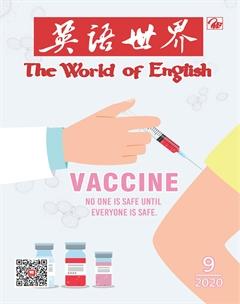
不信任疫苗或致全球危機
2020-10-09 11:18:55米歇爾·羅伯茨
英語世界 2020年9期
關鍵詞:疫情
米歇爾·羅伯茨
Public mistrust of vaccines means the world is taking a step backwards in the fight against deadly yet preventable infectious diseases, warn experts.專家警告說,公眾對疫苗的不信任意味著,世界在同那些致命卻可預防的傳染病的抗爭中倒退了一步。
The biggest global study into attitudes on immunisation suggests confidence is low in some regions.
The Wellcome Trust analysis includes responses from more than 140,000 people in over 140 countries.
The World Health Organization lists vaccine hesitancy as one of the top 10 threats to global health.
The global survey reveals the number of people who say they have little confidence or trust in vaccination.
When asked if vaccines were safe:
79% somewhat or strongly agreed
7% somewhat or strongly disagreed
14% neither agreed nor disagreed
When asked if they believed vaccines worked:
84% agree either strongly or somewhat
5% either strongly or somewhat disagree
12% neither agreed nor disagreed
Why does it matter?
There is overwhelming scientific evidence that vaccination is the best defence against deadly and debilitating infections, such as measles.
Vaccines protect billions of people around the world. They have completely got rid of one disease—smallpox—and are bringing the world close to eliminating others, such as polio.
But some other diseases, such as measles, are making a resurgence and experts say people avoiding vaccines, fuelled by fear and misinformation, is one of the main causes.
Dr Ann Lindstrand, an expert in immunisation at the WHO, said the current situation was extremely serious.
“Vaccine hesitancy has the potential, at least in some places, to really hinder the very real progress the world has made in controlling vaccine-preventable diseases,” she said. “Any resurgence we see in these diseases are an unacceptable step backwards.”
What about measles?
Countries that were close to eliminating measles have been seeing large outbreaks. Data shows a rise in cases in almost every region of the world, with 30% more cases in 2017 than 2016.
A decision not to vaccinate, for whatever reason, poses a risk to others as well as the individual from being infected themselves.
If enough people are vaccinated, it stops the disease from spreading through a population—something experts call “herd immunity”. Imran Khan, from the Wellcome Trust, said: “We are really concerned at the moment because for measles, anything less than 95% coverage can lead to outbreaks and that is what we are seeing.”
Where was trust low?
Some people living in several higher-income regions were among the least certain about vaccine safety.
In France—a country among several European ones now experiencing outbreaks of measles—one in three disagreed that vaccines were safe, according to the survey. That was the highest percentage for any country worldwide. People in France were also among the most likely to disagree that vaccines were effective, at 19%, and to disagree that vaccines were important for children to have, at 10%. The French government has now added eight more compulsory vaccinations to the three children in the country already receive.
Neighbouring Italy—where 76% agreed vaccines were safe—recently passed a law that allows schools to ban unvaccinated children, or fine their parents, after immunisation rates dwindled.
The UK has yet to go this far but Health Secretary Matt Hancock has said he “wont rule out” the idea of introducing compulsory vaccinations if necessary.
The US has also been experiencing its own measles outbreak—the biggest to hit the country in decades, with more than 980 confirmed cases in 26 states in 2019 to date.
In Northern America, and Southern and Northern Europe, just over 70% of people agreed that vaccines were safe. The figure was as low as 59% in Western Europe, and 50% in Eastern Europe.
Where was trust high?
Most people in lower-income areas agreed vaccines were safe. The highest number was in South Asia, where 95% of people agreed, followed by Eastern Africa, where the figure was 92%.
Bangladesh and Rwanda had nearly universal agreement about the safety and effectiveness and have achieved very high immunisation rates despite many challenges in physically getting vaccines to people.
Rwanda became the worlds first low-income country to provide young women universal access to the HPV vaccine that protects against cervical cancer.
What makes people sceptical?
In the survey, people with more trust in scientists, doctors and nurses tended to be more likely to agree that vaccines were safe. Conversely, those who had sought information about science, medicine or health recently appeared to be less likely to agree.
The Wellcome report does not explore all of the reasons behind low confidence but researchers say there are likely to be many factors involved.
Some of it may be complacency—if a disease has become less common, then the need to get immunised may feel less pressing when weighing the benefits against any possible risk.
The internet means beliefs and concerns about vaccines can be shared in an instant, spreading information that isnt necessarily based on fact.
In Japan, concerns about the HPV vaccine and a reported link with neurological problems were widely publicised, which experts think knocked confidence in immunisation in general.
Similarly, in France, there was controversy about a pandemic influenza vaccine—accusations that the government bought high quantities of the vaccine and unsubstantiated claims that it had been made too quickly and couldnt be safe.
In the UK, there has been misinformation circulating about the MMR jab and autism.
Dr Lindstrand said: “One of the most important interventions to counteract doubts and worries about vaccines is to have health workers really well trained and able and ready to recommend vaccinations based on scientific truth and to be able to respond correctly to questions and concerns that parents have and communities have.”
全球范圍最大的有關免疫態度的調研表明,某些地區的人信心不足。
英國惠康信托基金會的調研分析了超過 140 個國家逾 14萬人的答卷。
世界衛生組織將對接種疫苗猶豫不決列為了全球健康的十大威脅之一。
該項全球調研顯示出對疫苗接種沒有信心或根本不信任的人數。
當被問到是否認為疫苗安全時:
79% 某種程度上同意或強烈同意
7% 某種程度上不同意或強烈不同意
14% 既不同意也不反對
當被問到是否相信疫苗有效時:
84% 某種程度上同意或強烈同意
5% 某種程度上不同意或強烈不同意
12% 既不同意也不反對
疫苗為什么重要?
大量科學證據表明,接種疫苗是預防像麻疹這樣致命和使人衰弱的傳染病的最佳方法。
疫苗可以保護全球數十億人的健康安全。疫苗已徹底鏟除了天花,并將消滅小兒麻痹癥等其他疾病。
但還有些疾病,例如麻疹,正死灰復燃——專家說,主要原因之一是人們由于恐懼和錯誤認知而不接種疫苗。
世衛組織免疫專家安·林德斯特蘭德博士說,目前形勢極其嚴峻。
她說:“至少在某些地方,公眾對疫苗接種猶豫不決,而這可能真的阻礙世界在控制疫苗可預防疾病方面取得實實在在的進展。這些疾病出現任何死灰復燃的跡象都是令人無法接受的倒退。”
麻疹怎么了?
即將滅絕麻疹的國家又暴發了大規模麻疹疫情。數據顯示,世界上幾乎每一個地區的疫情病例數量都有所增加,2017年比2016年增加了30%。
無論出于何種原因決定不接種疫苗,都會增加本人及他人的感染風險。
如果足夠多的人接種疫苗,將阻止該疾病在人群中傳播——專家稱此為“群體免疫”。惠康信托基金會的伊姆蘭·汗說:“目前,我們真的很擔心,因為對于麻疹來說,疫苗接種低于95%的覆蓋率都可能導致疫情暴發,這就是我們正在見證的。”
哪里的信任度低?
居住在較高收入地區的一些人對疫苗的安全性最不信任。
調查顯示,法國是麻疹疫情暴發的歐洲國家之一,三分之一的法國人認為疫苗不安全。這是全球所有國家中不信任占比最高的。法國人對疫苗有效性的懷疑也排在前列,占比19%,另外,10%的人認為疫苗接種對兒童并不重要。法國政府現在已將該國兒童強制接種疫苗的種類從3種增加到了11種。
法國的鄰國意大利有76%的人認為疫苗是安全的。意大利疫苗接種率下降后,該國最近通過了一項法律,允許學校拒收未接種疫苗的孩子或對其父母罰款。
英國還沒有那么嚴格,但衛生大臣馬特·漢考克已經表示,他“不排除”必要時考慮采取強制接種的措施。
美國也一直在經歷麻疹的暴發——這是幾十年來該國最大的麻疹疫情,截至2019年6月已有26個州確診超過980例病例。
在北美、南歐和北歐,認為疫苗安全的人占比僅略高于70%。在西歐,這一數字低至59%,東歐僅為50%。
哪里的信任度高?
較低收入地區的大多數人都認為疫苗安全。信任度最高的是南亞,有95%的人表示贊同;其次是東非,92%。
在孟加拉國和盧旺達,人們普遍認同疫苗的安全和有效,盡管在獲得疫苗上還面臨許多挑戰,但接種率非常高。
盧旺達成為世界上第一個為年輕女性普遍接種預防宮頸癌的人乳頭瘤病毒疫苗(HPV疫苗)的低收入國家。
是什么讓人們心懷疑慮?
在調研中,對科學家和醫護人員更信任的人往往認同疫苗是安全的。相反,那些曾搜尋科學、醫學或健康信息的人最近似乎不太認同。
惠康的報告并未探討低信認度背后的所有原因,但是研究人員表示,這可能涉及多方面因素。
有些人可能抱有僥幸心理——如果某種疾病變得不那么普遍了,權衡利弊,接種疫苗可能就沒那么緊迫了。
互聯網意味著人們可以瞬間共享關于疫苗的各種看法和疑慮,傳播不一定基于事實的信息。
在日本,對HPV疫苗及其所謂與神經系統疾病有關的擔憂廣為流傳,專家認為這普遍打擊了人們對疫苗接種的信心。
與之相似,在法國,對某種大流行性流感疫苗也存在爭議——有人指責政府購買了大量疫苗,還有人毫無根據地指稱疫苗生產得太快而不可能安全。
在英國,有關MMR(麻疹、 流行性腮腺炎、 風疹)疫苗接種和孤獨癥的不實信息四處流傳。
林德斯特蘭德博士說:“要消除對疫苗的懷疑和憂慮,最重要的措施之一就是讓衛生工作者真正接受良好的培訓,有能力并準備好基于科學事實提供疫苗接種建議,并能夠準確回應父母和社區居民的問題和疑慮。”
(譯者為“《英語世界》杯”翻譯大賽獲獎者)
猜你喜歡
北京測繪(2022年5期)2022-11-22 06:57:43
音樂天地(音樂創作版)(2022年1期)2022-04-26 13:51:10
今日農業(2021年3期)2021-03-19 08:38:00
今日農業(2021年1期)2021-03-19 08:35:42
小學生學習指導(中年級)(2020年12期)2021-01-08 02:50:02
人大建設(2020年5期)2020-09-25 08:56:22
快樂作文(1.2年級)(2020年8期)2020-09-10 07:22:44
北極光(2020年1期)2020-07-24 09:04:04
安徽醫學(2020年6期)2020-07-17 12:18:48
文苑(2020年4期)2020-05-30 12:35:48