“十四五”土壤質量與食物安全前沿趨勢與發展戰略*
2020-10-22 08:05:42徐建明劉杏梅2
土壤學報 2020年5期
徐建明劉杏梅2
“十四五”土壤質量與食物安全前沿趨勢與發展戰略*
徐建明1,2?,劉杏梅1,2
(1. 浙江大學環境與資源學院,杭州 310058;2. 浙江省農業資源與環境重點實驗室,杭州 310058)
土壤質量與食物安全和人體健康息息相關。土壤質量與食物安全這一分支學科作為“十四五”土壤科學發展戰略重要的組成部分,致力于治理與改善耕地土壤質量以應對糧食安全危機。文獻計量結果表明,與發達國家相比,中國在該領域的研究起步較晚,但近年呈現加速上升甚至有超越的趨勢。隨著氣候及環境污染問題凸顯,國際上的相關研究熱點集中于環境監測、土地利用、施肥管理、污染修復(重金屬、抗生素、有機農藥和病原微生物)及可持續發展等方面。本學科以土壤質量、土壤污染和糧食安全為重點研究方向,通過與地理信息學、環境科學、應用數學、醫學等學科的交叉融合,借助同位素源解析、生物地球化學循環、分子生物學等前沿性理論與技術,未來將解決區域土壤質量監測、養分質量管理、食物安全與人體健康風險、土壤-作物系統中污染物遷移轉化及阻控修復等關鍵科學問題。
土壤質量;食物安全;土壤污染;計量分析;未來需求
土壤質量指土壤維持生態系統生產力,保障環境質量,促進動物和人類健康的能力[1],而在土壤學背景下食物安全主要指通過系列保障措施確保生產無毒、無害的農產品,包括生產過程安全與產品安全[2]。土壤質量與食物安全這一學科旨在綜合評估和改善土壤質量,保障土壤生態安全和資源可持續利用,運用規范的生產技術、方式及標準,生產對人或動物健康不產生危害或潛在危害的農業食品[3]。
本學科致力于為我國農業生產的可持續安全發展提供基礎理論和技術途徑,通過治理與改善耕地土壤質量來應對食物安全問題的挑戰[4]。該研究過程具有周期長、工程大、多技術手段、多學科交叉、區域管理多樣性等特點[5]。
學科本身涵蓋了土壤生產綜合指標體系、土壤生態環境功能、食物安全及健康風險[6]、地理信息技術及數學模型[7-9]、土壤污染遷移轉化、農業管理及品種篩選[10]、土壤質量改良及污染修復[11]等多個分支方向。隨著世界溫飽問題的解決及全球一體化進程的加快,大部分國家和地區已從食物產量短缺的危機轉向由產地污染引起的食物安全問題,繼而使得食物的質量安全上升為人類普遍關注的焦點。考慮土壤質量與食物安全之間的關系需要從土壤質量退化、農業投入品施用、土壤環境污染風險管控、農業管理對策及措施等各個方面進行切入[12]。
本文介紹了土壤質量與食物安全學科的研究進展,從文獻計量分析[13-14]的角度闡述該學科現有方向及國內外研究熱點,并根據當前的需求提出該學科的關鍵問題、理論前沿及優先交叉研究領域,為該學科的探索和發展提供啟示與未來方向。
1 學科發展現狀
1.1 研究方向
土壤質量與食物安全這一學科共設置了三大研究方向。(1)土壤質量。其主要關鍵詞包括土壤有機碳,土壤氮素管理,土壤微生物生物量,種植與耕作措施,土壤生物指標,土壤物理指標,土壤化學指標,土壤綜合指標,土壤質量指數,土壤生態功能,遙感監測,土壤肥力質量,土壤環境質量,土壤健康質量,食物安全,地統計學,地理信息系統。(2)土壤污染與農產品安全。其主要關鍵詞為產地環境,污染物吸收,污染物遷移,污染物轉運,污染物轉化,農產品安全,農產品品質,綠色農產品,農產品重金屬積累,農產品農藥殘留,品種篩選,作物抗逆性,風險預警,風險評估,實驗模擬,模型模擬,生物污染,抗性基因,環境醫學。(3)土壤質量與糧食安全。主要關鍵詞為農田地力,農田生產力,耕地質量,土壤退化,土壤肥力,土壤肥力減退,鹽堿土改良,承載力,閾值,農業管理,種植結構,商品糧基地,糧食安全,可持續發展,全球變化,情景分析,模型模擬,需求預測。
1.2 研究熱點——基于文獻計量
基于Web of Science(WoS)核心合集數據庫,本文通過對關鍵文獻、研究主題、關鍵詞的聚類分析,獲得了現階段關于土壤質量與農產品、糧食安全的研究熱點,歸納總結了其變遷及未來的趨勢。
1.2.1 土壤質量熱點分析文獻計量 近些年來,國際上對于土壤質量相關問題的關注程度越來越高[15],發文數量逐年增大(圖1)。在該領域發文數量排名前5的國家是美國、中國、巴西、西班牙和印度。歐洲一些國家由于曾面臨嚴重的土壤質量問題[12,16-17],因而對土壤質量問題的關注較早[16,18-19]。亞洲國家對于土壤質量問題的相關研究起步較晚,但是近些年來呈加速上升趨勢。美國起步較早,前期開展了大量研究,后期速度放緩。值得注意的是,中國在土壤質量研究領域異軍突起,近些年來的發文量逐漸超過美國,成為該領域發文量最大的國家。從發文的主要學科來看,土壤科學的發文比重最大,說明關于土壤質量問題的研究,一直是土壤科學工作者關注的重點,此外環境科學領域對于土壤質量的關注程度也占有一定的比例。
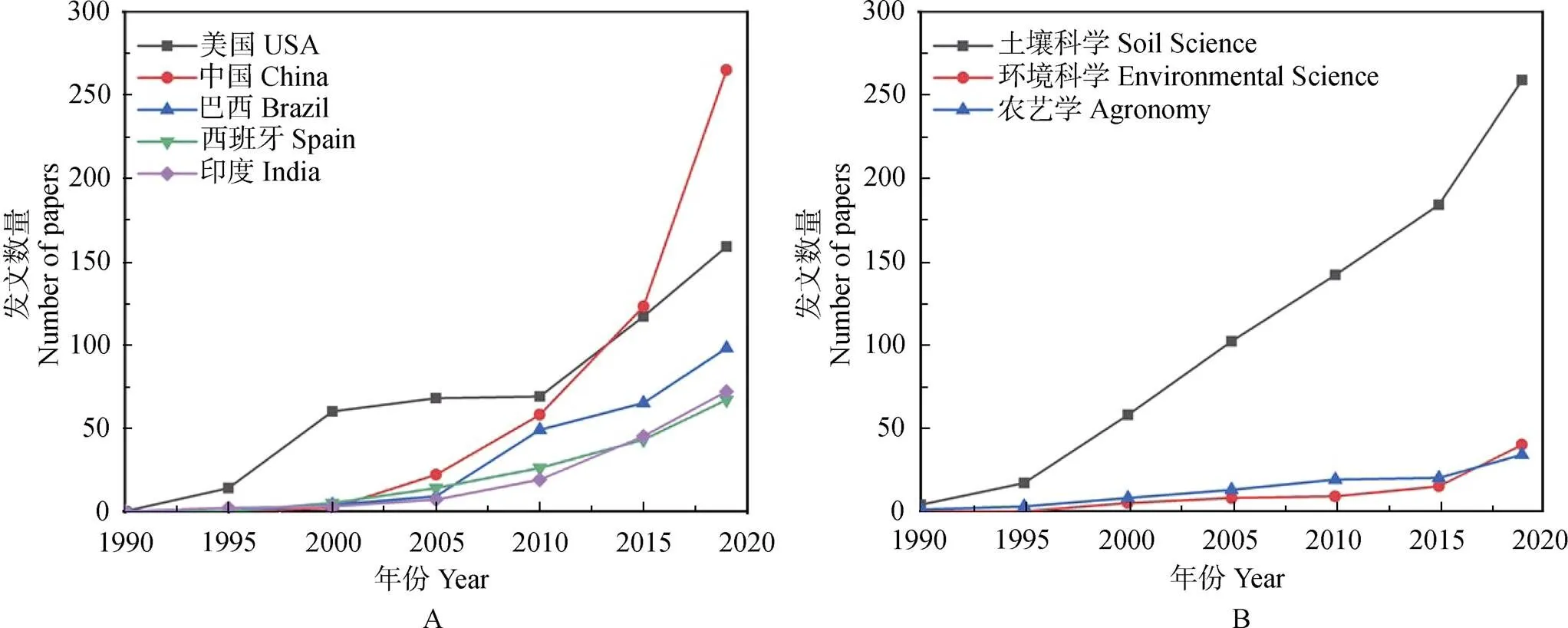
圖1 土壤質量研究領域主要國家(A)與主要學科發文數量(B)逐年變化
根據土壤質量研究的關鍵詞共現網絡,關于土壤管理、土壤有機質、土壤微生物量、土壤氮素管理以及土壤質量評價指標是該領域研究的熱點(圖2)。隨著世界氣候及環境等問題的逐漸凸顯[20],國際上對土壤環境監測、碳匯的研究增加[21],最近幾年在生物質炭[22]方面的研究也比較多。
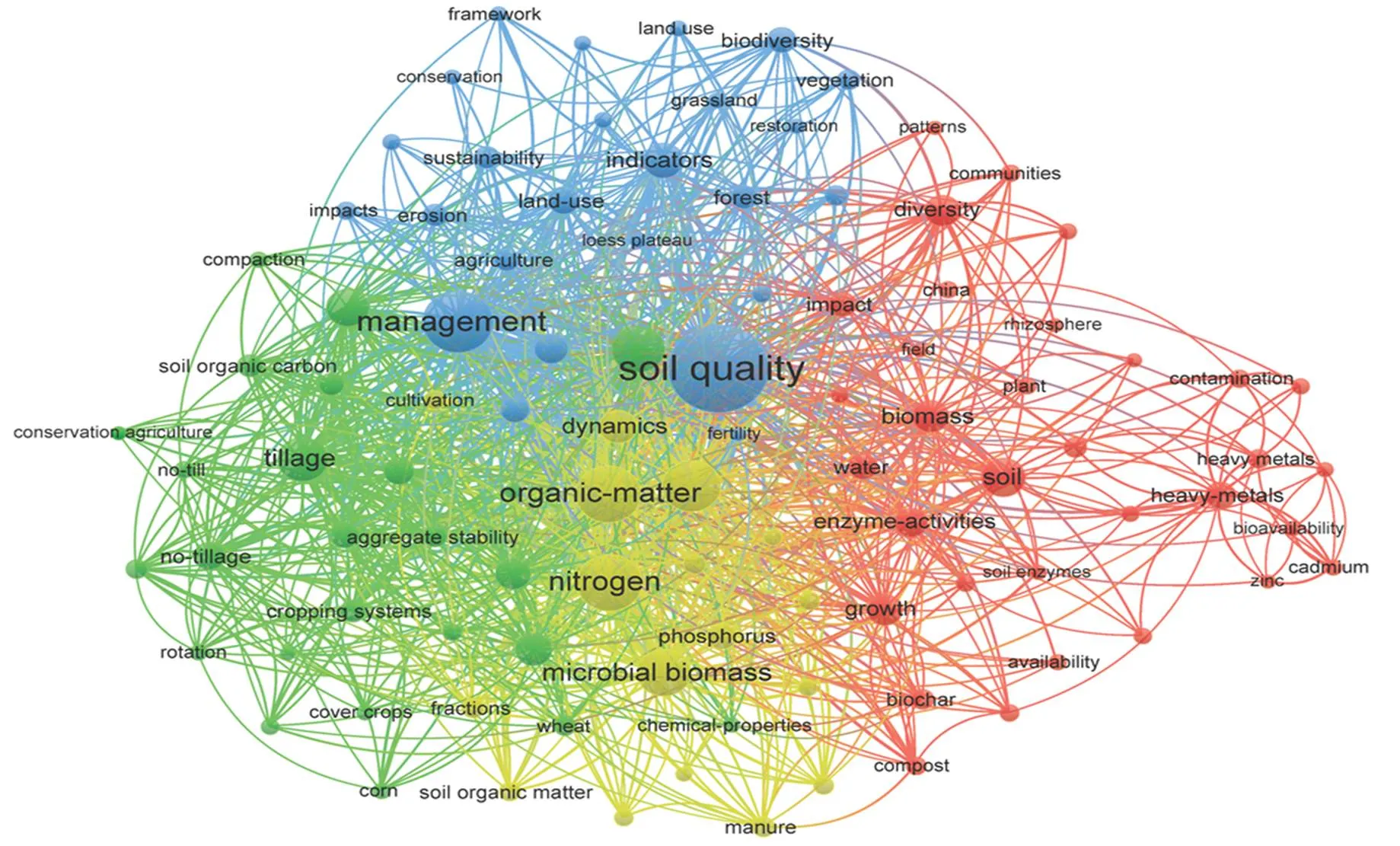
圖2 土壤質量領域關鍵詞共現網絡
1.2.2 土壤污染與農產品安全熱點分析文獻計量
伴隨人類劇烈的工業、農業生產活動,各種無機、有機污染物不斷進入土壤環境[23]。根據檢索結果可以發現(圖3),1974年出現了第一篇土壤污染與食物安全的相關文獻,2002年后歷年文獻數量皆高于50篇,2005年后發文量逐年上升,同時農產品安全領域越來越受研究者的關注。在發文量方面,中國、美國、巴西位居前三。在各國合作研究方面,美國與其他國家的合作交流最為廣泛,其次是中國。
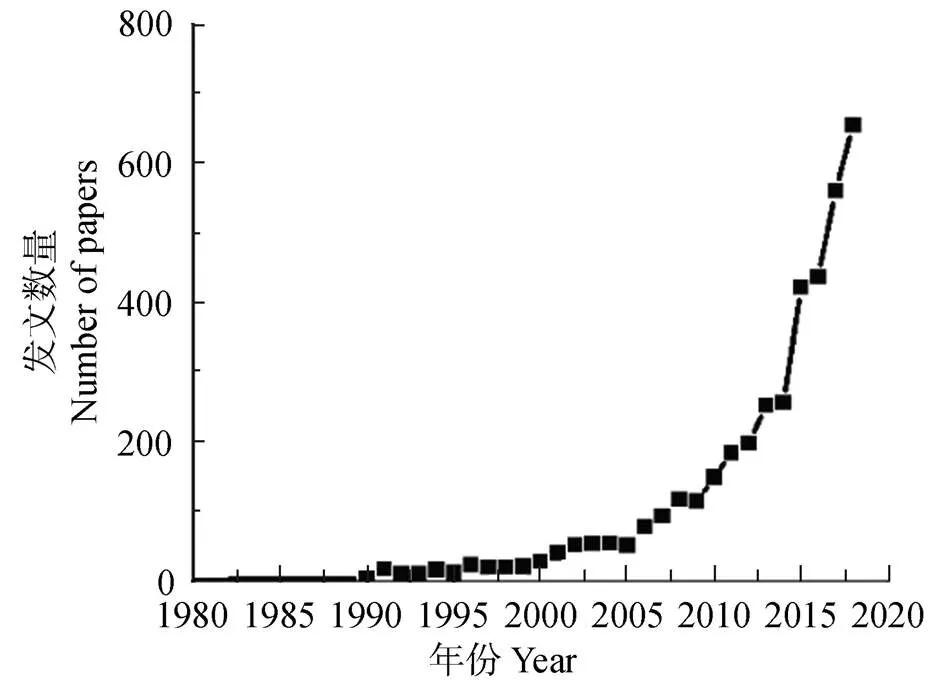
圖3 土壤污染與食物安全領域的年文獻產出量
根據關鍵詞共存網絡(圖4),土壤污染與農產品安全領域的關鍵詞可以主要劃分為四個聚類。紅色關鍵詞聚類的研究內容主要是土壤鎘、鉛等重金屬污染物對食物安全的影響,包括糧食作物的重金屬積累、土壤污染對作物生長的影響等方面[24-25]。綠色關鍵詞聚類的研究內容主要是病原微生物及其抗性基因對土壤生態系統多樣性和功能造成的毒害作用,從而引發對農產品安全的影響,包括土傳病蟲害、抗生素抗性基因、抗菌素耐藥性等方面[26]。藍色關鍵詞聚類的研究內容主要是農藥殘留對食物安全的影響,包括食物分析、農藥快速提取檢測等方面[27]。黃色關鍵詞聚類則主要集中在與農產品安全相關的人與動物健康風險評估方面[28-29]。
1.2.3 土壤質量與糧食安全熱點分析文獻計量 在WoS核心合集數據庫檢索到1900―2019年共4 379篇文獻涉及本主題,文獻計量結果表明(圖5),1981年開始出現第一篇關于土壤質量和糧食安全的研究文獻,到1996年每年文獻數量都在10篇以內;從1997年開始相關發文量有所增加,至2007年后歷年文獻數量皆高于50篇,且有逐年上升的趨勢,說明土壤質量和糧食安全相關領域越來越受到國內外的重視。我國在土壤質量和糧食安全領域的國際合作聯系密切,前三位主要合作國家是美國、英國和澳大利亞。
根據關鍵詞共存網絡(圖6),土壤質量和糧食安全領域關鍵詞可以主要劃分為三個聚類。紅色關鍵詞聚類的研究內容主要是施肥、作物類型和水肥管理對糧食安全的影響[30-31]。綠色關鍵詞聚類的研究內容主要是氣候變化、農業模式對糧食安全的影響[32-33]。藍色關鍵詞聚類的研究內容主要與集約型農業的可持續發展相關,重點突出了生態系統服務功能、生物多樣性、固碳、土地利用方式等方面[34]。
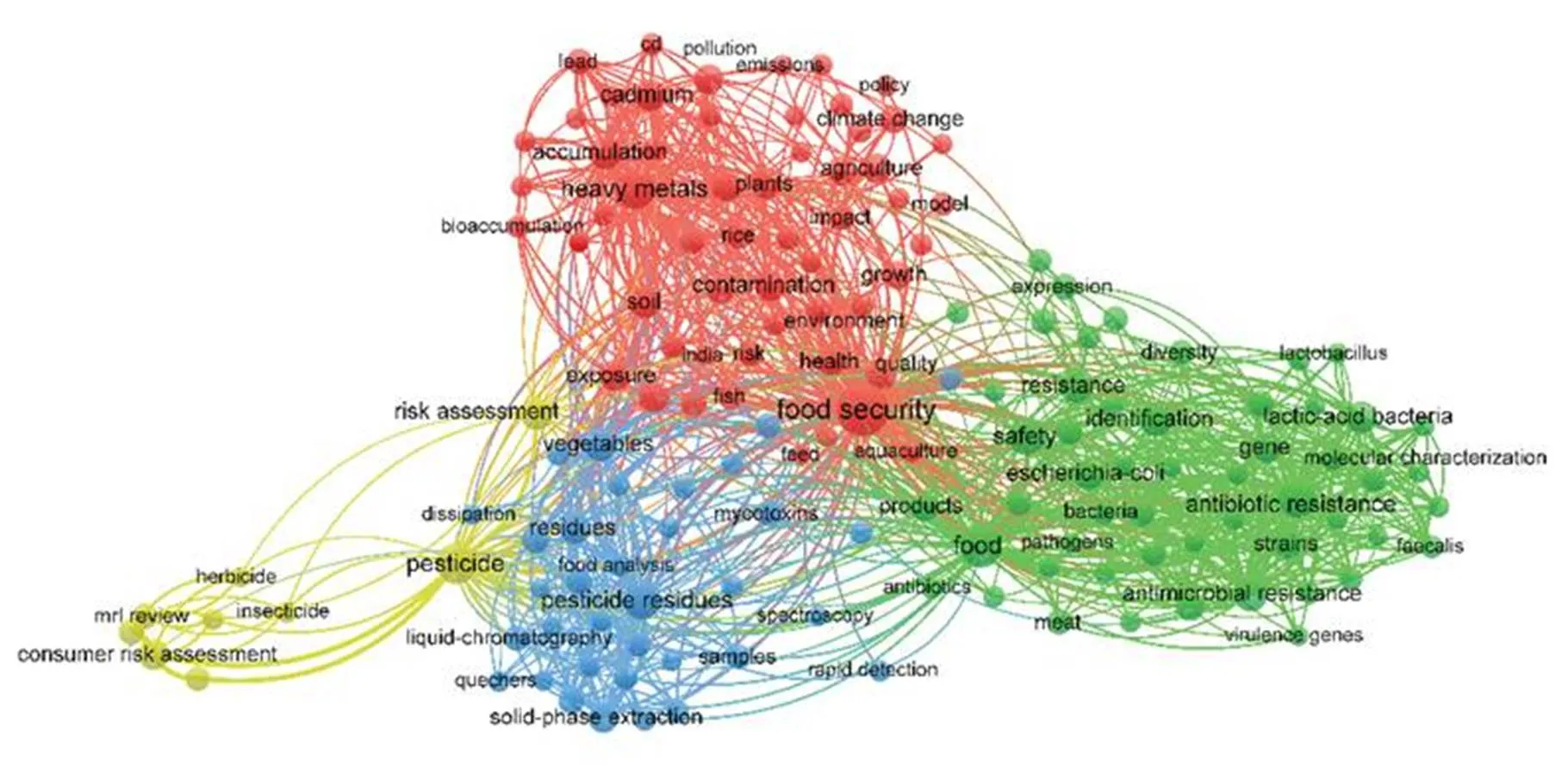
圖4 土壤污染與食物安全領域關鍵詞共現網絡
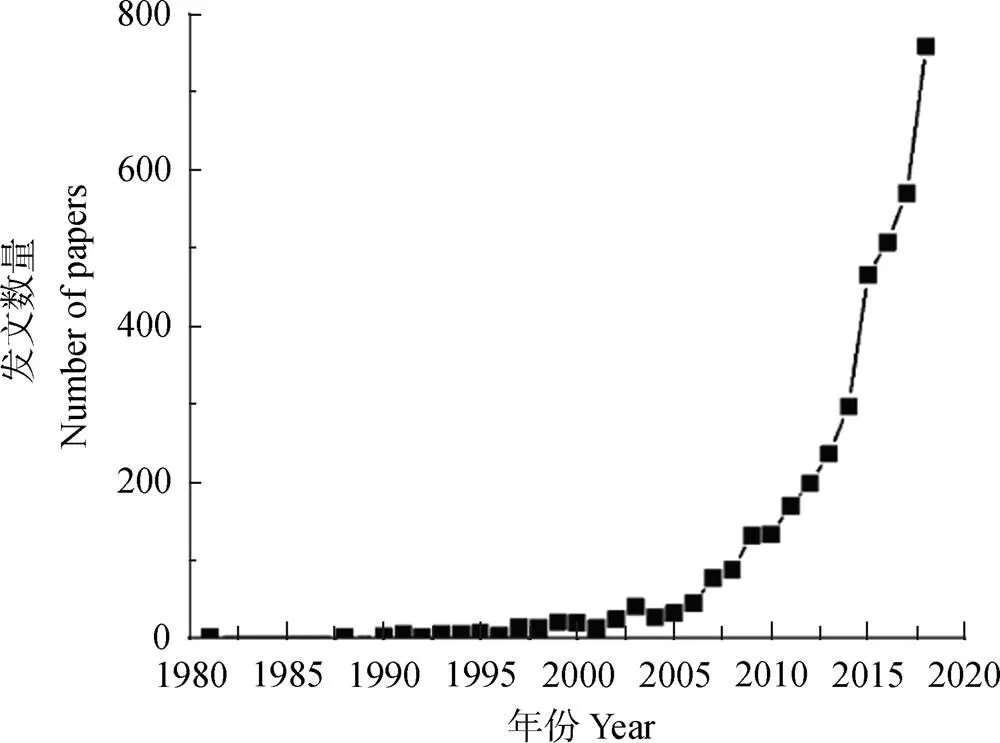
圖5 土壤質量與糧食安全領域的年文獻產出量
基于CiteSpace對土壤質量和食物安全領域關鍵詞突現(Keyword Burstiness)指標進行全面分析[35],選擇2014年以后的突現詞來描述近五年來的研究熱點(表1)。近五年來,突現強度較大關鍵詞有區域(Region,9.645)、策略(Strategy,8.946)、緩和(Mitigation,8.636)、營養物(Nutrient,8.505)、農業集約化(Agricultural intensification,8.022)、模式(Pattern,7.686)、家畜(Livestock,7.201)、環境影響(Environmental impact,7.176)、可持續集約化(Sustainable intensification,7.157)等,可見近期土壤質量與食物安全領域的研究前沿和熱點在于土壤質量區域化管理,因地制宜地制定相關策略或政策,通過土壤污染修復(包括物理、化學、生物手段)[36-38]、推行集約化模式等方法,提高土地利用率,發展可持續農業,以應對可能存在的因土地日益減少及土壤質量退化而引發的糧食安全危機[39]。
2 學科發展的關鍵問題與前沿趨勢
2.1 關鍵科學問題
綜合文獻檢索與文獻計量分析,北美、歐洲在土壤質量和食物安全領域的研究起步時間較早,中國、印度等發展中國家在該方面研究起步晚,但后期發展較快,產出頗豐。此外,澳大利亞、德國、荷蘭等國家也表現不凡。我國“十三五”期間首次將環境質量控制目標列為約束性指標,逐漸形成環境質量控制與污染總量控制并行的新形勢,“十四五”期間將進一步鞏固和提升環境質量改善成果,其中就包括土壤質量與食物安全問題,集中的關鍵科學問題主要有土壤質量管理與食物安全評價、區域化土壤質量與養分管理、污染物在土壤-作物系統的遷移轉化規律、土壤污染阻控與修復技術、土壤生物污染防控、土壤區域污染特征與環境風險、食物安全與人體健康風險[40]。
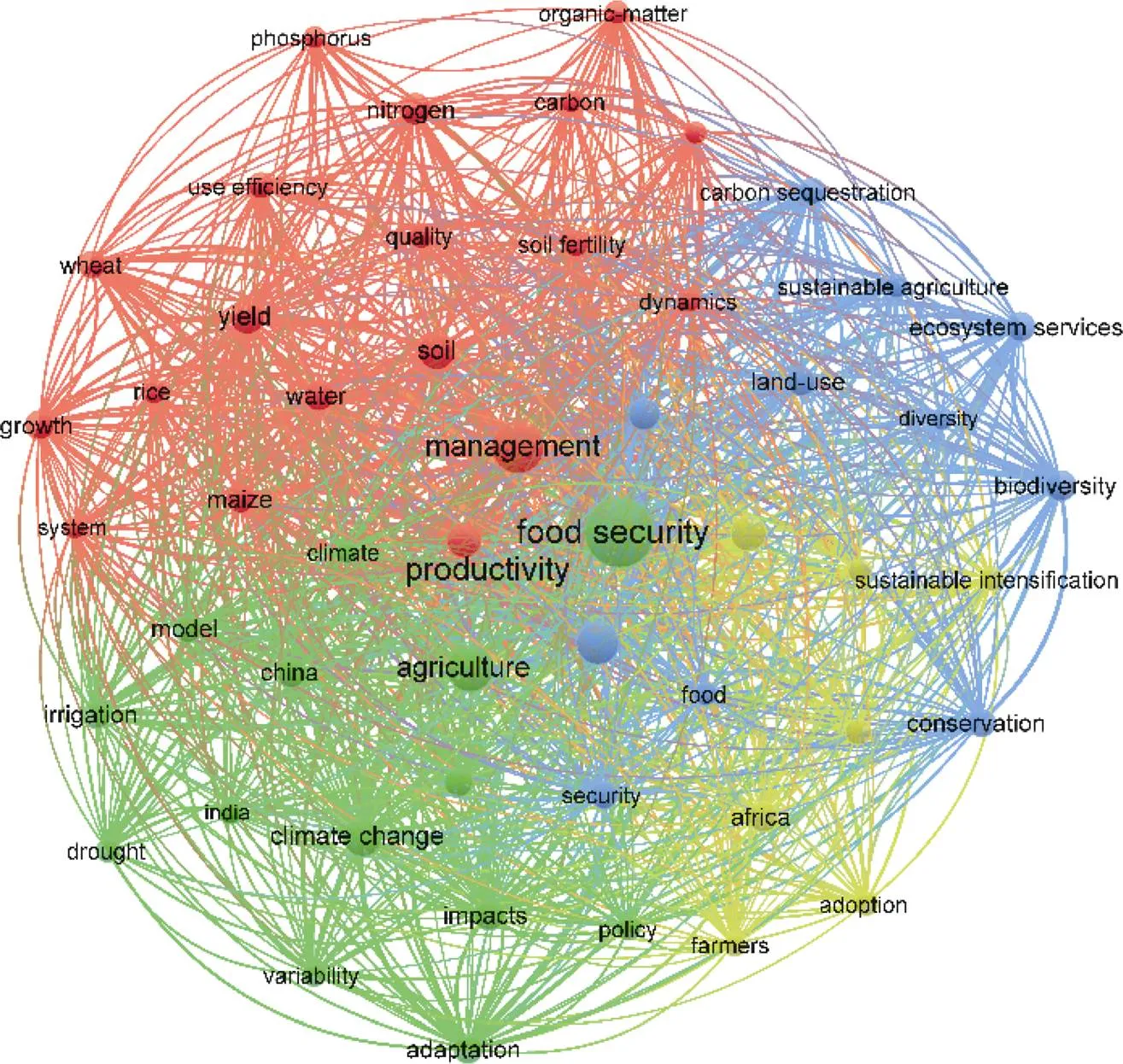
圖6 土壤質量與糧食安全關鍵詞共現網絡
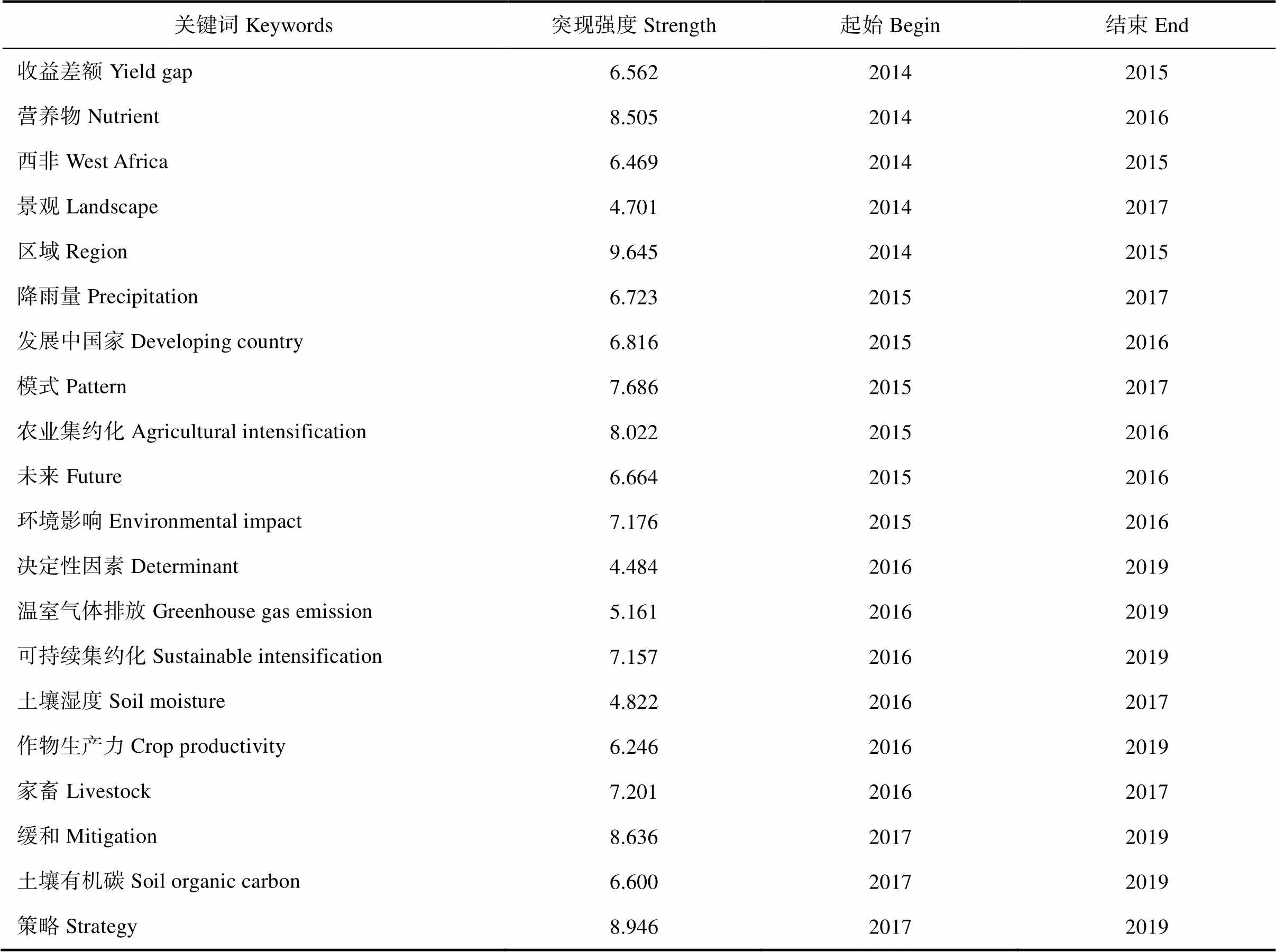
表1 近5年關鍵詞突現指標
(1)土壤質量管理與食物安全評價。根據土壤、作物的監測調查結果,需要構建土壤質量控制和調節的方法以及優化食物品質和數量安全的評價體系[41-42]。
(2)區域化土壤質量與養分管理。即在選定農業研究區域內進一步進行細分,以針對性的短期、長期農業施肥措施為基礎進行精準土壤養分質量管理[43-44]。
(3)污染物在土壤-作物系統的遷移轉化規律。土壤污染最大的風險在于污染物在作物中積累并危及人類健康,需明確土壤與作物復雜的交互作用對污染物遷移和積累的影響,以便制定應對措施[4,25,45-46]。
(4)土壤污染阻控與修復技術。強調以降低有機、無機污染物在土壤中的生物有效性為主要目的的修復過程,使污染物盡可能少地進入農產品中,主要包括物理(客土、整地)、化學(鈍化、淋洗)修復技術和新興的生態修復措施[11,47-48]。
(5)土壤生物污染防控。不同于有機、無機污染,外源和土著病原體及其所攜帶的抗性基因對作物產量影響的監測相對比較困難,外源病原菌一旦進入土壤等自然環境,將極易造成生物污染,其在土壤中的存活時間越長,則對農產品、生態環境和人類健康的潛在風險就越大[49],亟需明確其在土壤中的成活時間、傳播途徑、演化機制及其影響因子,以制定針對性的防治方案[50]。
(6)土壤區域污染特征與環境風險。過去的研究對土壤質量分區的科學性不足,分類過于粗糙、缺乏統一規范,為土壤污染分級管控帶來困難,在“十四五”期間需重點對污染區域進行更科學合理的空間類型與空間單元劃分,以便實施進一步的精細化管治措施[51],如對典型污染區域中土壤污染物進行源解析,明確污染物空間分布特征及關鍵成因,了解污染物持續輸入或消減的過程中對環境生態系統的影響和風險[6]。
(7)食物安全與人體健康風險。由于土壤中的有機、無機、生物污染物破壞土壤生態系統,影響作物品質和安全,且會通過食物鏈進入人體積累,過量時引起健康危害,因此相應的模型評估及管控措施的研究非常有必要,要盡快統一食物安全風險評估標準[52-53]。
2.2 國際研究趨勢及理論前沿分析
2.2.1 土壤質量的研究前瞻 在土壤質量研究方面,國際上對土壤質量評價標準體系建立[38]、評價模型方法等的關注度越來越高,同時也開始注重改善土壤質量在農業和環境中的應用,以及在全球范圍內開展不同尺度的土壤質量評價工作[54-55]。當前,有機農業與農業固碳在全球氣候變化(尤其是全球變暖)中的作用受到廣泛關注,且以生物質炭為研究主體的土壤修復與土壤質量關系研究迅速崛起[56]。此外,土壤質量監測及其對土壤修復、全球氣候變化的響應也是未來研究的重點。國際上土壤質量方面研究發展的主要趨勢包括[42]:(1)發展中國家將在土壤質量研究領域中發揮越來越重要的作用;(2)土壤質量對土壤修復、全球氣候變化的響應以及應對措施成為未來的研究熱點;(3)不同國家及地區應根據自身特點進行區域土壤質量的監測、評價、修復研究,制定相關法律和政策,保障土壤管理的規范化和可持續化。我國在“十四五”期間也將繼續立足生態環境保護的實際需求,重點攻堅土壤污染治理和修復工程,引進國際人才的同時加強本土相關專業人才的培養,致力于打造高水平的創新研究團隊,全面建立土壤環境質量監測網絡,健全土壤污染防治相關技術標準,推進土壤污染綜合防治先行區建設和土壤污染治理與修復技術應用試點項目,加強污染土地安全利用管理以防范和降低食物安全風險,特別是發揮農田土壤在農業空間中的生態功能等[57]。
2.2.2 土壤質量與食物安全的研究前瞻 在土壤質量與食物安全方面,國際研究者在保障農業可持續發展和滿足食物需求的基礎上,以食物安全性作為研究熱點,主要表現為控制食品中污染物的含量,降低人體健康風險[58]。超過土壤承載和自凈能力的土壤污染是引起土壤質量下降的重要因素[59],對其污染來源、過程、環境行為、效應及修復機理的研究應當予以深入,并以解決實際生產問題為導向[51,60]。以中國為首的發展中國家,由于人口眾多,土地資源緊張,一直受到環境問題和糧食問題的雙重困擾。進入21 世紀以來,糧食問題與環境問題之間的矛盾日益突出,更引發了各國對土壤質量的關注,致力于尋求一條可持續發展的道路。在全球化背景下,國際研究的趨勢和理論前沿包括:(1)土壤污染源解析[61-62];(2)土壤區域污染特征與人體健康風險;(3)土壤污染過程與機制;(4)土壤污染生態效應;(5)土壤污染修復機理及應用推廣。例如,在土壤重金屬區域污染特征與源解析的研究中,現有手段僅對部分污染物具有較高的辨識能力與精度[63-64],但借助不斷發展的同位素分餾[65]等先進技術,有望更接近真實地表征實際污染土壤中復雜的污染特征,以更精確地判斷污染源。同時,在典型重金屬與有機污染物的土壤污染過程、效應與機制的研究中,后續工作一方面迫切需要在宏觀尺度上著眼于生態系統網絡的復雜效應,進一步強調多要素-多界面-多過程的耦合,另一方面也需要在微觀尺度下借助分子生物學的迅猛發展,重點關注土壤生態功能(包括作物、土壤微生物和土壤動物)基因水平上的介導機制[66]。此外,在重金屬污染土壤的綜合修復技術方面,應以植物生長與土壤污染的內在聯系為基礎突出多種措施的聯合應用,特別是對植物生理與分子機制方面的修復效果給與更多的關注[67]。值得注意的是,談及土壤污染修復,土傳病原微生物等造成的生物污染往往容易忽視,未來的重點在于以分子生物學手段建立土壤微生物多樣性與土傳病害、寄主植物與病原微生物間的定量關系,通過選育抗病作物品種和接種拮抗微生物等環境友好型技術手段實現生物防控[68]。
2.3 學科交叉優先領域
由于土壤質量與食物安全這一分支學科的基礎數據涵蓋了農業、環境、化學、醫學等方面,需要用到信息技術(地理及生物信息)和工程手段來實現研究目標,因此這些學科與本學科經常相互借鑒、交叉和融合,從而促進相關研究的發展。當前條件下,有可能取得重大突破、解決重大污染、生態和災害問題的優先領域主要為以下兩個部分:
2.3.1 學科內部交叉的優先領域 主要是與土壤化學、土壤生物學、土壤肥力與養分循環、土壤污染與修復的交叉,圍繞土壤污染過程與土壤微生物的相互作用,探究土壤污染背景下微生物群落結構多樣性和功能的演變及生態效應變化,在分子生物學基因水平上揭示重金屬、有機和生物污染物對土壤關鍵功能微生物群落結構的影響及其長期動態演化過程[69]。其次,利用同步輻射、同位素標記及基因組學等先進技術手段,探究微觀尺度下重金屬(如鎘、砷等)、有機污染物(如有機氯農藥等)、病原生物(如大腸桿菌、立枯絲核菌、尖孢鐮刀菌等)與土壤礦物-有機質-微生物相互作用的多界面過程與機理[70]。在明確植物和微生物系統中響應污染的相關功能基因表達機制基礎上,利用轉基因技術修飾改造植物或微生物,獲得污染土壤的生物高效修復技術[71];同時在土壤污染修復過程中根據土壤微生物的響應特征,盡可能降低原位修復過程對微生物群落結構和生態功能的擾動。
2.3.2 與其他學科交叉的優先領域 這些領域涉及廣泛,主要為應用數學、醫學、地理信息學等。全球土壤污染問題呈現惡化趨勢,進而影響了農作物的品質(產量和污染物含量)以及攝入后的人體健康風險[72]。相比于有機污染物在農產品表面的殘留,土壤重金屬污染物及病原菌更容易通過作物攝取而通過食物鏈進入人體,對人體健康造成危害,但目前缺乏對人體健康風險的精準評價手段,現階段使用的評價模型單一[73],較少考慮人體消化系統(如腸道致病性微生物的毒害)和新陳代謝等復雜生理活動,對人體內污染物的吸收、轉運、積累的機制缺乏明確認識。因此,與醫學的交叉可獲得污染物在人體中傳輸轉化的毒理學規律,同時利用多種模擬預測的數學模型,結合地理信息獲取的大數據,理清污染源-環境介質(大氣、水、土壤、作物)-人體傳輸過程中的耦合作用及交互機制,可實現污染源對人體健康風險影響的量化評估。在上述研究的基礎上可建立區域污染物的“源-匯-人體”全過程動態風險預測鏈模型[58],從而實現針對性管控土壤污染物的主要污染源,降低人體健康風險,為預防和治理土壤污染提供新的重要思路和應對機制,促進區域環境與人體健康可持續發展。
3 學科展望
基于上述土壤質量與食物安全分支學科的發展現狀、關鍵需求、理論前沿和重點交叉方向,到2025年有希望和必要形成的引領性研究方向總結如下:
(1)區域土壤污染特征及環境健康風險。包括對重金屬、有機、生物等污染物的原位測定技術的革新,區域尺度土壤及農產品污染特征時空變異的表達,主要污染物的溯源及定量解析,土壤-作物系統中污染物遷移規律及空間對應機制的探索,不同污染物的“源-匯-人體”全過程動態風險預測鏈模型的建立,以及實現對不同人群健康風險的動態預測[74-75]。
(2)土壤重金屬及重金屬-有機復合污染過程、效應及機制。涵蓋土壤-生物微界面過程與生物有效性、吸收動態及毒理學的研究,土壤-作物系統中污染物遷移轉化規律的探討,分子、原子尺度上重金屬結合形態、價態變化的表征[76],相關氧化、還原、甲基化過程的微生物學機制揭示以及對應功能基因表達的測定,界面過程中作物和微生物解毒機制的研究,重金屬復合污染、重金屬-有機復合污染土壤中污染物間交互作用的明確闡述以及土壤微生物群落對污染的響應、適應與反饋調控機制的可視化[77]。
(3)土壤系統典型殘留有機污染物的污染風險評價與阻控。包括土壤和農產品中殘留的農藥等有機污染物及其降解產物全程監控、土壤地下生物系統響應有機污染及不同類型土壤有機污染物自凈功能的調控、農藥等有機污染物在農田系統殘留的暴露與風險,生源要素循環耦合的有機污染物強化消減與阻控修復工程化技術等。
(4)土壤系統新型有機/生物污染與風險防控。主要為農業土壤酞酸酯污染區域特征與風險評估的研究,不同設施種植模式下土壤新型有機物污染特征與源解析的探索[78],殘膜分解中微塑料和酞酸酯的土壤累積、生態效應與機理的揭示,不同農業種植模式下生物污染特征與微生物生態系統多樣性內在聯系、土壤抗性基因庫潛在轉移風險的探討,土壤-植物系統中病原體(細菌、真菌、病毒)及攜帶的抗性基因污染的分布、遷移規律與協同效應評價體系的建立,抗病作物育種-農業投入品無害化-田間土壤質量管理與生態防控模式的集成[79-80],以及設施農業土壤污染源頭防控-過程治理-末端監管全鏈條式高效防控技術與示范的應用和推廣[81]。
(5)保障農產品質量的污染土壤安全利用技術原理。涵蓋針對復雜污染狀況下以降低土壤污染物(特別是重金屬、農藥)生物有效性和同時提高土壤質量為目標的環境友好型土壤改良劑的研發制備[66],高效富集植物及低積累作物品種的篩選及其生理與分子機制的研究[82],特定復合污染區域特征下土壤-作物-水體系統中立體綜合防治技術和協同修復手段的建立(如重金屬的鈍化、低積累品種篩選、農藥的生物降解),以及結合基因工程技術實現適應復雜污染環境、可對多種污染物吸附降解的工程細菌人工培養和安全量產[80,83]。
[ 1 ] Zhao Q G,He J Z,Yan X Y,et al. Progress in significant soil science fields of China over the last three decades:A review[J]. Pedosphere,2011,21(1):1—10.
[ 2 ] Oliver M A. Soil and human health:A review[J]. European Journal of Soil Science,1997,48(4):573—592.
[ 3 ] Liu Y,Wen C,Liu X. China’s food security soiled by contamination[J]. Science,2013,339(6126):1382—1383.
[ 4 ] Zhu H H,Chen C,Xu C,et al. Effects of soil acidification and liming on the phytoavailability of cadmium in paddy soils of central subtropical China[J]. Environmental Pollution,2016,219:99—106.
[ 5 ] Koptsik G N. Modern approaches to remediation of heavy metal polluted soils:A review[J]. Eurasian Soil Science,2014,47(7):707—722.
[ 6 ] Bedná?ová Z,Kalina J,Hájek O,et al. Spatial distribution and risk assessment of metals in agricultural soils[J]. Geoderma,2016,284:113—121.
[ 7 ] Kaczynski R,Siebielec G,Hanegraaf M C,et al. Modelling soil carbon trends for agriculture development scenarios at regional level[J]. Geoderma,2017,286:104—115.
[ 8 ] Reimann C,Négrel P,Ladenberger A,et al. Comment on “Maps of heavy metals in the soils of the European Union and proposed priority areas for detailed assessment” by Tóth G,Hermann T,Szatmári G,Pásztor L[J]. Science of the Total Environment,2017,578:236—241.
[ 9 ] Mirzaeitalarposhti R,Demyan M S,Rasche F,et al. Mid-infrared spectroscopy to support regional-scale digital soil mapping on selected croplands of South-West Germany[J]. Catena,2017,149:283—293.
[ 10 ] Wang L,Yang D,Li Z,et al. A comprehensive mitigation strategy for heavy metal contamination of farmland around mining areas - Screening of low accumulated cultivars,soil remediation and risk assessment[J]. Environmental Pollution,2018,245:820—828.
[ 11 ] Li Z,Wang L,Meng J,et al. Zeolite-supported nanoscale zero-valent iron:New findings on simultaneous adsorption of Cd(II),Pb(II),and As(III)in aqueous solution and soil[J]. Journal of Hazardous Materials,2018,344:1—11.
[ 12 ] Virto I,Imaz M,Fernández-Ugalde O,et al. Soil degradation and soil quality in western Europe:Current situation and future perspectives[J]. Sustainability,2015,7(1):313—365.
[ 13 ] Eck N J,Waltman L. Software survey:VOSviewer,a computer program for bibliometric mapping[J]. Scientometrics,2010,84(2):523—538.
[ 14 ] Song X F,Chi P J. Comparative study of the data analysis results by vosviewer and citespace[J]. Information Science,2016,34(7):108—112,146. [宋秀芳,遲培娟. Vosviewer與Citespace應用比較研究[J]. 情報科學,2016,34(7):108—112,146.]
[ 15 ] Li B B,Xu M X,Gong C,et al. Hotspots and trends in international soil quality research[J]. Journal of Natural Resources,2017,32(11):1983—1998. [李彬彬,許明祥,鞏晨,等. 國際土壤質量研究熱點與趨勢——基于大數據的Citespace可視化分析[J]. 自然資源學報,2017,32(11):1983—1998.]
[ 16 ] Paleari S. Is the European Union protecting soil? A critical analysis of community environmental policy and law[J]. Land Use Policy,2017,64:163—173.
[ 17 ] Panagos P,Imeson A,Meusburger K,et al. Soil conservation in Europe:Wish or reality?[J]. Land Degradation & Development,2016,27(6):1547—1551.
[ 18 ] Juhos K,Czigány S,Madarász B,et al. Interpretation of soil quality indicators for land suitability assessment – A multivariate approach for Central European arable soils[J]. Ecological Indicators,2019,99:261—272.
[ 19 ] Stone D,Ritz K,Griffiths B G,et al. Selection of biological indicators appropriate for European soil monitoring[J]. Applied Soil Ecology,2016,97:12—22.
[ 20 ] Song X P,Hansen M C,Stehman S V,et al. Global land change from 1982 to 2016[J]. Nature,2018,560(7720):639—643.
[ 21 ] Davidson G R,Phillips-Housley A,Stevens M T. Soil-zone adsorption of atmospheric CO2as a terrestrial carbon sink[J]. Geochimica Et Cosmochimica Acta,2013,106:44—50.
[ 22 ] Wang M,Zhu Y,Cheng L,et al. Review on utilization of biochar for metal-contaminated soil and sediment remediation[J]. Journal of Environmental Sciences,2017,63(1):156—173.
[ 23 ] Duan Q,Lee J,Liu Y,et al. Distribution of heavy metal pollution in surface soil samples in China:A graphical review[J]. Bulletin of Environmental Contamination and Toxicology,2016,97(3):303—309.
[ 24 ] Tóth G,Hermann T,Da Silva M R,et al. Heavy metals in agricultural soils of the European Union with implications for food safety[J]. Environment International,2016,88:299—309.
[ 25 ] He M,Shen H,Li Z,et al. Ten-year regional monitoring of soil-rice grain contamination by heavy metals with implications for target remediation and food safety[J]. Environmental Pollution,2019,244:431—439.
[ 26 ] Fisher M C,Hawkins N J,Sanglard D,et al. Worldwide emergence of resistance to antifungal drugs challenges human health and food security[J]. Science,2018,360(6390):739—742.
[ 27 ] Hwang J,Zimmerman A R,Kim J. Bioconcentration factor-based management of soil pesticide residues:Endosulfan uptake by carrot and potato plants[J]. Science of the Total Environment,2018,627:514—522.
[ 28 ] Yang Q,Li Z,Lu X,et al. A review of soil heavy metal pollution from industrial and agricultural regions in China:Pollution and risk assessment[J]. Science of the Total Environment,2018,642:690—700.
[ 29 ] Zhang Y,Chen J,Wang L,et al. Establishing a health risk assessment for metal speciation in soil-A case study in an industrial area in China[J]. Ecotoxicology and Environmental Safety,2018,166:488—497.
[ 30 ] Szeles A,Horvath E,Vad A,et al. The impact of environmental factors on the protein content and yield of maize grain at different nutrient supply levels[J]. Emirates Journal of Food and Agriculture,2018,30(9):764—777.
[ 31 ] Solgi E,Sheikhzadeh H,Solgi M. Role of irrigation water,inorganic and organic fertilizers in soil and crop contamination by potentially hazardous elements in intensive farming systems:Case study from Moghan agro-industry,Iran[J]. Journal of Geochemical Exploration,2018,185:74—80.
[ 32 ] Miraglia M,Marvin H J P,Kleter G A,et al. Climate change and food safety:An emerging issue with special focus on Europe[J]. Food & Chemical Toxicology,2009,47(5):1009—1021.
[ 33 ] Tirado M C,Clarke R,Jaykus L A,et al. Climate change and food safety:A review[J]. Food Research International,2010,43(7):1745—1765.
[ 34 ] Wang J,Lin Y,Glendinning A,et al. Land-use changes and land policies evolution in China’s urbanization processes[J]. Land Use Policy,2018,75:375—387.
[ 35 ] Xiang C,Wang Y,Liu H. A scientometrics review on nonpoint source pollution research[J]. Ecological Engineering,2017,99:400—408.
[ 36 ] Liu L,Li W,Song W,et al. Remediation techniques for heavy metal-contaminated soils:Principles and applicability[J]. Science of the Total Environment,2018,633:206—219.
[ 37 ] Sun J,Pan L,Tsang D C W,et al. Organic contamination and remediation in the agricultural soils of China:A critical review[J]. Science of the Total Environment,2017,615:724—740.
[ 38 ] Song B,Zeng G,Gong J,et al. Evaluation methods for assessing effectiveness of in situ remediation of soil and sediment contaminated with organic pollutants and heavy metals[J]. Environment International,2017,105:43—55.
[ 39 ] Rickson R J,Deeks L K,Graves A,et al. Input constraints to food production:The impact of soil degradation[J]. Food Security,2015,7(2):351—364.
[ 40 ] Tian X,Qiu J. From challenges to demands and solutions of environmental pollution control in the coming 14th Five-Year Plan period[J]. Chinese Journal of Environmental Management,2019,11(3):46—49. [田欣,秋婕. “十四五”時期污染物總量控制的挑戰、需求與應對研究[J]. 中國環境管理,2019,11(3):46—49.]
[ 41 ] Poggio L,Vr??aj B,Hepperle E,et al. Introducing a method of human health risk evaluation for planning and soil quality management of heavy metal-polluted soils—An example from Grugliasco(Italy)[J]. Landscape and Urban Planning,2008,88(2/4):64—72.
[ 42 ] Bai Z,Thomas C,Ruiperez G M,et al. Effects of agricultural management practices on soil quality:A review of long-term experiments for Europe and China[J]. Agriculture Ecosystems & Environment,2018,265:1—7.
[ 43 ] Tang H,Xiao X,Li C,et al. Impact of long-term fertilization practices on the soil aggregation and humic substances under double-cropped rice fields[J]. Environmental Science & Pollution Research,2018,25(4):11034—11044.
[ 44 ] Moreno J L,Bastida F,Ondo?o S,et al. Agro-forestry management ofplantations and their impact on soil biological quality:The effects of fertilization and irrigation treatments[J]. Applied Soil Ecology,2017,117/118:46—56.
[ 45 ] Wang M,Chen W,Peng C. Risk assessment of Cd polluted paddy soils in the industrial and township areas in Hunan,southern China[J]. Chemosphere,2016,144:346—351.
[ 46 ] Zhang X,Yang H,Cui Z. Evaluation and analysis of soil migration and distribution characteristics of heavy metals in iron tailings[J]. Journal of Cleaner Production,2018,172:475—480.
[ 47 ] Zhang R,Li Z,Liu X,et al. Immobilization and bioavailability of heavy metals in greenhouse soils amended with rice straw-derived biochar[J]. Ecological Engineering,2017,98:183—188.
[ 48 ] Yoo J,Lee C,Lee J,et al. Simultaneous application of chemical oxidation and extraction processes is effective at remediating soil Co-contaminated with petroleum and heavy metals[J]. Journal of Environmental Management,2017,186:314—319.
[ 49 ] Xu J M. Soil Science[M]. 4th ed. Beijing:China Agriculture Press,2019. [徐建明. 土壤學[M]. 第4版. 北京:中國農業出版社,2019.]
[ 50 ] Bradford S,Morales V,Zhang W,et al. Transport and fate of microbial pathogens in agricultural settings[J]. Critical Reviews in Environmental Science and Technology,2013,43(8):775—893.
[ 51 ] Gao X L,Liao L W,Wu D X,et al. Strategic direction of regional governance upon eco-environment in the 14th Five-Year Plan[J]. Environmental Protection,2019,47:27—32. [高曉路,廖柳文,吳丹賢,等. “十四五”生態環境分區管治的戰略方向[J]. 環境保護,2019,47:27—32.]
[ 52 ] Lu Y,Song S,Wang R,et al. Impacts of soil and water pollution on food safety and health risks in China[J]. Environment International,2015,77:5—15.
[ 53 ] Wei J,Cen K. Assessment of human health risk based on characteristics of potential toxic elements (PTEs)contents in foods sold in Beijing,China[J]. Science of the Total Environment,2020,703:134747.
[ 54 ] Mueller L,Schindler U,Shepherd T G,et al. A framework for assessing agricultural soil quality on a global scale[J]. Archives of Agronomy & Soil Science,2012,58:S76—S82.
[ 55 ] Stone D,Costa D,Daniell T J,et al. Using nematode communities to test a European scale soil biological monitoring programme for policy development[J]. Applied Soil Ecology,2016,97:78—85.
[ 56 ] Agegnehu G,Srivastava A K,Bird M I. The role of biochar and biochar-compost in improving soil quality and crop performance:A review[J]. Applied Soil Ecology,2017,119:156—170.
[ 57 ] Liu Z Y,Mao X Q,Jiang H. Directions and strategies of eco-environmental protection during “the 14th Five-Year Plan” period[J]. Environmental Protection,2019,47:37—41. [劉崢延,毛顯強,江河. “十四五”時期生態環境保護重點方向和策略[J]. 環境保護,2019,47:37—41.]
[ 58 ] Yang S,Zhao J,Chang S X,et al. Status assessment and probabilistic health risk modeling of metals accumulation in agriculture soils across China:A synthesis[J]. Environment International,2019,128:165—174.
[ 59 ] Plekhanova I O. Self-purification of agrosoddy-podzolic sandy loamy soils fertilized with sewage sludge[J]. Eurasian Soil Science,2017,50(4):491—497.
[ 60 ] Jiang R,Wang M,Chen W,et al. Ecological risk evaluation of combined pollution of herbicide siduron and heavy metals in soils[J]. Science of the Total Environment,2018,626:1047—1056.
[ 61 ] Zhang H,Yao Q,Zhu Y,et al. Review of source identification methodologies for heavy metals in solid waste[J]. Chinese Science Bulletin,2013,58(2):162—168.
[ 62 ] Wang C,Wu S,Zhou S,et al. Characteristics and source identification of polycyclic aromatic hydrocarbons(PAHs)in urban soils:A review[J]. Pedosphere,2017,27(1):17—26.
[ 63 ] Reimann C,de Caritat P. Establishing geochemical background variation and threshold values for 59 elements in Australian surface soil[J]. Science of the Total Environment,2017,578:633—648.
[ 64 ] St. Luce M,Ziadi N,Gagnon B,et al. Visible near infrared reflectance spectroscopy prediction of soil heavy metal concentrations in paper mill biosolid- and liming by-product-amended agricultural soils[J]. Geoderma,2017,288:23—36.
[ 65 ] Wang W,Song X,Ma Y. Identification of nitrate source using isotopic and geochemical data in the lower reaches of the Yellow River irrigation district(China)[J]. Environmental Earth Sciences,2016,75(11):936.
[ 66 ] Li Z,Wang L,Wu J,et al. Zeolite-supported nanoscale zero-valent iron for immobilization of cadmium,lead,and arsenic in farmland soils:Encapsulation mechanisms and indigenous microbial responses[J]. Environmental Pollution,2020,260:114098.
[ 67 ] Jiang J,Liu H,Li Q,et al. Combined remediation of Cd–phenanthrene co-contaminated soil byandFQ1 and the antioxidant responses in[J]. Ecotoxicology & Environmental Safety,2015,120:386—393.
[ 68 ] Cai Z C,Huang X Q. Soil-borne pathogens should not be ignored by soil science[J]. Acta Pedologica Sinica,2016,53(2):305—310. [蔡祖聰,黃新琦. 土壤學不應忽視對作物土傳病原微生物的研究[J]. 土壤學報,2016,53(2):305—310.]
[ 69 ] Xie Y,Fan J,Zhu W,et al. Effect of heavy metals pollution on soil microbial diversity and Bermudagrass genetic variation[J]. Frontiers in Plant Science,2016,7(245):1—12.
[ 70 ] Xia S,Song Z,Jeyakumar P,et al. A critical review on bioremediation technologies for Cr(VI)-contaminated soils and wastewater[J]. Critical Reviews in Environmental Science and Technology,2019,49(12):1027—1078.
[ 71 ] Manoj S,Karthik C,Kadirvelu K,et al. Understanding the molecular mechanisms for the enhanced phytoremediation of heavy metals through plant growth promoting rhizobacteria:A review[J]. Journal of Environmental Management,2020,254:109779.
[ 72 ] Rehman Z U,Khan S,Brusseau M L,et al. Lead and cadmium contamination and exposure risk assessment via consumption of vegetables grown in agricultural soils of five-selected regions of Pakistan[J]. Chemosphere,2017,168:1589—1596.
[ 73 ] Liu X,Zhong L,Meng J,et al. A multi-medium chain modeling approach to estimate the cumulative effects of cadmium pollution on human health[J]. Environmental Pollution,2018,239:308—317.
[ 74 ] Wang P,Chen H,Kopittke P,et al. Cadmium contamination in agricultural soils of China and the impact on food safety[J]. Environmental Pollution,2019,249:1038—1048.
[ 75 ] Yang S,He M,Zhi Y,et al. An integrated analysis on source-exposure risk of heavy metals in agricultural soils near intense electronic waste recycling activities[J]. Environment International,2019,133(B):105239.
[ 76 ] Kopittke P M,Wang P,Lombi E,et al. Synchrotron-based X-ray approaches for examining toxic trace metal(loid)s in soil–plant systems[J]. Journal of Environmental Quality,2017,46(6):1175—1189.
[ 77 ] Xiao S,Zhang Q,Chen X,et al. Speciation distribution of heavy metals in uranium mining impacted soils and impact on bacterial community revealed by high-throughput sequencing[J]. Frontiers in Microbiology,2019,10:1867.
[ 78 ] Zhang Y,Wang P,Wang L,et al. The influence of facility agriculture production on phthalate esters distribution in black soils of northeast China[J]. Science of the Total Environment,2015,506:118—125.
[ 79 ] Salanoubat M,Genin S,Artiguenave F,et al. Genome sequence of the plant pathogen[J]. Nature,2002,415(6871):497—502.
[ 80 ] Zhao F J,Xie W Y,Wang P. Soil and human health[J]. Acta Pedologica Sinica,2020,57(1):1—11. [趙方杰,謝婉瀅,汪鵬. 土壤與人體健康[J]. 土壤學報,2020,57(1):1—11.]
[ 81 ] Ma Y,Liu Z,Xi B,et al. Characteristics of groundwater pollution in a vegetable cultivation area of typical facility agriculture in a developed city[J]. Ecological Indicators,2019,105:709—716.
[ 82 ] Guo H,Hong C,Xiao M,et al. Real-time kinetics of cadmium transport and transcriptomic analysis in low cadmium accumulator[J]. Planta,2016,244(6):1289—1302.
[ 83 ] Liu L,Bilal M,Duan X,et al. Mitigation of environmental pollution by genetically engineered bacteria - Current challenges and future perspectives.[J]. Science of the Total Environment,2019,667:444—454.
Frontier Trends and Development Strategies of Soil Quality and Food Safety in the 14th Five-Year Plan
XU Jianming1, 2?, LIU Xingmei1, 2
(1. Institute of Soil and Water Resources and Environmental Science, Zhejiang University, Hangzhou 310058, China; 2. Zhejiang Provincial Key Laboratory of Agricultural Resources and Environment, Zhejiang University, Hangzhou 310058, China)
The comprehensive evaluation and improvement of soil quality are closely linked with food security and human health. As an important component of the development strategy of soil science during the 14th Five-Year Plan, the subdiscipline about the soil quality and food security is making contribution to govern and improve the quality of cultivated soil, which will cope with the food security crisis. The results of bibliometric analysis show that although China has started late in the research of this subdiscipline compared with the developed countries, it is accelerating upward and even has the tendency to surpass all of the other countries in recent years. With the erupting of the climate and environmental pollution issues, the international research hotpots of this subdiscipline are mainly focused on the environmental monitoring, soil utilization, fertilization management, remediation of pollution (heavy metal (loid), antibiotic, organic pesticide, and pathogenic microorganism) and sustainable development. Meanwhile, this subdiscipline takes the soil quality, soil pollution, and food security as the key research directions. Combined with the fields of geomatics, environmental science, applied mathematics, and medicine to form new prior interdisciplines, this subdiscipline can utilize their advanced theories and techniques of isotope tracer, biogeochemical cycling, molecular biology, and health risk model to solve some key scientific problems in the soil quality monitoring under regional scale, quality management of soil nutrients, human health risk assessment, migration and transformation of pollutants in soil-crop systems, and immobilization and remediation of soil pollution in the future.
Soil quality; Food security; Soil pollution; Bibliometric analysis; Future demand
S15
A
10.11766/trxb202003300110
徐建明,劉杏梅. “十四五”土壤質量與食物安全前沿趨勢與發展戰略[J]. 土壤學報,2020,57(5):1143–1154.
XU Jianming,LIU Xingmei. Frontier Trends and Development Strategies of Soil Quality and Food Safety in the 14th Five-Year Plan [J]. Acta Pedologica Sinica,2020,57(5):1143–1154.
* 國家自然科學基金創新研究群體項目(41721001)和重大項目(41991334)資助 Supported by the National Natural Science Foundation of China Innovation Research Group Project(No. 41721001)and the Major Program of the National Natural Science Foundation of China(No. 41991334)
,E-mail:jmxu@zju.edu.cn
徐建明(1965—),男,浙江桐鄉人,博士,教授,主要從事土壤化學與生物化學、土壤污染控制與修復、產地環境質量與農產品安全等領域的研究。
2020–03–30;
2020–05–03;
優先數字出版日期(www.cnki.net):2020–05–26
(責任編輯:陳德明)
猜你喜歡
體育科技文獻通報(2022年3期)2022-05-23 13:46:54
中學生數理化·八年級物理人教版(2021年12期)2021-12-31 03:23:08
遼金歷史與考古(2021年0期)2021-07-29 01:06:54
中學生數理化·中考版(2020年10期)2020-11-27 01:59:48
科技傳播(2019年22期)2020-01-14 03:06:54
中國生殖健康(2019年2期)2019-08-23 08:12:08
民用飛機設計與研究(2019年4期)2019-05-21 07:21:24
當代陜西(2019年7期)2019-04-25 00:22:18
領導決策信息(2018年26期)2018-10-12 02:18:26
汽車觀察(2016年3期)2016-02-28 13:16:26