添加蒙脫石是否促進白花苜蓿的腐殖化進程?*
2020-10-22 08:05:48張一楓田宇欣段宏美
土壤學報 2020年5期
關鍵詞:結構
徐 楊,竇 森,張一楓,田宇欣,段宏美,白 月
添加蒙脫石是否促進白花苜蓿的腐殖化進程?*
徐 楊,竇 森?,張一楓,田宇欣,段宏美,白 月
(吉林農業大學資源與環境學院,長春 130118)
植物殘體和微生物生物量是腐殖物質(Humic substance,HS)形成的主要母體材料,同時黏土礦物作為土壤的重要組成部分,在HS的形成中也扮演重要角色,然而目前有關黏土礦物對HS形成過程的具體影響還不清楚。選擇將黏土礦物-蒙脫石和微生物-土壤浸提液作為控制條件對白花苜蓿進行模擬培養腐殖化,通過表征培養過程中總有機碳(Total organic carbon,TOC)含量、類腐殖質組成、類胡敏酸(Humic-like acid,HLA)的元素組成和紅外光譜特征,探究蒙脫石添加對白花苜蓿腐殖化進程的影響。結果表明,模擬培養腐殖化后,蒙脫石添加雖然加速了TOC的分解,促進HLA的生成,但使HLA的縮合度降低,結構簡單化;而土壤浸提液添加則使蒙脫石處理加快了結構更加復雜的HLA積累。培養后,不同處理的HLA均向著接近土壤胡敏酸(Humic acid,HA)O/C和H/C值的方向發展,其中未添加蒙脫石處理(AnM)的HLA復雜化程度與真正的HA最接近,更進一步說明蒙脫石不能促進HLA更接近土壤HA。綜上,在模擬培養腐殖化條件下,蒙脫石添加可促進白花苜蓿TOC的分解及其HLA的形成,從而加快白花苜蓿的腐殖化進程,但卻使形成的HLA結構更加簡單化,與真正的HA仍存在較大的差異,該研究結果為土壤HS的形成機理與起源探索提供了一定的科學借鑒。
白花苜蓿;模擬培養;腐殖化;腐殖物質;類胡敏酸
腐殖物質(Humic substances,HS)是土壤有機質(soil organic matter,SOM)的主體[1],執拗性的植物殘體和微生物殘體是HS的重要來源[2]。然而,HS形成的機制仍有待闡明,這種知識的缺乏阻礙了我們對土壤管理選項的優化或更新[2]。改變各種來源和動態將導致HS的組成、性質、過程和功能不同。因此,需要對HS的形成途徑進行更加深入細致的研究[7]。研究者認為被子植物對HS的形成與轉化起著至關重要的作用[3-4],其中白車軸草(L.)俗稱白花苜蓿研究較多,具有很大的研究價值,因此本實驗選用白花苜蓿為培養材料,以探究HS的形成。
有學者采用微生物純培養方法來研究HS的形成[5],但由于未加黏土礦物催化,形成的類腐殖物質(Humic-like substances,HLS)與土壤HS相差很大[6]。因此,HS與礦物表面之間的復雜相互作用,以及微生物作為參與者的作用需要比過去更詳細地闡明[7]。Birkel等[8]為證實黏土礦物催化作用,通過研究酚類(鄰苯二酚,連苯三酚和2,6-二甲基戊酚)在蒙脫石顆粒表面上的反應,得出礦物結構中的鐵是黏土催化活性的部分原因的結論。Filip等[9]指出,黏土礦物可縮短暗色物質形成的時間并增加堿提取腐殖酸類聚合物的數量。黏土礦物的催化作用主要通過間接影響酚類物質的形成而實現,但所形成的HS結構未見差異。Duarte等[10]認為礦物表面對土壤胡敏酸(Humic acid,HA)分子中非晶形亞甲基結構數量的提升具有顯著抑制作用,即提高了HA的芳香度。然而對HS的形成條件仍有諸多不解,黏土礦物對腐殖化進程的影響仍需要被更加準確和詳細的闡明。本研究分別將黏土礦物-蒙脫石和微生物-土壤浸提液作為控制條件,以探究蒙脫石處理對白花苜蓿腐殖化進程的影響,結果可為土壤HS的形成機理與起源探索提供了一定的科學借鑒。
1 材料與方法
1.1 供試材料
白花苜蓿:選取被子植物門,車軸草屬的白車軸草,俗稱白花苜蓿為培養材料。白花苜蓿于2017年4月7日采自長春市凈月區吉林農業大學第三試驗田。將采集得到的白花苜蓿進行清洗后風干,置于烘箱中90℃下高溫殺酶20 min,65℃烘干2 d,至重量不再變化。經剪切、磨碎后過1 mm(20目)和0.3 mm(60目)篩子備用。含碳量為440.8 g·kg–1,C/N為26.85。
黏土礦物:選用蒙脫石,于2017年3月購自上海國藥集團化學試劑有限公司,CAS NO.:1318-93-0。
供試土壤及土壤浸提液:供試土壤為草甸黑土,于2017年4月25日取自吉林農業大學玉米連作試驗田(43°48′46″ N,125°23′28″ E)0~20 cm耕層,土壤含碳量為9.76 g kg–1,C/N為7.28。于取土當天按水土比1︰2.5提取土壤浸提液。其余土壤風干過1 mm和0.3 mm篩子備用。
1.2 實驗設計
培養實驗于2017年4月26日開始。處理A在250 ml塑料燒杯內分別加入45 g蒙脫石和15 g白花苜蓿(60目),混合均勻。接種10 mL土壤浸提液并用蒸餾水調節混合物含水量至田間最大持水量的80%左右,用保鮮膜封口,在保鮮膜上均勻設置5個直徑為1 mm的通氣孔,放置30℃培養箱培養。同時設置了無蒙脫石(AnM)和無土壤浸提液(AnI)處理,培養條件和方法均與A處理相同。分別于培養0 d、90 d、180 d和360 d取樣分析,每個取樣時間3個重復,每次取走整瓶。
1.3 分析方法
土壤腐殖質與培養產物的類腐殖質組分采用腐殖質組成修改法進行提取[11-12]。其中水溶性物質(Water soluble substance,WSS)含碳量采用TOC 分析儀(日本島津 TOC-VCPH)測定;富里酸(Fulvic acid,FA)/類富里酸(Fulvic-like acid,FLA)和胡敏酸(HA)/類胡敏酸(Humic-like acid,HLA)采用重鉻酸鉀容量法;總有機碳(Total organic carbon,TOC)和胡敏素(Humin,Hu)/類胡敏素(Humin-like,HLu)采用德國碳硫分析儀(Elementar Analysensysteme GmbH)測定。用PQ=HA/(FA+HA)值表示材料的腐殖化程度。
土壤HA與培養產物提取物(HLA)采用國際腐殖質協會(International Humic Substances Society,IHSS)推薦的方法進行提取純化[13]。HA和HLA的元素組成和紅外光譜分別采用德國Elementar Vario EL Ⅲ型元素分析儀和美國AVATAR 360傅里葉變換紅外光譜儀進行測定。
1.4 數據處理
文中數據采用 Excel 2010 與Origin 7.5 軟件進行數據分析處理,用SPSS Statistics 20.0軟件進行顯著性差異分析,<0.05。
2 結 果
2.1 蒙脫石對白花苜蓿培養產物TOC的影響
如圖1所示,與未添加蒙脫石(AnM)相比,添加蒙脫石(A)對白花苜蓿腐殖化進程的影響十分顯著,促進了TOC的分解。培養90 d后,TOC的分解率為:A-t1(64.88%)>AnM-t1(22.58%);180 d后,總有機碳(TOC)進入“緩慢分解階段”,A-t2(66.13%)>AnM-t2(27.72%);360 d后,A-t3(75.36%)>AnM-t3(37.34%),蒙脫石處理始終加速TOC的分解。與未加土壤浸提液(AnI)相比,添加土壤浸提液(A)使蒙脫石處理在培養初期促進TOC的分解,隨著培養時間的增加,兩類處理的TOC基本接近。培養90 d后,TOC的分解率為:A-t1(64.88%)>AnI-t1(47.75%);180 d后,TOC分解緩慢,A-t2(66.13%)>AnI-t2(54.64%);360 d后,兩類處理TOC的減少量基本接近(A-t3 75.36%,AnI-t3 73.98%)。
2.2 蒙脫石對白花苜蓿培養產物中類腐殖質組分的影響及其PQ值與土壤的接近程度
從圖2可知蒙脫石對類腐殖質組分相對含量的影響。蒙脫石促進TOC的分解主要是通過促進WSS和HLu的減少來實現的,但同時促進了HLA的形成和HLA與FLA的轉化。
各處理類腐殖質組分的有機碳含量如表1所示。WSS的相對含碳量為:A-t0(13.22%)>AnM-t0(12.90%),AnM-t1(28.03%)>A-t1(14.43%),AnM-t2(15.50%)>A-t2(10.43%),AnM-t3(46.48%)>A-t3(7.581%),與未添加蒙脫石(AnM)相比,在模擬培養腐殖化過程中添加蒙脫石(A)使WSS的相對含碳量明顯減少。從HLA和FLA的變化看,培養0 d時,A類處理的HLA相對含量明顯低于AnM類,兩類處理的FLA相對含量相近;90 d后,HLA的相對含碳量:A-t1(21.38%)>AnM-t1(4.002%),FLA的相對含碳量:A-t1(5.216%)> AnM-t1(4.419%),蒙脫石促進HLA和FLA的積累;180 d后,HLA為:A-t2(14.19%)>AnM-t2(2.539%),FLA為:A-t2(8.485%)>AnM-t2(6.765%),HLA的積累量減少,FLA逐漸增加;隨著培養時間增加至360 d,HLA為:A-t3(21.38%)> AnM-t3(4.002%),FLA為:A-t1(5.216%)>AnM-t1(4.419%),蒙脫石進一步促進HLA的積累。 HLM在培養初期較容易被微生物分解利用,穩定性較低;隨著培養時間的增加,A類處理和AnI類處理的HLu的相對含碳量小幅度增加,逐漸變穩定;AnM類處理的HLu則與之相反。
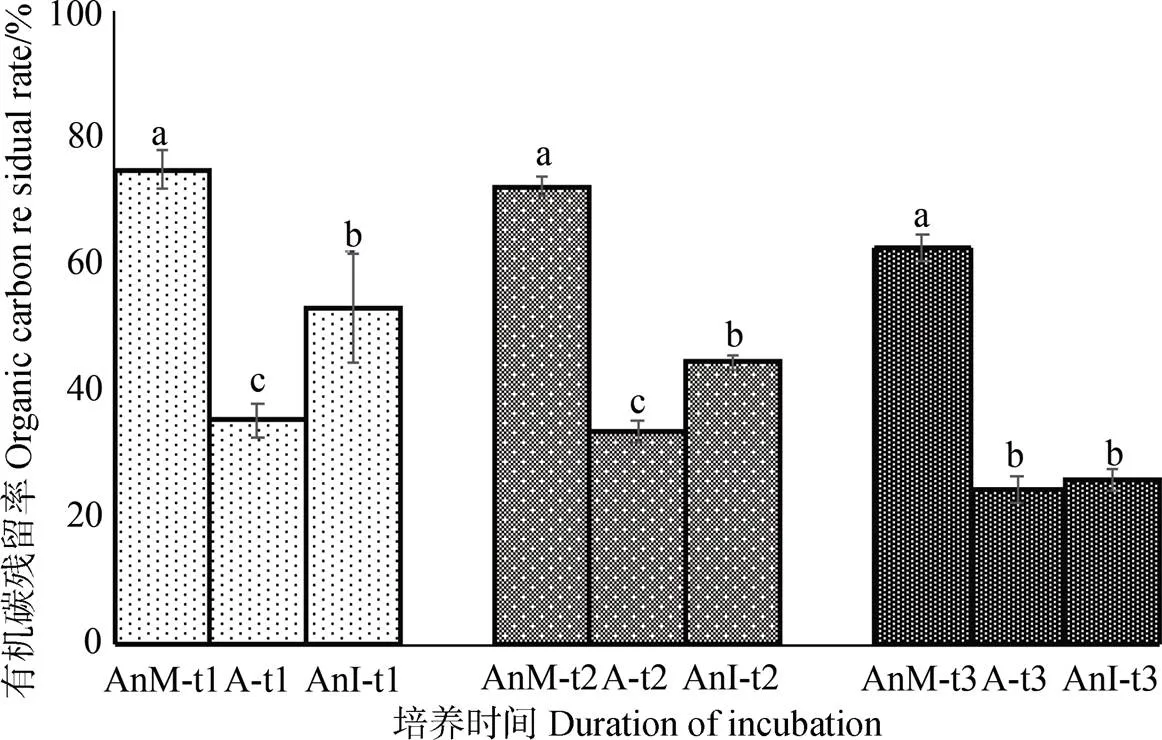
注:A為加入白花苜蓿、蒙脫石和土壤浸提液的處理, AnM和AnI分別為無蒙脫石和無土壤浸提液的處理,AnM-t1、A-t1、AnI-t1均代表培養90 d,AnM-t2、A-t2、AnI-t2均代表培養180 d,AnM-t3、A-t3、AnI-t3均代表培養360 d。有機碳殘留率為某一時間段的TOC與培養0 d TOC的比,即有機碳殘留率=TOCt/TOCt0。不同小寫字母代表同一時間不同處理間類腐殖質組分差異顯著(P<0.05)。下同。Note:A stands for treatment of addition of white alfalfa, montmorillonite and soil extract; AnM for treatment of addition of white alfalfa and soil extract; AnI for treatment of addition of white alfalfa and montmorillonite; and -t1, -t2 and -t3 for duration of the incubation for 90, 180 and 360 days, respectively. Organic carbon residual ratio is the ratio of TOC after a certain period of incubation to the initial TOC(i.e., organic carbon residual ratio = TOCt/TOCt0). Different lower-case letters represent significant differences in humus-like components between treatments after the same period of incubation(P <0.05).The same below.
蒙脫石對白花苜蓿培養產物PQ值的影響如圖3所示。在培養0 d時,A類PQ值低于AnM類處理;90 d后的PQ值為:A-t1(80.83)>AnM-t1(48.97),添加蒙脫石使PQ值迅速增加;180 d后, 兩類處理PQ值接近(A-t2 49.81,AnM-t2 49.36);360 d后,A-t3(62.84)>AnM-t3(26.19),蒙脫石再次使培養產物的腐殖化程度增加,與土壤的PQ值(60.02)十分接近。從AnI類和A類處理看,在蒙脫石條件下,添加土壤浸提液對白花苜蓿堿提取組分的影響較小,360 d后兩類處理的PQ值均與土壤十分接近。
2.3 蒙脫石對白花苜蓿培養產物HLA元素組成的影響及HLA與土壤HA的接近程度
培養產物HLA的元素組成見表2,各處理的培養產物HLA中C、H均小于培養物,N和O大體均大于培養物,模擬腐殖化培養促進N和O元素的積累及C和H的消耗。三種不同處理隨著培養時間的增加,H/C值逐漸減少,O/C則先增加后減少。通過對比AnM和A處理可知蒙脫石對白花苜蓿腐殖化進程的影響,培養90 d后,A處理的H/C由AnM處理的1.38增加至1.61;180 d后,由1.39變為1.53;360 d后,由1.36變為1.48。前期添加蒙脫石使A處理的H/C大幅度增加,HLA的結構簡單化,而隨著培養的進行,H/C的增加幅度逐漸減少,兩者HLA的復雜化程度的差距縮小。對比AnI和A處理,培養90 d后,A處理的H/C由AnI處理的1.81下降為1.61;180 d后,由1.62變為1.53;360 d后,兩者差距減小(AnI 1.50,A 1.48)。在蒙脫石條件下,前期添加土壤浸提液使A處理的H/C大幅度減小,促進HLA結構的復雜化;而隨著培養的進行,兩類處理的HLA的復雜程度基本接近。
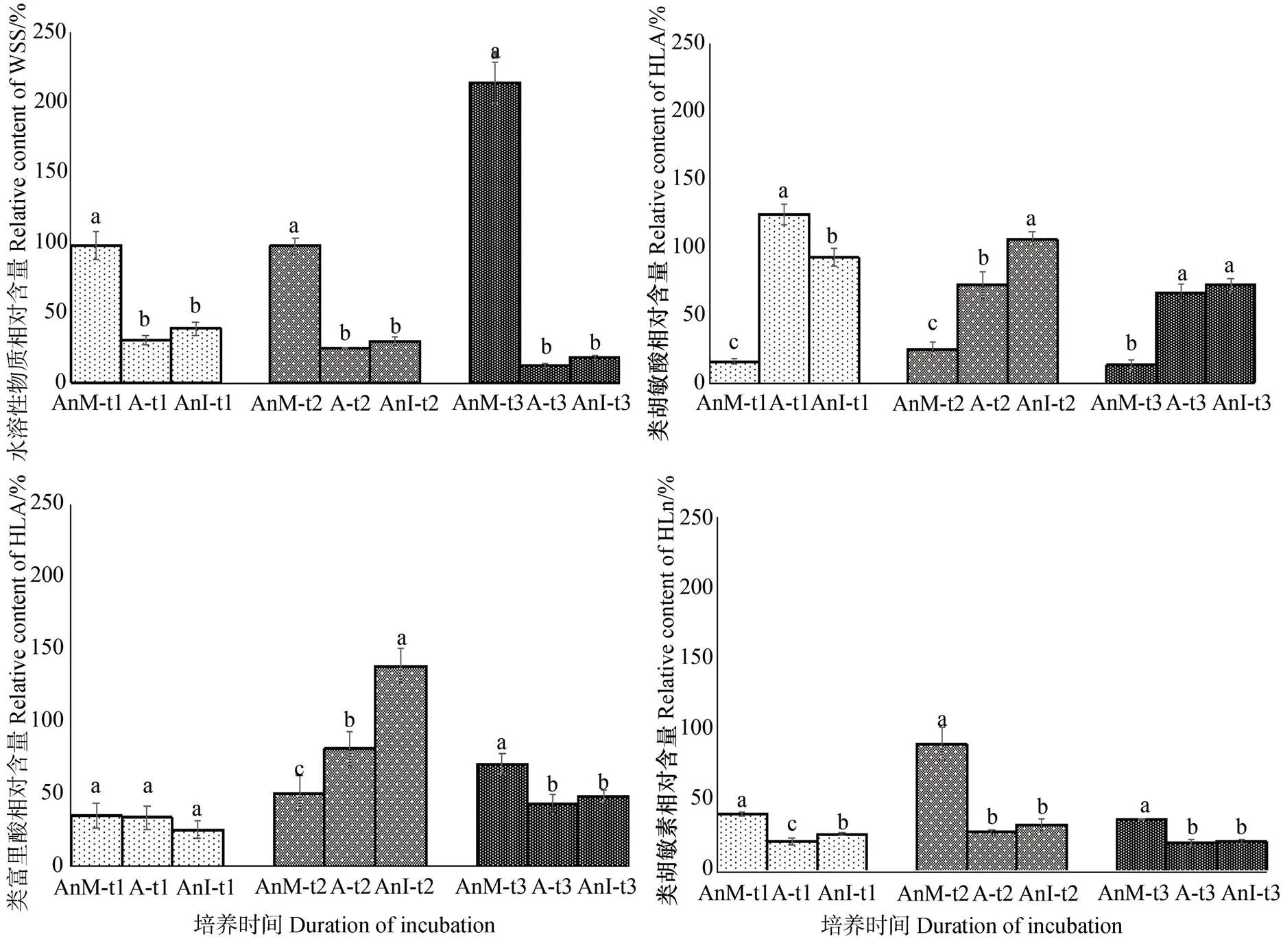
注:類腐殖質組分相對含量為某一時間段類腐殖質組分的含碳量與培養0 d時類腐殖質組分的比,即相對含量=Ct/Ct0。Note:Relative content of humus-like components is the ratio of the carbon content of the humus-like component after a certain period of incubation to the initial value of the humus-like components(i.e., the relative content = Ct/Ct0).
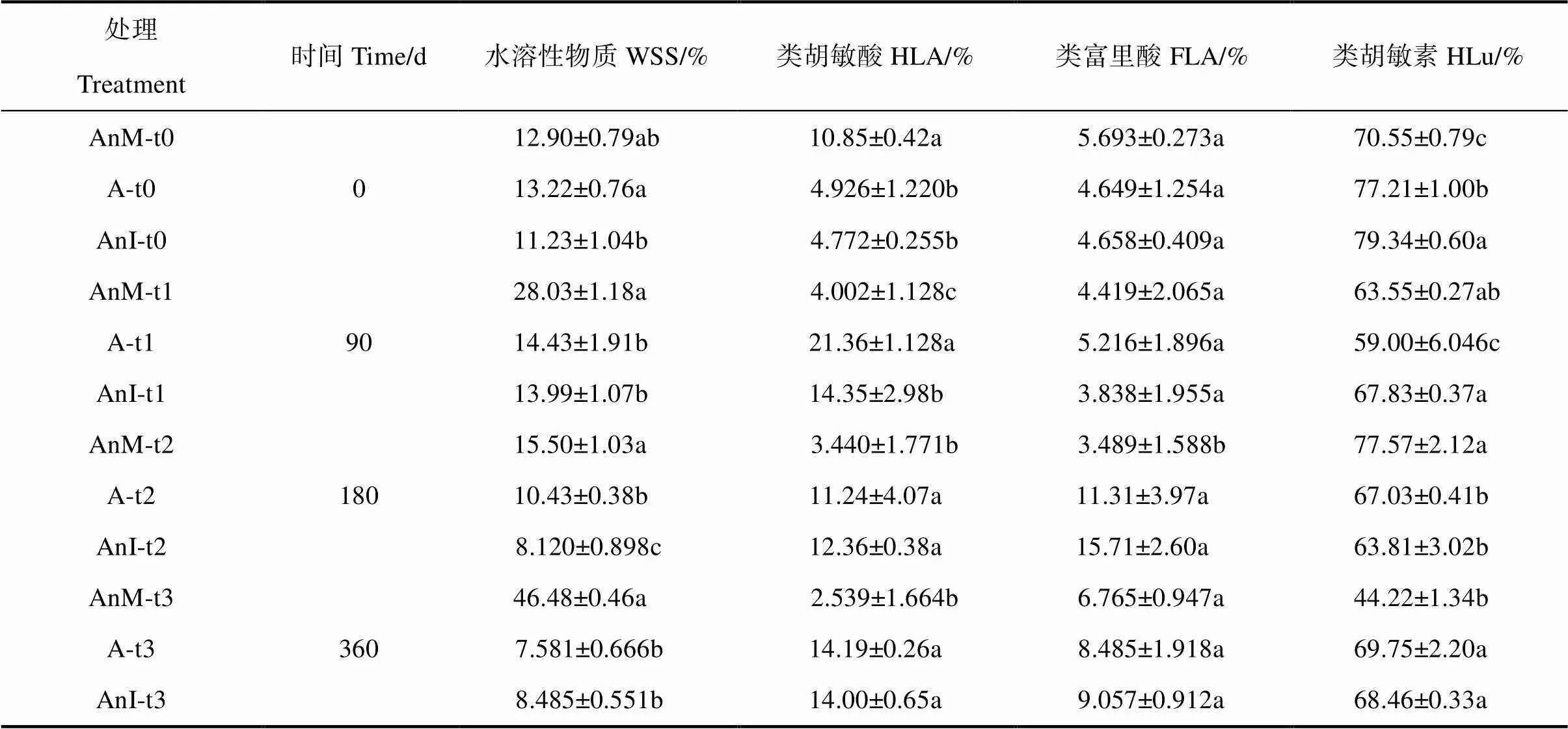
表1 蒙脫石添加對培養產物類腐殖質組分相對含量的影響
注:不同小寫字母代表同一時間不同處理間類腐殖質組分差異顯著(<0.05=。Note:the annotations are the same with Figure 1. Different lower-case letters represent significant differences in humus-like components between treatments, the same in duration of incubation(<0.05).
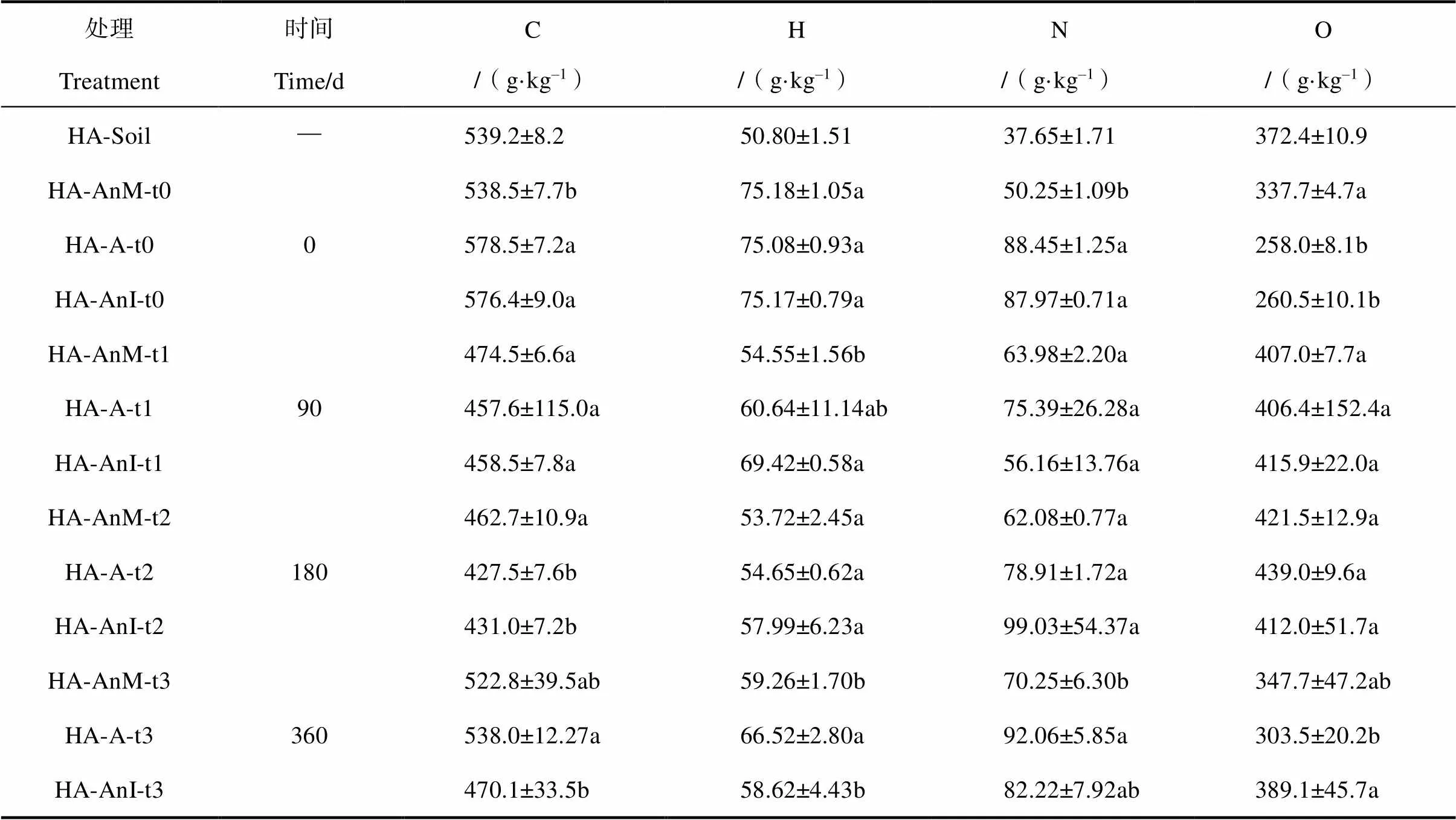
表2 蒙脫石添加對培養產物HLA的元素組成的影響
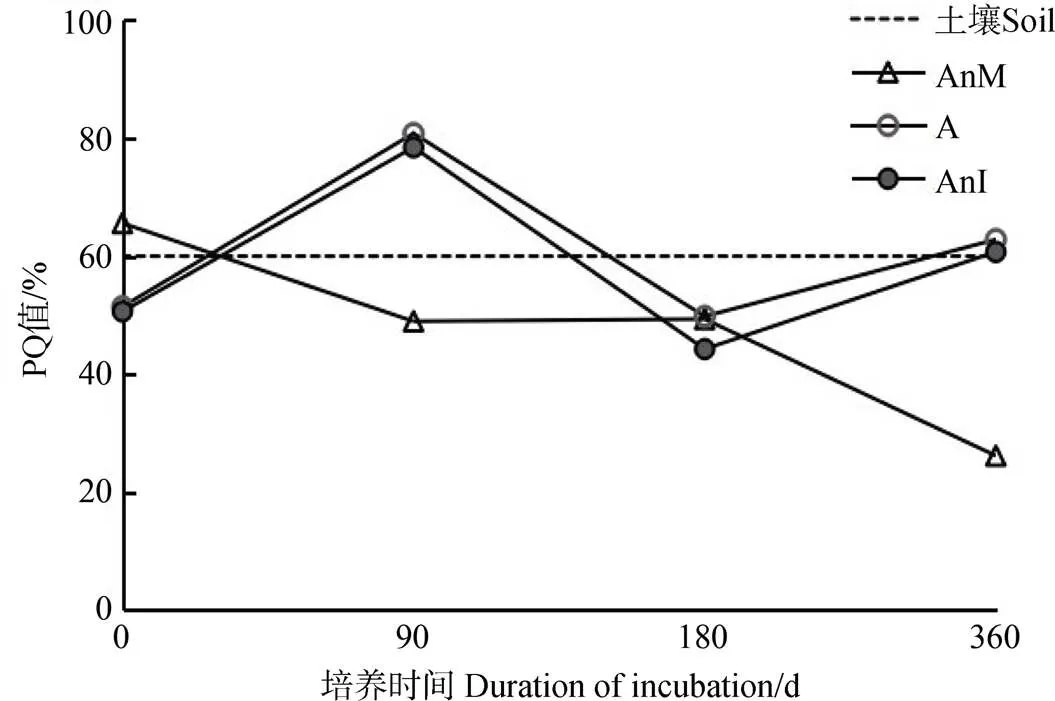
圖3 蒙脫石添加對白花苜蓿培養產物PQ值的影響
由范卡圖(圖4)可知,3類處理最終均是向著接近土壤HA的O/C和H/C值的方向發展。360 d后HLA與土壤HA的接近程度,AnM>A>AnI。未添加蒙脫石的AnM處理與土壤HA最接近,添加土壤浸提液的A處理其次,添加蒙脫石使形成的HLA結構更加簡單,與真正的HA仍存在較大的差異。
2.4 蒙脫石對白花苜蓿培養產物HLA紅外光譜的影響及HLA與土壤HA的接近程度
不同處理的白花苜蓿HLA與土壤HA的紅外光譜主要吸收峰相對強度見表3。各處理的HLA均顯示2 920 cm–1處代表不對稱脂族C-H伸縮振動的峰,2 850 cm–1處代表-CH2-對稱脂族C-H伸縮振動的峰,1 640 cm–1處代表芳香C=C伸縮振動的吸收峰;培養360 d后,各處理顯示出了與土壤HA相同的1 720 cm–1的酮、醛、酸中的羧基 C=O 伸縮振動峰。用2920/1640 比值代表材料脂肪族含量與芳香族含量的比值。
對比HA-AnM處理和HA-A處理的2920/1640比值:HA-A-t0(0.237)>HA-AnM-t0(0.186),HA-A-t1(0.184)>HA-AnM-t1(0.145),HA-A-t2(0.143)>HA-AnM-t2(0.138),HA-A-t3(0.136)> HA-AnM-t3(0.132),加入蒙脫石使生成的HLA脂肪族含量增加,結構簡單化,隨著培養時間的增加,兩類處理HLA的芳構化程度差距縮小。而對比HA-AnI處理和HA-A處理,HA-AnI-t0(0.225)> HA-A-t0(0.186),HA-AnI-t1(0.243)> HA-A-t1(0.184),HA-AnI-t2(0.156)>HA-A-t2(0.143),HA-AnI-t3(0.142)>HA-A-t3(0.136),HA-AnI-t1的突然增加與礦質化有關,添加土壤浸提液使蒙脫石處理有助于HLA的芳構化,隨著培養時間的進行,兩類處理芳構化程度的差距逐漸縮小。HLA的紅外光譜規律與元素組成規律相對應。
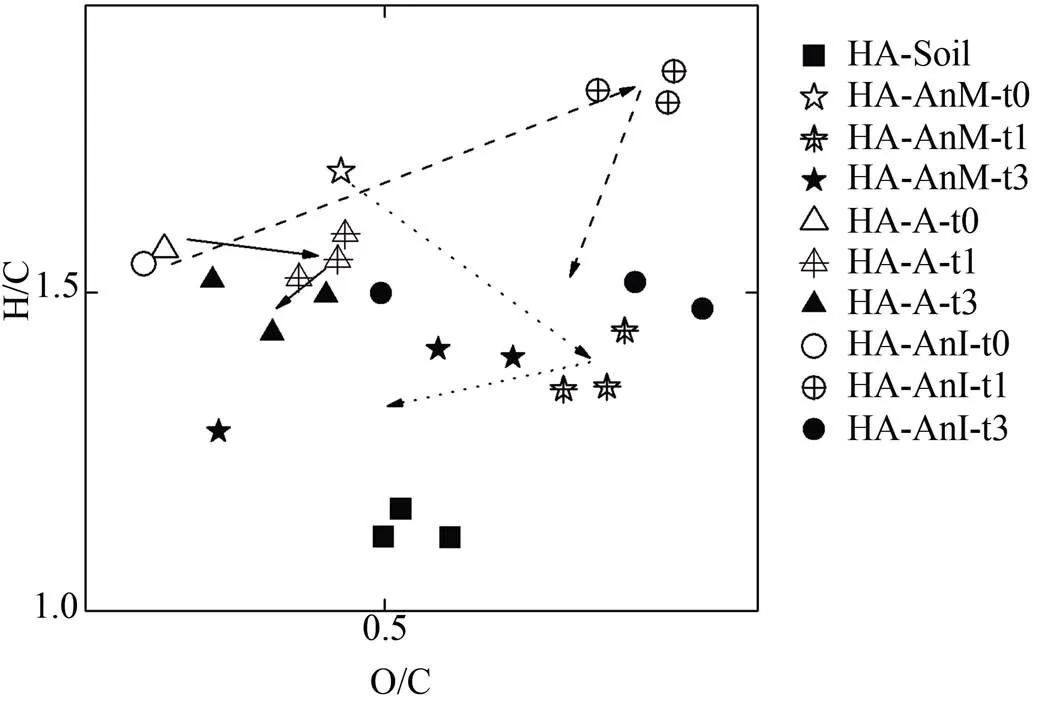
圖4 白花苜蓿培養產物的HLA與土壤HA的范卡圖
3 討 論
3.1 蒙脫石對培養產物TOC和類腐殖質組分的影響
蒙脫石處理和土壤浸提液處理加快了白花苜蓿TOC的分解。由于土壤浸提液中含有與土壤環境相似的微生物群體,對有機質維持和周轉的貢獻顯著[14];而蒙脫石不僅可通過影響微生物群落棲息微環境來影響微生物的代謝[15-17],同時蒙脫石還具有催化作用[18],因此兩種處理共同促進了白花苜蓿TOC的分解。蒙脫石促進TOC的分解主要通過促進WSS減少來實現,但同時促進了HLA和FLA的形成與轉化。從腐殖質組成的穩定性來看,WSS不穩定,易分解[19],蒙脫石的催化作用使WSS迅速減少。而PQ值的變化主要與前期蒙脫石對HLA的吸附[20]、中期HLA的積累與后期HLA和FLA的相互轉化有關,添加蒙脫石使PQ值增加,最終接近土壤HA,促進白花苜蓿的腐殖化進程。Loya等[19]指出腐殖化使水溶性(WS)和酸溶性(AS)組分部分的14C活性降低,但酸不溶組分(AIS)中的14C活性增加,微生物代謝物和降解的化合物結合到SOM的頑固化合物中,本實驗結果進一步證實了Loya等的研究。

表3 蒙脫石添加對培養產物HLA的FTIR光譜主要吸收峰相對強度的影響
在白花苜蓿模擬培養腐殖化過程中,蒙脫石加快TOC的分解,促進HLA的積累,結果與Gleixner[21]的研究一致。Gleixner指出當大多數植物有機碳通過土壤微生物時,除一部分用于細胞能量需求外,其余部分用于生物量的積累,微生物生物質主要由細胞碎片形成土壤有機質(SOM)。本實驗結果證實了前人的研究,進一步指出蒙脫石促進HLA的生成和FLA與HLA的相互轉化,以及對WSS、PQ值的影響,使對腐殖化進程的認識更具體化。
3.2 蒙脫石對培養產物HLA結構特征的影響
研究表明:蒙脫石使HLA的芳構化程度降低,結構趨于簡單化。添加土壤浸提液使蒙脫石處理的HLA結構復雜化。培養中期AnI處理的HLA縮合度減少與未添加土壤浸提液前期腐殖化速度較慢有關,培養仍處于礦質化階段[22],白花苜蓿被微生物分解成簡單的有機化合物,使縮合度減少。一些學者認為黏土礦物可提高HA的芳香度,使HA的結構更復雜。Duarte等[10]研究表明,礦物表面對土壤HA分子中非晶形亞甲基結構數量的提升具有顯著抑制作用,即提高了HA的芳香度。Filip等[9]表明黏土礦物的催化作用主要通過間接影響酚類物質的形成而實現,但所形成的HS結構未見差異。Fukuchi等[23]研究了鄰苯二酚、甘氨酸與葡萄糖在天然沸石催化作用下的縮聚反應,表明沸石有利于類HA中氮含量及分子量的提高,對醌、酮等羰基碳含量亦有提升作用。
本實驗的研究結果與前人不同,在模擬培養腐殖化360 d內,添加蒙脫石使HLA的結構簡單化,而添加土壤浸提液則可使蒙脫石處理的HLA的芳香度增加。因為在HS形成過程中,生物大分子(例如,蛋白質、多糖和木質素)最初分解為低分子量化合物(例如,氨基酸、糖和酚)。低分子量化合物隨后通過縮聚反應進行重組,形成HS。木質素蛋白理論[24]和美拉德反應[25]已被提出作為低分子量化合物重組并最終形成HS的反應途徑,這種反應以親核反應的形式進行。通常,在酸性催化劑存在下,親核反應得到增強[26]。眾所周知,黏土礦物以固體酸的形式廣泛分布在土壤環境中,所以蒙脫石可加速縮聚反應進行。然而蒙脫石的加入破壞了原本結構相對穩定的HLA,促進低分子量化合物(如氨基酸,糖和酚)之間的縮聚反應,在短時間的培養期內,新縮聚形成的HLA的結構仍然較簡單。而在蒙脫石條件下,在同等破壞HLA結構的基礎上加入土壤浸提液,更加速了縮聚反應的進行,所以添加土壤浸提液使蒙脫石處理的HLA結構更加復雜。但是隨著培養時間的持續增加,蒙脫石的加入是否會使HLA結構復雜化,還需要進行進一步研究。
在白花苜蓿培養產物HLA與土壤HA對比的范卡圖中,3類處理最終均是向著接近土壤HA的O/C和H/C值的方向發展,未添加蒙脫石(AnM)的HLA與真正的HA最接近,說明蒙脫石不能促進形成的HLA更接近土壤HA。Ahn等[27]研究表明:自然界中,土壤礦物通過氧化偶聯反應催化酚向腐殖物質聚合物轉化,采用三元體系法通過長絨毛栓菌所分泌的蟲漆酶、水鈉錳礦(-MnO2)以及鄰苯二酚之間的相互作用來模擬土壤過程,表明酶-土壤礦物-有機質間的相互作用對腐殖質形成過程具有重要意義。本研究證實了蒙脫石的貢獻,可加快白花苜蓿的腐殖化進程,但蒙脫石使生成的HLA更加年輕化,與真正的HA仍存在較大的差異。
4 結 論
在模擬培養白花苜蓿腐殖化過程中,蒙脫石促進TOC的分解和HLA的生成,且使HLA的縮合度降低;因此蒙脫石未能像文獻報道的那樣使HLA的芳構化程度增加,結構復雜化,相反卻使其結構更加簡單。而土壤浸提液添加,則使蒙脫石處理在促進HLA積累的同時,使HLA的縮合度增加,結構更加復雜化。在白花苜蓿培養產物HLA與土壤HA的范卡圖中,3類處理最終均是向著接近土壤HA的方向發展,其中培養后未添加蒙脫石(AnM)處理中HLA與真正的HA最接近,說明蒙脫石不能促進HLA更接近土壤HA。綜上,在模擬培養白花苜蓿腐殖化過程中,蒙脫石添加可加快白花苜蓿的腐殖化進程,但卻使形成的HLA結構更加簡單化,與真正的HA仍存在較大的差異。本研究結果探究了30℃培養條件下,蒙脫石對白花苜蓿模擬培養腐殖化的影響。今后還需要更多的研究來進一步理解黏土礦物對腐殖化過程的具體作用機制。
[ 1 ] Rodríguez F J, Schlenger P, García-Valverde M. A comprehensive structural evaluation of humic substances using several fluorescence techniques before and after ozonation. Part I:Structural characterization of humic substances[J]. Science of the Total Environment, 2014, 476/477:718—730.
[ 2 ] Garcia C, Nannipieri P, Hernandez T. The future of soil carbon:Its conservation and formation[M]. London, United Kingdom:Academic Press, 2018.Garcia C, Nannipieri P, Hernandez T. The future of soil carbon//The Future of Soil Carbon. Amsterdam:Elsevier, 2018:239—267.
[ 3 ] Stewart C E. Evaluation of angiosperm and fern contributions to soil organic matter using two methods of pyrolysis-gas chromatography-mass spectrometry[J]. Plant and Soil, 2012, 351(1/2):31—46.
[ 4 ] Ponge J F. Plant-soil feedbacks mediated by humus forms:A review[J]. Soil Biology & Biochemistry, 2013, 57:1048—1060.
[ 5 ] Li Y. Microorganisms use organic materials such as sugars and cyanobacteria to participate in the formation of humus[D]. Changchun:Jilin Agricultural University, 2016. [李艷. 微生物利用糖類和藍藻等有機物料參與形成腐殖質的研究[D]. 長春:吉林農業大學, 2016.]
[ 6 ] Dou S, Li Y, Guan S, et al. The structural distinctiveness of humic substances and its formation mechanism in simulated incubation[J]. Acta Pedologica Sinica, 2016, 53(4):821—831. [竇森, 李艷, 關松, 等. 腐殖物質特異性及其產生機制[J]. 土壤學報, 2016, 53(4):821—831.]
[ 7 ] Kallenbach C M, Frey S D, Stuart Grandy A. Direct evidence for microbial-derived soil organic matter formation and its ecophysiological controls[J]. Nature Communications, 2016, 7:13630. https://doi.org/10. 1038/ncomms13630.
[ 8 ] Birkel U, Gerold G, Niemeyer J. Abiotic reactions of organics on clay mineral surfaces[J]. Developments in Soil Science, 2002, 28:437—447.
[ 9 ] Filip Z, Haider K, Martin J P. Influence of clay minerals on growth and metabolic activity ofand[J]. Soil Biology & Biochemistry, 1972, 4(2):135—145.
[ 10 ] Duarte R M B O, Fernández-Getino A P, Duarte A C. Humic acids as proxies for assessing different Mediterranean forest soils signatures using solid-state CPMAS13C NMR spectroscopy[J]. Chemosphere, 2013, 91(11):1556—1565.
[ 11 ] Dou S. Soil organic matter[M]. Beijing:Science Press, 2010. [竇森. 土壤有機質[M]. 北京:科學出版社, 2010.]
[ 12 ] Dong S S, Dou S, Shao M J, et al. Effect of corn stover deep incorporation with different years on composition of soil humus and structural characteristics of humic acid in black soil[J]. Acta Pedologica Sinica, 2017, 54(1):150—159. [董珊珊, 竇森, 邵滿嬌, 等. 秸稈深還不同年限對黑土腐殖質組成和胡敏酸結構特征的影響[J]. 土壤學報, 2017, 54(1):150—159.]
[ 13 ] Kuwatsuka S, Watanabe A, Itoh K, et al. Comparison of two methods of preparation of humic and fulvic acids, IHSS method and NAGOYA method[J]. Soil Science and Plant Nutrition, 1992, 38(1):23—30.
[ 14 ] Malik A A, Roth V N, Hébert M, et al. Linking molecular size, composition and carbon turnover of extractable soil microbial compounds[J]. Soil Biology & Biochemistry, 2016, 100:66—73.
[ 15 ] Vogel C, Babin D, Pronk G J, et al. Establishment of macro-aggregates and organic matter turnover by microbial communities in long-term incubated artificial soils[J]. Soil Biology & Biochemistry, 2014, 79:57—67.
[ 16 ] Singh M, Sarkar B, Biswas B, et al. Relationship between soil clay mineralogy and carbon protection capacity as influenced by temperature and moisture[J]. Soil Biology & Biochemistry, 2017, 109:95—106.
[ 17 ] Babin D, Ding G C, Pronk G J, et al. Metal oxides, clay minerals and charcoal determine the composition of microbial communities in matured artificial soils and their response to phenanthrene[J]. FEMS Microbiology Ecology, 2013, 86(1):3—14.
[ 18 ] Ertem G, Gan Z H. Role of preparation method on the extent of montmorillonite catalysis for oligomer formation[J]. Applied Clay Science, 2014, 101:90—93.
[ 19 ] Loya W M, Johnson L C, Nadelhoffer K J. Seasonal dynamics of leaf- and root-derived C in arctic tundra mesocosms[J]. Soil Biology & Biochemistry, 2004, 36(4):655—666.
[ 20 ] Chen H F, Koopal L K, Xiong J, et al. Mechanisms of soil humic acid adsorption onto montmorillonite and kaolinite[J]. Journal of Colloid and Interface Science, 2017, 504:457—467.
[ 21 ] Gleixner G. Soil organic matter dynamics:A biological perspective derived from the use of compound-specific isotopes studies[J]. Ecological Research, 2013, 28(5):683—695.
[ 22 ] Kumar M, Kundu D K, Ghorai A K, et al. Carbon and nitrogen mineralization kinetics as influenced by diversified cropping systems and residue incorporation in Inceptisols of eastern Indo-Gangetic Plain[J]. Soil and Tillage Research, 2018, 178:108—117.
[ 23 ] Fukuchi S, Miura A, Okabe R, et al. Spectroscopic investigations of humic-like acids formed via polycondensation reactions between glycine, catechol and glucose in the presence of natural zeolites[J]. Journal of Molecular Structure, 2010, 982(1/2/3):181—186.
[ 24 ] Tan K H. Humic matter in soil and the environment:Principles and controversies[M]. Boca Raton,United States:CRC Press, 2014.
[ 25 ] Haffenden L J W, Yaylayan V A. Mechanism of formation of redox-active hydroxylated benzenes and pyrazine in13C-labeled glycine/D-glucose model systems[J]. Journal of Agricultural and Food Chemistry, 2005, 53(25):9742—9746.
[ 26 ] Varma R S. Clay and clay-supported reagents in organic synthesis[J]. Tetrahedron, 2002, 58(7):1235—1255.
[ 27 ] Ahn M Y, Martínez C E, Archibald D D, et al. Transformation of catechol in the presence of a laccase and birnessite[J]. Soil Biology & Biochemistry, 2006, 38(5):1015—1020.
Does Amendment of Montmorillonite Promote Humification of White Alfalfa?
XU Yang, DOU Sen?,ZHANG Yifeng, TIAN Yuxin, DUAN Hongmei, BAI Yue
(College of Resource and Environmental Science, Jilin Agricultural University, Changchun 130118, China)
Humic substances (HS), the main component of soil organic matter, are kind of macromolecular compounds, specific and multi-phased in property, formed during humification. However, in the past two decades, doubts have been arising about rationality of the disassociation process of HS. Currently, the research has shifted its focus from on chemical properties of HS to on identification of processes and mechanisms related to HS renewal and stabilization. Plant residues and microbial biomass are the main parent materials for the formation of humic substances, meanwhile, clay minerals, as an important part of the soil, also play an important role in the process. However, still little is known about any specific effects of clay minerals on formation of HS. Some scholars have used microbial pure culture methods to study formation of HS, but because of the absence of clay minerals, the formation of HS studied does not represent that in soil. Therefore, more efforts should be done to further elucidate in detail the complex interactions between HS and the surface of minerals, as well as the role of soil microbes as a participant. In order to explore effects of montmorillonite on humification process, white alfalfa, an angiosperm, was used in an incubation experiment with montmorillonite and microbe-soil extract as control conditions.In this experiment, there were three treatments, i.e. Treatment A, white alfalfa with montmorillonite and soil extract added; Treatment AnM, white alfalfa with soil extract added only; and Treatment AnI, only white alfalfa. Effects of the treatments and duration of the incuabtion on composition of humus-like substances and structure of humic-like acids (HLA) formed as incubation product of white alfalfa were studied. Water-soluble substances (WSS), fulvic-like acid (FLA), humic-like acid (HLA) and humin-like (HLu) were extracted with the modified humus composition method. HLA samples were extracted with the method recommended by the International Humic Substances Society (IHSS) for analysis of structure of HA with the elemental composition- infrared spectroscopy.Results show that the amendment of montmorillonite promoted decomposition of TOC and accumulation of simple structured HLA. After 90 days of incubation, H/C in Treatment A increased from 1.38 to 1.61, after 180 days from 1.39 to 1.53, and after 360 days from 1.36 to 1.48. The sharp increase in H/C in the early stage in Treatment A made the structure of HLA simple. However, with the incubation going on, the increase in H/C gradually dulled in trend. Its ratio of 2920/1640 in the infrared spectrum tended to be in consistence with that in elemental composition. At the end of the incubation, HLA, regardless of treatments, developed eventually quite close to the O/C and H/C of soil HA in value. Among the treatments, the HLA in Treatment (AnM) was the closest to real soil HA in complexity, indicating that montmorillonite cannot help HLA turn into soil HA.Overall, montmorillonite amendment may promote decomposition of TOC and formation of HLA, and accelerate humification process of white alfalfa; however, it does not enhance the aromatization of HLA in degree and the structure of HLA in complexity as speculated or reported in the literature. Instead, it simplifies the structure of HLA, which is still quite different from real soil HA.
White alfalfa; Simulated incubation; Humification; Humic substances; Humic acid
S151.9
A
10.11766/trxb201903060110
徐楊,竇森,張一楓,田宇欣,段宏美,白月. 添加蒙脫石是否促進白花苜蓿的腐殖化進程?[J]. 土壤學報,2020,57(5):1230–1239.
XU Yang, DOU Sen,ZHANG Yifeng, TIAN Yuxin, DUAN Hongmei, BAI Yue. Does Amendment of Montmorillonite Promote Humification of White Alfalfa?[J]. Acta Pedologica Sinica, 2020,57(5):1230–1239.
* 國家自然科學基金項目(41571231)資助 Supported by the National Natural Science Foundation of China(No. 41571231)
,E-mail:dousen1959@126.com
徐 楊(1994—),女,山東青島人,碩士研究生,從事土壤環境與生物化學研究。E-mail:857472355@qq.com
2019–03–06;
2019–04–21;
優先數字出版日期(www.cnki.net):2019–11–01
(責任編輯:盧 萍)
猜你喜歡
小獼猴智力畫刊(2023年4期)2023-04-23 08:49:58
哲學評論(2021年2期)2021-08-22 01:53:34
中華詩詞(2019年7期)2019-11-25 01:43:04
模具制造(2019年3期)2019-06-06 02:10:54
中學生數理化·高一版(2018年1期)2018-02-10 05:20:03
影視與戲劇評論(2016年0期)2016-11-23 05:26:01
七彩語文·寫字與書法(2016年7期)2016-07-28 21:40:22
七彩語文·寫字與書法(2016年6期)2016-07-15 19:36:34
人間(2015年21期)2015-03-11 15:23:21
現代企業(2015年9期)2015-02-28 18:56:50