同步發(fā)電機勵磁控制教學(xué)中的Matlab/simulink應(yīng)用實例
2020-11-02 02:34:32范程華張忠祥魯世斌
電腦知識與技術(shù)
2020年25期
關(guān)鍵詞:系統(tǒng)仿真
范程華 張忠祥 魯世斌


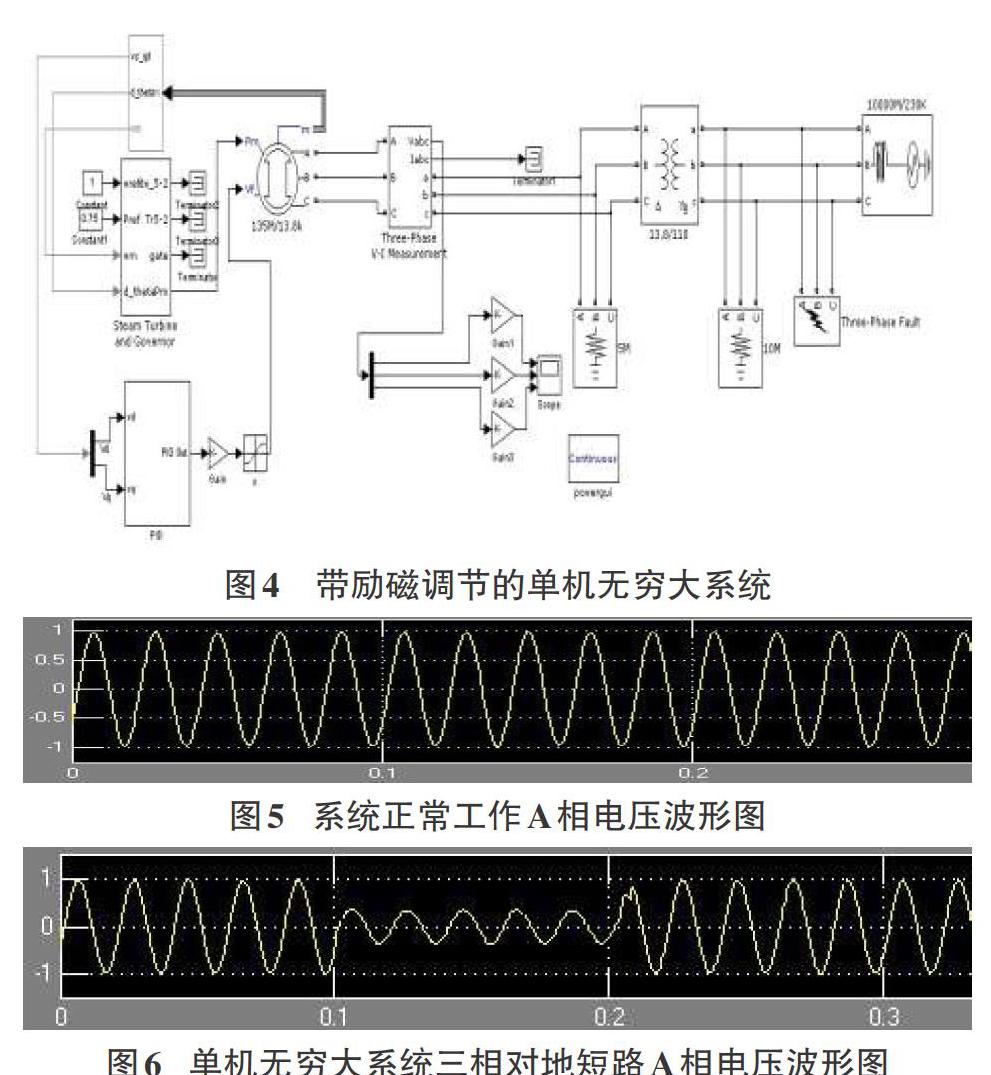
摘要:同步發(fā)電機勵磁控制系統(tǒng)是《電機控制技術(shù)》課程的重要部分,其中PID勵磁調(diào)節(jié)器的設(shè)計在教學(xué)中具有承前啟后的作用。本文以135MW汽輪發(fā)電機為例,介紹了一種基于積分分離PID勵磁調(diào)節(jié)器的設(shè)計方法,并采用simulink搭建了電力系統(tǒng)模型。仿真孤網(wǎng)運行并模擬故障,結(jié)果表明該勵磁控制器能有效提高電力系統(tǒng)的動態(tài)穩(wěn)定性。控制器的設(shè)計過程有助于學(xué)生理解PID調(diào)節(jié)器的控制方式,對后續(xù)課程設(shè)計具有一定指導(dǎo)意義。
關(guān)鍵詞:同步發(fā)電機;PID控制;勵磁調(diào)節(jié)器;系統(tǒng)仿真
中圖分類號:G64 ? ? ? 文獻標識碼:A
文章編號:1009-3044(2020)25-0028-03
Abstract: The synchronous generator excitation control system is an important part of the "Motor Control Technology" course, in which, the PID designing of excitation regulator is closely related to the previous and follow-up courses in the teaching.Taking 135MW steam turbine generator as an example, this paper introduces a design method based on integral separation PID excitation regulator, and builds the power system model with simulink. The results of isolation operation and simulating malfunctions show that the excitation controller can effectively improve the dynamic stability of the power system. The design process of the controller can helps students understand the control mode of the PID regulator, which has certain guiding significance for the subsequent course design.
Key words:Synchronous generator; PID control ; Excitation regulator; System Simulation
1 引言
《電機控制技術(shù)》課程中同步發(fā)電機勵磁調(diào)節(jié)器的控制規(guī)律通常有PID勵磁控制、線性最優(yōu)控制、自適應(yīng)勵磁控制和非線性勵磁控制等[1]。其中PID勵磁控制是本科教學(xué)階段的重要內(nèi)容之一,在工程實際中也得到了廣泛的應(yīng)用[2]。當(dāng)發(fā)電機并電網(wǎng)運行時,一旦其電壓頻率有波動,電網(wǎng)會自發(fā)地通過自己的能力將頻率電壓拉回適應(yīng)的范圍,如果沒有電網(wǎng),發(fā)電機只能靠調(diào)節(jié)勵磁系統(tǒng)以調(diào)節(jié)發(fā)電機的頻率電壓[3]。本文以135MW汽輪發(fā)電機孤網(wǎng)運行時負載對電力系統(tǒng)的電壓頻率要求為例,介紹了一種PID勵磁調(diào)節(jié)器的設(shè)計方法,并通過Matlab/simulink搭建電力系統(tǒng)模型進行系統(tǒng)穩(wěn)定性仿真,幫助學(xué)生理解PID控制規(guī)律及控制器設(shè)計步驟、方法。
2 同步發(fā)電機閉環(huán)控制系統(tǒng)設(shè)計
選取額定容量180MVA、額定功率135MW汽輪發(fā)電機為例,其輸出線電壓為13.8KV,并通過升壓變壓器接于110kV供電母線上,且不具備孤網(wǎng)運行條件。……
登錄APP查看全文
猜你喜歡
數(shù)字技術(shù)與應(yīng)用(2016年10期)2017-04-01 15:58:06
物流科技(2016年12期)2017-04-01 03:06:34
科教導(dǎo)刊(2016年33期)2017-02-27 11:00:52
航空兵器(2016年4期)2016-11-28 21:34:37
中國科技博覽(2016年10期)2016-04-29 05:26:16
科技與創(chuàng)新(2015年18期)2015-09-11 22:39:35
物聯(lián)網(wǎng)技術(shù)(2015年5期)2015-07-18 14:04:12
中國高新技術(shù)企業(yè)(2015年18期)2015-05-20 05:28:22
農(nóng)業(yè)科技與裝備(2014年2期)2014-11-28 21:10:29
計算機輔助工程(2014年1期)2014-03-13 08:34:33