北京首都國(guó)際機(jī)場(chǎng)T3航站樓
2021-05-11 06:42:48NigelYoung
世界建筑導(dǎo)報(bào) 2021年2期
關(guān)鍵詞:建筑設(shè)計(jì)
業(yè)主單位:北京首都國(guó)際機(jī)場(chǎng)有限公司
項(xiàng)目地點(diǎn):中國(guó)北京
建筑設(shè)計(jì):福斯特建筑事務(wù)所
合作單位:北京建筑設(shè)計(jì)院
結(jié)構(gòu)設(shè)計(jì)/機(jī)電設(shè)計(jì):奧雅納
景觀設(shè)計(jì):Michel Desvigne
照明設(shè)計(jì):Speirs and Major
設(shè)計(jì)/建造:2003 / 2008 年
攝影:Nigel Young / 福斯特建筑事務(wù)所
Client: Beijing Capital International Airport Company Ltd.
Location: Beijing, China
Architectural Design: Foster + Partners
Local collaborating architect: BIAD (Beijing Institute of Architectural Design)
Structural & Mechanical Engineers: Arup
Landscape Architect: Michel Desvigne
Lighting Consultant: Speirs and Major
Design / Completion: 2003 / 2008
Photography: Nigel Young / Foster + Partners
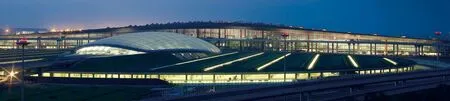
世界上最大的建筑——北京首都國(guó)際機(jī)場(chǎng)的新設(shè)航站樓——為2008 年奧運(yùn)會(huì)提前開(kāi)放。北京首都國(guó)際機(jī)場(chǎng)三號(hào)航站樓僅用了四年的時(shí)間便設(shè)計(jì)和建設(shè)完成,現(xiàn)已開(kāi)放使用。作為世界上最大的建筑和最先進(jìn)的機(jī)場(chǎng),該航站樓無(wú)論是在科技上,還是在運(yùn)作效率、乘客舒適度、可持續(xù)性和自然采光上,都提供給旅客無(wú)與倫比的飛行體驗(yàn)。作為第29 屆奧運(yùn)會(huì)參賽運(yùn)動(dòng)員進(jìn)入北京的門(mén)戶,其設(shè)計(jì)備受歡迎、振奮人心。高聳的空氣動(dòng)力屋頂和龍形結(jié)構(gòu)是北京的象征,像是在贊頌飛行中的驚險(xiǎn)和詩(shī)意。金色屋頂與紫禁城交相輝映,從紅色到橙色再到黃色的內(nèi)部調(diào)色引人注目,喚起了中國(guó)人的傳統(tǒng)色彩歸屬。
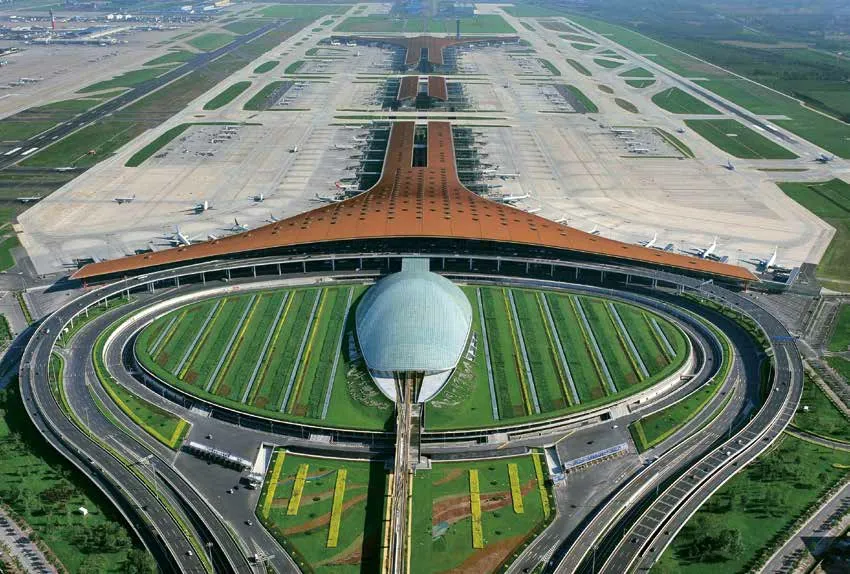
三號(hào)航站樓和地面運(yùn)輸中心(GTC)位于現(xiàn)存東跑道和即將建立的第三跑道之間,占地約130 萬(wàn)平方米,大部分區(qū)域處于同一棟建筑中。作為突破100 萬(wàn)平方米關(guān)卡的第一座建筑,截至2020 年,預(yù)計(jì)每年可輸送5000 萬(wàn)名旅客。這座建筑的規(guī)模空前,而其設(shè)計(jì)旨在解決現(xiàn)代航空旅行的復(fù)雜性,將空間清晰性與高服務(wù)標(biāo)準(zhǔn)結(jié)合起來(lái)。新航站樓和地面運(yùn)輸中心將為以友好、向上的態(tài)度服務(wù)旅客,同時(shí)提供更為便利的導(dǎo)航。建筑呈一個(gè)簡(jiǎn)單的對(duì)稱圖形分布,由三個(gè)相連的充滿光照的T3A、T3B 和T3C 組成,兩端呈扇形散開(kāi),以容納T3A(連接航站樓和國(guó)內(nèi)登機(jī)口)和T3B(國(guó)際登機(jī)口)的到達(dá)大廳和候機(jī)室。衛(wèi)星T3C(國(guó)內(nèi)登機(jī)口)處在對(duì)稱圖形的中心。這種布局是最大限度地?cái)U(kuò)大周長(zhǎng)的一種有效手段,能夠增加飛機(jī)停機(jī)坪的容量,同時(shí)保持高度緊湊的結(jié)構(gòu)和可持續(xù)的承載面積。
The world’s largest building - the new Terminal at Beijing Capital International Airport -opens ahead of schedule for the 2008 Olympics. Designed and completed in only four years, Terminal 3 at Beijing Capital International Airport has opened. The world’s largest building and most advanced airport, the new terminal offers an unparalleled travelling experience, not only technologically, but also in terms of operational efficiency, passenger comfort, sustainability and access to natural light. Completed as the gateway to Beijing for athletes participating in the twenty-ninth Olympiad, it is designed to be welcoming and uplifting. A symbol of place, its soaring aerodynamic roof and its dragon-like form celebrate the thrill and poetry of flight. Its gold roof resonates with the Forbidden City,while the striking interior palette of red through orange to yellow evokes traditional Chinese colours.
Located between the existing eastern runway and the future third runway, Terminal 3 and the Ground Transportation Centre (GTC) together enclose a floor area of approximately 1.3 million m2, mostly under one roof. The first building to break the one million square meter barrier, it will accommodate an estimated 50 million passengers per annum by 2020.Although conceived on an unprecedented scale, the building’s design aims to resolve the complexities of modern air travel, combining spatial clarity with high service standards.It will be friendly and uplifting for the passenger as well as easy to navigate. Comprising three connected, light-filled volumes - T3A, B and C - the simple, symmetrical diagram fans out at either end to accommodate the arrivals and departure halls for T3A(processing terminal and domestic gates) and T3B (international gates).The satellite T3C (domestic gates) occupies the centre of the diagram. This arrangement is an efficient means of maximizing the perimeter, so increasing the capacity for aircraft stands, while maintaining a highly compact and sustainable footprint.
雖然從北到南的長(zhǎng)度僅為3.25 公里,但這三個(gè)要素之間的視覺(jué)聯(lián)系是由強(qiáng)大的視準(zhǔn)線,以及低層與上層一個(gè)開(kāi)放的夾層之間的視覺(jué)連接維持的。所有的空間依靠天然采光,大片的玻璃和天窗讓人能時(shí)刻了解外面的情況以及天氣變化。中軸線上的立有獨(dú)特的紅色柱子,這些柱子沿著建筑的外部邊緣一直延伸到遠(yuǎn)處,讓人聯(lián)想到傳統(tǒng)的中國(guó)寺廟。
? Ma Wenxiao

總平面 Site Plan
候機(jī)樓的環(huán)抱式彎曲懸臂梁擺出簡(jiǎn)單的歡迎手勢(shì),歡迎乘坐公路交通工具或從地面運(yùn)輸中心而來(lái)的乘客。登機(jī)處和到達(dá)處分布于不同樓層。傳統(tǒng)的機(jī)場(chǎng)圖在T3B 處被顛倒過(guò)來(lái),到達(dá)大廳位于上層,這樣一來(lái),來(lái)京游客可以從最佳的有利地形感受這一巨大空間的宏偉壯觀。
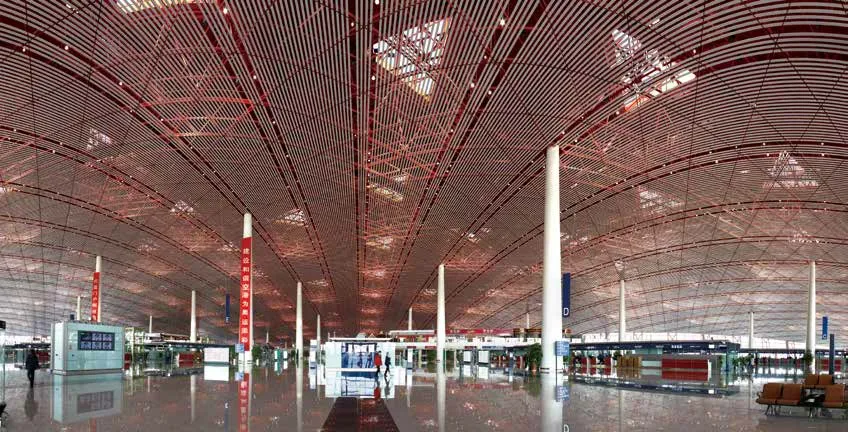
單一的一體屋頂天篷嵌有天窗以幫助定向,且能讓陽(yáng)光照射進(jìn)建筑內(nèi)部。建筑橫跨16 個(gè)色調(diào),T3A 入口由紅色過(guò)渡到橙色,再過(guò)渡到T3B 遠(yuǎn)端的黃色。這種布局建立了一個(gè)微妙的分區(qū)式系統(tǒng),對(duì)建筑規(guī)模進(jìn)行分解,易于尋路。而這種色調(diào)也應(yīng)用于候機(jī)大廳和到達(dá)大廳上方的天花板上,順序?yàn)橛杀钡侥希訌?qiáng)了屋頂平面的曲面感。
T3A 和T3B 航站樓之間的連接使用高速旅客捷運(yùn)系統(tǒng)(APM),時(shí)速可達(dá)80 千米,行車(chē)時(shí)間僅為兩分鐘。高速旅客捷運(yùn)系統(tǒng)由出發(fā)樓層進(jìn)入,處于經(jīng)過(guò)“綠色”切削的景觀中,暴露在日光下,旅客可以向上望向天空,或透過(guò)建筑物向外看,所有這些設(shè)計(jì)都有助于旅客保持一種方向感。
屋頂設(shè)計(jì)為一個(gè)帶有三角形采光天窗和彩色金屬面板的鋼制立體框架。框架呈彎曲狀,在中點(diǎn)上升,打造出一個(gè)巨大的如中央大教堂般的空間,而其在建筑邊緣的方向逐漸變窄,以便為旅客在前往大門(mén)和登機(jī)處時(shí)提供更加私密的空間。支撐玻璃窗的桁架與屋頂不斷變化的顏色系統(tǒng)相呼應(yīng)——從紅色到橙色再到黃色。幕墻的高透明度是通過(guò)超大的木框來(lái)實(shí)現(xiàn)的,這些木框的超大間距可使懸空玻璃產(chǎn)生更大跨度。航站樓是世界上最具可持續(xù)發(fā)展性質(zhì)的建筑之一,其采用了一系列被動(dòng)的環(huán)境設(shè)計(jì)理念,例如,東南方向的天窗可最大限度地利用清晨陽(yáng)光獲得熱量,而綜合環(huán)境控制系統(tǒng)可最大限度地減少能源消耗。航站樓并非由多個(gè)單獨(dú)的建筑組成,而是將所有的結(jié)構(gòu)緊密地連接在一起,以便在一個(gè)高效的結(jié)構(gòu)中流動(dòng),從而減少了用地,但其總占地面積仍比希思羅機(jī)場(chǎng)的1、2、3、4 號(hào)航站樓和新設(shè)立的5 號(hào)航站樓大17%。在建筑方面,其設(shè)計(jì)優(yōu)化了材料的性能,這些材料基于當(dāng)?shù)氐目色@得性、功能性、當(dāng)?shù)丶夹g(shù)的應(yīng)用和低成本采購(gòu)原則而進(jìn)行選擇。
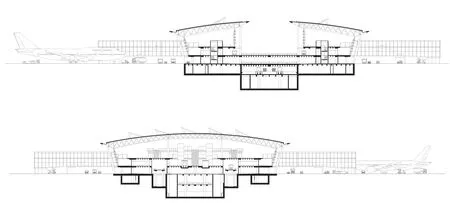
剖面 Section

? Fu Xing
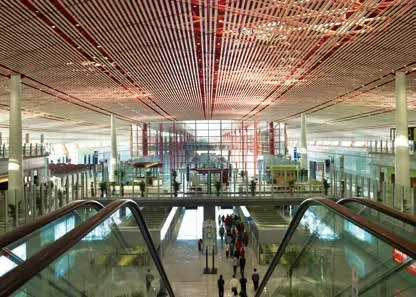

Although the length from north to south is three and a quarter kilometres, the visual links between the three elements are maintained by strong sight lines as well as visual connections between the lower level and an open mezzanine level above. All spaces are naturally lit and the generous glazing and skylights maintain a link with the outside and its changing sky. Views along the central axis are marked by the distinctive red columns,which continue along the external edges of the building into the distance, evocative of traditional Chinese temples.
The embracing curved cantilever of the terminal greets passengers arriving by road or from the GTC in a single welcoming gesture. Departures and arrivals are on separate levels. The traditional airport diagram has been inverted at T3B, with arrivals on the upper level, to allow visitors to Beijing to experience the thrill of this dramatic space from the best vantage point.
The single unifying roof canopy is perforated with skylights to aid orientation and bring daylight deep into the building. The colour palette moves through 16 tones from red at the entrance at T3A through to orange and finally yellow at the far end of T3B. This establishes a subtle zoning system that breaks down the scale of the building and enables easy way finding. This palette is also applied north to south in the ceiling above the arrivals and departures halls, heightening the sense of curvature in the roof plane.
Connections between T3A and T3B take place on a high speed automated people mover(APM) which travels at up to 80kph, with a journey time of just two minutes. The APM is easily accessed from the main departure level and set within a landscaped ‘green’ cutting,exposed to daylight and views up and through the building, all of which helps to maintain a sense of orientation.
The roof is a steel space frame with triangular roof lights and coloured metal decking.It curves, rising at the midpoint to create a dramatic central cathedral-like space, and tapering towards the edges of the building to provide more intimate areas as passengers travel towards the gates and the aircraft piers. The trusses that support the glazing echo the changing colour system in the roof - shifting from red to orange to yellow. The high transparency of the curtain walling is made possible by extra large mullions, which are generously spaced to allow larger spans of suspended glazing. The terminal building is one of the world’s most sustainable, incorporating a range of passive environmental design concepts, such as the south-east orientated skylights, which maximise heat gain from the early morning sun, and an integrated environment-control system that minimises energy consumption. Rather than the sprawl of many separate buildings, it uses less land by bringing everything closer together for ease of communication in one efficient structure,yet it is still 17% bigger than the combined floor space of all of Heathrow’s terminals 1, 2, 3,4 and the new Terminal 5. In construction terms, its design optimised the performance of materials selected on the basis of local availability, functionality, application of local skills,and low cost procurement.
猜你喜歡
北方建筑(2021年6期)2021-12-31 03:03:54
文苑(2020年10期)2020-11-07 03:15:36
現(xiàn)代裝飾(2020年7期)2020-07-27 01:27:42
現(xiàn)代裝飾(2020年6期)2020-06-22 08:43:12
現(xiàn)代裝飾(2020年4期)2020-05-20 08:55:08
流行色(2020年1期)2020-04-28 11:16:38
藝術(shù)啟蒙(2018年7期)2018-08-23 09:14:18
海峽姐妹(2017年7期)2017-07-31 19:08:17
Coco薇(2017年5期)2017-06-05 08:53:16
福建農(nóng)業(yè)科技(2016年10期)2016-03-07 09:46:49