
Pressure-induced anomalous insulating behavior in frustrated iridate La3Ir3O11?
2021-06-26 03:04:32ChunHuaChen陳春華YongHuiZhou周永惠YingZhou周穎YiFangYuan袁亦方ChaoAn安超XuLiangChen陳緒亮ZhaoMingTian田召明andZhaoRongYang楊昭榮
Chinese Physics B 2021年6期
Chun-Hua Chen(陳春華) Yong-Hui Zhou(周永惠) Ying Zhou(周穎) Yi-Fang Yuan(袁亦方)Chao An(安超) Xu-Liang Chen(陳緒亮) Zhao-Ming Tian(田召明) and Zhao-Rong Yang(楊昭榮)
1Anhui Province Key Laboratory of Condensed Matter Physics at Extreme Conditions,High Magnetic Field Laboratory,Chinese Academy of Sciences,Hefei 230031,China
2Science Island Branch of Graduate School,University of Science and Technology of China,Hefei 230026,China
3Institutes of Physical Science and Information Technology,Anhui University,Hefei 230601,China
4School of Physics,and Wuhan National High Magnetic Field Center,Huazhong University of Science and Technology,Wuhan 430074,China
5High Magnetic Field Laboratory of Anhui Province,Hefei 230031,China
Keywords: high pressure,5d iridates,semimetal–insulator transition,crystal structure
1. Introduction
The 5d transition metal oxides have recently attracted extensive interest due to their rich physical properties, including topological Mott insulator, topological Weyl semimetal,spin–orbital Mott insulator, quantum spin liquids (QSL),etc.[1–8]In iridate oxides, these emergent physical phenomena are not only triggered by a rare interplay of on-site Coulomb repulsion and strong spin–orbit coupling(SOC), but also strongly depending on specific crystal structures, e.g., Ruddlesden–Popper perovskite,[9]honeycomb,[6]pyrochlore,[10]and KSbO3-type structure.[11]For instance,Ruddlesden–Popper Sr2IrO4with Ir4+(5d5)exhibits a strong SOC-drivenJeff= 1/2 Mott-insulating state, where the corner-sharing IrO6octahedra form a quasi-two-dimensional structure.[12]Na2IrO3, a candidate for the Kitaev spin model on the honeycomb lattice with edge-sharing IrO6octahedra, behaves as a geometrically frustrated magnet in proximity to a QSL state with strong spin entanglements.[7]For cubic KSbO3-type La3Ir3O11, the corner- and edgesharing IrO6octahedra together construct a three-dimensional frustrated motif, in which each edge-sharing Ir2O10dimer has four connections to other dimers through corner-shared oxygens.[11]Early M¨ossbauer spectroscopy[13]and x-ray diffraction(XRD)experiments[11]on La3Ir3O11revealed that Ir ions formally take a nominal valence of 4.33+ as opposed to 4+. Recently, based on first-principles calculations, Singh and Pulikkotil predicted that La3Ir3O11hosts a SOC-driven semimetallic state composed of strongly hybridized Ir-5d and O-2p orbitals,[14]which was supported by electrical transport experiments carried out by Aoyamaet al.[15]Nevertheless,more recently,Yanget al. proposed that La3Ir3O11could be a possible QSL candidate.[16]
The experimental verification of superconductivity evolving from QSL has become one of the central issues in condensed matter physics soon after Anderson proposed that the unconventional superconductivity in cuprates can evolve from the spin liquid state.[17]As one of the fundamental state parameters, pressure has been proved to be an effective and clean way to tune the crystal structure and the electronic states in iridates[18–23]and QSL candidates.[24–28]Very recently, a persistent insulating state at megabar pressures was reported in Sr2IrO4, which offers a perspective for understanding the discrepancies between theoretical proposals and experimental results in Sr2IrO4, including the absence of superconductivity.[18]More interestingly, recent high-pressure experimental investigations uncovered pressureinduced superconductivity in NaYbSe2, which is a triangular QSL candidate.[27,28]For geometrically frustrated La3Ir3O11,theoretical calculations predicted a semimetallic state[14]or a possible QSL state[16]at ambient pressure, while transport experiments showed a stable semimetallic behavior towards 13 GPa.[15]Because the maximum pressure applied in the resistivity measurements is 13 GPa and the high-pressure structure is not reported,the detailed correlation between the structure and electronic state as well as their evolutions under high pressure is still unclear.
In this work, we report the electronic and structural properties of La3Ir3O11by combining high-pressure electrical transport, synchrotron XRD, and Raman spectroscopy measurements. By extending the pressure up to 50–80 GPa, a semimetal–insulator transition is revealed at a critical pressurePc~38.7 GPa. It is shown that although the pristine KSbO3-type structure is stable up to 73.1 GPa, the bulk modulus as well as the pressure dependence of bond lengthdIr?Irdisplays changes aroundPc. Consistently, Raman spectra show corresponding anomalies acrossPc. Our results show that the local distortion of IrO6octahedra plays a key role in the emergent insulating behavior, by weakening electron hopping of pressurized La3Ir3O11.
2. Experimental details
La3Ir3O11single crystals were grown by flux method.[15]The samples were first characterized at ambient pressure via electrical resistance, Raman spectrum, and energy dispersive x-ray spectroscopy (Fig. S1 in supplementary material). A standard four-probe method was employed to perform the high-pressure electrical transport measurements on single crystals of La3Ir3O11in a BeCu diamond anvil cell(DAC) with a rhenium gasket. The culet sizes of diamond were 300μm.Sodium chloride(NaCl)powder was used as the pressure transmitting medium.High-pressure angle-dispersive synchrotron XRD and Raman scattering experiments were carried out in a Mao–Bell cell at room temperature. A pair of diamond in a diameter of 200 μm and rhenium gasket were used. Daphne 7373 served as the pressure transmitting medium.Synchrotron XRD experiments(λ=0.6199 ?A)were conducted at the beamline BL15U1, Shanghai Synchrotron Radiation Facility (SSRF). The final images were integrated via the DIOPTAS program[29]and standard Rietveld refinement method was used to fit the XRD patterns via the GSAS-II program.[30]Raman scattering measurements were performed at room temperature on a freshly cleaved single crystal using 532 nm solid-state laser for excitation with power below 10 mW to avoid any heating effect. The ruby fluorescence shift was used to calibrate the pressure at room temperature in all experiments.[31]
3. Results and discussion
Figures 1(a) and 1(b) show the selected temperaturedependent resistanceR(T)curves of La3Ir3O11single crystal at high pressures up to 53.8 GPa. At 0.3 GPa, the resistance first increases slightly with decreasing temperature, and then decreases remarkably followed by an upturn below 60 K.The nonmonotonic temperature dependence of resistance implies a semimetallic conductivity,which is in line with that case of ambient pressure in Fig. S1 as well as previous literature.[15]Here two characteristic temperaturesTpandTdare marked by up and down arrows,respectively.With increasing pressure up to 18.1 GPa, the resistance over the whole temperature range decreases with bothTpandTdbeing shifted to lower temperatures monotonically. This trend changes at 24.7 GPa, above which the resistance rises inversely,which can be seen clearly from the isothermal resistance curves at 5 K,100 K,and 300 K in Fig.1(c). When the pressure increases up to 38.7 GPa,the characteristic temperaturesTpandTdalmost disappear and the sample exhibits a complete insulating behavior. As the pressure is continuously increased from 38.7 GPa to 53.8 GPa,the insulating behavior maintains and the resistance globally gets enhanced,demonstrating a semimetal–insulator transition around 38.7 GPa.
To check the structural stability of pristine La3Ir3O11under pressure, we performed high-pressure synchrotron XRD measurements on crushed crystal powder. Figure 2(a) shows the representative diffraction patterns at room temperature.With increasing pressure up to 73.1 GPa, all the diffraction peaks move towards high angles and no peak splitting due to symmetry reduction can be detected throughout the whole pressure range studied. The XRD patterns can be refined by a standard Rietveld method with the cubic KSbO3-type structure (space groupPn-3, No. 201). Figure 2(b) displays the schematic structure of La3Ir3O11, in which each edgesharing Ir2O10dimer has four connections to other dimers through corner-shared oxygens.[11]A representative refinement of the XRD patterns at 0.7 GPa is presented at the bottom of Fig.2(a). Note that the exact position of oxygen atoms cannot be extracted in this XRD experiment due to low scattering power of oxygen atoms. Figure 2(c) shows the extracted volume and bond lengthdIr?Iras a function of pressure. One can see that the pressure-dependent volume anddIr?Irconsistently show a kink around 37.1 GPa. Meanwhile,the trend of bond angles does not display obvious change except some fluctuations (not shown here). This indicates that although the KSbO3-type structure is stable under pressure,a subtle structural modification occurs in the pressurized La3Ir3O11. The volume can be fitted well by the third-order Birch–Murnaghan equation of state,[32]which yields the ambient pressure volumeV0=870.8 (±0.8) ?A3, bulk modulusB0=229.6 (±3.5) GPa for the low–pressure region of 0.7–37.1 GPa,andV0=840.3(±5.4) ?A3,B0=357.2(±23.0)GPa for the high-pressure region of 40.3–73.1 GPa. The first-order derivative of the bulk modulus at zero pressure,B'0,is fixed at 4 for all fittings. The structural modification is accompanied by an increment of bulk modulus ?B0/B0~55.6%at 37.1 GPa.Note that close to the critical pressure,the semimetal–insulator transition is observed(see Fig.1).

Fig.1.Representative temperature-dependent electrical resistance R(T)curves of La3Ir3O11 at high pressures(a)below 33.5 GPa and(b)above 38.7 GPa,respectively. The characteristic temperatures Tp and Td are marked by the vertical arrows,which are extracted the first derivative of resistance dR/dT. (c)Left: The isothermal resistance at 5 K,100 K,and 300 K as a function of pressure. Right: The pressure dependence of temperatures Tp and Td.
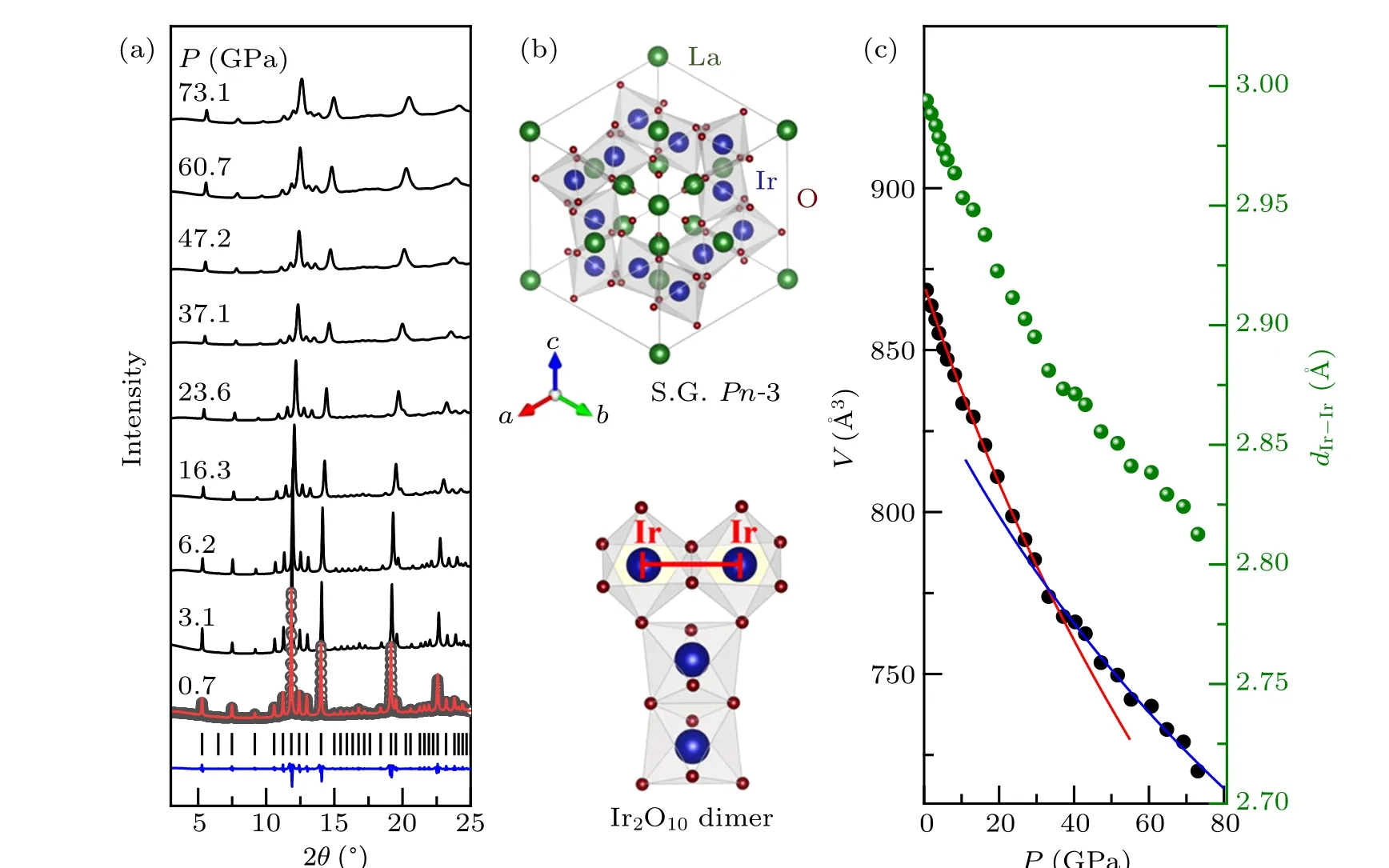
Fig.2. (a)Room-temperature synchrotron XRD patterns(λ =0.6199 ?A)of La3Ir3O11 under compression up to 73.1 GPa. For 0.7 GPa, the solid lines and open circles represent the Rietveld refinements for the lattice and observed data,respectively. The vertical bars symbolize the peak positions of cubic Pn-3 phase(Z=4). (b)Upper: Schematic crystal structure of La3Ir3O11 viewed along[111]direction. Lower: Enlarge view of Ir2O10 dimer with two edge-sharing IrO6. The Ir–Ir bond length dIr?Ir is denoted by the red line segment. (c)Pressure dependence of the volume and bond length dIr?Ir. The red and blue solid lines represent the fitting results with the Birch–Murnaghan equation of states below and above 37.1 GPa,respectively. The orange and yellow regions are guides to the eyes.
Raman spectroscopy is an effective and powerful tool in detecting lattice vibrations, which can provide information including electron–phonon coupling, weak lattice distortion,and/or structural transition. We conducted room-temperature Raman scattering experiments for comparison with the XRD data. Figure 3(a) shows the selected Raman spectra of La3Ir3O11single crystal at high pressures. At 0.6 GPa, one can see that 13 Raman peaks appear in the frequency range of 170–1000 cm?1, which is consistent with that case of ambient pressure. Here these peaks are named as M1?13, considering no reference about the specific vibration modes in La3Ir3O11. Consistent with XRD data, upon compression to 33.8 GPa, a discernable change in the relative intensity occurs between modes M10and M12,as denoted by the blue and red arrows, respectively. Namely, mode M12becomes more and more weaker, while mode M10becomes more and more stronger with increasing pressure across 33.8 GPa. In addition, mode M2exhibits a distinct redshift in the low-pressure region while turns back to blueshift above 33.8 GPa,which can be clearly discerned from the contour plot of Raman spectra in the frequency range of 170–300 cm?1[see Fig.3(b)].
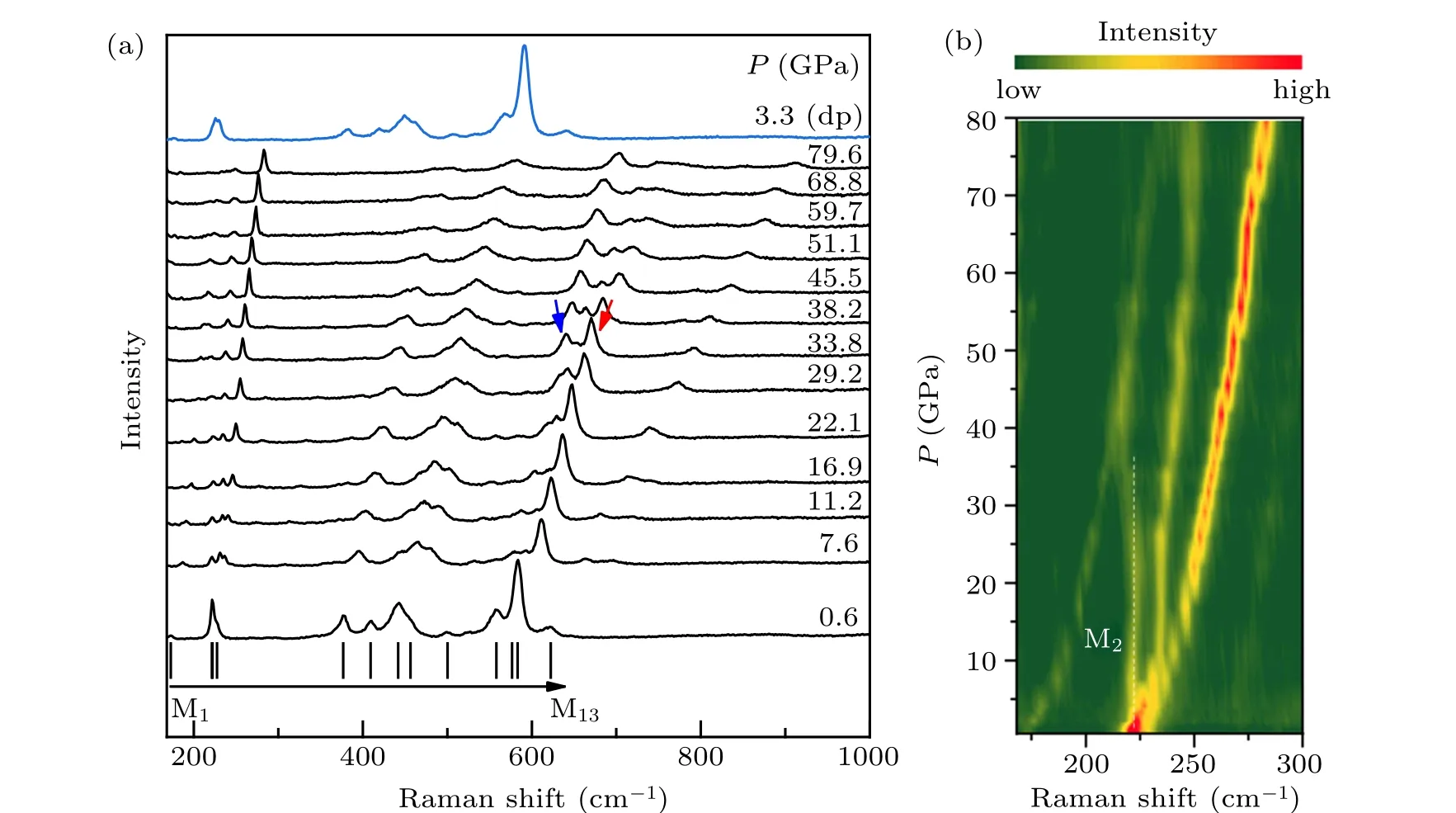
Fig. 3. (a) Selected room-temperature Raman spectra of La3Ir3O11 single crystal under compression and decompression (denoted by “dp”).At 0.6 GPa,Raman modes named M1?13 are marked by the black vertical bars. At 33.8 GPa,the anomaly in intensity of Raman modes M10 and M12 is symbolized by the blue and red arrows,respectively. (b)Contour plot of Raman modes M1?4 under compression. For clarify,the frequency of Raman mode M2 at 0.6 GPa is indicated by the vertical dashed line.
Figures 4(a)and 4(b)display the pressure-dependent frequency obtained from Lorentz fittings of the Raman peaks.Notably, all the modes except mode M2shift to higher frequencies monotonically. The pressure evolution of mode M2displays three different regions, i.e., two normal blueshift regions plus a redshift region (see the gray area). Concomitantly, the frequency of M3mode shows a kink in region II.We note that the abnormal evolutions of cubic KSbO3-type La3Ir3O11deduced from our Raman spectra are very similar to the case of body-centered cubic KSbO3,which were attributed to the distortion of SbO6octahedron at high pressures.[33]In the pressurized La3Ir3O11,the occurrence of structural distortion is in accordance with the change of bulk modulus as well as anomaly in the pressure dependence of bond lengthdIr?Ir.Moreover, it can account for the abnormal insulating behavior. On one hand, it is commonly believed that the metallic state is favored at high pressures as the shrinkage of lattice normally enhances the band overlapping. On the other hand,the enhanced crystal distortion,i.e.,rotation and tilting of IrO6octahedra,generally weakens electron hopping and can lead to localization. We note that the competition of these two forces renders Sr2IrO4a persistent insulator at megabar pressures.[18]
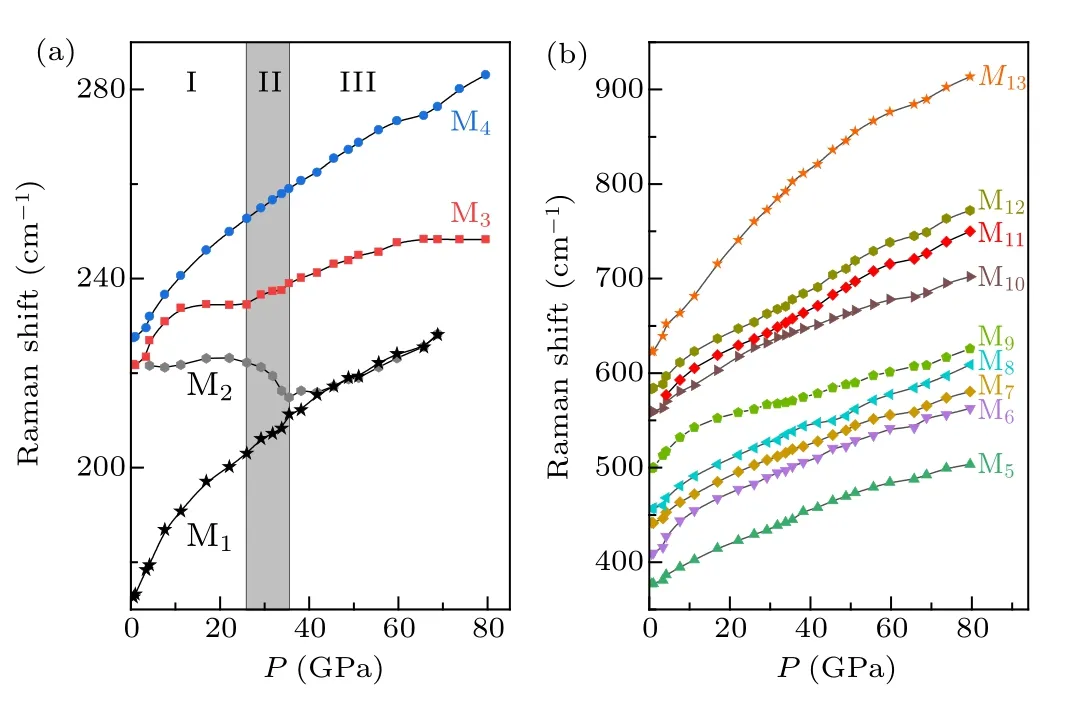
Fig.4. The pressure dependence of low-frequency Raman modes M1?4 (a)and low-frequency Raman modes M5?13 (b). The pressure evolution of M2 mode exhibits three distinct regions,i.e.,two normal blueshift regions plus a redshift region.
4. Conclusion
In summary, we have investigated the pressure effect on the structural and electronic properties of geometrically frustrated iridate La3Ir3O11by combining high-pressure synchrotron XRD,Raman scattering, and electrical transport experiments, from which a critical pressurePc~38.7 GPa was revealed. We observed a semimetal–insulator transition atPc,which can be further correlated to the appearance of structural distortion. Our work emphasizes a unique, ultra-important role that the lattice plays in determining the ground state in spin–orbit-coupled materials.
Acknowledgments
A portion of this work was supported by the High Magnetic Field Laboratory of Anhui Province. We thank Zhaoming Tian for affording the single crystals. We thank Lili Zhang for supporting our XRD experiments. The high-pressure synchrotron x-ray diffraction experiments were performed at beamline BL15U1,Shanghai Synchrotron Radiation Facility.

- Chinese Physics B的其它文章
- Coarse-grained simulations on interactions between spectrins and phase-separated lipid bilayers?
- Constraints on the kinetic energy of type-Ic supernova explosion from young PSR J1906+0746 in a double neutron star candidate?
- Computational model investigating the effect of magnetic field on neural–astrocyte microcircuit?
- Gas sensor using gold doped copper oxide nanostructured thin films as modified cladding fiber
- Exact explicit solitary wave and periodic wave solutions and their dynamical behaviors for the Schamel–Korteweg–de Vries equation?
- Suppression of ferroresonance using passive memristor emulator