FOUL PLAY
2021-08-27 05:48:10BYSAMDAVIES
漢語世界 2021年4期
BY SAM DAVIES

The pain and glory of China’s drive to reform football
中國職業足球俱樂部:光輝夢想與艱難處境
After a four-hour train journey, three buses, and a five-kilometer ride on a rented bicycle, Hu Guofeng(pseudonym) had finally reached his destination. Deep in the Jiangsu countryside, flanked by mountains at the end of a dusty dirt road, a gleaming new sports stadium protruded from the earth like a metallic alien spacecraft in the dusty landscape.
Hu’s surprise at finding this stateof-the-art stadium in what seemed to be “the middle of nowhere” was only mirrored by the shock of the group of young players he’d come to see—the reserve team for Tianjin Teda Football Club, who had not expected this lone fan to show up in the vast stadium to see them play Shanghai Shenhua FC.“Back then, I was a one-man army,”he reminisces to TWOC.
A fan of the Tianjin team since 2010 and a member of the club’s“ultra fan” group association, Hu regularly traveled alone to support the players. “It felt like my team was down to earth, when you chanted the players could hear you and before the game the players could talk to you…I felt like I supported a team that really cared about its fans.”
But that was back in 2018, already a decade beyond the real glory days for Chinese football fans. After years of frustration with the management of the football club, Hu is now questioning the point of supporting the team: “Ever since money poured into the league, Tianjin isn’t so competitive anymore…and because the club is owned by a state-owned company, they don’t need fans to keep the club running. They don’t care about us.”
Hu’s journey from avid fan to frustrated onlooker is emblematic of the trajectory professional Chinese football has taken over the last decade. While vast sums of money have flowed into football clubs and government officials have lined up to back plans to make China a proud football nation, a lack of oversight,unsustainable business models,poor communication with fans, and constantly shifting regulations mean Chinese football has lost its soul,according to Hu.
In some ways, football has never been more popular in China. Before the pandemic, attendance at matches in the Chinese Super League (China’s top division) was the fifth highest in the world, and TV rights to stream matches boomed to 1.3 billion USD between 2016 to 2021, over 14 times their yearly value back in 2015.

The Tianjin Teda Football Stadium has been empty of fans for over a year because of the pandemic
Government initiatives to “reform and develop” Chinese football are ambitious, with the State Council setting out plans in 2015 to establish 50,000 “special football schools” by 2025 to increase youth participation in football, with the “long-term goal” of hosting the FIFA World Cup and making China a “global football power.” In 2016, the National Development and Reform Commission published medium-tolong-term goals aiming to have over 50 million people participating in football by 2020, and a football pitch for every 10,000 people by 2030. By 2050, it hopes to deliver a Chinese “football dream” with a high percentage of the population involved in the sport, and a competitive national team.
Spurred on by official support,corporations and wealthy entrepreneurs have established and bought up clubs and spent fortunes buying top foreign players, while local governments have built state-of-theart stadiums for matches. While the national men’s team has struggled—ranked 77th by FIFA, football’s international governing body, coming behind Curacao (76th), South Korea(39th), and Japan (28th)—and the women’s team declined from their powerhouse status in the 1990s,China’s club teams have fared well in the regional Asian Champions League, with Guangzhou Evergrande winning the competition twice in the last decade.
But in reality, the industry is built on shaky ground. Clubs face a constant battle to survive amid spiraling costs,while fans fight to have a say in a highly commercialized and politicized environment. “Football is not about football in China,” says Tobias Ross,a doctoral researcher at the University of Nottingham who studies the Chinese football industry. “Here, 99 percent of people involved in football are just involved in it because they want to have a favorable relationship with the government. This, in my opinion, destroys the whole system and makes it very shaky and chaotic,and unsustainable.”
In the late 1990s and 2000s,corruption was the major problem in Chinese football. Match fixing was common, and in 2009 an investigation by the Ministry of Public Security ended with the jailing of multiple national team players, three former vice presidents of the Chinese Football Association, and China’s only referee to officiate a game at the World Cup. Shanghai Shenhua FC was also stripped of its 2003 league title.
The bigger problem today, though,lies in the massive disparity between a team’s running costs and the amount of revenue they generate, and in the convergence of political and commercial interests at the top of the sport. Based on interviews with industry insiders throughout China’s top three professional men’s leagues,Ross argues wealthy club owners see a football team as a way to advertise their brands and get close to local officials to smooth their business operations.“The classic Chinese case is a real estate company investing in a football club not to make money from the football business but to get favorable treatment for their core business, which is property,” says Ross.
In 2010, the Evergrande Real Estate Group bought Guangzhou Football Club and renamed it Guangzhou Evergrande FC (despite fan protests),pumping vast funds into the club,buying up the best domestic players and running at a massive loss to ensure success on the pitch. Victories followed, with the club winning the CSL in eight out of the last ten seasons, and becoming the first Chinese team since 1990 to win the Asian Champions League in 2013.Xu Jiayin, Evergrande’s billionaire founder, once stated that owning a football club ensured his company got onto the evening news for a fraction of the costs of advertisements,according to The Economist.
But the strategy of huge investment for quick success forced rivals to respond, with nearly all the teams in the top leagues making massive losses and relying on investment from their owners to survive—a strategy pejoratively dubbed “gold dollar football (金元足球)” by fans and pundits.
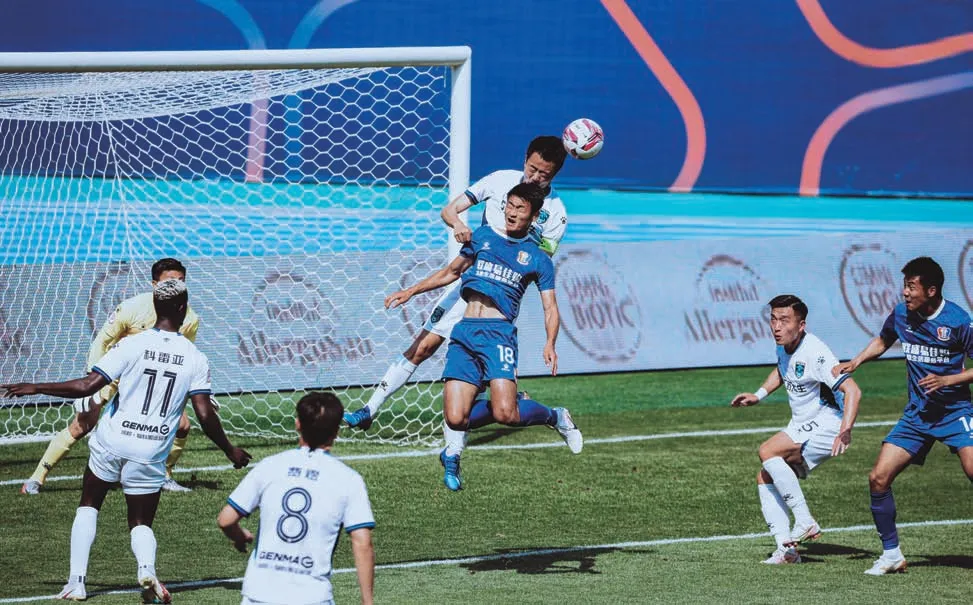
The quality of foreign players in China has improved, but many argue domestic players are worse than in the 1990s
Foreign stars arrived at astronomical costs. Argentinian international Carlos Tevez joined Shanghai Shenhua in 2017 at 40 million USD a year;Shanghai SIPG (owned by the stateowned Shanghai International Port Group) spent 440 million RMB buying Brazilian forward Oscar from England’s prestigious Chelsea football club; Cedric Bakambu moved from Villareal in Spain to Beijing’s Guoan for 315 million RMB in 2018…the list is endless. In the January 2016 transfer window, CSL clubs spent more than 366 million USD on players, more than any other league in the world—despite club revenues being just a fraction of those in the big European leagues.
“Before Evergrande, the salaries in China were comparable to leagues in Japan and South Korea,” says Ross.Now, “football is basically a moneyburning business.” In December 2020, the state-run Xinhua News Agency reported that CSL clubs were spending an average of 1.1 billion RMB a year, with about 70 percent going to player wages, while only making around 190 million RMB in revenue from traditional sources like ticket sales, sponsorship, merchandize,and TV rights.
The shortfall is made up by investors,leaving clubs at the mercy of their owners. “Whenever the parent company has a problem, football is the first thing they are going to cut,”says Ross. Even the richest and most successful teams are not immune: Just a few months after Jiangsu Suning FC won the CSL for the first time in its history, its owner and chief financial backer, retail giant Suning,announced it was pulling out of the club because of the economic impact of the pandemic. With no buyer willing to take on the nearly 600 million RMB of debt on the team’s books, the club folded in February of this year.

Despite some passionate fans, most clubs make little money from ticket sales and merchandize
In the lower leagues, this is an even more serious problem, as players frequently suffer salary delays. Meanwhile, owners bleed cash running the teams. “If you want to make money, [owning a football club] is not a good choice,” says Liu Tianwen, an assistant to the chairman at Nantong Zhiyun FC, a club in the Chinese second tier based in Nantong,Jiangsu province.
Liu tells TWOC that the club’s short-term goal is “just to get out of the pandemic unscathed, then we want to continue increasing our revenue.”Virtually all the club’s revenue comes from sponsorships and selling products,and “the purchasing power of Chinese fans isn’t as high as in Europe or South America,” she explains. Like virtually all clubs in their division, Nantong Zhiyun has received zero matchday revenue during the pandemic as games were held without fans.
Before the 2020 season, at least 13 clubs from the second- and third-tier leagues in China folded, mostly from bankruptcy. “When we first joined [in 2016] we were in the third division;now, pretty much all of our opponents from back then no longer exist,” Liu says.
Player protests against their clubs failing to pay them on time are common. In June 2019, players of third-division club Dalian Chanjoy penned a letter to the CFA, the body responsible for governance of the game in China, claiming the club owed its staff a total of 7 million RMB:“We have no way to support our families,” read the letter. The club folded in 2020.

In May of last year, Liaoning Hongyun, a second-tier club tracing its history back to 1953, folded after repeatedly failing to pay player salaries since 2018. When the players sought help from the Liaoning Sports Bureau to reclaim the wages owed them, they were told there was nothing the government body could do. Players later discovered the club fraudulently claimed to the tax office that they had already been paid. “The players haven’t received a penny,” club captain Sang Yifei wrote to the CFA.
For Liu’s club, Zhiyun, some good has come from other teams disappearing. In 2020, they picked up a talented teenager named Song Haoyu, whose original team Shanghai Shenxin also folded. He has become their first youth player to become a regular starter for their first team. “By developing more players through the youth system, we can bring more profit to the club,” says Liu, pointing to the transfer fees the club receives for those young players as a potentially more sustainable revenue source.
Hu, however, struggles to get excited about these changes, such is his disillusionment with his team. He argues the experience was “purer”for fans before the money flowed in.“Admittedly attendances at matches were poor before all the money…but the fans got what we wanted, and the clubs cared more about the fans.”
He reminisces about drinking beer and lighting flares at matches, before this was banned in 2017; also making banners and dressing in black for the games, writing and chanting their own songs, and waving flags in support. The fan club also donate to charitable causes, sending football gear to kids in the countryside:
“Football should be part of the community,” says Hu. Hu is such an avid fan that he learned Spanish just to follow South American football culture more closely, and once took a seven-day train journey from Tianjin to Xinjiang to watch a reserve team game.
The CFA is in theory independent from the General Administration of Sports (GAS) government agency,but is in practice staffed by GAS appointees and often appears to act in tandem with them. It produces new rules and regulations for teams to follow on a regular basis, often seemingly without warning. Earlier this year, a “neutral name policy”required teams to drop any mention of team owners from their team names. Guangzhou Evergrande rebranded as Guangzhou FC, while Hu’s team Tianjin Teda is now Tianjin Jinmen Tiger.
Fans like Hu protested that changing names would remove a key part of the team’s identity. But they were ignored.The idea behind the rule change was to stop teams constantly changing names every time their owners changed, and from being viewed only as a marketing platform for owners.But four or five Tianjin fan groups have disbanded over the issue.
Another rule change that went awry was in 2017, when it was announced that clubs could only field three foreign players in a match, and mandated that they have a Chinese player under the age of 23 on the pitch at the start of the game. It was meant to improve domestic player performance. But the change was announced in the middle of a transfer window, when many clubs had already bought players and were then left with too many foreigners in their squads that they couldn’t get onto the pitch.
Other regulations have been more radical and have the potential to make the sport much more sustainable. A 100 percent tax on purchasing players who cost over 45 million RMB was introduced in 2017, meaning the big money moves of the past are no more. A salary cap now limits any new contracts for foreign players in the CSL to 3 million euros per year,and 5 million RMB per year for domestic players.
Rules introduced in 2019 also required CSL clubs to set up and field a women’s team. While China’s national women’s team has traditionally far outperformed their male counterparts, results have been on the slide since the 2000s, and China has just 23,359 registered female players—a lower level of female participation than nations like Australia and Japan, which have much smaller populations.Meanwhile, some lower-league clubs have ditched their women’s teams because of tight finances caused by the pandemic.
Despite undoubted infrastructure improvements and well-meaning reforms, China’s football landscape has yet to significantly improve fans’ experiences, build sustainable clubs that foster loyal fanbases or meaningfully contribute to their communities, or raise the quality of the national men’s and women’s teams.
That’s why Hu feels so irked by Tianjin Teda’s name change. “What I can’t stand is they totally ignore the fans’ voice…it’s a disgrace to the game of football and to fans like us who devote our lives to the team.We consider ourselves not only loyal to the team but also to the values of the community,” Hu says. “Football should be the people’s game.”

Fans at Pudong International Airport welcomed Argentinia international Carlos Tevez after he transferred to Shanghai Shenhua FC in 2017