
The Light Inside
2021-09-05 17:01:01
漢語世界(The World of Chinese) 2021年4期

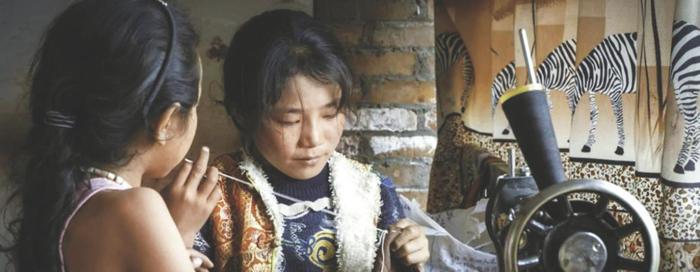
Director Khashem Gyal on film as a religion and how real culture is “inner” culture
對話藏族導演卡先加:用鏡頭“追光”
Director Khashem Gyal stands on the stage in a panel of emerging directors at the Guangzhou International Documentary Film Festival, in front of a screen showing the Chinese characters for his name written in the wrong order. The moderator greets each speaker with familiarity and turns to Khashem Gyal, exclaiming in welcome and genuine surprise, “We dont know you very well.”
Chinas documentary filmmaking scene seems to regard Khashem Gyal as something of a mystery. He says he has never been to film school, nor does he often socialize with other directors. Born in the Amdo region on the eastern edge of the Tibetan plateau, he later attended the Qinghai Nationalities University to study Tibetan literature. His film production company, Amilolo Film Group, is based in Xining, the capital of the far-western Qinghai province.
Khashem Gyals first documentary, 2013s Valley of the Heroes, chronicles a Tibetan language enrichment class in Qinghai, where Tibetan children now attend schools which teach primarily in Mandarin. His second documentary, Daughter of the Light (2020), created with the support of TokyoDocs Colors of Asia Award, follows Metok Karpo, an artistically talented Tibetan girl who lives at a boarding school for orphans and goes to visit her estranged father on the grasslands.
Sitting down with TWOC for a coffee on a drizzly morning, Khashem Gyal recounts how he came to chronicle social changes on the Tibetan plateau, his views on culture, and how he seeks to illuminate the inner landscape through filmmaking.
Can you tell us about your journey into filmmaking?
I grew up in a very traditional family in eastern Tibet. When I entered university for Tibetan literature, I found that photography and film have the power to sculpt time.
The film industry in northwestern China is very marginal. It was hard to even find books on it. I established a small organization called the Amilolo Film Group to hold film screenings and movie nights, discuss films, and invite professors to speak, creating a community. Amilolo means “mothers baby” in my dialect of Tibetan—for kids speaking my dialect, it feels intimate.
Later we found out about a group of classmates going to a local village and trying to revive Tibetan culture and language in a community. I borrowed 30,000 RMB from friends and family, bought equipment, and went to the project site with my team members. Thats how I started my first film, Valley of the Heroes. After shooting, I didnt know how to edit, so I learned on the keyboard, button by button.
How did you come to the subject of your second film, Daughter of the Light?
Producer [of the film] Rinchen Dorje and I are from the same hometown. We came out of our tiny village and when we went back we found that many things had changed in ways that maybe people from outside cant see. We started with the big social picture and looked for someone who could reflect these changes.
When we began shooting at a boarding school, Metok Karpo said she had never seen her father, and loves to draw, and I could see her ambiguous feelings about her family. I thought there was a story there. While shooting, I lived and taught at the school for two years. I was still sleeping when she ran into my room to ask me, “Why does someone miss another person?” Then I turned on my camera. The film became less about the societal picture, and more about her individual emotional journey.
While I lived at the school, many TV stations would come and shoot the children as if they should be pitied or helped. The children didnt like it. I wanted to shoot their real condition, to understand them instead of pitying them.
What drew you to this topic of cultural and language preservation in Valley of the Heroes?
Im always interested in old things. Once, I lived in Xian for a few months in a very old building. When you lie down its dark and cold, but you can feel that people lived in that kind of environment for years—you can smell so many things in old furniture, there are images on the walls. There is a sense of memory.
In China, old things are being destroyed in the name of development. Our GDP is growing quickly, and we are developing materially, but we are forgetting or ignoring our inner side. Whether buildings or humans, we are not created in a vacuum. When buildings or people or nations collapse, we destroy our memory and belonging; all these are linked to past and future, and connected with the preservation of culture and language. If we lose our inner values, there will be nothing to rely upon. We are empty.
What is the role of film in cultural preservation?
If we put expectations on film to preserve a culture, then it wont be able to do much. A film can preserve memories, a moment of life…But in terms of keeping a language or culture alive, it cannot do much.
Then why make films?
In 2016, I spent three days on a train. I saw migrant workers carrying their luggage on their backs. As I took pictures, I felt that I saw my brothers, my sisters, my villagers around me. From the workers sweat, I could smell something very familiar to me. I felt that we are so similar, but because of the secondary value of language and culture, we have separated into different groups of people.
Im interested in putting effort into seeing how we are physically and culturally different, yet connected together. Film is a way to always expand my horizon of life, and continually broaden my heart. In making a film, I put myself in different environments, I want to challenge and reconstruct my values. Its a process of educating myself.
Did Daughter of the Light succeed in challenging your values?
We have this concept of a child—that they know little, and we have to teach and guide them. But we see with Metok Karpo, through her limited vocabulary, that her way of thinking is very philosophical and poetic, simple and easy. It challenged my idea that teachers really teach. We are giving information and data but can we call it wisdom? Both sides can be learners.
Metok Karpo is already a great artist. It was inspiring to me when she drew her hometown into an outline of her hand. She cannot always be in her homeland, so she drew it into her own palm. I dont believe she ever learned these things from teachers. She has this imagination and power. Each student has this power. They are all challenging my ideas.
For Daughter of the Light, we worked with a Japanese producer and co-director, an Austrian editor, an English sound editor, and a Japanese composer. Because the film is for everyone to watch, and will go beyond Tibet, we deleted some typical Tibetan cultural moments that would take too much explanation for others to understand. We purposely stripped those cultural aspects away so that the audience could focus on Metok Karpos inner world.
Both films depict social changes in Tibetan communities. Do you see yourself as a Tibetan director?
I am kind of suspicious about being put in a group. I dont interact much with other directors, even other Tibetan filmmakers. Most directors live in big cities: Beijing, Shanghai, Guangzhou; I live in Xining. I dont want a label—minority, Tibetan, documentarian. Im a storyteller.
I really hate this idea of a minority consciousness. How did we become a minority? Just because of numbers? The subliminal message is you have to be guided, be helped, be sympathized with. Sometimes its very awkward to be put in a minority program or ethnic section. You dont need to separate us, just give us an equal platform and equal resources to share.
In recent years, many Chinese directors have been making films in Tibet. What do you think of this trend?
Most Tibetans know more about Han people than Han people know about Tibetans. From a young age, we learn Chinese history. Most kids, even in small villages, speak more fluent Mandarin than me. We also watch many Han films.
We have a lot of films that Han directors made about minorities. There are some good ones. If they are good directors, they can get into the world of the people they are shooting, and can make a great film. But most stories stay on the surface level—how they live, eat, or dance, as if its mysterious. Life is not that mysterious, but if its mysterious to you in your head, then you will make a mysterious film.
How do you avoid this?
Culture is embedded in our way of thinking. There are things I learned from my parents—my mother never went to school, but she prostrates every morning and night to pray. She makes zamba bread and gives them to her bird friends every day. She doesnt have much to say about theories or ideas, but she expresses her love toward different beings through her actions. She is devoted to what she thinks is right, and neither compromises nor complains. This influences my work. This is her religion; film is my religion. Her actions taught me that even if something is difficult, you do it.
Film has the power to educate, to learn about people in a very different culture, environment, and geography, to enter into their inner world and life in a very short time. In the future, we need to put more effort on the oneness of human beings, rather than suggesting that what one group has is the best. This is not so that we lose what we have, but to learn how all cultures are colorful and vibrant.
– Tina Xu (徐盈盈)
 漢語世界(The World of Chinese)2021年4期
- 漢語世界(The World of Chinese)的其它文章
- 光影
- You’ve got questions? she’s got answers
- 野
- Playing Chicken
- Singing the Changes
- Burst Your Bubble