
Magnetic and electronic properties of two-dimensional metal-organic frameworks TM3(C2NH)12*
2021-09-28 02:17:22ZhenFeng馮振YiLi李依YaqiangMa馬亞強YipengAn安義鵬andXianqiDai戴憲起
Chinese Physics B 2021年9期
Zhen Feng(馮振)Yi Li(李依)Yaqiang Ma(馬亞強)Yipeng An(安義鵬)and Xianqi Dai(戴憲起)
1School of Physics,Henan Normal University,Xinxiang 453007,China
2School of Materials Science and Engineering,Henan Institute of Technology,Xinxiang 453000,China
Keywords:two-dimensional metal-organic frameworks,electronic structure,magnetic property,strain engineering
1.Introduction
Compared with bulk materials,two-dimensional(2D)materials exhibit many unique characters in mechanical,electrical,optical,and thermal properties.Therefore,many scientists make enormous effects to explore the new family of 2D nanomaterials,[1,2]which could display metallic,semiconducting,superconducting,insulating,thermoelectric,and ferroelectric properties.[3–6]However,most 2D materials exhibit a nonmagnetic ground state,suggesting that they are different to be utilized as spintronic devices and magnetic recording materials due to the prerequisite requirements of magnetism.
Usually,the electronic and magnetic characters of pristine 2D monolayers could be tuned and introduced by absorbing and doping transition metal(TM)atoms.This approach has been successfully realized in series of 2D monolayers,including graphene,[7,8]graphyne,[9]arsenene,[10]h-BN,[11,12]and phosphorene.[13]Another side,some intrinsic magnetic 2D materials such as CrI3,[14]Cr2Ge2Te6,[15]MnBi2Te4,[16]and Fe3GeTe2[17–19]have been experimentally discovered and investigated,which have potential applications in high-density data storage and nano-spintronic devices.[20,21]For instance,the spin polarization of half-metallic(HM)ferromagnets could reach 100%,due to the single spin state characteristics,i.e.,one spin state is metallic conduction while the other state is semiconducting.The HM magnets are important in some cases,such as spin-filters and spin-polarized scanning tunneling microscope.Half semiconductors(HSC)are characterized by unique spin states that valence band maximum(VBM)and conduction band minimum(CBM)come from the same spin state.For bipolar magnetic semiconductors(BMS),VBM and CBM consist of opposite spin states,indicating that they could apply in spin injection and generation.[22,23]These promising applications drive more scientists to explore the 2D magnetic nanomaterials.
The 2D metal-organic frameworks(MOF)are porous hybrid materials consisting of transition metal nodes and organic ligands,and a recent class of magnetic materials.[24–26]Transition metal atoms are periodically connected with the organic ligands in MOF materials,inducing charge redistribution and strong interaction between them.These are beneficial to the stability of the framework structures.Recently,a series of 2D MOF nanomaterials were experimentally synthesized.For instance,M3C12X12andM3C36H12X12systems(M=transition metal atoms,X=O,S,and NH).[21,27–31]Scientists are paying more and more attention to these interesting lattice structures,they are seeking more MOF candidates using similar chemical reactions and theoretical investigations.For example,Rabczuket al.found that Ag,Cu,Cr,and MnC12(NH)122D MOF monolayers exhibit half-metallic characters,suggesting that they are promising candidates for spintronics.[32]Sarkaret al.proposed several 3d transition metals based on the M3C12S12.They found that Cr3C12S12exhibits spin-liquid,whereas Co3C12S12,Fe3C12S12,and Mn3C12S12are ferromagnetic half-metals.[33,34]Zhaoet al.found that Mn3C12S12monolayer exhibits a half-metallic performance,and its Curie temperature is about 200 K by using the Ising model.The Mn3C12S12monolayer possesses a nonmagnetic ground state and a SOC band-gap reaching 2.4 meV,indicating that it may achieve the quantum anomalous Hall effect.[35]A similar atomic structure,Mn3C12N12H12monolayer was predicted by Sunet al.The calculated results showed that the p–d exchange interactions could more effectively mediate the magnetic couplings,which results in a high Curie temperature of 450 K.[36]Very recently,Fenget al.reported a magnetic 2D Fe-PTC MOF material,which was synthesized from the reaction of 1,2,3,4,5,6,7,8,9,10,11,12-perthiolated coronene(Fe-PTC)with ammoniacal solutions of iron acetate.[37]The variable temperature conductivity measurements revealed that the 2D Fe-PTC MOF pellets display a typical semiconducting character and a room-temperature high conductivity reaching 10 S·cm?1.Furthermore,it is ferromagnetic below 20 K.The ferromagnetic ordering behavior mainly comes from the indirect exchanges between the localized spins of Fe atoms rather than the neighboring Fe atoms.
Being influenced by the above findings,we propose several 2D transition metal-organic frameworks(TM-NH MOF,TM=Sc–Zn)systems using density functional theory(DFT)computations.The geometric construction and stability of these TM-NH MOF structures are firstly investigated.Then,their electronic structures are studied and diagnosed.Lastly,the magnetic properties of TM-NH MOF and their strain effect are systematically discussed.These results could provide a series of 2D MOF materials as potential excellent candidates applied in nanoscale spin electric devices.
2.Methods
The spin-polarized DFT calculations were performed with the Viennaab-initiosimulation package(VASP).[38,39]The generalized gradient approximation(GGA)with the Perdew–Burke–Ernzerhof(PBE)was selected to describe the exchange-correlation approximation.[40]The projected augmented wave(PAW)was adopted with the plane-wave cutoff energy of 500 eV.[41]The vacuum layer was larger than 20?A between the periodically repeated monolayers.The Hellmann–Feynman force on each atom was less than 0.01 eV·?A?1,and the total energy change was less than 1.0×10?5eV.A densek-point mesh with a grid density of 2π×0.01?A?1in the Monkhorst–Pack scheme was used.To treat the exchange–correlation energy of the localized d-orbital of TM atoms,the PBE+U(U=3 eV)calculations were employed by adding the Hubbard term to the Hamiltonian.[42,43]The VASPKIT code was used to manipulate the in/output VASP files.[44]Theab-initiomolecular dynamics(AIMD)was conducted with the Nose algorithm in theNVTensemble.[45]
3.Results and discussion
3.1.Geometry and stability
The unit cell of the studied 2D metal-organic frameworks is built by three transition-metal atoms on graphene with four pyridine-nitrogen-like atoms passivated by H atoms(TM-NH MOF),as shown in Fig.1,leading to a chemical formula of TM3(C2NH)12in a primitive cell.As similar to other 2D MOF materials,TM-NH MOF monolayers are 2D porous carbonrich materials with one-atom-thickness.The nanosheets of graphene with three high-symmetric sp2-C atoms(C1,C2,C3)possess largeπ-bonds,which would enhance the stability of these TM-NH MOF monolayers.The optimized lattice constants of these TM-NH MOF(TM=Sc–Zn)monolayers were calculated by the variation of energies with different lattice constants(Fig.S1).The calculated lattice constants(la),bond lengths of TM–N(DTM?N),N–H(DN?H),N–C1(DN?C1),C1–C2(DC1?C2),and C2–C3(DC2?C3),and the diameters of the hole(Φ)are summarized in Table 1 and Table S1.The lattice constants of the TM-NH MOF monolayers display a decreased trend for Sc–Co(13.23?A→12.52?A)and an increased trend for Ni–Zn(12.52?A→12.95?A).The bond lengths of N–H(DN?H),N–C1(DN?C1),C1–C2(DC1?C2),and C2–C3(DC2?C3)keep the same for different TM-NH MOFs.The bond lengths of TM–N(DTM?N)and the diameters of the hole(Φ)exhibit the same change trend as that of the lattice constants,as transition-metals have different atomic radii.For example,the Sc-NH MOF monolayer possesses the largest lattice constants(13.23?A)corresponding to the largest atomic radius of Sc atom,consistent with the previous theoretical investigations for other 2D MOF materials.[46,47]
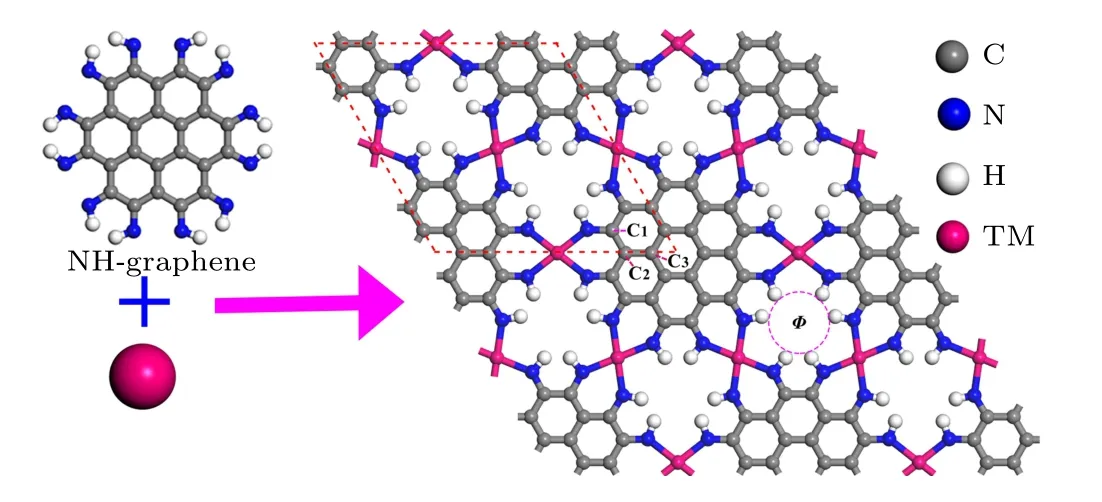
Fig.1.Schematic atomic structures of 2D TM-NH MOF materials.The red dashed lines outline the unit cell.
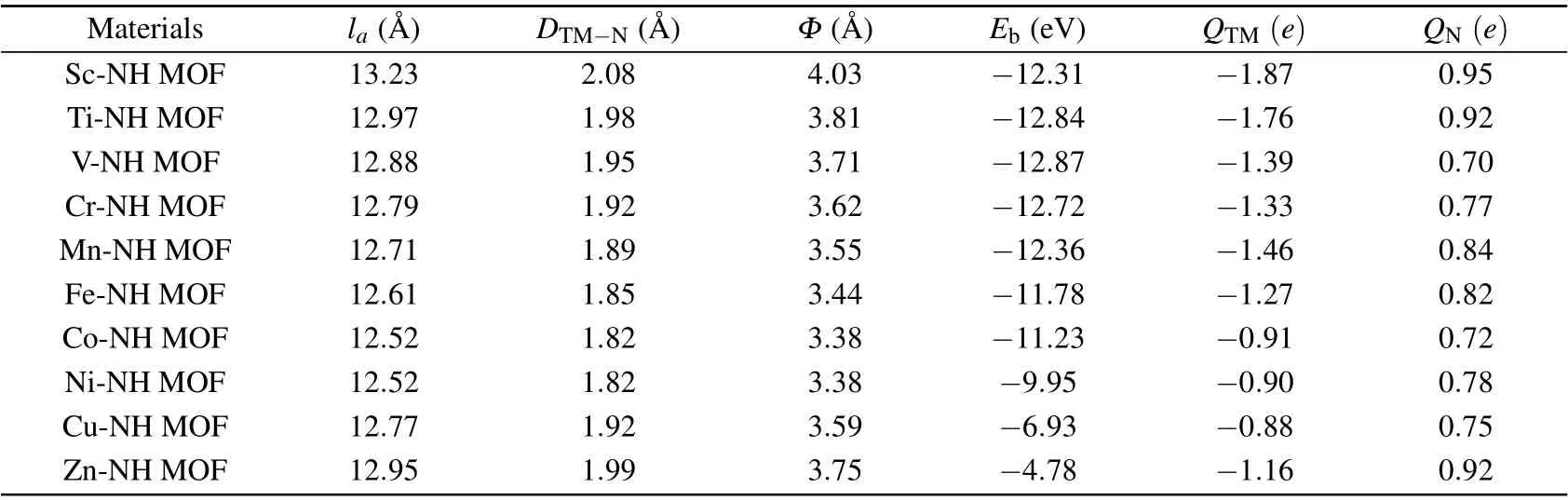
Table 1.The geometric parameters[lattice constants(la),bond lengths of TM-N(DTM?N),diameters of the hole(Φ)],the binding energy(Eb)per unit cell,and charge transfer of TM(QTM)and N atoms(QN)for different TM-NH MOF monolayers.For Bader charge analysis,+and?denote gaining and losing electrons,respectively.
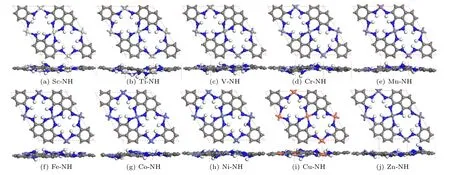
Fig.2.Top and side views of TM-NH MOF materials after the AIMD simulations at 500 K for 3 ps.
3.2.Electronic property
Both non-magnetic and magnetic configurations were investigated to identify the ground states of TM-NH MOF systems.The spin-polarized energy difference(ΔEspin)between the total energies of non-magnetic and magnetic states was computed byΔEspin=ENM?EM,whereENMandEMare the total energies for non-magnetic and magnetic states,respectively.The calculated spin-polarized energy differenceΔEspinis listed in Table 2.For Ti-,V-,Cr-,Mn-,Fe-,Co-,and Cu-NH MOFs,theΔEspinvalues are positive,while for Sc-,Ni-,and Zn-NH MOFs,theΔEspinvalues are zero.These results confirm that Ti-,V-,Cr-,Mn-,Fe-,Co-,and Cu-NH MOFs have magnetic ground states and Sc-,Ni-,and Zn-NH MOFs do not have ferromagnetic states.
The electronic band structures of the TM-NH MOF monolayers were explored and plotted in Fig.3.These 2D TM-NH MOF nanomaterials could exhibit versatile electronic structures.The Ti-,V-,Cr-,Mn-,Fe-,Co-,and Cu-NH MOFs possess spin splitting of band structures,producing magnetism.The Sc-,Ni-,and Zn-NH MOFs do not display spin polarization,according to the spin-polarized energy difference(ΔEspin)and being close to the hexaaminobenzederived 2D MOFs.[32]The Sc-,Ti-,V-,Cr-,and Mn-NH MOFs exhibit metallic characters,while Fe-,Co-,Ni-,Cu-,and Zn-NH MOFs are semiconductors(SM),and their band gaps are 0.56 eV,0.25 eV,0.41 eV,0.48 eV,and 0.61 eV,respectively(Table 2).The energy band structures of the Coand Cu-NH MOFs show a good bipolar magnetic semiconductor(BMS)feature,indicating they could be used for spin generation and injection.[23]
Structural stability is a prerequisite requirement for any practical material.We first calculated the binding energy(Eb)per metal atom of these TM-NH MOF materials by the formulaEb=(Etot?Elinker?ETM)/3,whereEtot,Elinker,andETMrefer to the total energy of a unit cell,the energies of an isolated organic ligand(NH-graphene)and a TM atom,respectively.From Table 1,it is found that the binding energies(Eb)per metal atom range from?4.78 eV to?12.87 eV,which possess a similar magnitude for M3C12S12,[48,49]M3C12N12H12,[32,50]and M3C12O12.[46,47]These negative binding energies imply that these TM-NH MOF monolayers can be synthesized through appropriate chemical reactions.
To further examine the thermal dynamics of these 2D MOF materials,canonical ensemble-based AIMD simulations were conducted under 500 K for 3000 fs.As shown in Figs.2 and S2,the variations of the total energy and temperature during the whole process display a little oscillation within a fixed value.The AIMD final geometric structures of these TM-NH MOFs show a slight buckling distortion and no bond-breaking,confirming their robust thermal structural stabilities.
The structural stability confirms the effective connection between the TM nodes and NH-graphene organic ligands,which could be further validated by the charge transfer through Bader charge analyses.[51]The Bader charge results are listed in Table 1.The TM atoms lose electrons,while the neighboring N atoms get electrons.The losing electrons of the TM atoms decrease monotonously from Sc to Cu,which is tied to the electronegativity of TM.Generally,the lower electronegativity an element possesses,the more easily it loses electrons.The intense difference in electronegativity of TM and N elements induces strong charge transfer and interaction,which contributes to their robust ionic bonds(Fig.S3).
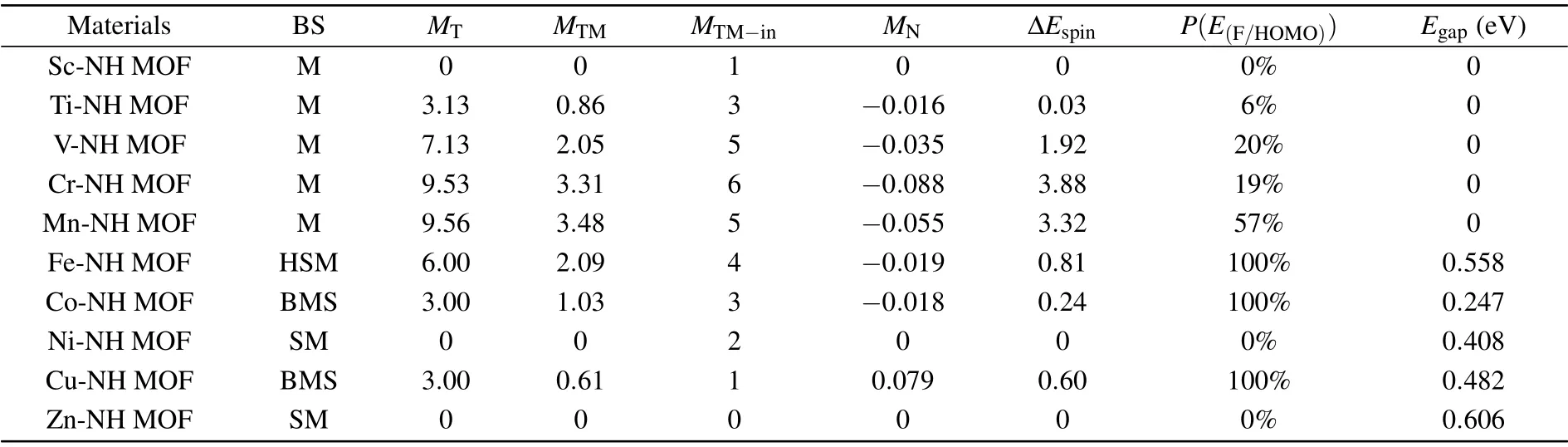
Table 2.Band structure(BS)(M,HSM,BMS,SM denote metal,half-semiconductor,bipolar magnetic semiconductor,and semiconductor),total magnetic moment MT(μB)of TM-NH MOF,the magnetic moment of TM atomic basin MTM(μB)and N MN(μB)atom for TM-NH MOF systems and the integer values of TM atoms MTM?in(μB).ΔEspin(eV)is the energy difference between the total energies for non-magnetic and magnetic states.The spin polarization P(E(F/HOMO))at the Fermi level or the HOMO.
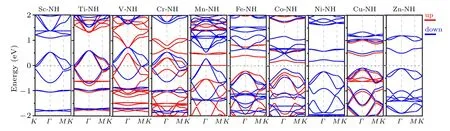
Fig.3.Band structures of TM-NH MOF monolayers.The Fermi levels(EF)are set to 0 eV.
To better understand the electrical features of TM-MH MOF nano-monolayers,the total density of states(TDOS)is depicted in Fig.4.The spin-asymmetry of TDOS around the Fermi energy is observable for Ti-,V-,Cr-,Mn-,Fe-,Co-,and Cu-NH MOF monolayers,while the delicate symmetrical TDOS can be found for Sc-,Ni-,and Zn-NH MOF nanosheets,consistent with the band structures.
3.3.Magnetic property
The total magnetic moments(MT)of TM-NH MOF systems,magnetic moments of TM atomic basin(MTM)and N(MN)atom in TM-NH MOF systems are listed in Table 2.For Sc-,Ni-,and Zn-NH MOF systems,the total magnetic moment is zero.Ti-,V-,Cr-,and Mn-NH MOF single layers possess fractional magnetic moments that range from 3.13μBto 9.56μBdue to fractional transfer charges from the TM atoms to the N atoms.While Fe-,Co-,and Cu-NH MOF systems exhibit integer magnetic moments with the values of 6μB,3μB,and 3μB,respectively,which are similar to the cases for TM-germanene,[52]TM-BeO,[53]and TMgraphdiyne/graphyne.[9]The total magnetic moments(MT)primarily come from the TM atoms(MTM).The total magnetic moments are lower than the corresponding integer values of the TM atoms(MTM?in),which results from the strong interaction between the TM atoms and the NH-graphene.

It could be concluded that the different TM atoms in MOF monolayers could effectively tune their magnetic and electronic characteristics.This modulation mainly results from the electron transfer between TM elements and the NHgraphene.From Table 2,obvious charge transfer takes place from TM atoms to NH-graphene ligands,which could not only strengthen the structure stability but also tune the magnetic and electronic properties effectively.
To further study the magnetism of these TM-NH MOF sheets,their spin-charge densities are plotted in Fig.5.Sc-,Ni-,Zn-NH MOFs have no spin density distribution,suggesting their total magnetic momentsMTbeing 0μB.In Ti-,V-,Cr-,Mn-,Fe-,and Co-NH MOF materials,the magnetic moments are localized.The spin-up densities are mainly around the TM atoms,while some spin-down densities distribute near the nearest N atoms.In the Cu-NH MOF monolayer,there are some spin-up densities around the N atoms,and spin-up and spin-down densities around the Cu atom,according to the results of magnetic moments depicted in Table 2.

Fig.4.Total density of states of TM-NH MOF monolayers.The Fermi levels(EF)are set to 0 eV.
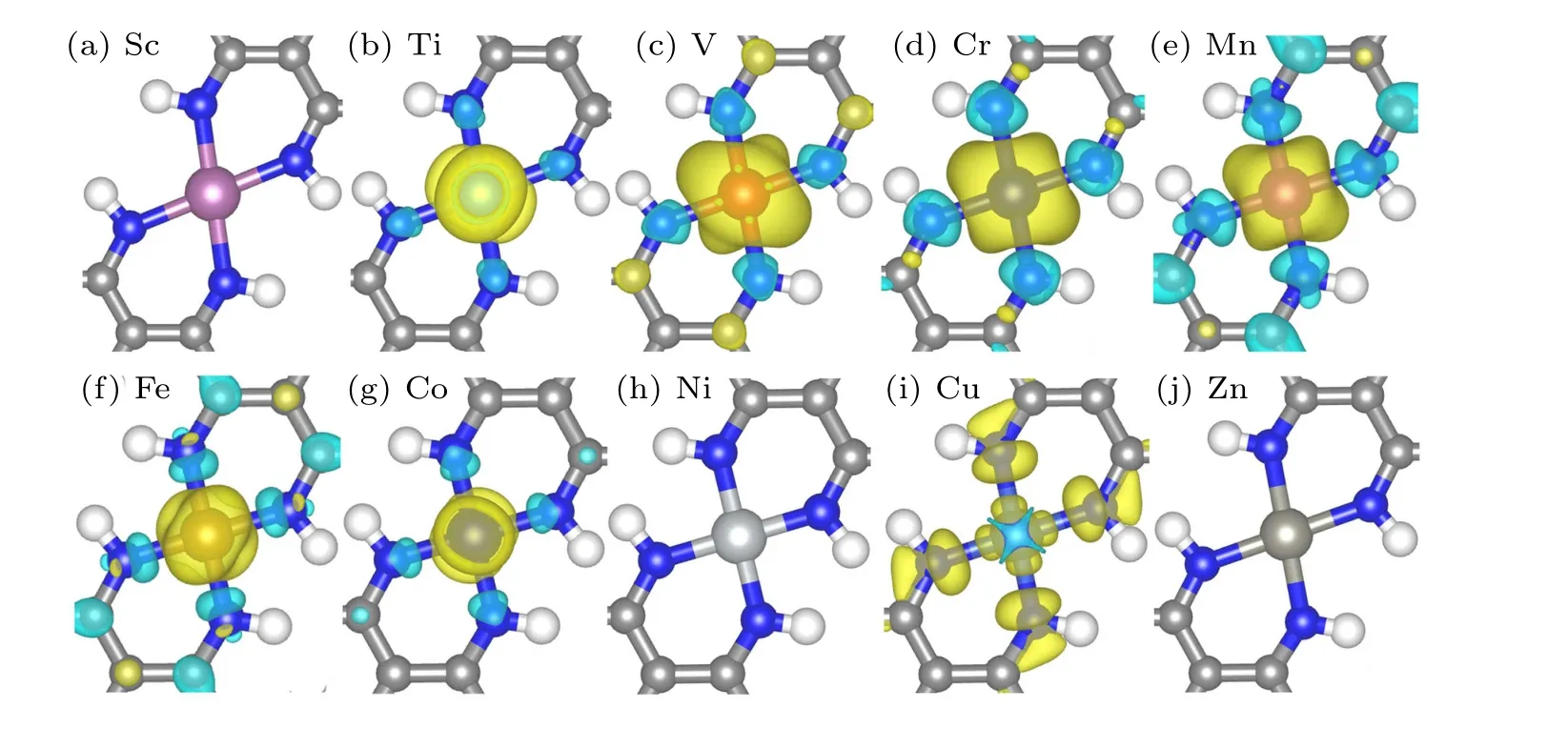
Fig.5.Spin density distribution for(a)–(j)Sc–Zn TM-NH MOF monolayers.The yellow and blue isosurfaces denote the spin-up and spin-down charge densities,respectively.The isosurface charge density is 0.005 e/?A3.
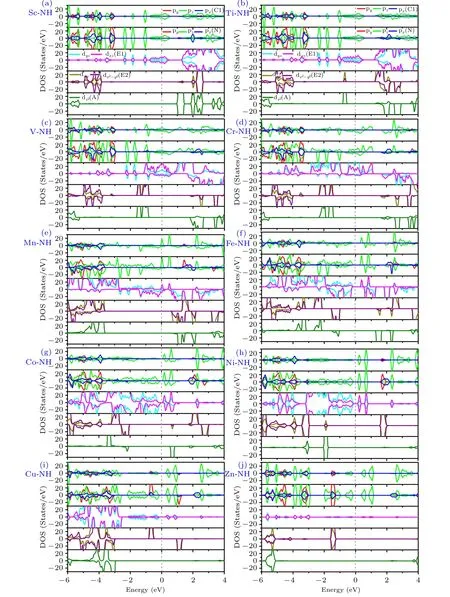
Fig.6.PDOS of C1(denote in Fig.1),N,and TM in TM-NH MOF monolayers.The Fermi levels(EF)are set to 0 eV.
We plot the characteristics of projected density of states(PDOS)of the TM,N,and C1atoms for all ten TM-NH MOF systems in Fig.6.For Sc-NH MOF monolayer(Fig.6(a)),the delicate symmetry of PDOS indicates its nonmagnetic ground state.The N-pz,C-pzstates significantly overlap with the Sc-E1(dyz,dxz)states at Fermi level(EF),which manifests that the Sc-NH MOF possesses metallic character.As shown in Fig.6(b),the hybridization between the E1(dyz,dxz)orbitals of Ti and pzorbitals of O/N atoms occurs at the Fermi level(EF),leading to a metallic character.The giant asymmetry in the E2(dxy,dx2?y2)and A(dz2)orbitals of Ti atoms results in Ti-NH MOF monolayer becoming original magnetic,agreeing well with the spin density distribution shown in Fig.5(b).According to the PDOS of V-,Cr-,Mn-NH MOFs in Figs.6(c)–6(e),they show similar distribution.The E1(dyz,dxz)orbitals of TM and pzorbitals of O/N atoms are split asymmetrically atEF,which induce the magnetic moments of 7.13μB,9.53μB,9.56μBfor V-,Cr-,and Mn-NH MOFs,respectively.
The Fe-NH MOF is similar to Co-NH MOF(Figs.6(f)–6(g)).The pzand E1(dyz,dxz)orbitals are split asymmetrically near the Fermi level,while the px,py,E2(dxy,dx2?y2)and A(dz2)orbitals are split asymmetrically far away from the Fermi level,which manifests their spin magnetism.The origins of VBM and CBM of Fe-and Co-NH MOF systems are different.For the Fe-NH MOF monolayer,the VBM and CBM come from the degenerate spin up Fe-dyzand Fe-dxzorbitals.While for the Co-NH MOF single-layer,the VBM and CBM are originated from the degenerate spin-down Co-dyzand spinup Co-dxzorbitals,respectively.These show that the Fe-NH MOF monolayer is a half-semiconductor(HSM)and Co-NH MOF is a bipolar magnetic semiconductor(BMS).Fe-and Co-NH MOF systems display the same spin polarization of 100%(Table 2),implying that they are potential candidates for spinelectronic devices.
The PDOSs of Ni-and Zn-NH MOF monolayers shown in Figs.6(h)and 6(j)clearly indicate that the spin-up and spin-down states are symmetric,indicating their nonmagnetic ground states.Their origins of VBM and CBM are different,which are Ni-E1(dyz,dxz)and N-pzfor Ni-NH MOF,while C-pzand N-pzfor Zn-NH MOF.Ni-and Zn-NH MOF monolayers are nonmagnetic semiconductors with band-gap energy of 0.41 eV and 0.61 eV,respectively.
For the monolayer Cu-NH MOF,the spin-up and spindown PDOSs are asymmetrical,indicating the presence of magnetism.The N-pz,C-pz,and E1(dyz,dxz)orbitals split asymmetrically and significantly overlap near the Fermi level,leading to the spin-up densities of Cu and N atoms in Cu-NH MOF(Fig.6(i)).Cu-NH MOF is a bipolar magnetic semiconductor(BMS),the VBM and CBM come from the spin-up N-pzand spin-down N-pzorbitals,respectively.
3.4.Strain effect
The 2D MOF materials possess a large dynamical range of exerting elastic strain,which could encourage them in the application of flexible spintronic devices.[54–56]The biaxial strain is defined byε=Δc/c0,where the lattice constants of the pristine and strained supercells arec0andc=c0±Δc,respectively.Here,the+|ε|and–|ε|represent tensile strain and compressive strain,respectively.The strain range from?5%to+5%was considered according to their mechanical strength and the previous reports,and the corresponding variations of the total magnetic moment(MT)of TM-NH MOF structures were calculated and shown in Fig.7.The strain can not induce the magnetism of Sc-,Ni-,and Zn-NH MOF systems,they still stay in the nonmagnetic ground state(Table S2).The strain also does not affect the total magnetic moments of Feand Co-NH MOFs,they remain at 6μBand 3μB,respectively.Interestingly,Cr-NH MOF has an approximately linear correlation between the total magnetic moment and strain(?5%to+5%).For V-and Ti-NH MOF monolayers,there is a slight increase from compressive strain of?5% to tensile strain of+5%.The Cu-NH MOF sheet exhibits a total magnetic moment of 1μBunder the strain of?5% to?3%,and a total magnetic moment of 3μBunder the strain of?1% to+5%.Furthermore,the PDOS of E1(dyz,dxz),E2(dxy,dx2?y2)and A(dz2)of the TM atoms in TM-NH MOFs under the different strain were calculated and shown in Fig.S4.The PDOS display different overlap nearEFunder different strain,leading to the variation in the total magnetic moments.The results confirm that strain engineering is an effective strategy to tune the electric and magnetic characters of nanomaterials.
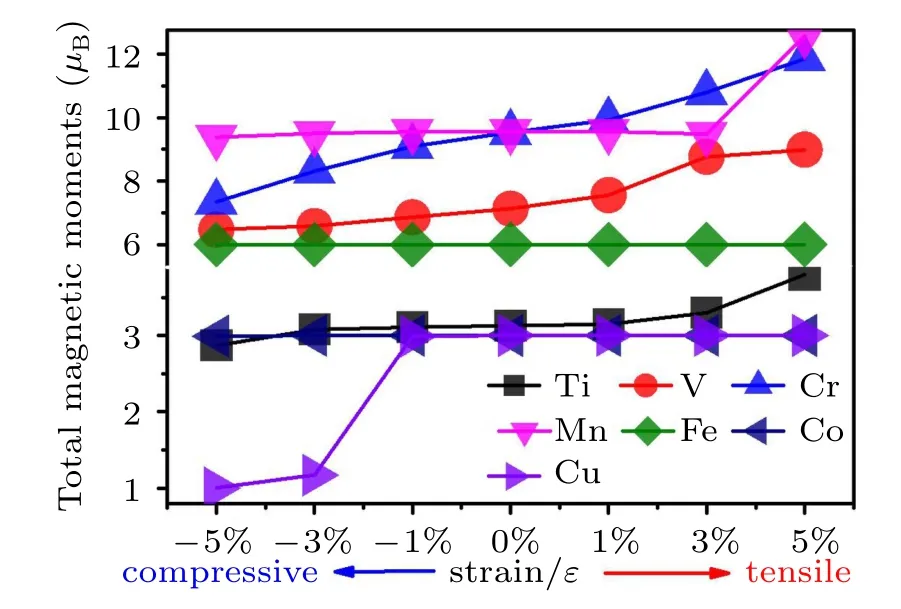
Fig.7.Magnetic moments of TM-NH MOF monolayers under the strain from?5%to 5%.
4.Conclusion
In summary,a series of 2D MOF materials TM3(C2NH)12are investigated by DFT calculations.The binding energies and AIMD indicate that these ten TM-NH MOF(TM=Sc–Zn)monolayers possess excellent structural stability,which results from the charge transfer and strong interaction between TM and NH-graphene.The optimized lattice constants of the TM-NH MOF monolayer are 12.52?A–13.23?A,which is dependent on the atomic radii of the transition-metal atoms.These TM-NH MOF monolayers exhibit different magnetic and electronic characters.Sc-,Ti-,V-,Cr,and Mn-NH MOFs are metallic,while Ni-and Zn-NH MOFs exhibit semiconductors(SM)with band gaps of 0.41 eV and 0.61 eV,respectively.Co-and Cu-NH MOF nanomaterials are good bipolar magnetic semiconductors(BMS).Fe-NH MOF monolayer is a half-semiconductor(HSM).The central transition metal atom could effectively modulate the magnetic property of TMNH MOFs,especially the different spin polarized d-orbitals of the TM atoms.The effect of elastic strain on the magnetic and electronic characters is studied under strain(from?5%to+5%).The results testify that charge redistribution of TM-3d states is responsible for the magnetic transformation under different elastic strains.This work proposes a new class of 2D MOF materials,and could shed light on the development of 2D magnetic materials.
Acknowledgment
The authors thank the high performance computing center of Henan Normal University,and national super computing center in Zhengzhou.
- Chinese Physics B的其它文章
- Origin of anomalous enhancement of the absorption coefficient in a PN junction?
- Protection of isolated and active regions in AlGaN/GaN HEMTs using selective laser annealing?
- First-principles study of plasmons in doped graphene nanostructures?
- Probing thermal properties of vanadium dioxide thin films by time-domain thermoreflectance without metal film?
- An improved model of damage depth of shock-melted metal in microspall under triangular wave loading?
- Signal-to-noise ratio of Raman signal measured by multichannel detectors?