
Gate-controlled magnetic transitions in Fe3GeTe2 with lithium ion conducting glass substrate?
2021-09-28 02:18:44GuangyiChen陳光毅YuZhang張玉ShaomianQi齊少勉andJianHaoChen陳劍豪
Chinese Physics B 2021年9期
Guangyi Chen(陳光毅),Yu Zhang(張玉),Shaomian Qi(齊少勉),and Jian-Hao Chen(陳劍豪),,3,4,?
1International Center of Quantum Material,School of Physics,Peking University,Beijing 100871,China
2Beijing Academy of Quantum Information Sciences,Beijing 100193,China
3Key Laboratory for the Physics and Chemistry of Nanodevices,Peking University,Beijing 100871,China
4Interdisciplinary Institute of Light-Element Quantum Materials and Research Center for Light-Element Advanced Materials,Peking University,Beijing 100871,China
Keywords:two-dimensional magnetism,two-dimensional material,ionic gating
1.Introduction
In recent years,van der Waals(vdW)two-dimensional(2D)materials[1–3]have attracted a lot of attention,with numerous research focusing on the physical properties and potential applications in such systems with strong confinement.So far,a large number of 2D materials have been investigated,with properties including insulators,semiconductors,semimetals,and even correlated electronic materials.Among these compounds,vdW magnets are of great interest.According to the Mermin–Wagner theorem,long-range magnetic order in 2D systems would be strongly suppressed by thermal fluctuations.Recently,it is realized that magnetic anisotropy could counteract such fluctuations,[4]resulting in ferromagnetic order in Cr2Ge2Te6[5,6]and CrI3[7–9]atomic layers.Such findings inspire people to further study the intrinsic magnetism in 2D vdw magnets.Fe3GeTe2(FGT)is considered as a promising vdW ferromagnet.[10–14]Due to strong spin–orbit coupling-induced magneto crystalline anisotropy along the c axis,bulk FGT crystals exhibit a relatively high ferromagnetic transition temperature(Tc)of about 220 K,and long-range magnetic order exists down to the monolayer limit.FGT with such intrinsic ferromagnetic property and its metallic nature in the 2D limit gives us with a good material platform:we could study its magnetic properties through electrical transport measurement,and the interplay of spin and charge degrees of freedom provides more possibilities in device concepts based on magnetic vdW heterostructures.[15–17]
The magnetic properties of magnetic materials can be modulated with different methods,such as strain[18–21]and electrical-gating.[12,22]Gate-controlled magnetism is an attractive way to realize magnetoelectronic devices.vdW crystals have the advantage to be prepared into thin layers and could be readily tuned by various kinds of gating modulation.Typically,gating could cause changes in the ferromagnetic transition temperature Tcand the coercive field Hc,which are driven by magnetoelectric effect.Ionic gating provides a much larger gating effect compared with conventional solid dielectric and is a promising method to modulate magnetism in 2D materials.[12]However,ionic liquid gating could be less convenient in practical application due to its liquid nature.Thus solid electrolytes could provide the benefits of a solid substrate and at the same time deliver similar doping capacity as liquid electrolytes.Previously,such a technique has been applied to modulate the carrier density in FeSe using solid electrolyte(Li1+x+yAlx(Ti2yGey)P3?zSizO12)[23,24]and to induce superconductivity in SnSe2using solid electrolyte Li2Al2SiP2TiO13.[23–25]Solid electrolytes are also used in a number of experiments to construct special field effect devices,[26–34]yet there is no report so far on tuning magnetism in vdW magnets via solid electrolyte.In this work,we investigate the modulation of FGT’s ferromagnetism by Li+doping via lithium-ion conducting glassceramics(LICGC)substrate.Hcand Tcare both found to decrease with the increasing gating voltages,and such variation is attributed to Li+intercalation effect.We believe that the tunability of FGT provides more possibilities for electrically controlled magnetoelectronic devices.
2.Method
The bulk FGT crystals are grown by the chemical vapor transport method,and thin FGT samples measured in this work are mechanically exfoliated from bulk crystals and deposited on LICGC substrates.As shown in Fig.1(a),we use fourterminal measurement method to measure our samples.Standard electron-beam lithography technique is used to pattern electrodes with 5-nm Ti/50-nm Au.The bottom gate electrodes are evaporated on the back of the LICGC substrate.In addition,to prevent FGT from oxidizing when exposed to ambient conditions,the samples were kept in inert atmosphere or with a PMMA capping layer during the preparation and measurement process.In order to improve the contact quality,Ar+plasma cleaning is carried out for 20 minutes during the electrodes fabrication process.The transport measurements were performed in a Quantum Design PPMS-9,with 80-nA AC current at 18.88 Hz provided by a lock-in amplifier(Stanford Research SR830).The back-gate voltage is applied from 0 V to 3.5 V using a Keithley 2400 multimeter.
3.Results and discussion
In this letter,we study the magnetic properties of FGT thin flakes by measuring the Hall resistance Rxywith the external magnetic field applied perpendicular to the sample plane.As a ferromagnetic material,the Hall resistance Rxyis composed of a normal Hall resistance and an anomalous Hall resistance,which could be described as[35]

where R0μ0H is the normal Hall resistance,RSM is the anomalous Hall resistance,where R0is the ordinary Hall coefficient and RSis the anomalous Hall coefficient,H is the applied magnetic field and M represents the magnetic moment of the sample.For a metallic ferromagnetic material,the anomalous Hall resistance is the main part of the Rxy.The characteristics of M could then be extracted from the Hall resistance.The Hall resistance as a function of the applied magnetic field H at various temperatures is shown in Fig.1(b).The magnetic field is applied perpendicular to the sample plane,which is swept between?2 T and 2 T.At low temperature,the Rxy–H curve of FGT thin flakes shows standard ferromagnetic hysteresis behavior,with a coercive field of~2200 Oe(1 Oe=79.5775 A·m?1)at 10 K.The remanent Hall resistance Rxy|H=0is directly proportional to the zero-field spontaneous magnetization according to Eq.(1).At higher temperature,e.g.,T=250 K,the hysteresis loop disappears,which indicates that thermal fluctuations severely suppressed ferromagnetism.The coercive magnetic field Hcis defined as the magnitude of the magnetic field at which Rxy=0 in the Rxy–H hysteresis loop.Generally,Hcis the same for the positive and negative magnetic field since there is no exchange bias effect in our devices.To get the information of the temperature-dependent Rxy|H=0,we first polarized our sample with H=?2 T at 10 K,then measured Rxy|H=0at H=0 T from 10 K to 300 K,with a ramp rate of 5 K/min.Figure 1(c)plots Rxy|H=0versus T from 150 K to 240 K.It can be seen that Rxy|H=0decreases sharply at about 200 K,indicating the transition of the FGT thin flake from ferromagnetic state to paramagnetic state.Such a rapid decrease is observed in 4 different samples,with thickness ranging from 42.7 nm to 84.5 nm.We define Tcas the temperature at the middle point of such sharp transition in the Rxy|H=0versus T curves.Figure 1(d)shows Hcversus T in which Hcis found to decrease monotonically with increasing T,and become too small to measure before reaching 200 K.
Next,we focus on modulating the magnetism of FGT thin flakes by Li+doping using solid electrolyte LICGC substrates.Just like the charging process that occurs in lithium-ion batteries,when a positive voltage Vgis applied on the bottom gate,the Li+in LICGC are expected to move towards the other surface of the LICGC,and get close to the FGT crystals.As we examine the effect of gating on FGT with LICGC,a remarkable change in the ferromagnetism of FGT thin flakes with gating could be observed with increasing gating voltage.As shown in Fig.2(a),Hcof the FGT thin flake decreases with an increasing Vgat different temperatures from 10 K to 100 K.When none zero Vgis applied,Hcchanges from 654.9 Oe(Vg=0 V)to 493.6 Oe(Vg=3.5 V).We can see that the temperature would also influence the gating effect.At lower temperature,variation in Hcseems to increase as a function of the gate voltage.We also measure the percentage change of Hcas a function of Vg,namely,|ΔHc(Vg)|/Hc(Vg=0)versus Vg,as shown in Fig.2(b).HereΔHc(Vg)=Hc(Vg)?Hc(Vg=0 V)is the difference of gate voltage induced changes in Hcat a particular temperature as compares to the zero gate value.It can be seen that the modulation of Hcby Vgis not linear when applying Vgfrom zero to 3.5 V at 100 K:an abrupt change is observed at around Vg=2.75 V.The totalΔHc/Hc(0)modulation efficiency is found to be up to~24.6%for Vgfrom 0 to 3.5 V at T=100 K.

Fig.1.Anomalous Hall effect in thin FGT flake.(a)Schematic diagram of few-layered FGT on LICGC substrate with Ti/Au electrodes.(b)Rxy versus H loops measured at T from 10 K to 250 K.The hysteresis behavior of the Rxy versus H loop is evident.(c)Rxy|H=0 versus T curve at Vg=0 V and T from 150 K to 240 K,the circle point marks the Tc.(d)Temperature dependence of Hc from 10 K to 100 K,which decreases monotonically with increasing temperature.
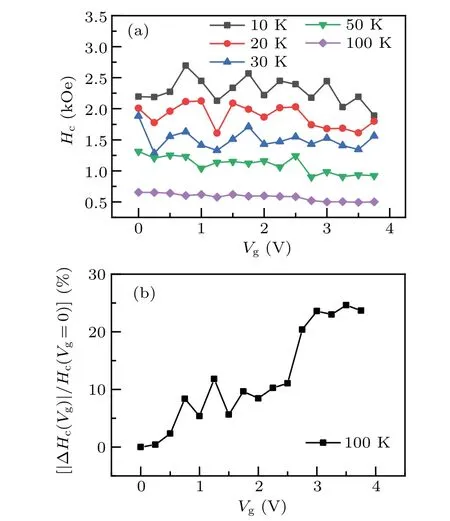
Fig.2.The modulation of Hc in the thin FGT flake by ionic gating with LICGC.(a)Hc versus Vg from 0 V to 3.5 V at different temperature T.(b)The percentage change of Hc as a function of Vg,e.g.,|ΔHc(Vg)|/Hc(Vg=0 V)as a function of Vg from 0 V to 3.5 V at T=100 K.HereΔHc=Hc(Vg)–Hc(Vg=0 V).
To fully illustrate such modulation effect on the ferromagnetism of our sample,we further investigated the influence of Li+doping on Tc.Figure 3(a)shows the temperature dependence of the normalized Rxy|H=0,e.g.,Rxy|H=0(T)/Rxy|H=0(T=150 K),with different Vg,measured from low temperature to high temperature.Here the Rxy|H=0data are normalized by their values at T=150 K and plotted at the range of 150 K to 250 K,in order to illustrate the small but finite tunability in Tcat around 200 K.It is worth pointing out that for larger applied Vg,the temperature at which Rxy|H=0reaches zero does not change much,while the onset temperature for the sharp transition from finite to zero Rxy|H=0is tuned.Thus,in addition to defining Tcas the middle temperature point of such finite to zero Rxy|H=0transition,we could also use the width of such transition WTas a characterization of the transition process.It could be seen that at larger Vg,Tcshifts to lower temperatures.Specifically,in the Tcversus Vgcurve,we could see that Tcdrops sharply at Vg=2.5 V while it is almost invariant at smaller Vg,as shown in Fig.3(b).A decrease in Tccould mean a shift of the transition step,a change in the slope of the step,or a combination of both.Using WT,we could see that it is mainly a change in the slope of the transition step that is modified by Vg,as WTis significantly widened when Vg>2 V.This effect may be caused by the increase in inhomogeneity in FGT due to Li+intercalations during gating.
The observed gate dependence of Hcand Tcof FGT thin flakes on LICGC substrates may involve the following effects:i)pure electrostatic gating effect,including conventional electric field effect as well as the accumulation of Li+at the bottom surface of FGT;ii)intercalation of Li+in the FGT atomic layers;iii)irreversible electrochemical reactions.It is unlikely that pure electrostatic gating effect would induce such substantial change of Hc(up to 24.6%)and Tc(up to 2.5%),since FGT is a metal with high carrier concentration and our samples thickness of 52.1 nm.Thus,pure electrostatic gating would not provide enough change in carrier concentration to significantly affect Hcand Tc.Besides,electrostatic gating of only the bottom surface of FGT would not significantly influence Hcand Tcof the whole crystal of FGT containing?65 atomic layers.Thus,such effects are unlikely to come from pure electrostatic gating.Furthermore,we found that when we set Vgback to zero after previously setting it at a finite value,Hcrecovers partially overtime.For example,when we set Vg=3.5 V first and then back to 0 V,Hccould recover from 493.6 Oe to 528 Oe at 100 K.As a matter of fact,in order to protect the sample from air,our gate modulation and measurements are done in high vacuum environment or in helium atmosphere.Thus irreversible electrochemical reactions are unlikely to be the cause of such gate modulation.With the above information,we came to the conclusion that our experimental observation is in line with the scenario that Li+intercalations might occur during the gating process of FGT on LICGC substrate.The diffusion of Li+between FGT layers would influence the interlayer exchange coupling and the magnetic anisotropy,which results in the decrease of Hcand Tc.Such the mechanism is shown in Fig.4,and it is consistent with previous experiment on FGT gating with ionic liquid,in the regime that Vg<1.4 V.[12]The enhancement of Tcobserved in Ref.[12],for Vg>1.4 V is not observed in our experiment,possibly due to the difference in the stages and homogeneity of Li+intercalations between ionic liquid gating and gating through solid electrolyte substrates.The details of such differences warrant further investigations.

Fig.3.The modulation of Tc in the thin FGT flake by ionic gating with LICGC.(a)The remanent Hall voltage Rxy|H=0 versus T at various Vg,where the Rxy|H=0 data are normalized by their values at T=150 K.Tc is marked as circle points.(b)The Vg dependence of Tc,the inset shows the width of the transition step WT versus Vg.

Fig.4.The schematic diagram of gate-controlled Li+doping in the FGT flake with LICGC substrate.
4.Conclusion
In summary,we have fabricated FGT thin flake devices on solid Li+electrolyte LICGC substrates.Ferromagnetism in FGT thin flakes is found to be modulated with the help of LICGC.Specifically,the coercive field Hcand the Curie temperature Tcare strongly determined by the ionic gating voltage.We attribute such variation of Hcand Tcto the ionic doping and possibly intercalations of Li+between the atomic layers of FGT.Our results shows that solid electrolytes provide a new way to manipulate ferromagnetism in van der Waals magnets,and open new possibilities in future magnetoelectronic devices.
- Chinese Physics B的其它文章
- Origin of anomalous enhancement of the absorption coefficient in a PN junction?
- Protection of isolated and active regions in AlGaN/GaN HEMTs using selective laser annealing?
- First-principles study of plasmons in doped graphene nanostructures?
- Probing thermal properties of vanadium dioxide thin films by time-domain thermoreflectance without metal film?
- An improved model of damage depth of shock-melted metal in microspall under triangular wave loading?
- Signal-to-noise ratio of Raman signal measured by multichannel detectors?