The Poet on Earth
2021-10-28 13:51:00SiyiChu
漢語世界(The World of Chinese) 2021年5期
Siyi Chu
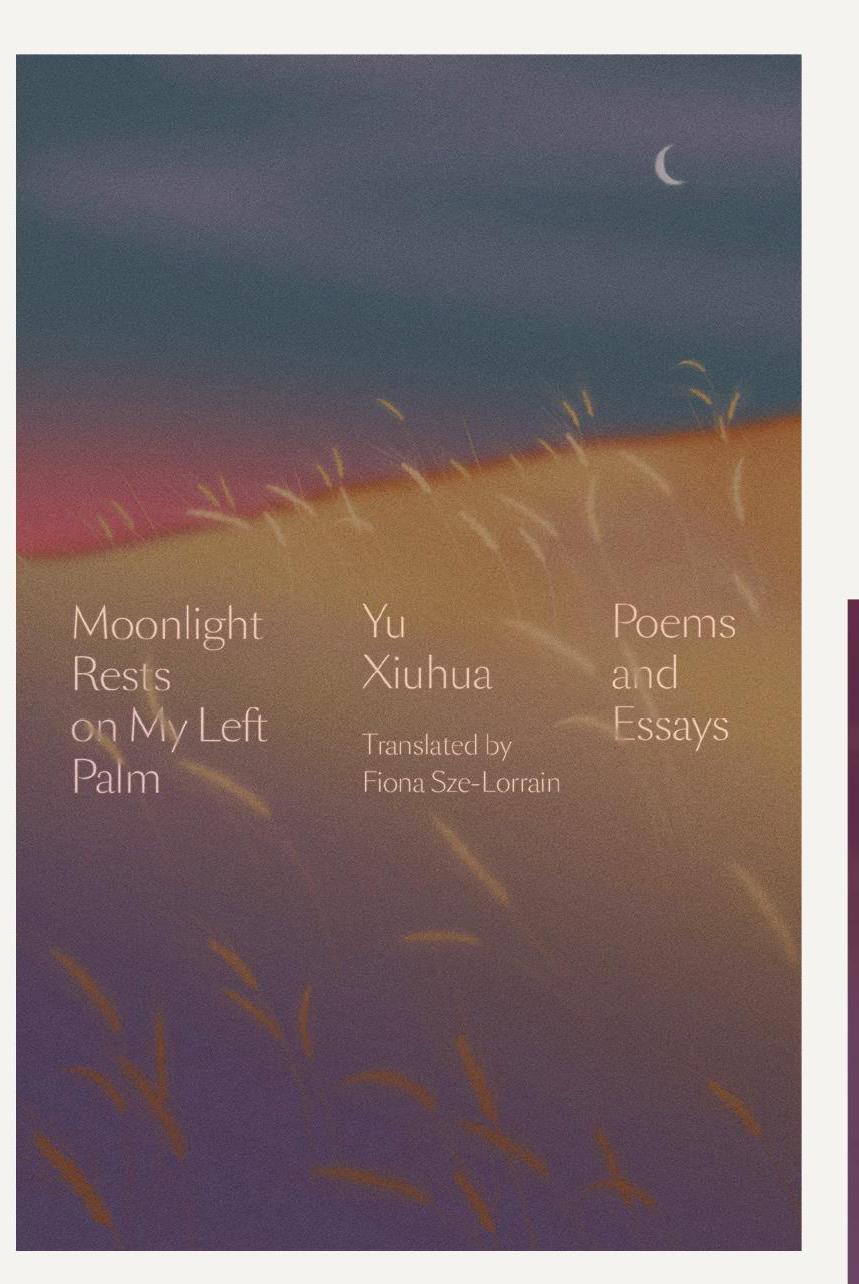
Yu XiuhuasMoonlight Rests on My Left Palm is an unabashed celebration of the power of straight-talking
《月光落在左手上》:余秀華的詩意與現實
by Siyi Chu (褚司怡)
Fucking you and being fucked by you are quite the same,” opensMoonlight Rests on My Left Palm, the first anthology of Chinese poet Yu Xiuhua (余秀華) to be published in English, translated by Fiona Sze-Lorrain.
The line is tinged with novelty. The poem from which it is taken, “Crossing Half of China to Fuck You,” went viral in November 2014 when a national poetry magazine published it on the Chinese messaging app WeChat, reportedly attracting over 1 million shares and bringing Yu to public attention. Although other translators have previously rendered the poem in English, Sze-Lorrain is the first to directly use the word “fuck” instead of the coyer “sleep with” or “lie with.”
The word choice echoes the deliberate vulgarity and delicate rawness that permeate all of Yus poetry. While the euphemism 睡(literally, “sleep”) is not an obscenity in Chinese, it carries a certain coarseness in a society where public discussions of sexuality are still not widely accepted. Soon after it went viral, “Crossing” was labeled “slut poetry” by some internet users who felt ill-at-ease with such candid expressions of sexuality from Yu, a rural woman with cerebral palsy. But behind the poems title lies both an emotional world that is down-to-earth and writing style that is incredibly perceptive.
“I penetrate a hail of bullets to fuck you / I press countless dark nights into one dawn to fuck you / I, as many, run as one to fuck you...” Within a few lines, the poem becomes the story of a person striving to affirm her existence by connecting with another, no matter how frivolously. We digest Yus imagery, and with it, discover a poet who shatters and fuses claims to sexuality in an almost self-empowering way; who embraces the possibility of promiscuity through words. We see that for Yu, poetry is not about packaging thoughts and feelings, but about stripping away pretense, leaving life naked and raw.
Yu wrote her first poem, “Imprinting,” in 1998. She was just 22 years old, had lived her entire life in a small village in central Chinas Hubei province, and had entered into an arranged marriage as a teenager. Yus disability made her unsuited for farming life, but she found an outlet through poetry, a literary genre whose tendency toward brevity stops her from overexerting herself. “Much as society might contaminate my mind, poetry cleanses me with compassion,” she writes in an essay that also appears inMoonlight.
The poems that follow “Crossing” continue to dazzle with their rich imagery and surprising juxtapositions. “Softly I sway in water / carry luminous words at the tip of grass,” she writes in “A Pool of Water.” Yus expressions are unembroidered, eschewing the rules of poetry and the impulse of many poets to dress up their words in smart turns of phrase. Yet they are always anchored in a simple time and place—often her village or her body—and are imaginative and free enough to fill the reader with envy.
Perhaps this linguistic freedom is intrinsic rather than deliberate. Yu gives clues to its origin in the essay “My Nostalgia Is Different Than Yours” as she comments on the perceived mundanity of village life: “The so-called plainness isnt about plainness itself, but that we hurry our way through life, and have yet to chew on it carefully, thus wasting its exquisite flavors.”
By staggering words based on her everyday life, Yu widens, deepens, and crystallizes readers perceptions of reality. In “Wheat Has Ripened,” she equates the movements of a wheat field with romantic sensations: “In moonlight meditation, wheat rubs against each other / All things on earth are in love now.” “Short” starts innocuously, counting off short things in the field before laying the weight of time onto the readers shoulders: “Short things cant be blown away / Fathers sixty years, my thirty-eight.”
Since rising to fame, Yu has never been seen as just a poet: She is a peasant poet, a poet with a disability, and a rural female poet who writes about sex and love. These labels are perhaps more helpful for understanding the social discourse around Yu rather than the poet herself. Several essays inMoonlighthint at how Yu challenges these classifications.
She writes about her disability in “The Swaying Mortal World,” shifting the focus away from herself: “Any social tolerance bestowed upon me, a distinctly handicapped person, will mirror the yardstick for a healthy society.” In “I Live to Reject Lofty Words,” she rejects being likened to others before her as well as being made into a role model for those after her: “People need a role model because they have no idea what to do in times of anguish...Once they imagine they have found a plausible reference at last, they might realize how futile it is.” By interweaving essays in between poetry,Moonlightalso leaves space for Yu to bestow meanings upon her own life and combat those she has no control over.
Perhaps Yus rejection of labels and embrace of lifes plain and exquisite flavors originated from the same place—an eagerness to see life only in its truest forms. In the essay “In Rejection of Lofty Words,” she writes: “I am desperately in love with this inexplicable and obscure life. I love its conceit, and the haze that surfaces at low points in my life. I am grateful for being well and alive, and all because of my lowly existence.”
Yet Yus rejection does not seem to extend to a desire to control the interpretation of her poems. When a poem leaves the poets hand, it continues to have a life of its own. As further translations prolong the life of Yus work, its worth looking forward to the new meanings that will take root.
Seeking Ghosts
How the memoirs of a Chinese American author, haunted by her parents, can help us relate to our own families
Theres something familiar about Seeing Ghosts, Kat Chows brave new memoir. Its not just because it takes this Shenzhen-dwelling reviewer to Guangzhou, where her father grew up before expatriating to the US via Hong Kong. Its not just the description of rising into the middle class in a 1980s and 90s America that still feels like recent history.
Instead, its the candid, vividly detailed scenes of family life that remind me of my own mother and father. I think many readers will feel the same.
Chows writing stirs a memory of my own from high school. Im chatting with my mother, who is seated at the kitchen table, describing a homework assignment to write about what influenced me. Something cautious, hopeful, and anxious widens in her eyes as she asks if Ill write about her. Suddenly bashful, I reply that I dont know.
Yet Chow, a former NPR reporter, delves into that challenge with a courage I can only envy. It takes bravery to reveal oneself and ones family, especially when still so young (shes 31 years old), and especially when tragedy is so central to that story. The books themes follow broadly familiar contours: life, death and unkept deathbed promises, and the grief and growth that take place before those obligations are resolved.
In Seeing Ghosts, that story unfolds in episodic scenes that flit through space and time, while also frequently switching perspectives—from first-person to the third and even to the second, when Chow speaks to the ghost of “Mommy.” (I soon stopped cringing at the childish address Chow uses throughout the book; any name repeated long enough becomes normal.) These mini-chapters draw from the rich archive kept by Chow, a former teenage diarist who interviewed family members and kept the recordings year after year, device after device.
Her writing style here isnt postmodern per se, but builds the characters of her parents in fragmented layers around unknowable centers. Reading the memoir feels almost like flipping through a family photo album, showing the people and their surroundings but leaving a silence in their hearts. This feels even truer with Chows inclusion of anodyne photos of the family standing side by side, half-smiles revealing little of their fears and frustrations.
Across this constellation of scenes from the life of Chow and her parents, readers can assemble various storylines: her mothers death and life; her fathers childhood and widowerhood; the daughters paths; the psychology and physicality of grief; and Chows thoughts on race and immigration. The most evocative writing is about death and its aftermath, as when she tells her mothers ghost, “You stomp around in the attic of our familys grief. The thrums and rattles from your footsteps constantly punctuate our thoughts.”
Yet Chows more empathic writing is about her father, who is left distracted, disheveled, and dismayed by the death of his wife, the “general” in charge of the household. Despite Chows feelings of neglect and resentment, her father emerges as a fascinating and fully human character. Neither villain nor hero, this complicated man is simply unprepared for the challenges that come his way.
The mentality of Chows father is visible in his behavior and his habit of hoarding, though Chows many interviews with him, from childhood through the present, never elicit a great deal of reflection from either of them. When she does get him to speak about his experience of “the American Dream,” his responses are somewhat predictable, focusing on access to freedom and opportunity while failing to probe whether he has squandered his own chance of fulfillment. Chow just wants to know whether hes happy, without really exploring what that means.
The author presents herself similarly, with self-analysis kept to a minimum. In her we see how the immigrant experience played out in this family, with their Chinese heritage reduced largely to food, a few Cantonese phrases and death rites that feel largely disconnected from the belief systems that bore them. There is much to be written about the experience, but its largely left for the reader to piece together and explore on their own.
Chows relatively few and vaguely frightening memories of her mother clearly imprinted themselves onto her young mind. But though theyre recounted with love and honesty, theyre also not as tight or compelling as a more fictionalized account might have achieved—perhaps one that featured more scenes with the mother-ghost, with more space to give her a voice and an answer to the authors subconscious pain and longing. Id like to read that version for the drama, but the minimalism of Seeing Ghostsultimately succeeds in painting a more authentic portrait of the family.
I never mustered the courage to write about my own mother, but Chows honest appraisal is a work her mother would probably appreciate. Her father likely does as well, maybe giving an acidic laugh as he starts to see himself through his youngest daughters eyes. Many readers will appreciate this opportunity to see their own families in a new light, and consider how we can miss them before theyre gone, and still find them in ourselves. – ?Adam Robbins
Ghost Forest
Canadian writer Pik-Shuen Fungs debut novel traces a journey of self-discovery after her father passes away, leaving her with the question of how to grieve in a family that doesnt air their emotions openly. Having grown up in Vancouver with a father who stayed in Hong Kong for work, she searches for traces of her father in her own memory, as well as that of her mother and grandmother. Sparse yet powerful prose in short vignettes cast her faraway father in shades of myth and reality, and paints the silhouette of his absence in her life. Nevertheless, the novel depicts the ways unspoken love becomes felt.
Vessel
This best-selling memoir by millennial writer and fashion executive Cai Chongda is translated into English by Dylan Levi King. Born in 1982 in a fishing village in Fujian province, Cai is forced to become the head of his household from a young age due to his fathers medical condition, and supports his family by writing, eventually becoming the youngest-ever editorial director of GQ China. In 14 essays, Cai reflects on the lessons from his childhood and his spiritual debts to his hometown. The publisher HarperVia compares Cais writing to J.D. VancesHillbilly Elegyfor his unrestrained affection for where he comes from, and the investigation of his roots and becoming.
AI 2041
Kai-Fu Lee, former president of Google China, joined with acclaimed novelist Chen Qiufan to weave ten short stories that meditate on the ways artificial intelligence will disrupt the social and economic order. In cities across the world, ordinary people adapt to a world of human-machine symbiosis, autonomous weapons, and smart technology: In San Francisco, AIs continuous replacement of human labor spurs the birth of a new “job reallocation” industry; in Mumbai, a teenage girl fights back against big datas role in romance. Imaginative and engrossing, these prescient stories bring large existential questions to relevance on an intimately human scale. – TINA XU (徐盈盈)
Illustration by Cai Tao and Elements from Shetuwang
猜你喜歡
中國新聞周刊(2024年18期)2024-06-07 22:40:49
金橋(2022年7期)2022-07-22 08:33:14
文苑(2020年11期)2021-01-04 01:53:20
中國三峽(2016年6期)2017-01-15 13:59:16
現代計算機(2016年12期)2016-02-28 18:35:29
發明與創新(2015年25期)2015-02-27 10:39:23
中國衛生(2014年12期)2014-11-12 13:12:38
浙江人大(2014年5期)2014-03-20 16:20:31
杭州科技(2014年4期)2014-02-27 15:26:58
絲綢之路(2004年8期)2004-04-29 00:00:00