The Nuclear Option
2021-12-13 11:32:49ZhengYiwen
漢語世界(The World of Chinese) 2021年6期
Zheng Yiwen


Under the mountains of Fuling, remnants of a top-secret nuclear project have come to light
從廢棄的核工業基地到新興的旅游景點:探秘世界上最大的人工山洞
The Wu River, the largest southern tributary of the Yangtze, meanders through the magnificent green peaks of the Wuling Mountains in west-central China as in a traditional landscape painting. At the confluence of the two rivers, the city of Fuling, now a district of Chongqing municipality, lies shrouded in mist and rain for most of the year.
This scenery was thus described by poet Lu You (陸游) who sailed here in the Southern Song dynasty (1127 – 1279). Likewise, the Qing dynasty (1616 – 1911) poet Weng Ruomei (翁若梅) eulogized the Wu River corridor as “unique and unrivaled.” A famous boulder in the area was where the scholar Cheng Yi (程頤) gave lectures that led to the rise of the “Fuling School” of Neo-Confucianism during the Song dynasty (960 – 1279), and more recently, in the late 1990s, US Peace Corps volunteer Peter Hessler spent two years teaching English at the local teachers college, chronicling the experience in his best-selling memoirRiver Town: Two Years on the Yangtze.
Its hard to tell that this picturesque landscape was once the site of one of the most secretive and ambitious military projects in Chinese history, known only to top leaders such as former premier Zhou Enlai, as well as a few core personnel from the Ministry of Military Nuclear Industry. Inside the hollowed-out Jinzi Mountain of Baitao town in Fulings suburbs lie the remnants of the 816 nuclear plant designed to produce weapons-grade plutonium—a base so secret, it has only ever been known by this code name.
“Even as a local, I knew nothing about this nuclear plant before the government revealed it in 2002,” Mr. Yi, my driver, tells me as our car winds between the dense forests and along clear streams that run for miles. I had come to Fuling intent on following Hesslers footsteps and revisiting some of the places he described in his book, but Yi insisted I make a stop at this military megaproject, which had been revived as a tourist attraction in 2010, though foreign tourists were not allowed to visit until 2016.
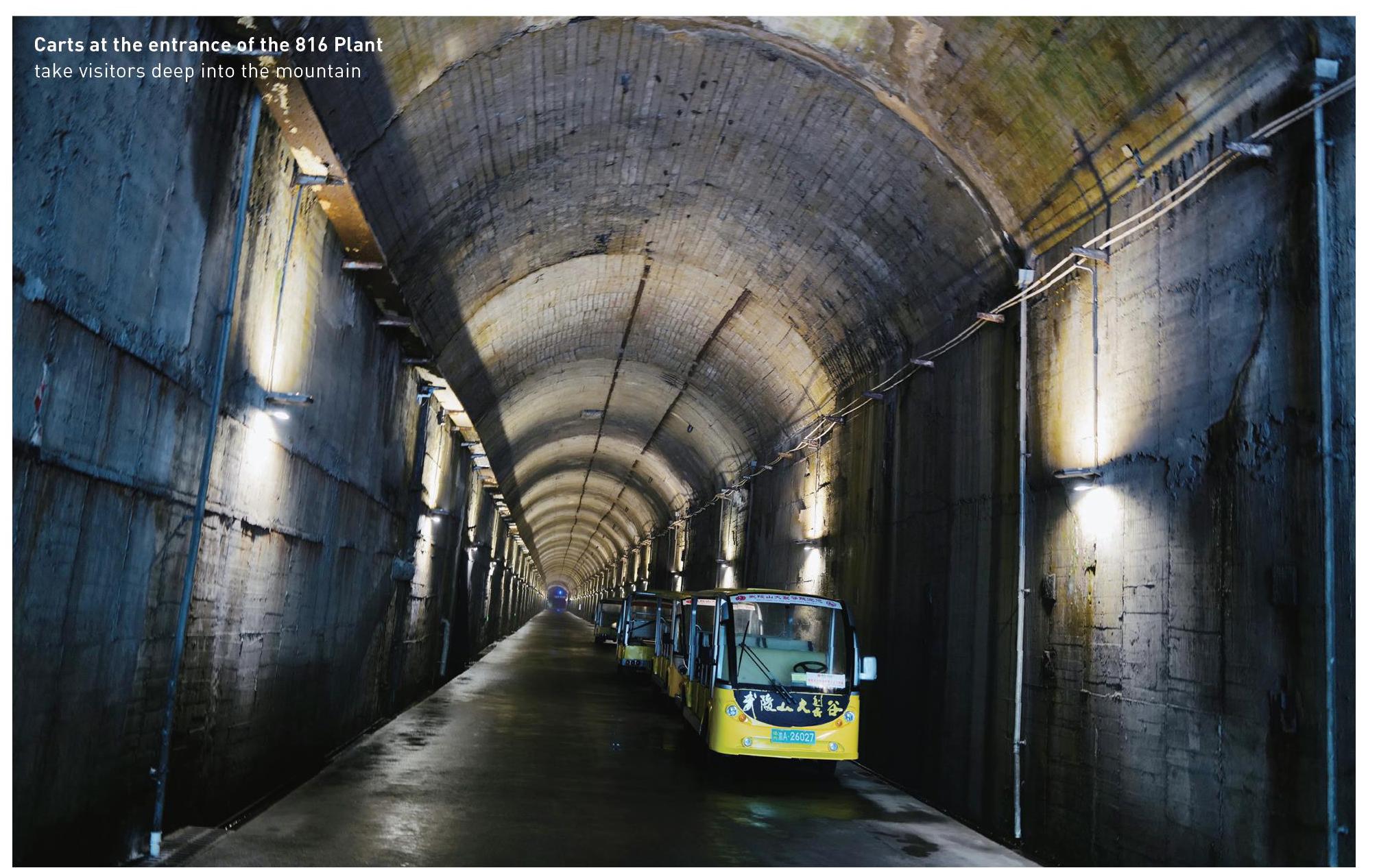
A chimney abruptly rising from the mountain is our first indication that weve nearly arrived. The entrance itself is a cave at the bottom of tree-carpeted mountains, with a red five-pointed star hanging on a green iron gate. Behind it, cool air whizzes out from an immense tunnel. Guides lead the tourists gathered at the gate into several vacant shuttle carts like schools of fish—the sound of the carts arrival had been drowned out by shutter sounds from mobile phones and cameras.
Riding into the tunnel, deep underground, tourists disembark at another gate. Their curious and fearful murmurs echo noisily in the hollow mountainside. “Hush! Please do not drown out the voices of history!” our tour guide, a young man wearing glasses, booms over a megaphone. His voice is filled with reverence. “You cant imagine how magical, mysterious, marvelous this construction is—this miracle symbolic of loyalty, faith, and sacrifice!”
Construction on the 816 Nuclear Military Plant Project started under the direction of Chairman Mao Zedong in 1966 and was terminated in 1984. This megaproject, conceived as a network of nuclear-weapon manufacturing tunnels, is still called the largest man-made tunnel structure in the world in online sources. It was the centerpiece of the “Third Front Movement,” a massive campaign to industrialize Chinas interior launched by Mao in 1964, motivated by national defense.
In the 1960s, China was facing mounting tensions internationally. The Sino-Soviet split took place at the start of the decade, and conflict between Vietnam and the US had escalated after the Gulf of Tonkin Incident in 1964. The decade also saw China and Vietnam clash in several armed skirmishes. The “Third Front” called for China to industrialize its predominantly agricultural interior provinces, as this was the hardest part of the country for a foreign power to invade.
At the time, China already had a nuclear reactor—the Soviet-designed 404 Project in the northwestern Gansu province. The 816 Project, conceived soon after the Sino-Soviet split, called for building a replica of the 404 Project to enhance Chinas national defense and prevent possible Soviet invasion or nuclear attack. It was Chinas first attempt to build a nuclear reactor that could produce weapons-grade plutonium without Soviet involvement.
The Wu River Valley was chosen out of 90 proposed sites. Its dense mountains provided concealment, and there were large quantities of water nearby to cool the nuclear reactions.
“Considering were in a nuclear plant, arent we running the risk of radiation exposure?” asks a worried tourist, interrupting our guides spiel.
“Patience, please! I havent finished yet!” answers the tour guide, sounding a little offended.
According to government figures, the 816 Project cost 740 million RMB to construct—which the government doled out freely, despite the ruinous economic impacts of the Cultural Revolution. To avoid any possibility of exposure and unexpected attacks, the reactor was built underground, which made an already challenging engineering process even more difficult and costly.
In 1982, construction on the 816 Project had slowed down, and it was called off by the Central Military Commission in 1984, when the plant was 85 percent complete, as China resumed diplomatic relations with most of the world. The plant was then partly converted into a chemical fertilizer factory under the Jianfeng Group. In 2002, the military declassified the nuclear plant, though some documents and equipment remain confidential even today.
“[The project] ended before it began. There were no nuclear tests here, so theres no radiation at all,” the tour guide finally puts the tourists fears to rest. “In the next two hours, all you will be shocked by is greatness.”
“Shocked” is putting it mildly: With an abrupt wail of sirens, the iron gate open slowly, accompanied by a harsh beeping sound. We are ushered into a cavernous hall that once held the plants power generators, as magnificent EDM music echoes through the space and LED lights alternately flash blue, red, and green. It is nothing like the staid educational facilities Id learned to expect from Communist history sites around the country—more like the worlds largest underground disco, held in bomb-proof surroundings within concrete walls.
“Wow! Feel like Im in a Resident Evilinstance dungeon!” A teenage tourist shouts feverishly, looking at an image displayed in the middle of the hall, of a mushroom cloud from Chinas first nuclear test at Lop Nur, Xinjiang, in 1964.
The whole tour takes two hours, consisting of one-third of a vast underground cavern. Other areas of the mountain are still highly restricted to tourists. The tour guide reminds us to follow closely on his heels, as it is easy to get lost in this maze.
Labyrinthine it certainly is. The entire nuclear complex has a total area of 100,000 square meters and a height of 79.6 meters, roughly equal to a 20-floor building. There are 20 kilometers of tunnels wide enough for cars to pass through, linking together 18 artificial caves over 13 different levels.
We walk deeper and deeper into the belly of the mountain, through a tubular tunnel rimmed with blue, red, and green lights. Next stop is the cavern of the reactor pan, where the radiation would have been highest had it ever been put to use. Today, an art installation of green plastic tubes sprouts up from this basin, representing the nuclear rods once housed here, bathing visitors in green lights as if exposing them to radiation.
Passing through into the next room, what was once a science lab displays neat rows of 1,034 brand-new looking equipment, arranged in a neat line like a uniformed army. “They represent the most advanced manufacture of the time…and cost 1,300 RMB each, when an ordinary Chinese familys monthly salary was only 80 RMB. Unfortunately, they were not put into use,” the guide explains, while some of the group cluck at the waste of money.
We follow the guide into a concrete chamber exhibiting the history of the nuclear complex, which displays black-and-white photos of soldiers hewing the mountainside with simple hammers and wrenches, and a group of smiling women gathered to move a giant boulder by hand.
It was 17 grueling years of construction, with more than 60,000 engineering soldiers of the Peoples Liberation Army participating, while the nations top scientists and engineers were sent in from all around the country.
With strict military discipline enforced, different departments didnt even know each others tasks. Letters to the complex carried no address, only the mail code “Chongqing 4513,” and when the soldiers and researchers wrote to their families, they were not allowed to give any clues as to their location, the nature of their work, and when they would be back. “They disappeared overnight—a living person vanished, one after another,” the tour guide intones, dramatically describing the soldiers comings and goings.
Rather than a human enemy, the soldiers “fought” against mountain rocks. In an interview with the state-run news site People.cn in 2019, Yang Wenli, a solider who participated in the construction, recalled the dangerous working conditions: “We felt like sandwiches; slices of meat placed between the rocks. The tunnels were narrow, with smoke and dust billowing out. We had no mechanized equipment, only with picks, shovels, explosives, pneumatic drills, and our bloody hands.”
Soldiers worked around the clock, urged on by slogans still visible on the concrete walls: “Fight the clock against imperialism, revisionism, and counterrevolutionaries!” Or, “Be resolute, fear no sacrifice, and surmount every difficulty to win victory!” Official figures show that around 76 soldiers, with an average age of 21, died during construction and were buried in a makeshift cemetery outside near the cave, but the tour guide emphasizes that the real fatalities be in the thousands.
Such tales of sacrifice move some of the tourists. “They reflect the greatness of the Chinese people!” exclaims one middle-aged man. But one young boy points out the construction ended up being a huge waste of money and lives. “What a ridiculous project, just like the Cultural Revolution!”
The elders dont take kindly to such remarks. “So na?ve! What if the Soviet Union had invaded our territory?” another older tourist retorts. “Without such a national defense base, you might never have seen the light of day, boy!”
There are deep, dark gaps in the cavern wall between the exhibition chambers, leading to off-limits areas guarded by exposed iron gates. At one point, I become so focused on taking photos that I dont realize the group has left me far behind.
Suddenly swallowed in darkness, I feel a strong sense of grief and loss for all those people who gave years of their lives to the 816 Project, which ultimately turned to nothing. It perfectly fit the popular slogan “Every generation has its own mission and burden.” The 816 Nuclear Base stands as a testament to what ordinary Chinese achieved through sheer fanatical will and persistence, and dazzling it up for tourists is perhaps better than letting the memories (and mistakes) of that era slip through the cracks of time.
As for me, terrified at the thought of poking around 816 alone, I quickly take my bearings and hurry after the group, surrounded by the energetic music and bright lights of what feels like the largest underground nightclub on Earth.
Carts at the entrance of the 816 Plant take visitors deep into the mountain
Chinas first atomic bomb is displayed in an exhibition hall with LED lighting
A tunnel in the mountainside is one of the few hints of the existence of the 816 Project
Gigantic mine tunnels with 200-foot ceilings are cut into the rock
Car tires from delivery trucks were abandoned inside the tunnels when the plant was decommissioned
Photographs by Zheng Yiwen