推挽型隔離DC-DC變換器軟開關(guān)條件分析
2021-12-22 06:37:20闞志忠馮建興孟憲慧王曉寰張純江
電工技術(shù)學(xué)報 2021年23期
關(guān)鍵詞:分析
闞志忠 馮建興 孟憲慧,2 王曉寰 張純江
推挽型隔離DC-DC變換器軟開關(guān)條件分析
闞志忠1馮建興1孟憲慧1,2王曉寰1張純江1
(1. 燕山大學(xué)電氣工程學(xué)院 秦皇島 066000 2. 唐山學(xué)院機(jī)電工程系 唐山 063000)
電流型隔離DC-DC變換器具有電流脈動小的優(yōu)點(diǎn),有利于延長儲能系統(tǒng)鋰電池的使用壽命;同時,減小開關(guān)損耗是提高功率變換效率的關(guān)鍵技術(shù)之一。因此該文討論利用電流型推挽隔離DC-DC變換器開關(guān)管的寄生電容進(jìn)行諧振,滿足開關(guān)管的軟開關(guān)條件。首先分析變換器的增益特性和工作模態(tài);其次基于變換器的等效電路模型,詳細(xì)分析推挽型隔離DC-DC變換器的軟開關(guān)瞬態(tài)過程,推導(dǎo)出變換器全部開關(guān)管軟開關(guān)條件的參量表達(dá)式;最后通過仿真和實(shí)驗(yàn)結(jié)果驗(yàn)證了軟開關(guān)條件的正確性。
DC-DC變換器 軟開關(guān) 推挽型 隔離
0 引言
由于具有較高的安全性、較好的保護(hù)性和較小的體積,隔離型DC-DC變換器在電動汽車、新能源發(fā)電等方面得到廣泛應(yīng)用[1-4],且智能電網(wǎng)和能源互聯(lián)網(wǎng)中電能路由器的研究給這類變換器提出了新要求[5-8]。本文研究適用于電能路由器儲能接口的推挽隔離型DC-DC變換器,用于鋰離子電池和電能路由器直流母線之間能量傳輸。作為儲能接口的DC-DC變換器需滿足如下要求:①能夠?qū)崿F(xiàn)功率雙向傳輸;②高效率;③寬電壓范圍;④電池側(cè)低電流紋波。為此,許多學(xué)者開展了大量研究工作。
高效率是儲能接口隔離型DC-DC變換器的重要指標(biāo),簡化變換器結(jié)構(gòu)、減小變換器的回流功率和實(shí)現(xiàn)軟開關(guān)為高效率變換器研究的三個典型方向。文獻(xiàn)[9-10]研究了一種隔離型雙半橋DC-DC變換器拓?fù)浼捌涔ぷ髟怼Ec全橋變換器相比,該變換器功率器件數(shù)量減少一半,且無需額外的開關(guān)器件和諧振元件,可實(shí)現(xiàn)軟開關(guān)條件下的雙向功率流動。文獻(xiàn)[11]討論了輸入電感、移相角與占空比對雙半橋DC-DC變換器軟開關(guān)條件的影響。文獻(xiàn)[12]分析了傳統(tǒng)的移相全橋DC-DC變換器的功率回流現(xiàn)象和回流功率對電流應(yīng)力的影響。文獻(xiàn)[13]分析了PWM+移相控制下雙半橋DC-DC變換器傳輸電感電流變化區(qū)間,通過占空比控制限制傳輸電感電流尖峰減小回流功率。文獻(xiàn)[14]在建立推挽型隔離DC-DC變換器的狀態(tài)平均模型的基礎(chǔ)上,采用PWM加移相方式達(dá)到降低傳輸電感電流、減小回流功率和提高傳輸效率的目的。文獻(xiàn)[15]重點(diǎn)討論利用開關(guān)管占空比、移相比和變換器增益之間的關(guān)系優(yōu)化變換器的軟開關(guān)區(qū)間。本文針對電流型輸入推挽隔離DC-DC雙向變換器實(shí)現(xiàn)全部軟開關(guān)問題,逐一分析開關(guān)管的軟開關(guān)瞬態(tài)工作過程;建立每一個軟開關(guān)瞬態(tài)過程的等效電路模型,詳細(xì)推導(dǎo)出與每個開關(guān)對應(yīng)的軟開關(guān)工作條件,同時分析傳輸電感和開關(guān)管輸出電容對軟開關(guān)的影響。
1 變換器的工作原理
1.1 拓?fù)浣Y(jié)構(gòu)及增益

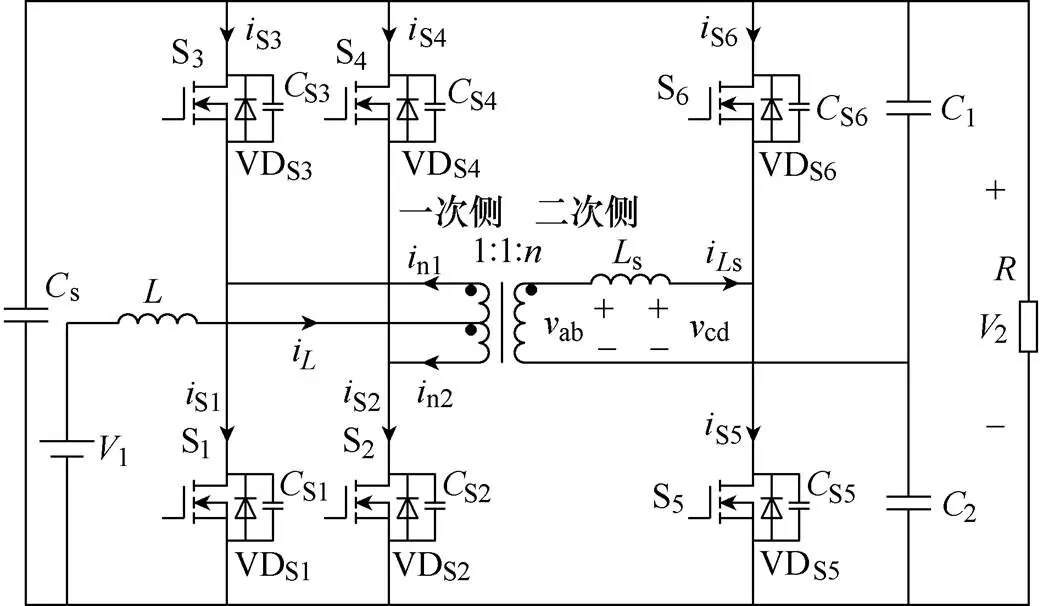
圖1 推挽型隔離DC-DC變換器


圖2 變換器的等效電路

圖3 一次和二次電壓波形
為保持在一個開關(guān)周期內(nèi)輸入升壓電感及變壓器的伏秒平衡,可得

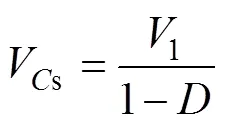
當(dāng)變換器穩(wěn)態(tài)運(yùn)行時,變壓器二次側(cè)傳輸電感s兩側(cè)電壓的幅值分別為

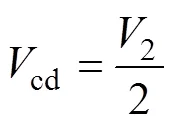

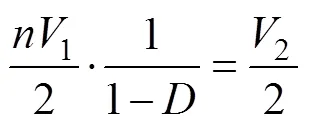
則輸入電壓1與輸出電壓2的電壓轉(zhuǎn)換比為
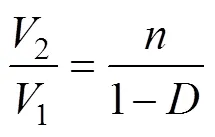

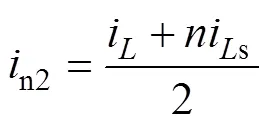
根據(jù)圖1中變壓器的一次電流KCL方程和變壓器磁動勢平衡關(guān)系可得
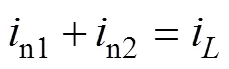

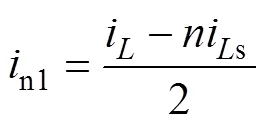
將式(7)~式(9)聯(lián)立,可以解出
1.2 工作模式分析
一個開關(guān)周期中推挽型隔離DC-DC變換器共有18個工作模態(tài),變換器一個開關(guān)周期內(nèi)的工作波形如圖4所示。


圖4 一個開關(guān)周期內(nèi)的波形


從3~6時間段為后半個開關(guān)周期,其工作模態(tài)與0~3時間段類似,在此不再進(jìn)行贅述。
2 軟開關(guān)過程分析
通過對第1節(jié)工作原理分析可發(fā)現(xiàn),推挽型隔離DC-DC變換器實(shí)現(xiàn)零電壓開通,在開關(guān)管開通、關(guān)斷過程中開關(guān)管的寄生電容與變壓器傳輸電感s進(jìn)行諧振,并在開關(guān)管開通前其兩端電壓下降到零,使反向并聯(lián)二極管導(dǎo)通。下面通過分析諧振過程推導(dǎo)出推挽型DC-DC變換器的軟開關(guān)條件。

在推挽型隔離DC-DC變換器中,橋臂S1和S2、橋臂S3和S4、橋臂S5和S6的工作方式完全對稱,不存在超前滯后現(xiàn)象。因此,只要實(shí)現(xiàn)了開關(guān)管S1、S3和S5的零電壓開通,即可實(shí)現(xiàn)所有開關(guān)管的零電壓開通。因此,將對開關(guān)管S1(模態(tài)18)、S3(模態(tài)15)、S5(模態(tài)4)進(jìn)行軟開關(guān)分析。

2.1 開關(guān)管S1軟開關(guān)分析
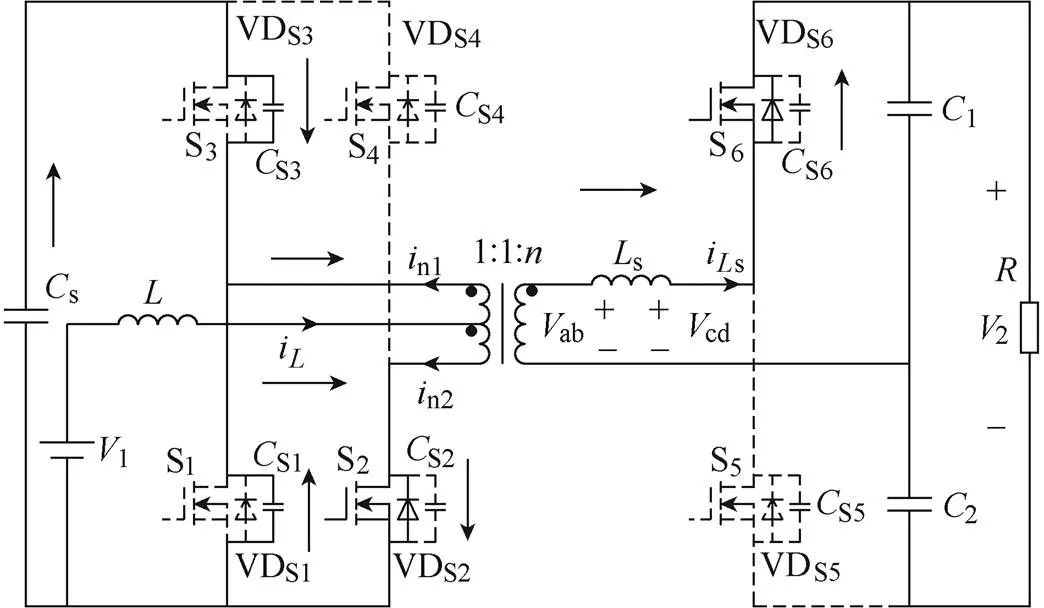
圖5 S1零電壓開通電路

圖6 S1零電壓開通等效電路
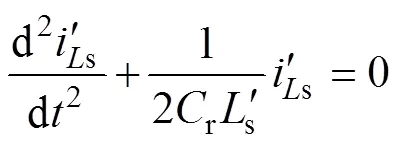
根據(jù)圖6等效電路可列方程式為

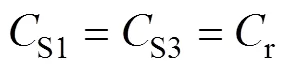
由于開關(guān)器件寄生參數(shù)的一致性,則假設(shè)
解式(12)可得

此時,0.5<<1,聯(lián)立式(13)、式(14)可解得
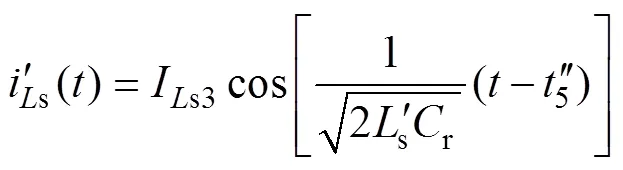





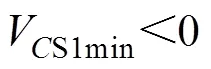
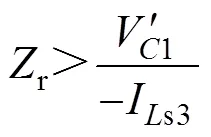
同時式(20)還可寫成
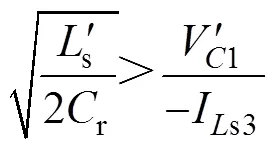
由此可看出,當(dāng)傳輸電感固定不變時,在一定范圍內(nèi)寄生電容r越小,S1越容易實(shí)現(xiàn)軟開關(guān)。
2.2 開關(guān)管S3軟開關(guān)分析
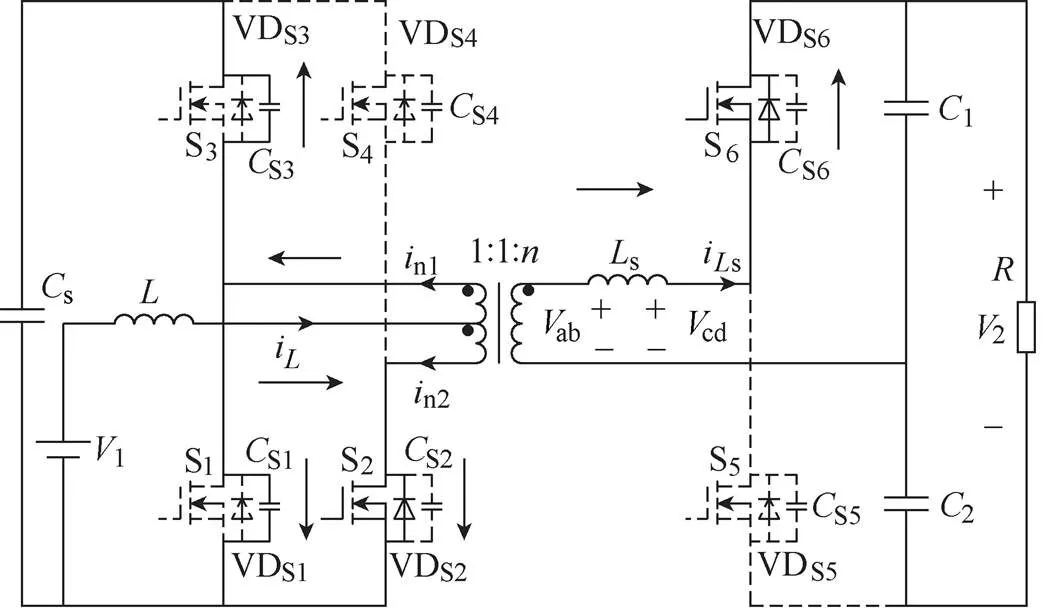
圖7 S3零電壓開通電路
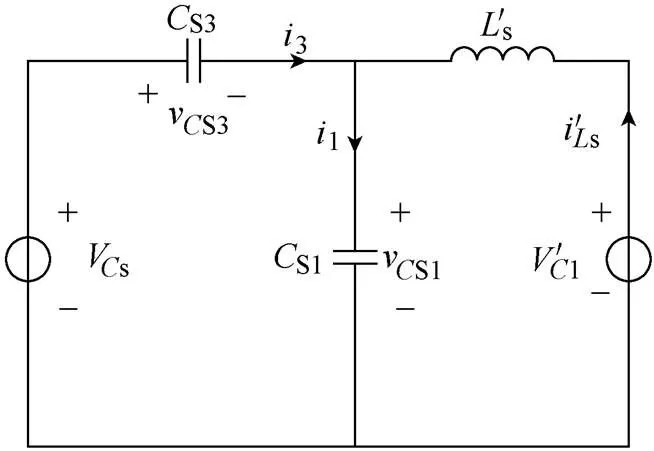
圖8 S3零電壓開通等效電路
根據(jù)等效電路可列方程式為
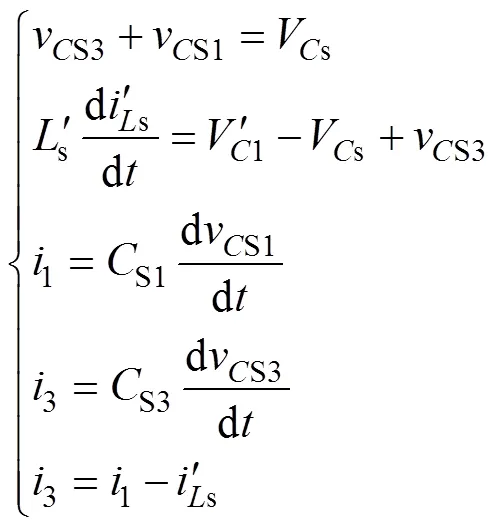
由于開關(guān)器件寄生參數(shù)一致性,則假設(shè)

則可解出


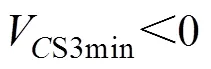
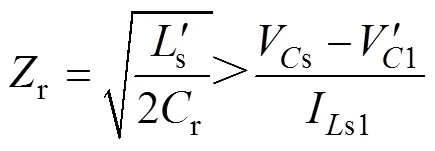
由式(26)可得,當(dāng)傳輸電感固定時,在一定范圍內(nèi)寄生電容值r越小,S3越容易實(shí)現(xiàn)軟開關(guān)。
2.3 開關(guān)管S5軟開關(guān)分析

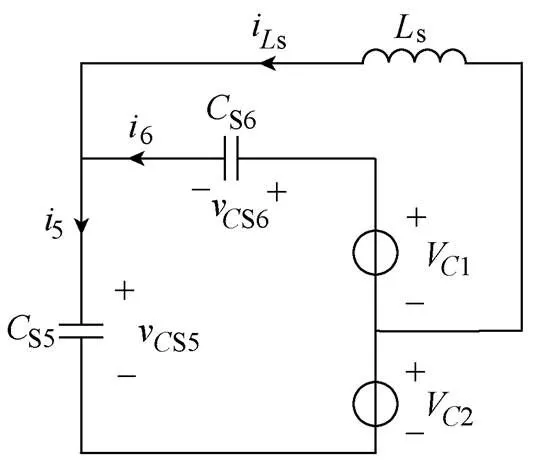
圖10 S5零電壓開通等效電路

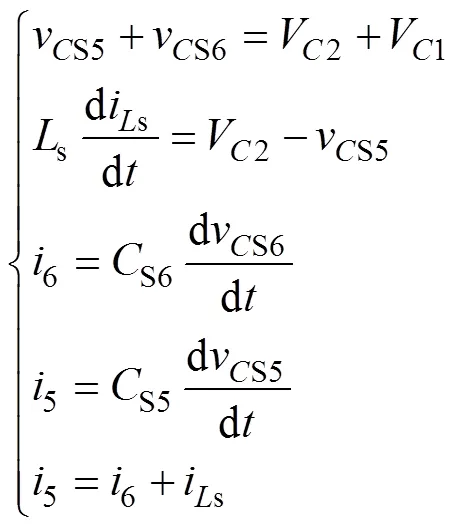
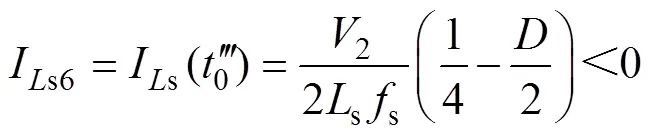
則可解出電容S5兩端電壓為

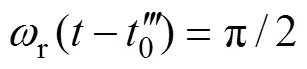

由式(31)可以看出,當(dāng)傳輸電感固定時,在一定范圍內(nèi)寄生電容r越小,S5越容易實(shí)現(xiàn)軟開關(guān)。
3 仿真與實(shí)驗(yàn)結(jié)果分析
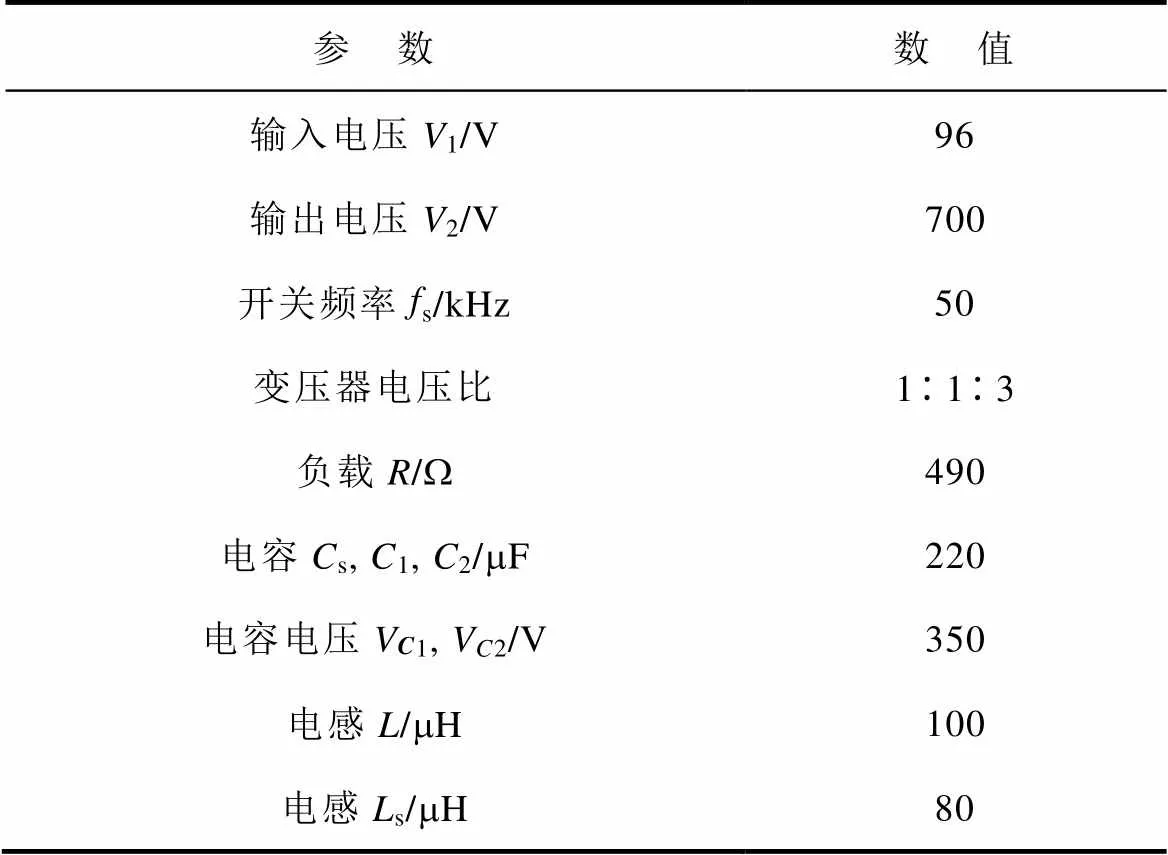
為驗(yàn)證理論分析的正確性,采用Matlab仿真軟件建立仿真模型進(jìn)行驗(yàn)證,變換器主電路的仿真與實(shí)驗(yàn)參數(shù)見表1。
3.1 仿真分析
3.1.1 全周期軟開關(guān)仿真分析

表1 主電路參數(shù)
Tab.1 main circuit parameters
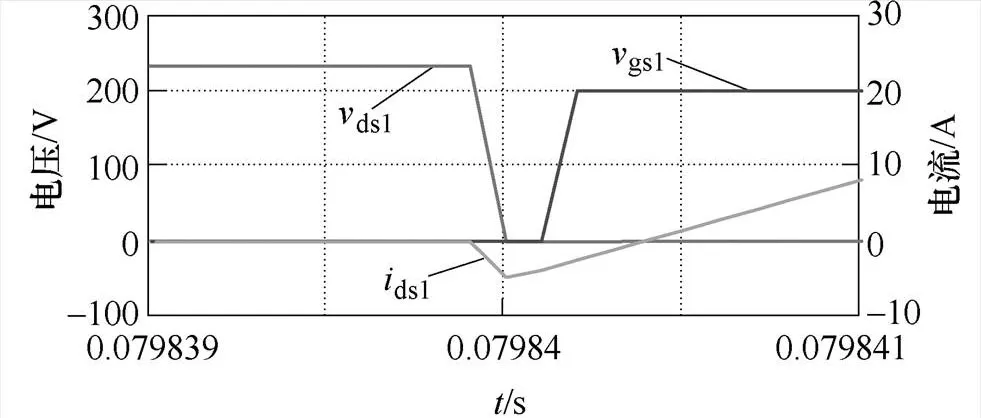
圖11 S1的開通過程仿真波形


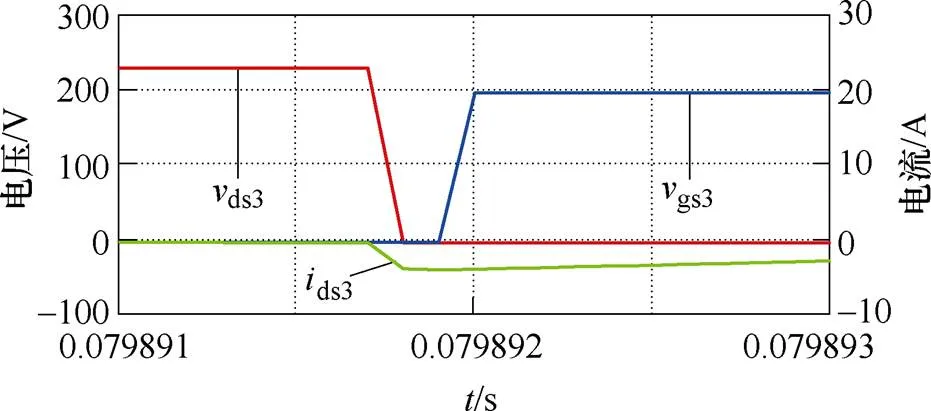
圖12 S3開通的仿真波形

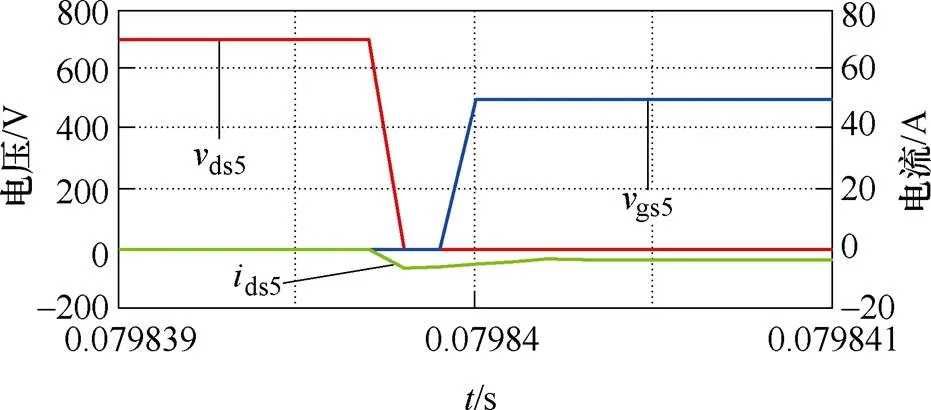
圖13 S5的開通過程仿真波形
根據(jù)開關(guān)管S5軟開關(guān)過程原理,代入相應(yīng)數(shù)值后可得:Is6=-7A,s=80mH,V2=350V。根據(jù)式(31)可得,r<16nF。開關(guān)管S5的寄生電容為130pF,該參數(shù)符合軟開關(guān)寄生電容的數(shù)值范圍,滿足開關(guān)管S5軟開關(guān)條件。
3.1.2 寄生電容對軟開關(guān)的影響
在驗(yàn)證變換器所有開關(guān)管零電壓開通的基礎(chǔ)上,S2的寄生電容增加0.1mF,進(jìn)一步驗(yàn)證軟開關(guān)條件,圖14為增加了0.1mF寄生電容開通過程仿真波形。
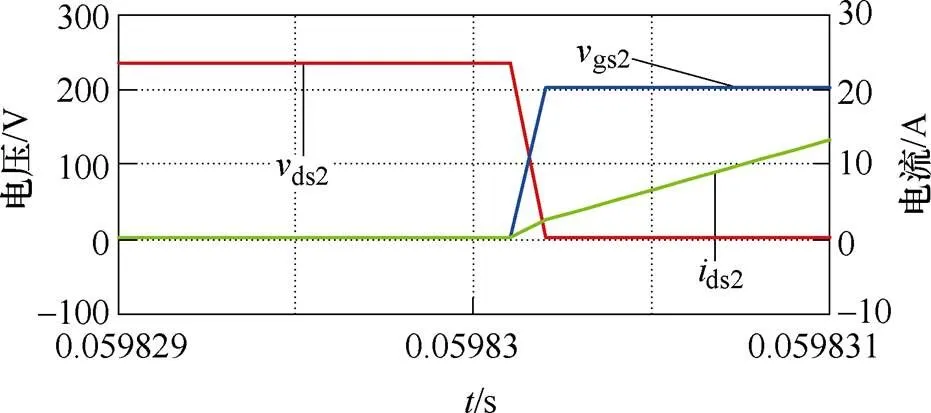
圖14 增加了0.1mF寄生電容開通過程仿真波形

由3.1.1節(jié)可知,開關(guān)管寄生電容范圍r<8.166nF,開關(guān)管兩端寄生電容要在此范圍內(nèi),否則推挽型隔離DC-DC變換器將不能滿足零電壓開通條件。
3.2 實(shí)驗(yàn)分析

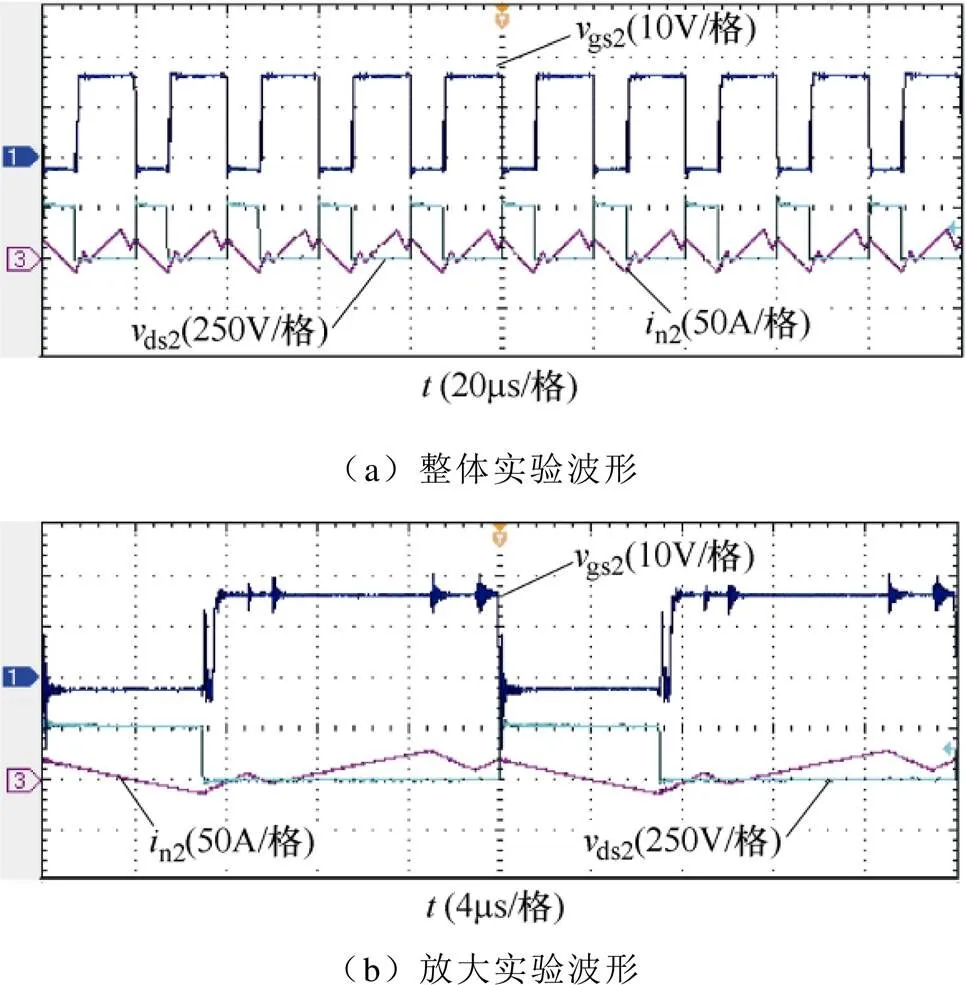
圖15 S2的軟開關(guān)實(shí)驗(yàn)波形

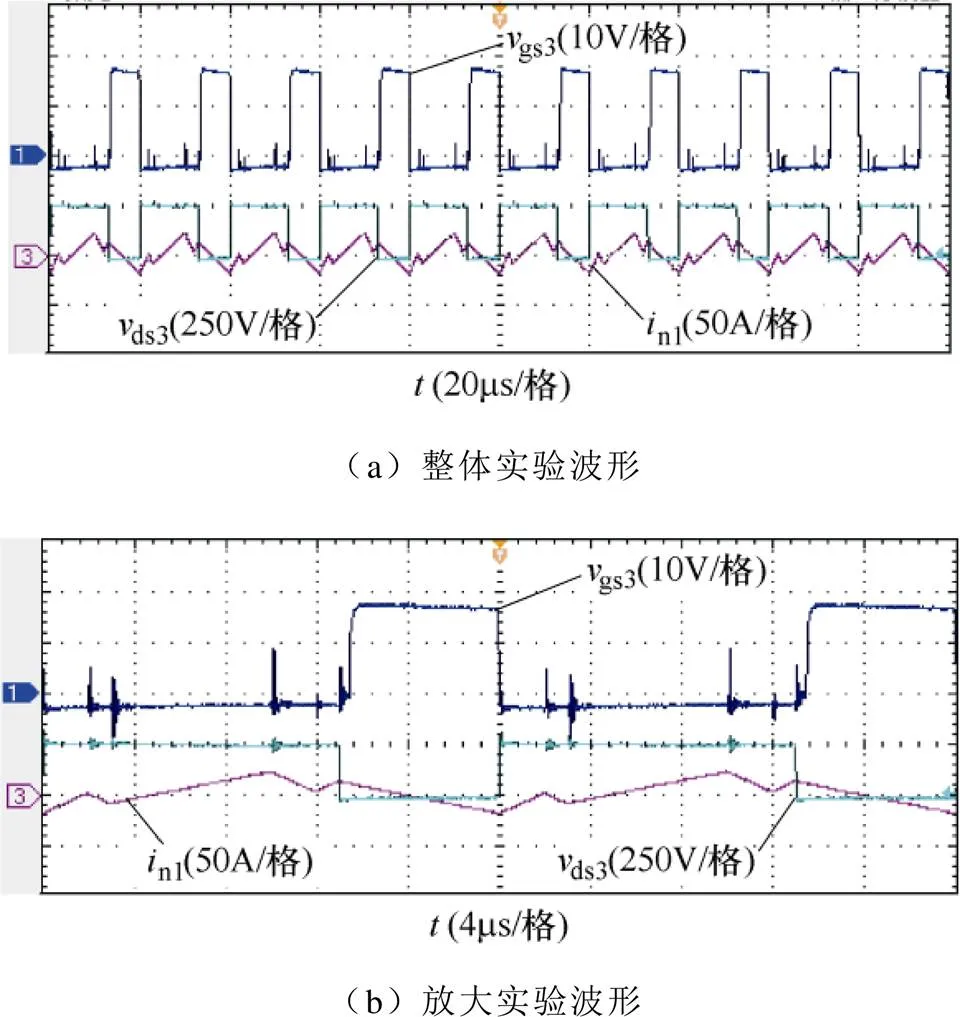
圖16 S3的軟開關(guān)實(shí)驗(yàn)波形


圖17 S5的軟開關(guān)實(shí)驗(yàn)波形
4 結(jié)論
電流型推挽隔離DC-DC變換器具有適合寬電壓范圍、電池側(cè)低電流紋波的特點(diǎn)。本文首先分析了其工作原理,重點(diǎn)分析了變換器軟開關(guān)過程,尤其是分析了寄生參數(shù)對軟開關(guān)的影響,推導(dǎo)了推挽隔離DC-DC變換器中各個開關(guān)管達(dá)到軟開關(guān)條件的參數(shù)表達(dá)式。在仿真和實(shí)驗(yàn)中通過設(shè)置不同的諧振電容值,進(jìn)一步驗(yàn)證了軟開關(guān)條件理論分析的正確性與有效性。
[1] 李廣地, 阮杰, 王昆, 等. 一種混合調(diào)制型三路輸出DC-DC變換器[J]. 電工技術(shù)學(xué)報, 2019, 34(22): 4719-4727.
Li Guangdi, Ruan Jie, Wang Kun, et al. A hybrid modulated triple-output DC-DC converter[J]. Transa- ctions of China Electrotechnical Society, 2019, 34(22): 4719-4727.
[2] 余雪萍, 涂春鳴, 肖凡, 等. 三端口隔離DC-DC變換器的暫態(tài)直流偏置機(jī)理及抑制策略[J]. 電工技術(shù)學(xué)報, 2020, 35(9): 1962-1972.
Yu Xueping, Xu Chunming, Xiao Fan, et al. Transient DC bias mechanism and suppression strategy of the three-port isolated DC-DC converter[J]. Transactions of China Electrotechnical Society, 2020, 35(9): 1962- 1972.
[3] 楊超, 許海平, 袁志寶, 等. 雙PWM控制下三電平半橋隔離型雙向DC-DC變換器的全局最小峰值電流研究[J]. 電工技術(shù)學(xué)報, 2020, 35(8): 1679-1689.
Yang Chao, Xu Haiping, Yuan Zhibao, et al. Global minimum peak current control of the three level isolated half-bridge bi-directional DC-DC converters with PWM-phase-shifting control[J]. Transactions of China Electrotechnical Society, 2020, 35(8): 1679- 1689.
[4] 殷曉東, 羅登, 李祖勇, 等. 一種雙向隔離DC-DC變換器二次紋波電壓抑制方法[J]. 電工技術(shù)學(xué)報, 2018, 33(6): 1356-1363.
Yin Xiaodong, Luo Deng, Li Zuyong, et al. A second-order ripple voltage suppression algorithm of bidirectional isolation DC-DC converter[J]. Transa- ctions of China Electrotechnical Society, 2018, 33(6): 1356-1363.
[5] Wu Runze, Wang Bixiao, Zou Yingjie, et al. Energy router interface model based on bidirectional flow control for intelligent park[C]//43rdAnnual Con- ference of the IEEE Industrial Electronics Society, Beijing, 2017: 7771-7776.
[6] Li Zhen, Li Penghua, Sheng Wanxing, et al. Research on a household energy router for energy internet[C]// Conference on Industrial Electronics and Applications, Wuhan, 2018: 952-957.
[7] Wang Kaixuan, Liu Xiaosheng, Zhao Liang, et al. Research on structure and energy management strategy of household energy router based on hybrid energy storage[C]//2019 IEEE Power & Energy Society Innovative Smart Grid Technologies Con- ference (ISGT), Washington, DC, 2019: 1-5.
[8] Qin Yuchao, Hua Haochen, Cao Junwei. Short-term energy cache regulation for energy router: a robust h-infinity approach[C]//2019 IEEE International Con- ference on Energy Internet (ICEI), Nanjing, 2019: 161-166.
[9] Li Hui, Peng Fangzheng, Lawler J S. A natural ZVS medium-power bidirectional DC-DC converter with minimum number of devices[J]. IEEE Transactions on Industry Applications, 2003, 39(2): 525-535.
[10] Peng Fangzheng, Li Hui, Su Guijia, et al. A new ZVS bidirectional DC-DC converter for fuel cell and battery application[J]. IEEE Transactions on Power Electronics, 2004, 19(1): 54-65.
[11] Hamid Daneshpajooh, Alireza Bakhshai, Praveen Jain. Design of DC-DC converter with phase shift and duty cycle control for full range soft switching[C]//2011 IEEE 33rd International Telecommunications Energy Conference (INTELEC), Amsterdam, 2011: 1-6.
[12] Zhao Biao, Yu Qingguang, Sun Weixin. Extended- phase-shift control of isolated bidirectional DC-DC converter for power distribution in microgrid[J]. IEEE Transactions on Power Electronics, 2012, 27(11): 4667-4680.
[13] Kang Xiangli, Li Shouxiang, Keyue Ma Smedley. Decoupled PWM plus phase-shift control for a dual-half-bridge bidirectional DC-DC converter[J]. IEEE Transactions on Power Electronics, 2018, 33(8): 7203-7213.
[14] Kang Xiangli, Li Shouxiang, Keyue Ma Smedley. Analysis and modelling of a bidirectional push-pull converter with PWM plus phase-shift control[C]// 42nd Annual Conference of the IEEE Industrial Electronics, Florence, 2016: 1268-1273.
[15] Li Shouxiang, Kang Xiangli, Keyue Ma Smedley. A control map for a bidirectional PWM plus phase- shift-modulated push-pull DC-DC converter[J]. IEEE Transactions on Industrial Electronics, 2017, 64(11): 8514-8524.
Analysis of Soft Switching Conditions of Push-Pull Isolated DC-DC Converter
111,211
(1. School of Electrical Engineering Yanshan University Qinhuangdao 066000 China 2. Department of Mechanical And Electrical Engineering Tangshan University Tangshan 063000 China)
The current source isolated (CSI) DC-DC converter has the advantage of low current ripple, and it is beneficial to the service life of the lithium battery of the energy storage system. At the same time, reducing the switching loss is one of the key technologies to improve the power conversion efficiency. Therefore, this paper discusses the method of using the parasitic capacitance of the push-pull CSI DC-DC converter switch tube to perform resonance to meet the soft-switching conditions of the switch tube. Firstly, the gain characteristics and operating mode of the converter are analyzed. Secondly, based on the converter’s equivalent circuit model, the soft-switching transient process of the push-pull CSI DC-DC converter is analyzed in detail, and the parametric expressions of the soft-switching conditions of all switches of the converter are derived. Finally, the simulation and experimental results verify the correctness of the soft-switching conditions.
DC-DC converter, soft-switching, push-pull, isolation
10.19595/j.cnki.1000-6753.tces.L90349
TM46
國家自然科學(xué)基金資助項目(51877187)。
2020-07-09
2020-12-09
闞志忠 男,1970年生,博士,副教授,研究方向?yàn)樾履茉醋儞Q技術(shù)。E-mail: kanzhizhong@126.com
張純江 男,1961年生,教授,博士生導(dǎo)師,研究方向?yàn)榭稍偕茉捶植际桨l(fā)電及控制、逆變電源及并聯(lián)并網(wǎng)技術(shù)、儲能系統(tǒng)功率流控制。E-mail: zhangcj@ysu.edu.cn(通信作者)
(編輯 陳 誠)
猜你喜歡
現(xiàn)代畜牧科技(2021年9期)2021-10-13 06:39:14
民用飛機(jī)設(shè)計與研究(2020年4期)2021-01-21 09:15:02
電子制作(2018年18期)2018-11-14 01:48:24
山東工業(yè)技術(shù)(2016年15期)2016-12-01 05:31:22
當(dāng)代經(jīng)濟(jì)研究(2016年5期)2016-12-01 03:12:05
現(xiàn)代農(nóng)業(yè)(2016年5期)2016-02-28 18:42:46
出版與印刷(2016年3期)2016-02-02 01:20:11
中國中醫(yī)藥現(xiàn)代遠(yuǎn)程教育(2014年11期)2014-08-08 13:23:44
華北水利水電大學(xué)學(xué)報(社會科學(xué)版)(2014年3期)2014-04-16 04:38:31
終身教育研究(2014年5期)2014-02-28 01:23:06