
The Sky’s the Limit
2022-02-25 13:34:16SamDavies
漢語世界(The World of Chinese) 2022年1期

Plagued by over-construction, safety issues, and environmental concerns, China’s skyscraper boom may be finally coming to an end
摩天大樓比高熱消退之后
Text by Sam Davies
Photographs from VCGandShetuwang
As office workers and shoppers milled around inside Shenzhen’s 356-meter-tall SEG Plaza in May of last year, they suddenly began to feel the floor swaying beneath their feet. “Everyone was scared, they were running around as if in a disaster movie,” a shaken worker from the 55th floor told Jimu News the day of the incident.
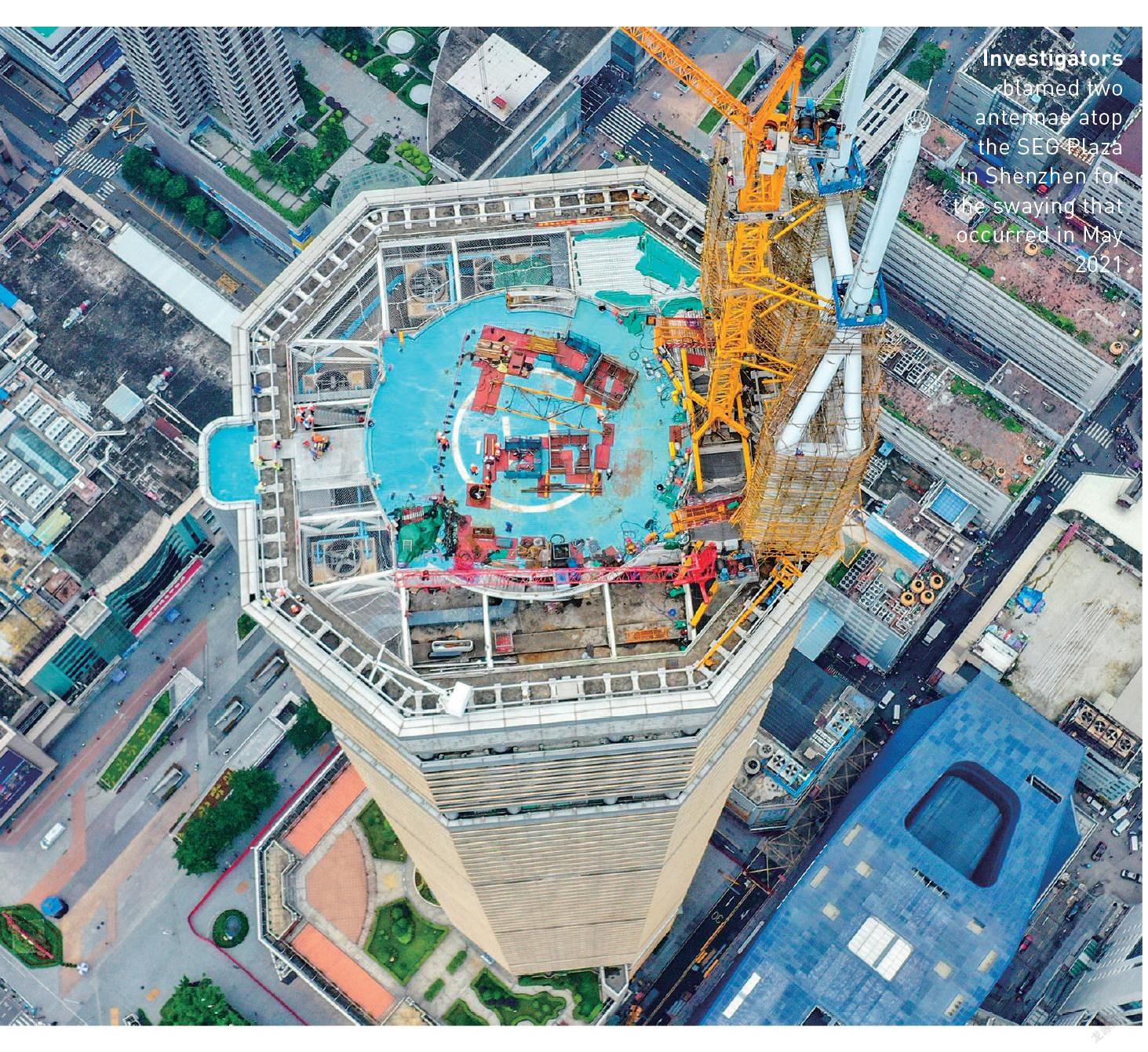
But it wasn’t an earthquake that made the world’s 222nd tallest building tremble, and water slosh around in glasses as the tower moved like a cruise liner on rolling waves. Instead, wind captured by two 50-meter antennae atop the skyscraper had led to “vortex-induced resonance,” authorities announced in July, after the building had been closed for weeks of investigation.
Though no one was harmed by the swaying, and the building formally re-opened to businesses and the public on September 8, the incident marked a symbolic end to Chinese cities’ skyward building spree that saw the country go from completing the Guangzhou Baiyun Hotel, the Chinese mainland’s first inhabitable building over 100 meters tall, in 1978, to having the most skyscrapers in the world by 2007.
“The SEG Plaza shaking incident made people reflect on some of the negative content behind high-rise buildings,” says Yan Yuejin, research director of E-house China Research and Development Institute, a real estate think tank, citing vacant office space in high-rises, unfinished projects, fire safety concerns, and environmental issues.
On July 7, less than two months after the SEG Plaza incident, new regulations released by the National Development and Reform Commission placed a nationwide ban on the construction of new towers over 500 meters tall, while “strictly restricting” the construction of buildings over 250 meters high. The Ministry of Housing and Urban-Rural Development (MOHURD) also stated that cities with a population under 3 million people were forbidden from building towers over 150 meters tall, and mandated that local governments conduct safety inspections of their existing tall buildings.
These restrictions on height will help end the “blind pursuit of high-rises that ignores the practicality of buildings” according to Yan, who argues some towers have been built as symbols of political achievement, rather than for sound economic reasons.
China now leads the world in most skyscraper rankings according to the Council for Tall Buildings and Urban Habitat (CTBUH), a non-profit industry body based in the US, with 2,680 buildings over 150 meters tall, 912 over 200 meters, and 101 over 300 meters. Since the Baiyun Hotel in 1978, nine buildings have been named the tallest on the Chinese mainland. Nine cities in China had skyscrapers over 200 meters tall by 1998, and annual completion numbers exceeded 10 for the first time in 2006, before an explosion of construction in the 2010s.
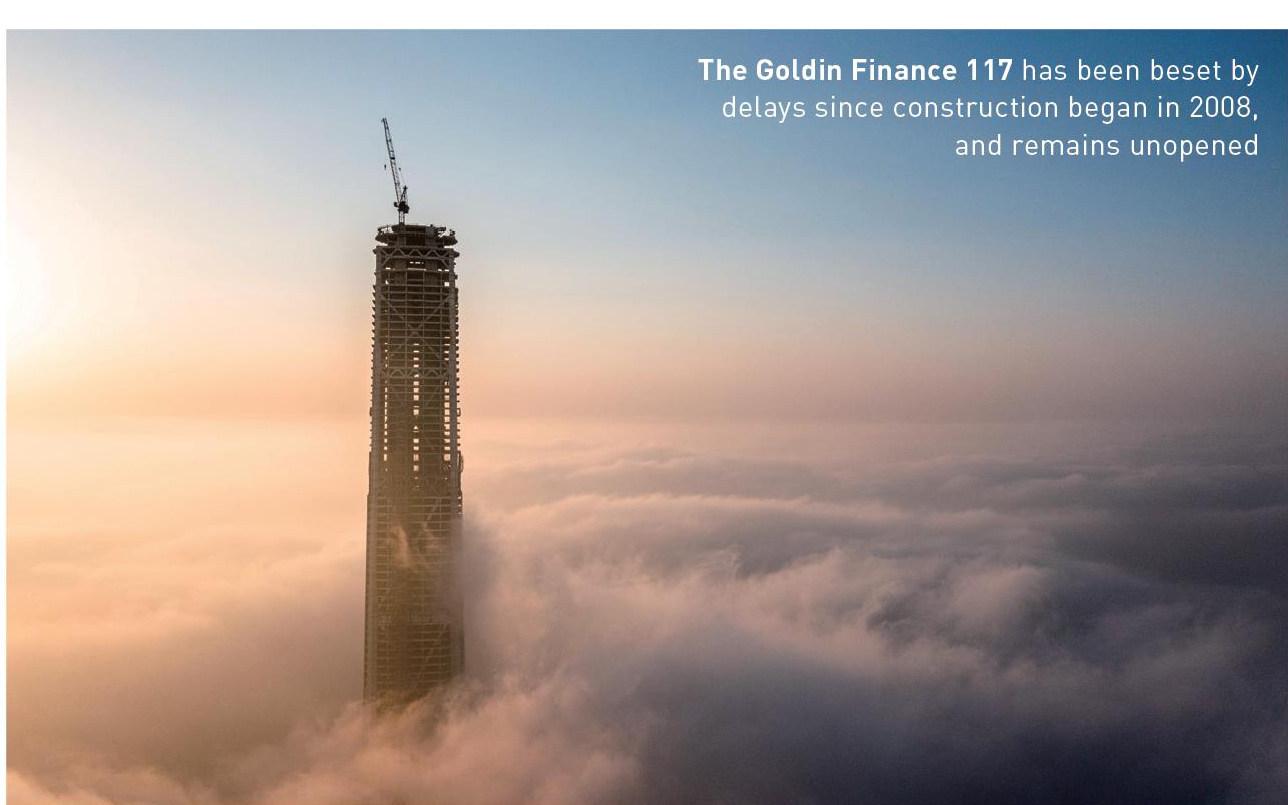
However, many tall buildings in China, particularly in smaller cities, remain untenanted or unfinished. Yan points to the Goldin Finance 117 tower in Tianjin, which began construction in 2008 and stands at 596 meters, but remains unoccupied, as an example of poorly executed skyscraper plans. The project, originally scheduled for completion in 2014, has seen construction halted twice due to lack of funding from its parent company, Goldin Properties.
Tianjin, a city which endured an economic slump in the 2010s, has up to 12 buildings scheduled to be over 200 meters high that are “on hold.” China’s northeast, where the economy has also struggled in recent years, accounts for nearly a third of all “on hold” or uncompleted high-rises in the country.
These unfinished towers often remain standing as hollow shells for years, with demolition complex and expensive. Most saw developers run out of cash midway through construction, and are marooned until their fortunes improve or another firm steps in to bridge the funding gap. Some, like the Ping An Finance Center in Shenzhen, had to make do with reduced heights, while others, like Changsha’s 838-meter Sky City building, never got off the ground—the building site has now been repurposed as a fish farm, with a stone tablet marking the day that construction on the tower broke ground 10 years ago.
Even when completed, filling skyscrapers with tenants can be a struggle. In Shanghai, one of the country’s most developed and attractive cities for business, the Shanghai Tower, China’s tallest building at 632 meters tall (completed in 2015), struggled to fill its office space for years. The problem is more common in smaller cities, and has only intensified since the Covid-19 pandemic, according to Yan.
With no tenants, developers aren’t able to cover the (often borrowed) money used in construction. “For real estate companies, if there are too many vacancies, a vicious circle will emerge as rents continue to decline and quality companies become more reluctant to come [to that city],” Yan tells TWOC.
Local city governments often sign off on skyscrapers in the hope they will attract businesses, bring real estate development, and provide an iconic skyline to attract investors and visitors. A 2010 contract between the Wuhu city government in Anhui province and a property firm to develop a plot of land shows the city required the building to be over 200 meters tall. The Goldin Finance 117 tower was meant to be at the center of a new business district in Tianjin which featured multiple residential and commercial towers, a wine museum, and gardens.
Smaller cities are more at risk of this phenomenon. A 2020 study by researchers from Deakin University and real estate company China Jinmao Holdings Group Limited found skyscraper buildings in nearly half of “tier two” cities “cannot be justified by economic fundamentals.” They also noted that officials in smaller cities sometimes built skyscrapers to increase their chances of promotion, or simply satisfy their egos.
Prior to the economic reforms of the 1980s and 90s, the tallest buildings in China were in the concessions occupied by foreign powers on the Chinese mainland, or in British-controlled Hong Kong. The 77-meter Sassoon House (now the Fairmont Peace Hotel) located on the Bund in Shanghai, was the tallest building in China on its completion in 1929.
In the 1990s, China’s fiscal reforms put greater responsibility on localities to make their own revenue. Local government achieved this in large part by sales of government-owned land to developers, and this combined with massive migration to cities to make high-rise construction attractive to governments and developers. Similarly, the emergence of a market economy put cities in direct competition with each other for commerce and talent, and gleaming new towers were planned in the hope of attracting businesses and workers to cities.
While successful high-rise office buildings have provided the space for new commercial activity in China’s cities, the move toward tall tower blocks also altered street-level interactions and social life in the urban space. In a study of residents in Jinan who had their low-rise homes demolished by the government and subsequently moved to high-rise buildings, researchers at the University of Cambridge found that the densely packed towers increased privacy and led to less interaction between neighbors, as well as less commercial activity on the sidewalks.
For wildlife, particularly birds, skyscrapers can pose significant dangers. A study by researchers at the Smithsonian Conservation Biology Institute in Washington DC, published in 2014, estimated that as many as one billion birds die each year in the US after colliding with buildings. Birds struggle to discern glass, often mistaking reflections for trees or open air, while they are also attracted to the bright lights of cities and high-rises.
Data on the problem in China remains sparse, but scholars estimate bird deaths could be on a similar scale to the US given that China’s east coast is on a major migratory route, and features many of China’s largest cities and tallest buildings. In September 2021, Duke Kunshan University in Suzhou released a study of bird-window collisions in China, with 39 recorded over 77 days, and found that buildings with more glass coverage saw more collisions.
Building up also incurs significant economic costs. The Shanghai Tower, for example, cost 2.4 billion US dollars to construct, while China Zun, the tallest building in Beijing at 528 meters, completed in 2018, cost an estimated 3 billion US dollars. Above a certain height, the costs per meter of construction balloon, as taller buildings require stronger materials, more elevators, and more sophisticated methods to build wind-resistance.
Once finished, skyscrapers continue to cost more than low-rise buildings to operate. “Super-tall buildings [defined as over 300 meters by the CTBUH] tend to use glass, because a glass fa?ade is easy to build and it’s light” compared to concrete, says Wei Feng, a research scientist in the US who focuses on building energy efficiency. “But it’s difficult to insulate glass…And it receives more solar radiation in the summer which means you have to spend more on air conditioning.” Costs also rise because of the equipment and energy needed to, for example, pump water to bathrooms on higher floors and provide heating, Feng says.
This adds to the significant environmental cost of skyscrapers, which some studies suggest are less energy-efficient both to construct and to operate than low-rise buildings. In China, most tall buildings are constructed using reinforced concrete and steel frames, which produce significant emissions to make—a fifth of China’s carbon emissions come from the construction industry.
Other countries have used less polluting wood-frame structures in construction but “China doesn’t have large wood resources…so would have to import it from Canada or Scandinavia,” says Feng. “China wants to build 2 billion square meters of new construction per year—so would it be feasible for China to use wood structures? Would it deforest the entire planet if it did that? These are important challenges.”
Greener construction could make skyscrapers in China more environmentally friendly, and in 2016 MOHURD set a target of having 10 million square meters of “ultra-low emissions” buildings by 2020. The country now has a three-star grading system for rating the environmental impact of buildings which is “very similar with the US and UK standards,” according to Feng, and mandates that “government invested properties build to a certain star level.”
Designers are attempting to create greener skyscrapers by improving insulation or incorporating vegetation. The Nanjing Vertical Forest project unveiled in 2016 envisions “two green towers” covered in 800 trees and over 2,500 other plants that will produce up to 16.5 tons of oxygen a year, according to Stefano Boeri Architetti, the architecture firm involved.
But this is a drop in the ocean compared with the carbon emissions generated by China’s building sector, which released 1,599 megatons of carbon dioxide in 2015, according to research by Feng and colleagues at Tsinghua University in Beijing. Besides, the vertical forest project has also been the victim of delays—completion was originally planned for 2019, but it remains unfinished.
“The traditional structural engineering style won’t change that much [in the future],” Feng predicts. “But I think there are some opportunities…to optimize the design, to reduce the amount of cement we use, and to avoid over design of buildings.” Construction companies could “try to avoid using fossil fuels like coal and natural gas to produce the materials and try to use renewable energies instead.”
Today, China’s residential and commercial floor space-per-capita remain below the level of developed countries. The ratio is less than half of that of the US, meaning Chinese on average have less living and office space. Demand for space is likely to grow, tempting companies and governments to build tall towers to fit in more people and businesses.
So while new height restrictions may mean the Shanghai Tower will remain China’s tallest building for the foreseeable future, and future high-rises may be forced to become more pragmatic and greener, there will still be companies and cities keen to build iconic tall buildings, says Yan: “There is a need, after all, to create landmarks.”
The Goldin Finance 117 has been beset by delays since construction began in 2008, and remains unopened
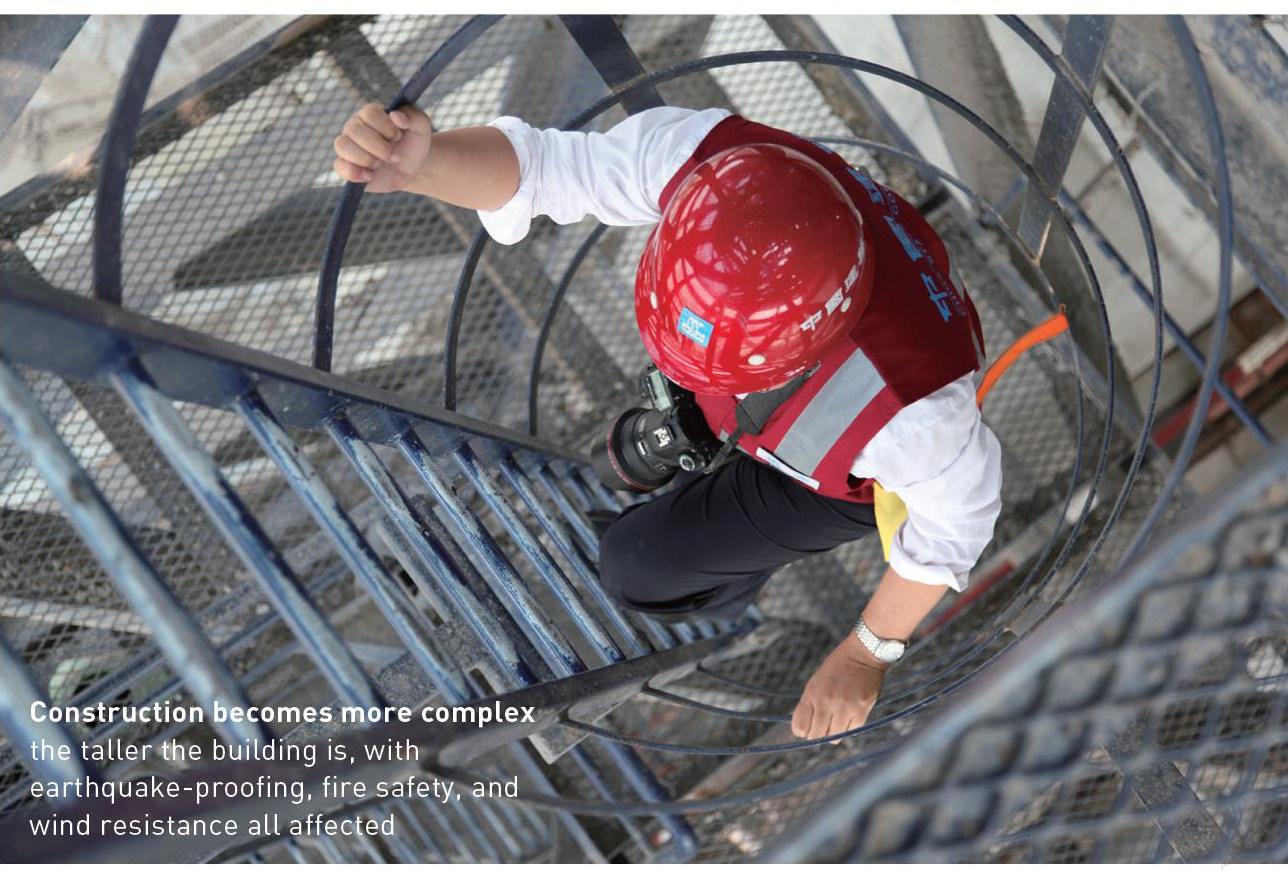
Construction becomes more complex the taller the building is, with earthquake-proofing, fire safety, and wind resistance all affected
Investigators blamed two antennae atop the SEG Plaza in Shenzhen for the swaying that occurred in May 2021
“Vertical forests,” energy efficient towers incorporating large amounts of vegetation, may be acarbon-friendly solution to tall buildings
 漢語世界(The World of Chinese)2022年1期
- 漢語世界(The World of Chinese)的其它文章
- On the Character: 動
- No Excuses
- Rough Cut
- When China Goes on the Road
- A New Way of Seeing
- 學中文