
Multicentric recurrence of intraductal papillary neoplasm of bile duct after spontaneous detachment of primary tumor: A case report
2022-03-07 13:06:38FukuyaKuwanoNagasawaMoritaTanakaYadaMasumotoMotomura
World Journal of Clinical Cases 2022年3期
INTRODUCTION
Multiple endocrine neoplasia type 1 (MEN1) is a rare hereditary tumor syndrome inherited in an autosomal dominant manner and characterized by a predisposition to a multitude of endocrine neoplasms, mostly of the parathyroid, endocrine pancreas and anterior pituitary tumors. Other endocrine tumors in MEN1 include gastroenteropancreatic neuroendocrine tumors, adrenocortical tumors, and rarely pheochromocytoma[1-3]. MEN1 is caused by inactivating mutations ofgene. The incidence is 1/10000–1/100000.is a tumor suppressor gene and is located on human chromosome 11q13.gene is 9 kb and contains 10 exons. Exons 2–10 are coding regions.gene encodes the protein menin, which contains 610 amino acids[4,5].Menin plays an important role in cell division and proliferation, cell cycle regulation and genomic stability. Mutations ofgene can lead to functional loss of menin,and occurrence of multiple tumors[6-11]. Gene mutation analysis is an important diagnostic method for MEN1[1].
It has been reported that expression of menin is preserved in human normal thyroid tissue and thyroid tumors, but it can be decreased or absent in certain types of thyroid tumors[11-14]. Currently, little is known about the prevalence of papillary thyroid carcinoma (PTC) and nodular goiter in MEN1 patients, and it is unclear whether tumorigenesis of these thyroid tumors is MEN1 related. The role of menin protein deficiency in tumorigenesis of PTC and/or nodular goiter is still controversial. Here,we present a patient with MEN1 accompanied by coinstantaneous PTC and nodular goiter and review the related literature.
CASE PRESENTATION
Chief complaints
肋骨骨折是胸部創(chuàng)傷最嚴(yán)重的表現(xiàn)形式,是僅次于顱腦創(chuàng)傷致死的第二大病因,其死亡率在2%~20%[1]。肋骨骨折的診斷主要靠影像學(xué)檢查,而骨折的定位和診治往往涉及到肋骨的分段。為此,臨床提出了肋骨的“解剖學(xué)分段”,而影像也提出了肋骨的“影像學(xué)分段”。我院從2015年CT運(yùn)行以來便開始總結(jié)并提出了“肋骨CT四段法”。本研究通過對肋骨CT分段的應(yīng)用,以及對各區(qū)段肋骨骨折發(fā)生率和臨床術(shù)后診斷符合率的統(tǒng)計(jì)分析,來探討肋骨的CT分段在肋骨骨折診治中的應(yīng)用價(jià)值。
伊泰普水電站1996年至2011年的年度發(fā)電量統(tǒng)計(jì)表和2012年、2013年的相關(guān)報(bào)導(dǎo)顯示,其每年的年發(fā)電量絕大多數(shù)的年份都超過了819.9億kW·h,自2007年裝機(jī)容量達(dá)到14 000 MW以后,除2010年的年發(fā)電量為859.7億kW·h以外,每年的年發(fā)電量都超過了900億kW·h其中2012年為982億kW·h,2013年的年發(fā)電量達(dá)到986.3億kW·h。這也充分證明伊泰普水電站的這種裝機(jī)容量選擇的方法對其它這種類型的水電站裝機(jī)容量選擇非常適用。
History of present illness
Her father had a history of stomach surgery, but the details were unknown since he died 20 years ago. Other relatives of the patient had no symptoms of MEN1 syndrome.
水表和人們的生活密切相關(guān),常見水表是由殼體、套筒、內(nèi)芯三個(gè)部分組成。在日常使用中,水表的計(jì)量性能和安裝環(huán)境、使用條件、管網(wǎng)水質(zhì)等密切相關(guān)。以下結(jié)合實(shí)踐,探討了計(jì)量準(zhǔn)確度的影響因素和改進(jìn)對策。
History of past illness
式中:r為電動機(jī)轉(zhuǎn)動半徑;δ為等效旋轉(zhuǎn)質(zhì)量比;Cd為阻尼系數(shù);Af為前區(qū)面積;vk為電動機(jī)速度;fr為滾動阻力;idf為差速比.
Personal and family history
The patient immediately came to our hospital after discovery of the neck mass.
Physical examination
Because the patient had a large functional parathyroid cyst, her serum calcium and iPTH levels were significantly abnormal and several solid nodules were detected in the right thyroid lobe (the largest nodule was suspected to be malignant by ultrasound). Fine needle aspiration (FNA) could not be performed for parathyroid cysts. And the patient refused FNA of the thyroid nodule before operation for fear of additional injury and requested to perform rapid intraoperative pathological diagnosis. Parathyroidectomy and unilateral thyroid lobectomy were recommended and performed with the patient’s consent.
There was an anterior neck mass which was movable due to breathing.
Laboratory examinations
The results of biochemical tests were as follows: serum calcium 2.82 mmol/L(reference range: 2.11–2.52 mmol/L); albumin 47.7 g/L (reference range: 40–55 g/L);serum intact parathyroid hormone (iPTH) elevated to 676.3 pg/mL (reference range:12–88 pg/mL); gastrin 17: 0.8 pmol/L (reference range: 1–15 pmol/L); thyroid function was normal; thyroid peroxidase antibody was 23.98 IU/mL (reference range:< 35 IU/mL).
A 35-year-old woman presented with a neck mass on physical examination, but without abnormal feelings.
Imaging examinations
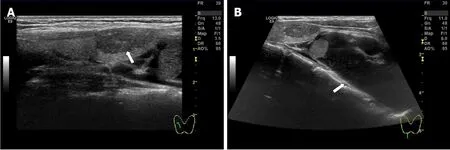
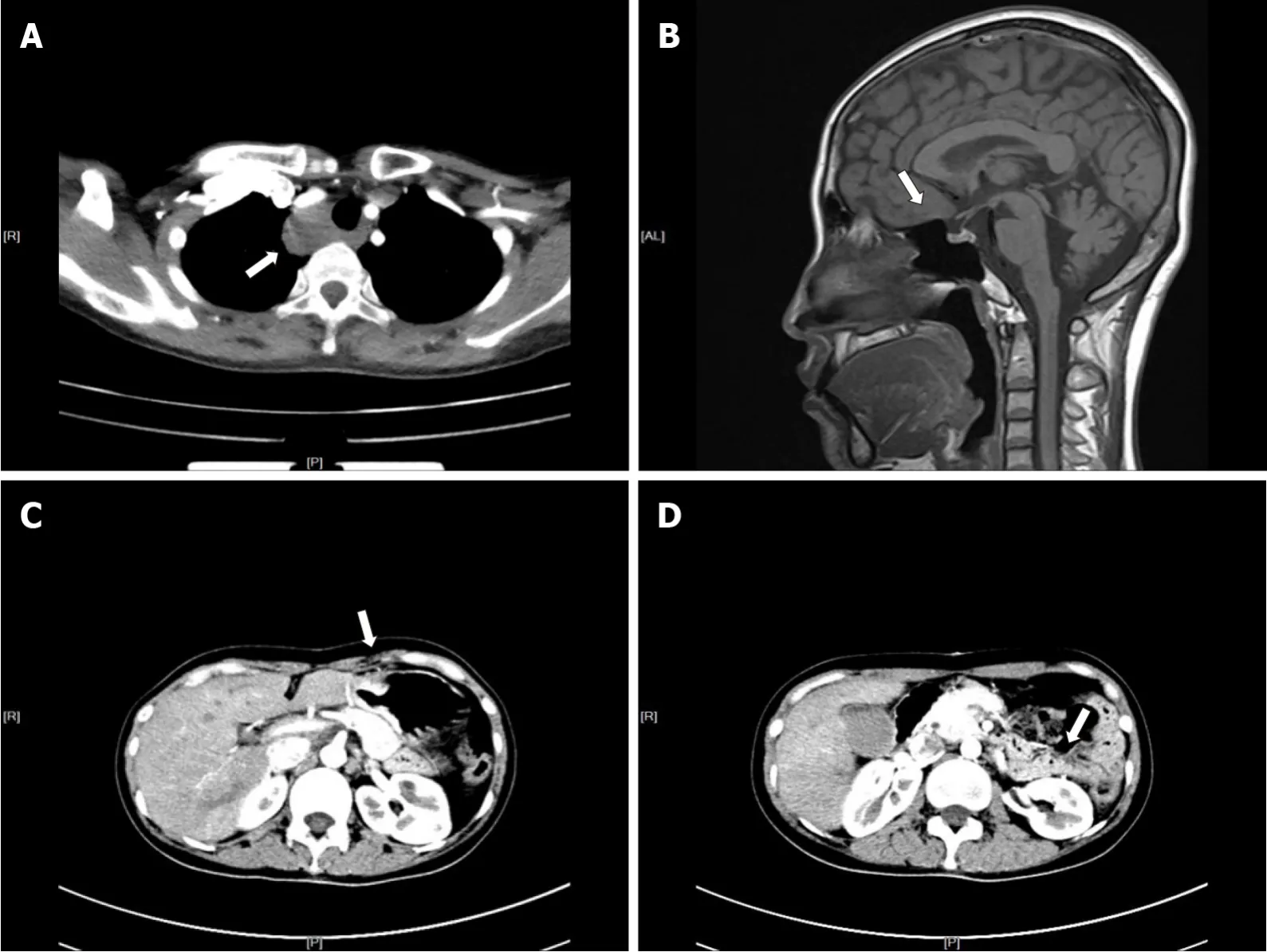
Neck ultrasound revealed a 64 mm × 28 mm × 45 mm cystic mass located below the right lobe of the thyroid gland with a well-defined smooth border, and several solid nodules were detected in the right thyroid lobe, with the largest (18 mm × 10 mm × 8 mm) in the right lower thyroid lobe. The largest nodule in the thyroid had an unclear boundary, dotted calcification and abundant internal blood flow (Figure 1A and B).Computed tomography (CT) or magnetic resonance imaging examination showed changes in the pituitary region; lesions in the right thyroid lobe and superior mediastinum; and changes after partial gastrectomy and in the tail of the pancreas(Figure 2A–D). In 99mTc-methoxyisobutyl isonitrile scintigraphy, tracer uptake was increased in the right lower region of the thyroid gland and mediastinum, and no abnormal retention of the tracer in the late phase was observed. No uptake was detected in other regions. Preoperative sestamibi single-photon emission computed tomography (SPECT)/CT found a lesion in the right lower thyroid lobe and part of which extended to the superior mediastinum (Figure 3A). Bone scanning showed Tscores -2.6 and Z-scores -2.0.
FINAL DIAGNOSIS
The final diagnosis of the presented case was thyroid neoplasm (right lobe).
The patient underwent partial resection of the pancreas and stomach for pancreatic and gastroduodenal neuroendocrine tumor 4 years ago. The patient had a history of pituitary microadenoma for 2 years, which was not treated but under observation.
TREATMENT
Her father had a history of stomach surgery, but the details were unknown since he died 20 years ago. Other relatives of the patient had no symptoms of MEN1 syndrome.
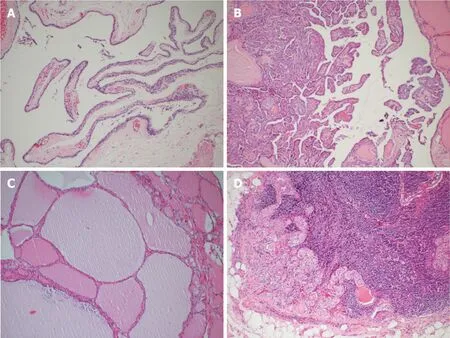
During the operation, gross examination of the largest cyst showed that it was partially surrounded and contiguous with the right lower thyroid lobe and extended to the superior mediastinum, and it was peeled off easily from the right lower thyroid lobe and mediastinum. Furthermore, it was filled with clear watery fluid, suggesting that it was a parathyroid cyst (Figure 3B). The largest cyst and right lobe of the thyroid were removed. The central lymph nodes were cleared. Intraoperative frozen section pathology showed that the largest cyst was the source of parathyroid, and parathyroid carcinoma was excluded. A PTC (maximum diameter 1 cm, invading the capsule) was found in the thyroid right lobe. In the central lymph nodes, 4/5 had cancer metastasis.iPTH at 20 min after resection was decreased to 253.4 pg/mL. Other parathyroid glands were explored. Two upper parathyroid glands were normal. The left lower parathyroid was enlarged and removed. Rapid intraoperative pathological examination revealed that the left lower parathyroid had adenomatoid hyperplasia.After another 20 min, serum iPTH decreased to 63.9 pg/mL. The postoperative pathological results were PTC (maximum diameter 1cm, invading the capsule) in the right thyroid lobe and nodular goiter. In the central lymph nodes, 4/5 had PTC metastasis. In the right cervical cysts, parathyroid cysts (monolocular) showed adenomatous hyperplasia. In the left lower parathyroid, adenomatous hyperplasia was observed (Figure 4). The patient had indications for a total thyroidectomy because of central compartment lymph node metastasis. But the patient had a strong desire to preserve the thyroid gland and refused to remove the left lobe.
After surgery, the patient was closely monitored on serum calcium and was pumped calcium gluconate 2.0 g/day through a central venous catheter for 5 d. After taking 1.5 g calcium carbonate daily for 3 mo, her serum calcium levels returned to normal. Meanwhile the patient received endocrine suppression therapy after the operation.
OUTCOME AND FOLLOW-UP
After the operation, genetic analysis was performed, and a germlinegene mutation was detected. There was a heterozygous mutation in the second exon ofgene which was 357-360delCTGT. During follow-up, there was no hypoparathyroidism or other complications. The laboratory data on postoperative day 2 showed that serum calcium was 1.98 mmol/L and iPTH was 24.1 pg/mL. After taking 1.5 g calcium carbonate daily for 3 mo, the patient’s laboratory data improved: calcium 1.98 mmol/L and iPTH 43.7 pg/mL. Calcium was 2.47 mmol/L and iPTH was 61 pg/mL after 18 mo. One month after the operation, the dose of levothyroxine was reduced from 75 mg to 50 mg.

DISCUSSION
Currently, the role of inactivating mutations ofgene in tumorigenesis of PTC and/or nodular goiter is still controversial. It remains to be determined by more case reports and further research.
在飼料中增加一定比例的脂肪粉或者植物油,適度提高能量水平。公豬和母豬可適當(dāng)?shù)脑黾语曃沽浚⑻砑泳哂锌箲?yīng)激、抗氧化能力的飼料添加劑,以增強(qiáng)豬體的抗寒能力。保育期采用濕拌料飼喂方式的,使水的溫度保持在20℃~30℃,禁止使用冷水飼喂。
MEN1 is a rare hereditary tumor syndrome inherited in an autosomal dominant manner and presents mostly as the parathyroid[15], endocrine pancreas (such as gastrinoma)[16] and anterior pituitary tumors[17]. Other endocrine and nonendocrine lesions of MEN1, such as adrenal cortical tumors, carcinoids of the bronchi,gastrointestinal tract and thymus lipomas, angiofibromas, and collagenomas, have also been described[1,18]. MEN1 with a large functioning parathyroid cyst is rare. Cavalli[15] found that approximately 300 cases of sporadic parathyroid cysts had been reported up to 2017, and only two cases have been described in MEN1. Parathyroid cysts can be divided into functioning and nonfunctioning, and most parathyroid cysts are nonfunctioning. The functioning parathyroid cysts are more likely to be caused by degenerative changes in parathyroid adenoma than hyperplasia in our case[19]. In many cases, it is difficult to diagnose the nature of the cyst merely by ultrasound before surgery. Parathyroid cysts need to be differentiated from lymphatic cysts, cystic thyroid nodules and hemangioma[20,21]. The diagnostic rate can be improved by laboratory examination and other imaging examinations. Preoperative SPECT/CT is useful in localizing parathyroid cysts in most patients, with an accuracy rate up to 79%if it is interpreted in combination with cervical ultrasound images[22]. Postoperative pathological diagnosis is the gold standard. The clinical features of hyperparathyroidism (HPT) with MEN1 are similar to those with sporadic HPT, but the former is often more aggressive. For patients who have HPT with MEN1, early surgical treatment is preferred. Surgical treatment should be considered in asymptomatic patients when (1) serum calcium is higher than the reference range 2.52mmol/L; (2)glomerular filtration < 60 mL/min; (3) bone mineral density at any point is 2.5 or lower, or patient has fragility fractures; and (4) age < 50 years. Whether early surgery can reduce the incidence rate and mortality is not clear. For patients who have HPT with MEN1, especially in asymptomatic or mild and young patients, early parathyroidectomy can reduce the long-term effects of HPT on the patients, especially reducing the bone loss. Although our case was a young woman with normal upper parathyroid glands on both sides, and bilateral lower parathyroid glands showed adenoma-like changes and hyperplasia, parathyroid hormone and serum calcium levels had increased significantly. To avoid a permanent hypoparathyroidism, we did not perform subtotal parathyroidectomy or a total parathyroidectomy with parathyroid tissue autotransplantation. And based on our past experience, unless it is a parathyroid cancer, surgery can achieve a better treatment effect by removing the problematic parathyroid glands. In the present case, the parathyroid hormone had decreased from 676.3 pg/mL to 63.9 pg/mL after the removal of the bilateral inferior parathyroid glands, and the patient’s serum parathyroid hormone was 47.6 pg/mL at 27 mo postoperatively. FNA is the most useful means for diagnosis of thyroid nodules,however, it is not widely accepted for diagnosis of parathyroid tumors due to the risk of dissemination of tumor cells.
據(jù)介紹,每一個(gè)合作的農(nóng)戶或種植基地,農(nóng)拓者都會安排專業(yè)人員對土壤進(jìn)行分析,收集歷年作物生長、天氣變化等大量數(shù)據(jù),在大數(shù)據(jù)的基礎(chǔ)上量身打造出覆蓋種、肥、藥和田間管理等多方面的全程種植解決方案,并在種植過程中進(jìn)行監(jiān)督化的跟蹤管理。在這種模式下,農(nóng)民的種植水平得以提升,避免了肥藥的浪費(fèi)和無效施用,精準(zhǔn)的病蟲害解決方案保障了作物健康,促進(jìn)了農(nóng)民增產(chǎn)增收,交出了辣椒畝產(chǎn)增幅30%、番茄畝產(chǎn)增幅40%、其他作物均有不同比例增產(chǎn)的答卷。
Two different forms of MEN1, sporadic and familial, have been described[23]. The sporadic form presents with two of the three principal MEN1-related endocrine tumors (parathyroid adenoma, enteropancreatic tumor and pituitary tumor) within a single patient, while the familial form consists of MEN1 with at least one first-degree relative showing one of the endocrine characteristic tumors[24-27]. In our case, the patient did not provide a clear family history. It is still unclear what form of MEN1 our patient had. There is no evidence to exclude the accidental occurrence of MEN1 with PTC and nodular goiter in this patient.
So far, few cases of thyroid carcinoma and/or nodular goiter combined with MEN1 have been reported. Whether there is a correlation among them is still controversial[12,28,29]. Hill[30] investigated the probability of concomitant thyroid cancer in patients with MEN1. They found that in patients with MEN1, a 28% substantial incidence of thyroid cancer was observed and all cancers in MEN1 patients were common PTCs histologically (100%). We noticed that only PTCs that measured >1 cm in diameter were considered in the report by Hill[30]. But at present, papillary thyroid microcarcinoma (PTMC) accounts for more than half of all PTCs in clinical practice. If we take these PTMC cases into account, the actual incidence of papillary thyroid carcinoma would be higher in MEN1 patients. Our case was PTMC. MEN1 is caused by inactivating mutations of thegene that encodes the protein menin[2]. Menin is a nuclear protein whose interaction with several other nuclear proteins indicates a role in transcriptional regulation. Previous studies have supported a role for MEN1 in controlling cell growth and differentiation, and in sensing or repairing DNA damage as well. The loss of menin function in tumor precursor cells is involved in the mechanism underlying tumor formation in MEN1[8-10,31-33]. Research showed that the inactivation of menin in the thyroid gland of young mice affected the proliferation of follicular cells[13]. Capraru[11] showed that the expression of menin was positive, identical to normal thyroid tissue, but it could be decreased or absent in some thyroid tumors including PTC. As is well known, mutations of thegene cause deficiency in the menin protein in MEN1 patients. There was a heterozygous 357-360delCTGT mutation in the second exon of MEN1 gene in our case. Further molecular studies are needed to evaluate the role of menin protein deficiency in tumorigenesis of PTC and nodular goiter. Kazubskaia[34] investigated follicular cell (papillary and follicular) thyroid carcinoma, genetic inheritance and molecular diagnostic markers. They believed that familial PTC and PTC may be a component of multitumor syndromes, such as MEN1, Cowden syndrome, and familial adenomatous polyposis. We speculate upon possible reasons for the association between MEN1 and PTC/nodular goiter. Loss of heterozygosity (LOH) studies have been used to identify sites harboring tumor suppressor genes involved in tumor initiation or progression.is a tumor suppressor gene located on human chromosome 11q13. Specific genomic areas, such as 3p22, 7q31, 11q13 and 11q23, have been reported to be involved in some epithelial or endocrine tumor types[35]. PTC is also one of the endocrine tumors. Whether inactivating mutations of 11q13 can induce PTC remains to be further studied. Chu[36,37] found MEN1 deletion in neurotrophic tyrosine kinase receptor (NTRK)-rearranged PTC patients. They also proved that nucleotide variants and indels in pTERT, MEN1 and CDH1 were observed in several kinase fusion-related PTCs. The relationship among MEN1, PTC and NTRK needs to be further studied. In the analysis ofgene, about 20% may have false negative results due to the diversity of the causative mutation and scattered position in the entire open reading frame. Moreover, approximately 10% new germline mutations are being detected in the overall MEN1 patients, which may be the reason why the genotype- phenotype correlations could not be identical in 10%-30% of patients[38]. In 2008, Kim[29]reported the first case of PTC combined with MEN1 in Korea. Their patient’s genetic analysis of DNA had revealed no germline mutation ingene locus. But there was a genetic mutation in our case. Menin, the protein encoded bygene is ubiquitously expressed in endocrine tissues, is less in many endocrine tumors including PTC. Deletion of the MEN1 tumor suppression still might be etiologically related to the oncogenesis of PTC. DNA analysis of more samples with PTC combined with MEN1 may be helpful. Now it is very difficult to confirm the LOH ofgene completely and accurately, which has dozens of polymorphic markers[29]. The clinical aspects and molecular genetics of MEN1 were reviewed together with the reported 1336 mutations[39]. It has been proved that many of the diseases that have been widely believed to be associated with MEN1 mutations, such as pituitary tumors, lung carcinoids,, sometimes failed to exhibit meaningful LOH at 11q13[40]. For PTC,some people have used three of polymorphic markers to test one patient’s sample,with limited results[12]. The exact significance remains to be determined by more case reports and further research. It is another possibility that MEN1 patients who develop PTC may have specificmutations of the affected allele that act like dominant oncogenes with regard to thyroid cancer oncogenesis. If any of these scenarios was the case, thegene could play a role in the development of the papillary cancer without obvious LOH of the gene locus.
CONCLUSION
In summary, we presented a rare case of MEN1 combined with PTC and nodular goiter, in which a germline mutation of thegene was detected. It is possible there is a potential correlation between MEN1 syndrome and PTC/nodular goiter.However, further studies and additional case reports are required to clarify it.
 World Journal of Clinical Cases2022年3期
- World Journal of Clinical Cases的其它文章
- Mycoplasma hominis meningitis after operative neurosurgery: A case report and review of literature
- Recurrence of sigmoid colon cancer–derived anal metastasis: A case report and review of literature
- New method to remove tibial intramedullary nail through original suprapatellar incision: A case report
- Metastasis to the thyroid gland from primary breast cancer presenting as diffuse goiter: A case report and review of literature
- Gastric submucosal lesion caused by an embedded fish bone: A case report
- Epibulbar osseous choristoma: Two case reports