
Clinical study on the minimally invasive percutaneous nephrolithotomy treatment of upper urinary calculi
2022-03-15 07:11:56XiaoJianXuJunZhangMiaoLiJianQuanHou
World Journal of Clinical Cases 2022年4期
INTRODUCTION
Urinary calculi formation is a common clinical urinary disease.It currently ranks first in the incidence of urological diseases.In recent years,the incidence of urinary calculi has increased yearly with changes in modern people’s life pressures and diet.Traditional treatments have been the use of medicine to remove the stones,but their effect is moderate,and relapse is common after these types of treatment[1].In recent years,surgical treatment has played an important role in the treatment of urinary calculi.Traditional percutaneous nephrostomy surgery is invasive,which can easily cause bleeding and cause greater trauma to patients,especially when larger stones are involved.Many limiting factors inhibit the wide application of this method.In recent years,with the development of minimally invasive technology,microchannel technology has reduced damage to the renal cortex by reducing the size of the nephroscope,which not only ensures the effect of the surgical treatment but also reduces harm to the patients[2].To further analyze the clinical treatment effect of minimally invasive percutaneous nephrolithotomy (mPCNL) on upper urinary tract stones,this study was performed to provide a basis for clinical guidance.
MATERIALS AND METHODS
General information of the patients
Patients with upper urinary tract stones who were treated in our hospital from February 2017 to March 2018 were selected as the research subjects.The inclusion criteria were as follows:(1) Adults;(2) Those who were diagnosed with upper urinary tract stones;and (3) Those who had no other serious diseases of the urinary system.The exclusion criteria were as follows:(1) Patients with incomplete clinical data;and (2) Patients with urinary system infection.According to the inclusion and exclusion criteria,a total of 80 study subjects were included,including 40 cases in the PCNL group (22 males and 18 females,aged 30-65 years old,with an average age of 39.02 ± 2.68 years) and 40 cases in the mPCNL group (25 males and 15 females,aged 28-64 years old,with an average age of 39.05 ± 3.12 years old).The two groups of patients were comparable with no obvious differences in general information,such as age and sex.The study was reviewed and approved by the hospital ethics committee.
The youth told him all his story, and when he had finished, the old man said: Spade and shovel12 do your duty, and they danced about the cave till, in a short time, there was not a speck13 of dust left on the floor
Method
In this study,a microchannel percutaneous nephrolithotomy was used to treat kidney stones.This method improved the traditional standard channel nephrolithotomy.The expansion channel used in the microchannel was an F14-18,and a ureteroscope was used instead of the nephroscope to allow for the full flexibility of the ureteroscope.Due to the small diameter of the scope,it can enter the renal pelvis and calyces through the fistula,especially for partial renal calyx stenosis,and can pass smoothly[9,10].Microchannel percutaneous nephrolithotomy uses ultrasound guidance to observe the structure of the puncture channel in real time and distinguish the collection system,the renal calyx,and the location of kidney stones,which helps the physician grasp the position of the puncture needle,the puncture angle and the depth and avoid the puncture.This route prevents damage to the nearby pleura and spleen[11-15].The establishment of an ideal percutaneous renal channel is an important factor for successful stone removal.Clinically,a path with a relatively thin renal cortex and fewer blood vessels should be selected according to the location,size and outflow tract of the stone to establish a puncture channel as long as possible to reach the junction of the target renal calyx,renal pelvis and ureter.It is convenient to maximize the operating angle and facilitate the placement of the double J tube anteriorly[16-18].Microchannel percutaneous nephrolithotomy can also use an ultrasonic lithotripsy probe to quickly suck the stone fragments and the perfusate out of the body while directly looking at the ultrasonic lithotripsy through the working channel,accelerating the outflow of the perfusate,and effectively reducing the pressure in the renal pelvis.There is no need to repeatedly clamp and remove the stone.By reducing the puncture caliber,reducing the loss of renal cortex and reducing the pressure in the renal pelvis,the stone removal rate is greatly improved[19].To prevent iatrogenic kidney laceration from causing hemorrhage due to excessive expansion of the mPCNL operation,the needle should be punctured at a suitable position under ultrasound guidance to avoid overextension of the puncture.At the same time,the anesthesiologist can cooperate to maintain the kidney to fix the kidney.Pulmonary inflation allows the kidney to move down and fix it in place,which effectively reduces the difficulty of puncture.At the same time,it can preventively reduce the mucosal congestion and edema caused by stones due to the administration of antibacterial drugs before surgery.At the same time,attention should be given to monitoring the coagulation factors[20].
What I hadn’t counted on were the people with enormous orders who chose to use the drive-thru window, or the women who felt that the coffee was much too creamy, or the men who wanted their iced coffees remade again and again until they reached a certain level of perfection. There were moments when I was exasperated4 with the human race as a whole, simply because I couldn’t seem to please anyone. There was always too much sugar, too little ice, and not enough skim milk. Nevertheless, I kept at it.
:The condition of the ureter was observed,a dilator was used for dilation,and an F24 working sheath was inserted;the ultrasound energy was set to 80% after inserting the nephroscope,after which ultrasound or pneumatic ballistics was used for lithotripsy,and the calculus in the neck of the kidney was clamped and clipped.
:A ureteroscope was used to observe the condition in the kidney,and a pneumatic ballistic probe was used to crush the stones;the larger stones were removed with a foreign body forceps,and an infusion pump was used to discharge the smaller stones sequentially.If necessary,dual-channel lithotripsy treatment was carried out.
After stone removal,the ureteral catheter was withdrawn from both groups.If it was difficult to explore the renal pelvis,a zebra guide wire was inserted into the lumen of the ureteral catheter to expose the position of the renal pelvis.An F5-7 double J tube was inserted anteriorly,and an ostomy tube was inserted for urinary catheterization,resulting in more bleeding.The patient was compressed with a clipped fistula tube to stop the bleeding,hemostatic and anti-infective treatments were given after the operation,and the patient was strictly required to stay in bed.
Evaluation index
The general condition of the two groups of patients during the perioperative period was observed,and stone clearance,pain,renal function indicators [serum creatinine (Cr),β2 microglobulin (BMG) and retinol binding protein (RBP)],serum inflammation indicators (interleukin-6,tumor necrosis factor-α,C-reactive protein) and differences in the incidence of complications were compared.The evaluation of visual analog scale (VAS) was carried out by the visual analog scoring method.The specific method was as follows:A 10 cm horizontal line was drawn on paper;one end of the horizontal line was 0,indicating no pain,the other end was 10,indicating severe pain,and the midsection indicated different degrees of pain.
Statistical analysis
One month after treatment and 3 mo after treatment,the quality of life of patients in the mPCNL group is lower than that of the PCNL group,and the Qmax level is higher than that of the PCNL group.The difference is statistically significant (P<0.05) (Table 5).
RESULTS
Comparison of the general conditions of the two groups of patients during the perioperative period
This study aimed to observe the therapeutic effect of mPCNL on upper urinary tract stones.
THERE was once upon a time a widow1 who had two daughters.2 The eldest13 was so much like her in the face and humor that whoever looked upon the daughter saw the mother. They were both so disagreeable and so proud4 that there was no living with them.

Comparison of renal function indices of the two groups of patients before and after treatment
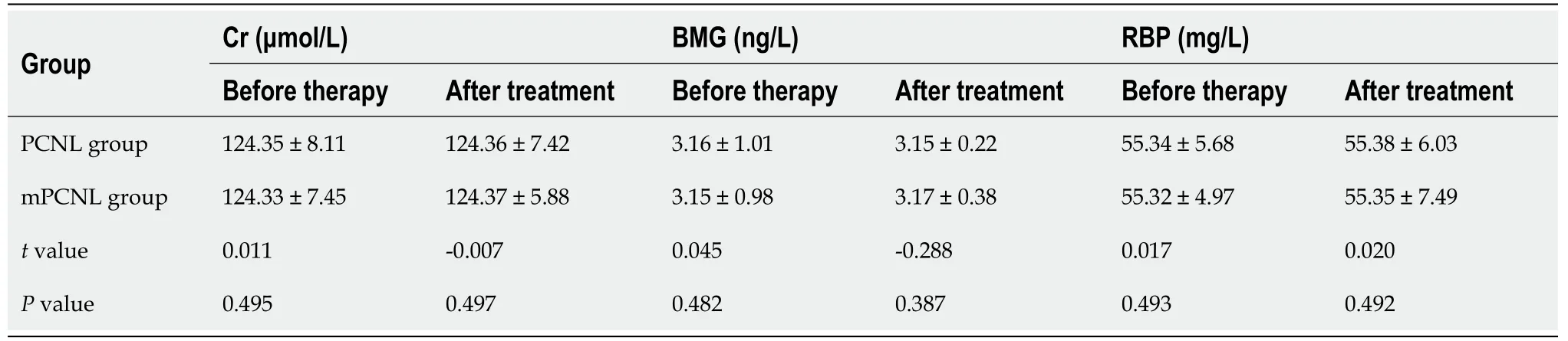
This study showed that patients in the mPCNL group had a longer operation time than those in the PCNL group and had more intraoperative blood loss than those in the PCNL group,indicating that mPCNL treatment for urinary calculi is more complicated and that blood loss during the operation is greater.After treatment,there was no difference in the levels of Cr,BMG and RBP in the mPCNL group,indicating that the two surgical methods do not have a significant impact on the renal function of patients with urinary calculi.The VAS score of patients in the mPCNL group was lower than that in the PCNL group.There was no significant difference in the stone removal rate between the two groups,indicating that mPCNL can reduce pain in the treatment of urinary calculi.Both methods can effectively remove stones.There was no significant difference in the incidence of urinary extravasation,dyspnea,and peripheral organ damage between the two groups of patients,indicating that the application of mPCNL for the treatment of urinary calculi will not increase the occurrence of complications and is safe to use.The advantage of this study lies in the analysis of the clinical efficacy of the two surgical methods applied to urinary calculi,which provides a basis for further clarifying the choice of treatment options for urinary calculi.The clinical features of the patient’s calculi and the economic situation should be considered for a reasonable selection of surgical options.This study included a limited number of patients,and long-term follow-up observation was not possible.Therefore,further multicenter,large-sample,randomized controlled trials are needed for in-depth demonstration.
Comparison of pain and clearance rate between the two groups
Table 3 shows that the VAS score of patients in the mPCNL group was lower than that of the PCNL group (=12.191,<0.001) and that there was no significant difference in the stone clearance rate between the two groups (value=1.013,=0.314).

Comparison of the incidence of complications between the two groups
There is no significant difference in the incidence of urine extravasation,dyspnea,and peripheral organ damage between the two groups (=1.053,=0.305) (Table 4).

Comparison of postoperative recovery of the two groups of patients
After data entry,SPSS 11.5 software was used for analysis.Counting and measurement data are expressed as examples and the mean ± SD,respectively.The comparison of general conditions,pain conditions and renal function indices of the two groups of patients during the perioperative period was analyzed by-test.The comparison of stone clearance and complication rates between the two groups of patients was statistically processed by the chi-square test,which showed statistical significance (<0.05).

DISCUSSION
Kidney stone formation is a common disease in the urinary system.In recent years,its prevalence has shown an increasing trend.Kidney stones generally occur in the renal pelvis and calyces of patients.When the stone diameter is large,the probability of stone removal is reduced.Some patients may have no clinical signs for a long time.When stones cause obstruction of the patient's urinary system,they cause kidney function damage,which results in long-term renal insufficiency,and thus treatment should be carried out as soon as possible[3,4].Studies have shown that the factors affecting the formation of stones are relatively large and are related to many factors,such as environment,diet,age,and genetics.On one hand,the stone-forming substances in the urine are in a state of supersaturation,and the substances that promote the formation of stones have increased;on the other hand,renal tubule damage to the epithelial cells leads to stone formation[5].At present,surgical treatment has become an important method for the treatment of kidney stones.Traditional open surgery is more traumatic for patients and has a slow postoperative recovery.Therefore,with the rapid development of minimally invasive techniques,more options are provided for the treatment of kidney stones[6].Percutaneous nephrolithotomy is widely carried out in clinical practice,but the blood supply of the human renal cortex is abundant,while the blood supply of the renal medulla is lower.The outer diameter of the traditional standard channel is larger,and kidney damage is serious,so bleeding easily occurs.During this process,the patient’s tolerance is reduced due to prolonged surgery,and the damaged renal parenchyma has greater bleeding.Surgery will cause expansion of the damage,the formation of small blood clots in the bleeding,and changes in renal hemodynamics,which may easily cause the perfusion fluid to return.The flow causes infectious stones and bacteria to enter the bloodstream,aggravating the damage to the kidneys[7,8].
Both groups of patients underwent general anesthesia.After satisfactory anesthesia was achieved,the bladder lithotomy position was taken,an F4-6 ureteral catheter was placed,the patient was moved to a prone position,and the puncture area was determined under ultrasound guidance on the patient’s posterior axillary line,11intercostal space,under the 12rib.A 17.5 g renal puncture needle was used to puncture the renal calyces,after which the needle core was removed and physiological saline was injected through the catheter;the renal passage was established,after which a guide wire was inserted for expansion,and then an F16 peeling sheath was inserted.
There is no difference in renal function indices between the two groups of patients before treatment,and after treatment,there is no difference in the levels of Cr,BMG and RBP in the mPCNL group (Table 2).
CONCLUSION
The authors studied the mPCNL on upper urinary tract stones and its influence on the renal function of patients.
ARTICLE HIGHLIGHTS
Research background
Upper urinary tract stones are very common in China.However,there are few clinical reports on the impact of minimally invasive percutaneous nephrolithotomy (mPCNL)on patients with inflammatory factors,and because of the different levels of technology,some minimally invasive surgeries have frequent postoperative complications.
Research motivation
In summary,mPCNL has a good therapeutic effect on upper urinary tract stones.The stone removal rate is high,and this method will not cause kidney damage or increase the incidence of complications.Thus,it has a good application value.
Research objectives
The operation time of the mPCNL group is longer than that of the PCNL group (=-34.392,<0.001) and that the intraoperative blood loss is greater than that of the PCNL group (=34.090,<0.001) (Table 1).
Research methods
The authors selected patients as research subjects and were divided into the PCNL group and the mPCNL group.
Immediately after lunch we made for the trailhead. Chuck joined us and led the expedition. The little guys fell in on the trail() ahead of me with their full daypacks, slouch hats, and bottles filled with water. They soon found walking sticks. I laughed as I watched Wes lurching along the trail ahead of me struggling with all his gear. He shuffled4 along behind his brothers careful not to drop behind. Not a syllable5() of complaint escaped his lips.
One cold evening during the holiday season, a little boy about six or seven was standing1 out in front of a store window. The little child had no shoes on and his clothes were mere2 rags. A young woman passing by saw the little boy and could read the longing3 in his pale blue eyes. She took the child by the hand and led him into the store. There she bought him new shoes and a complete suit of warm clothing.They came back outside into the street and the woman said to the child, “Now you can go home and have a very happy holiday.”The little boy looked up at her and asked, “are you God, Ma’am?”She smiled down at him and replied, “No son, I’m just one of His children.”The little boy then said, “I knew you had to be some relation.”
Research results
The Qmax level of the mPCNL group was higher than that of the PCNL group.
The messenger awoke with such a start, and when he saw that the hour had almost run out he snatched up the answer and rushed back with such speed that the clock had not yet struck when he entered the palace
Research conclusions
mPCNL has a good therapeutic effect on upper urinary tract stones.
Research perspectives
The purpose of this study was to further confirm the therapeutic effect of mPCNL in upper urinary calculi.
 World Journal of Clinical Cases2022年4期
- World Journal of Clinical Cases的其它文章
- Surgical treatment of acute cholecystitis in patients with confirmed COVID-19:Ten case reports and review of literature
- Rituximab as a treatment for human immunodeficiency virusassociated nemaline myopathy:What does the literature have to tell us?
- Eustachian tube involvement in a patient with relapsing polychondritis detected by magnetic resonance imaging:A case report
- Endoscopic clipping for the secondary prophylaxis of bleeding gastric varices in a patient with cirrhosis:A case report
- Inflammatory myofibroblastic tumor after breast prosthesis:A case report and literature review
- Langerhans cell histiocytosis presenting as an isolated brain tumour:A case report