未知時變擾動及模型參數動態不確定下船舶自動靠泊控制
2022-04-02 23:10:22趙永生吳韜白一鳴
上海海事大學學報 2022年1期
趙永生 吳韜 白一鳴

摘要:針對未知時變擾動及模型參數動態不確定下的船舶自動靠泊控制問題,提出一種新的間接神經自適應的靠泊控制策略。采用徑向基函數神經網絡逼近船舶模型參數中動態不確定部分,采用帶有唯一虛擬參數的線性化參數形式表示模型參數動態不確定性和未知時變擾動構成的復合不確定項,使計算簡單,易于工程實現。利用Lyapunov理論證明提出的自動靠泊閉環控制系統的穩定性和信號的一致有界性。仿真實驗結果證明了該控制律可以使船舶達到期望的位置和艏向角,實現船舶自動靠泊。
關鍵詞:
自動靠泊; 動態不確定; 未知時變擾動; 神經網絡; 虛擬參數
中圖分類號:? U664.82
文獻標志碼:? A
Automatic berthing control of ships with unknown time-varying
disturbance and dynamic uncertainty of model parameters
ZHAO Yongsheng, WU Tao, BAI Yiming
(College of Marine Electrical Engineering, Dalian Maritime University, Dalian 116026, Liaoning, China)
Abstract:
Aiming at the ship automatic berthing control problem under the unknown time-varying disturbance and the dynamic uncertainty of model parameters, a new indirect neural adaptive berthing control strategy is proposed. The radial basis function neural network is used to approximate the dynamic uncertain part of the ship model parameters, and the linearized parameter form with a unique virtual parameter is used to express the compound uncertainty from the dynamic uncertainty of model parameters and the unknown time-varying disturbance, making the calculation simple and the project realization easy. The stability of the proposed automatic berthing closed-loop control system and the consistent boundedness of the signal are proved by Lyapunov theory. Simulation experiment results prove that the control law can control a ship to the desired position and heading angle, and realize ship automatic berthing.
Key words:
automatic berthing; dynamic uncertainty; unknown time-varying disturbance; neural network; virtual parameter
0 引 言
船舶在自動靠泊過程中除受到常見的風、浪、流干擾外,還受到岸壁效應、淺水效應的影響[1],這使得自動靠泊控制比常見的跟蹤控制更加困難。國內外相關學者采用輸出反饋[2]、魯棒[3]、滑模[4]等控制算法研究了欠驅動船舶自動靠泊控制,取得了良好的效果,但由于欠驅動船舶沒有配備側推裝置,通常只能實現泊位外鎮定控制。配備有全驅動裝置的船舶的靈活性能夠滿足自動靠泊控制目標對船舶的要求。
為研究自動靠泊控制問題,需要建立考慮淺水效應、岸壁效應、船舶低速特點的數學模型。文獻[5-8]都在MMG(ship maneuvering model group)分離型模型基礎上建立數學模型,而由于MMG需要使用大量的經驗公式,所建立的數學模型不夠精確。另外,MMG較多應用于大型船舶,可實際上大型船舶需要拖船等進行輔助才能完成靠泊,而且需要的靠泊操縱水域較大,很難滿足自動靠泊的要求。Fossen模型較多應用于中小型船舶,而且采用的是簡潔的矩陣運動方程形式,易于反映船舶機械操縱特性,因此越來越多的學者采用Fossen模型研究自動靠泊控制[9-11]。然而,大部分研究把Fossen模型中的擾動簡單地視作風、浪、流擾動,沒有考慮岸壁效應對船舶產生的干擾。岸壁效應指船舶在靠近泊位時所受的岸壁對船舶的干擾力和力矩[12],如果忽略岸壁效應,控制精度會降低,靠泊安全性會受到影響。
文獻[13]利用矢量反步法,設計了魯棒自適應控制律,實現了在擾動時變未知情況下的動力定位控制。文獻[14]針對外部擾動為已知常值和未知常值的情況,設計了魯棒無源輸出反饋控制器,實現了船舶定位控制的漸近穩定。文獻[15]利用非線性規劃方法提出最短時間的自動靠泊方法,根據外界干擾引起的預測控制誤差的性能指標,調整最短時間的靠泊控制輸入參數。在設計靠泊控制器時,大多數研究假設船舶模型參數精確已知,而實際上船舶在自動靠泊過程中由于岸壁效應、環境擾動的影響很難得到精確的模型參數。神經網絡因其具有非線性函數的逼近特性,被用于解決自動靠泊問題。文獻[16-19]利用神經網絡技術對船舶模型參數動態不確定性進行重構,取得了良好的靠泊控制效果。上述文獻提出的控制策略,除了需要對外部時變擾動設計自適應律進行補償之外,還需要對神經網絡中較多的參數進行在線學習,計算復雜。文獻[20]設計了一種新的魯棒自適應有限時間航跡跟蹤控制律,該控制律只需要在線學習一個參數,有利于工程實現。gzslib202204031044本文在總結上述研究的基礎上,同時考慮未知時變擾動和模型參數動態不確定性,設計一種自動靠泊控制算法,并對一艘供給船進行仿真實驗來驗證本文設計的控制算法的有效性和魯棒性。本文主要貢獻是:(1)基于Fossen模型建立了考慮岸壁效應的自動靠泊數學模型。(2)針對船舶模型參數動態不確定問題,引入徑向基函數(radial basis function,RBF)神經網絡在線估計模型參數中動態不確定部分,并采用虛擬參數學習方法和間接自適應方法,提出一種新的間接神經自適應的靠泊控制策略。(3)所提出的控制方案只需在線學習一個參數,計算簡單,易于工程實現。
1 問題描述
船舶靠泊屬于低速大漂角緩慢運動,研究船舶運動一般只考慮船舶的縱蕩、橫蕩和艏搖3個自由度的水平面運動,而忽略船舶的垂蕩、橫搖和縱搖運動這3個自由度的影響。建立如圖1所示的船舶運動坐標系:慣性坐標系(OEXEYEZE)和船體坐標系(AXYZ)。在地球表面上任意選取一點作為慣性坐標系的原點OE,OEXE軸指向正北方向,OEYE軸指向正東方向,OEZE軸指向地心方向。假設船舶左右對稱,選取船舶重心A作為船體坐標系的原點,AX軸指向船首方向,AY軸指向右舷方向,AZ軸指向船底方向。
3 仿真結果與分析
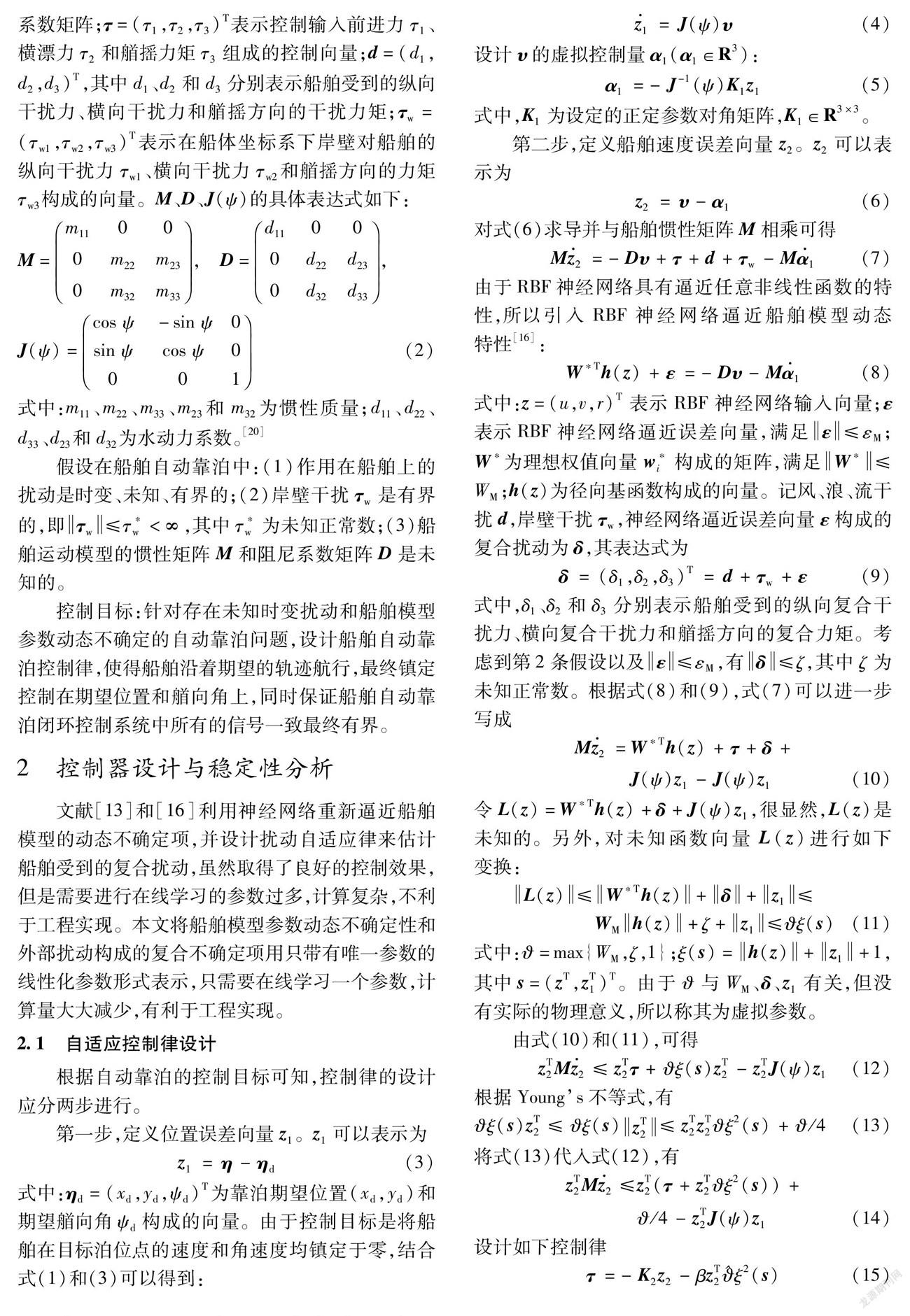
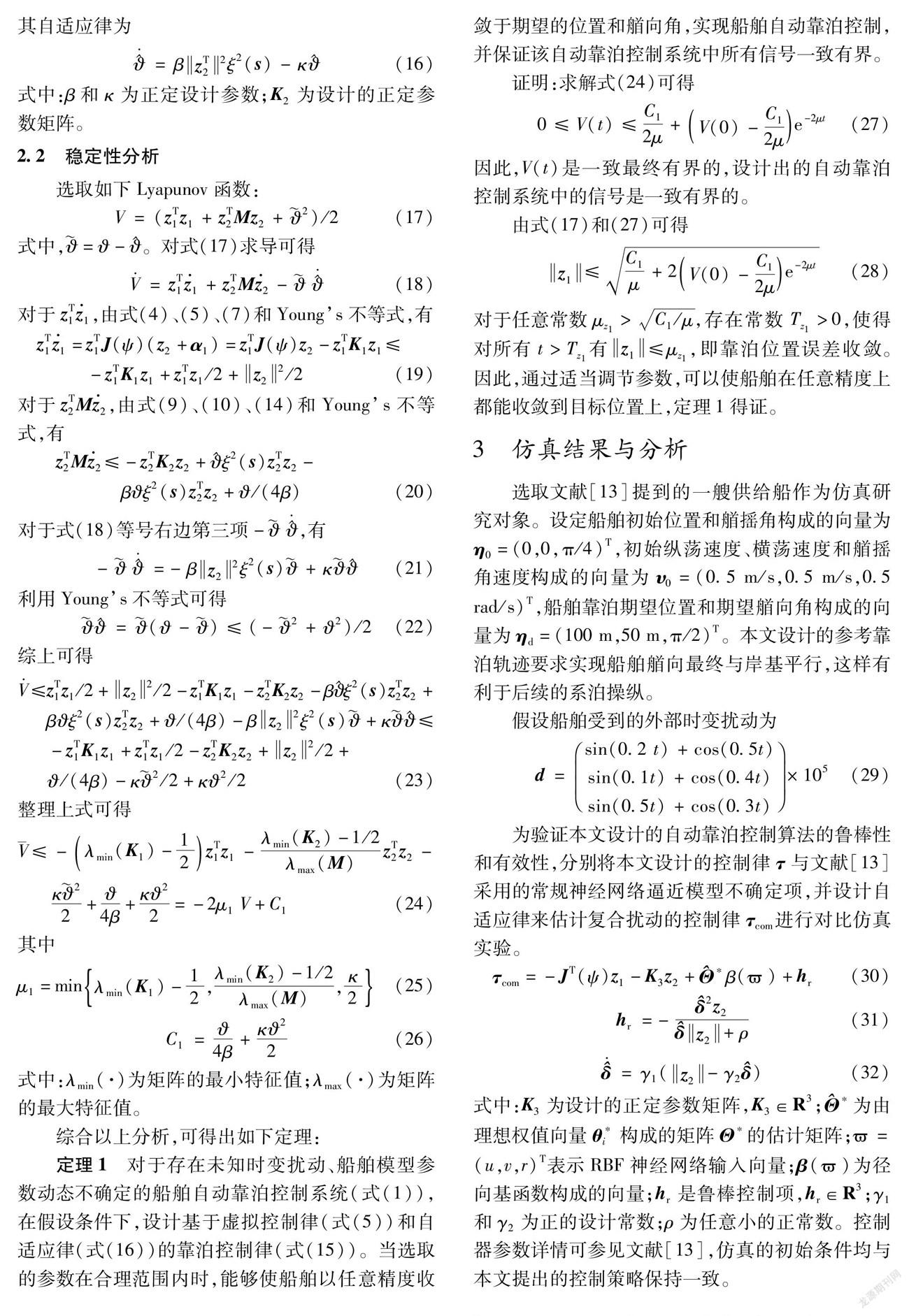
選取文獻[13]提到的一艘供給船作為仿真研究對象。設定船舶初始位置和艏搖角構成的向量為
[WTHX]η[WTBX]0=(0,0,π/4)T,初始縱蕩速度、橫蕩速度和艏搖角速度構成的向量為
[WTHX]υ[WTBX]0=(0.5 m/s,0.5 m/s,0.5 rad/s)T,船舶靠泊期望位置和期望艏向角構成的向量為
[WTHX]η[WTBX]d=(100 m,50 m,π/2)T。本文設計的參考靠泊軌跡要求實現船舶艏向最終與岸基平行,這樣有利于后續的系泊操縱。
假設船舶受到的外部時變擾動為
為驗證本文設計的自動靠泊控制算法的魯棒性和有效性,分別將本文設計的控制律
[WTHX]τ[WTBX]與文獻[13]采用的常規神經網絡逼近模型不確定項,并設計自適應律來估計復合擾動的控制律
[WTHX]τ[WTBX]com進行對比仿真實驗。
[WTHX]θ[WTBX]*i構成的矩陣[WTHX]Θ[WTBX]*的估計矩陣;=(u,v,r)T表示RBF神經網絡輸入向量;[WTHX]β[WTBX]()為徑向基函數構成的向量;
[WTHX]h[WTBX]r是魯棒控制項,
[WTHX]h[WTBX]r∈R3;γ1和γ2為正的設計常數;ρ為任意小的正常數。控制器參數詳情可參見文獻[13],仿真的初始條件均與本文提出的控制策略保持一致。
仿真結果見圖2~9。由圖2可知,在兩種控制律作用下,船舶都可以克服外部擾動,沿著期望軌跡航行,最終靠泊在目標泊位。圖3表示兩種控制算法的控制輸出,表明設計的控制器控制平穩,且控制輸出在合理范圍內。由圖4~7可知:相比于控制律
[WTHX]τ[WTBX],在控制律
[WTHX]τ[WTBX]com作用下船舶跟蹤上期望軌跡需要更長的時間,且在控制律
[WTHX]τ[WTBX]com作用下的船舶運動速度收斂較慢。從圖6可以看到,相比于控制律
[WTHX]τ[WTBX],在控制律
[WTHX]τ[WTBX]com作用下船舶艏向角調節需要的時間更長,控制精度更低。圖8說明選取的自適應參數合適,能對未知時變擾動和神經網絡誤差逼近值進行有效估計。
上述結果表明,針對存在未知時變擾動和模型參數動態不確定的船舶自動靠泊控制問題,本文設計的自動靠泊控制算法取得了良好的控制效果。與文獻[13]中的控制策略相比:一方面,船舶靠泊運
動速度更快,定位誤差更小,符合靠泊操縱的安全性和準確性要求;另一方面,本文通過引入一種虛擬參數的思想,將未知時變擾動和模型參數動態不確定性構成的復合不確定項用帶有唯一參數的參數化形式表示,只需在線學習一個參數,使得整個設計過程計算量較小,易于工程實現。
4 結束語
本文研究了存在未知時變擾動和模型參數動態不確定的船舶自動靠泊控制問題,引入RBF神經網絡逼近模型動態不確定部分,采用虛擬參數學習方法和間接神經自適應方法,提出一種新的間接神經自適應的靠泊控制策略。仿真實驗證明,設計的靠泊控制器可以使船舶克服外部未知時變擾動,將最終姿態鎮定控制在目標位置,體現了控制算法的有效性和魯棒性。
參考文獻:
[1]張強, 張顯庫. 船舶自動靠泊控制研究綜述[J]. 大連海事大學學報, 2015, 41(3): 1-9. DOI: 10.16411/j.cnki.issn1006-7736.2015.03.001.
[2]DO K D, PAN J. Underactuated ships follow smooth paths with integral actions and without velocity measurements for feedback: theory and experiments[J]. IEEE Transactions on Control Systems Technology, 2006, 14(2): 308-322. DOI: 10.1109/TCST.2005.863665.
[3]張強. 船舶自動靠泊簡捷非線性魯棒控制[D]. 大連: 大連海事大學, 2018.
[4]代昌盛. 欠驅動船舶運動的自適應迭代滑模控制研究[D]. 大連: 大連海事大學, 2017.gzslib202204031044[5]AHMED Y A, HASEGAWA K. Implementation of automatic ship berthing using artificial neural network for free running experiment[C]∥9th IFAC Symposium on Control in Transportation Systems. The International Federation of Automatic Control, 2013, 46(33): 25-30. DOI: 10.3182/20130918-4-JP-3022.00036.
[6]AHMED Y A, HASEGAWA K. Automatic ship berthing using artificial neural network based on virtual window concept in wind condition[C]∥13th IFAC Symposium on Control in Transportation Systems. The International Federation of Automatic Control, 2012, 45(24): 286-291. DOI: 10.3182/20120912-3-BG-2031.00059.
[7]MIZUNO N, TAMAI Y, OKAZAKI T, et al. A ships minimum-time maneuvering system using neural networks[C]∥Conference of the IEEE Industrial Electronics Society. IEEE, 2002: 1848-1853. DOI: 10.1109/IECON.2002.1185252.
[8]OKAZAKI T, OHTSU K. A study on ship berthing support system: minimum time berthing control[C]∥IEEE International Conference on Systems. IEEE, 2008: 1522-1527.
[9]FOSSENT I. Handbook of marine craft hydrodynamics and motion control[M]. Trondheim, Norway: John Wiley, 2011:
285-342.
[10]FOSSEN T I. A nonlinear unified state-space model for ship maneuvering and control in a seaway[J]. International Journal of Bifurcation and Chaos, 2005, 15(9): 2717-2746. DOI: 10.1142/S0218127405013691.
[11]PARK B S, KWON J W, KIM H. Neural network-based output feedback control for reference tracking of underactuated surface vessels[J]. Automatica, 2017, 77: 353-359. DOI: 10.1016/j.automatica.2016.11.024.
[12]高守軍. 岸壁效應與船舶安全操縱[J]. 天津航海, 2019(2): 24-27.
[13]DU J L, HU X, KRSTIC'
M, et al. Robust dynamic positioning of ships with disturbances under input saturation[J]. Automatica, 2016, 73: 207-214. DOI: 10.1016/j.automatica.2016.06.020.
[14]MUHAMMAD S, DRIA-CEREZO A. Passivity-based control applied to the dynamic positioning of ships[J]. IET Control Theory and Applications, 2012, 6(5): 680-688. DOI: 10.1049/iet-cta.2010.0554.
[15]MIZUNO N, KURODA M, OKAZAKI T, et al. Minimum time ship maneuvering method using neural network and nonlinear model predictive compensator[J]. Control Engineering Practice, 2007, 15(6): 757-765. DOI: 10.1016/j.conengprac.2007.01.002.
[16]WANG D, HUANG J. Neural network-based adaptive dynamic surface control for a class of uncertain nonlinear systems in strict-feedback form[C]∥Proceedings of the 40th IEEE Conference on Decision and Control. IEEE, 2005: 2156-2167. DOI: 10.1109/TNN.2004.839354.gzslib202204031044[17]IM N K, HASEGAWA K. A study on automatic ship berthing using parallel neural controller (2nd report): motion identification considering lateral speed and angular velocity to cope with disturbances[J]. Journal of the Kansai Society of Naval Architects of Japan, 2002, 237: 65-70.
[18]IM N K, NGUYEN V S. Artificial neural network controller for automatic ship berthing using head-up coordinate system[J]. International Journal of Naval Architecture and Ocean Engineering, 2018, 10(3): 235-249. DOI: 10.1016/j.ijnaoe.2017.08.003.
[19]LI T S, LI R H, LI J F. Decentralized adaptive neural control of nonlinear interconnected large-scale systems with unknown time delays and input saturation[J]. Neurocomputing, 2011, 74(14/15): 2277-2283. DOI: 10.1016/j.neucom.2011.03.005.
[20]祝貴兵. 水面船舶魯棒自適應航跡跟蹤控制研究[D]. 大連: 大連海事大學, 2019.
(編輯 賈裙平)
收稿日期: 2020-12-24
修回日期: 2021-03-15
基金項目:
大連市軟科學研究計劃(2019J11CY014)
作者簡介:
猜你喜歡
童話王國·奇妙邏輯推理(2024年5期)2024-06-19 16:03:38
艦船科學技術(2022年14期)2022-09-22 03:07:40
船舶(2021年4期)2021-09-07 17:32:22
中學生數理化·七年級數學人教版(2020年10期)2020-11-26 08:24:50
數學物理學報(2020年2期)2020-06-02 11:29:24
小哥白尼(趣味科學)(2019年10期)2020-01-18 09:16:22
藝術啟蒙(2018年7期)2018-08-23 09:14:18
海峽姐妹(2017年7期)2017-07-31 19:08:17
Coco薇(2017年5期)2017-06-05 08:53:16
光學精密工程(2016年6期)2016-11-07 09:07:19