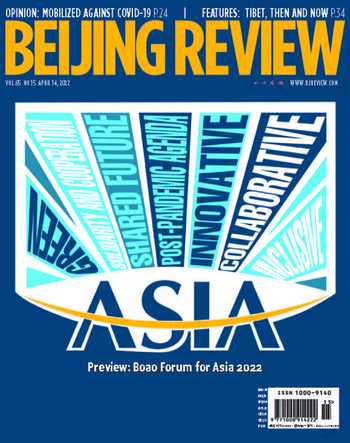
TEAMWORK MAKES THE DREAM WORK
2022-04-13 00:47:36ByCaoLi&ChenYanjun
Beijing Review 2022年15期
By Cao Li & Chen Yanjun
The year 2021 saw the world economy largely bounce back to its pre-pandemic levels, but the recovery pace may decelerate this year. COVID-19 resurgences, the Russia-Ukraine conflict and hiking global inflation all weigh on the global outlook for 2022.
There is positive movement in regional integration, while Asia remains the key driver of global growth, accounting for over 47 percent of the world’s GDP at purchasing power parity. According to the Asian Development Bank, intraregional trade in the Asia-Pacific amounted to 58.5 percent of total regional trade—a record high since 1990.
Regional integration has been a theme of the Boao Forum for Asia(BFA). During the process of soliciting opinions on the theme for this year’s annual conference, all stakeholders called for unity and trust, keeping their eye on deeper cooperation and continuous progress.
What the BFA advocates is that with globalization slowing down and regionalization picking up as evidenced by the entering into force of the Regional Comprehensive Economic Partnership (RCEP)—the world’s largest free trade agreement (FTA) consisting of 15 Asia-Pacific countries—plus the teamwork in the fight against the pandemic, Asian economies can work together. Casting aside prejudice and differences, their joining forces not only empowers global recovery, but also helps them catch the huge benefits multilateralism can deliver to each nation, the region and the world.
Narrowing development disparity should top the Asian agenda. Put forward by President Xi Jinping at the General Debate of the 76th Session of the UN General Assembly in 2021, the Global Development Initiative—with innovation, coordination, green, openness and sharing as its core concepts—has given direction to how Asia can act in concert.
On green development, the BFA applauds the outcomes of the UN Climate Change Conference in Glasgow, the UK, and the UN Biodiversity Conference in Kunming last year, both of which contributed to paving the way toward eco-friendly growth. At the Kunming conference, China announced an initiative to establish a fund to support biodiversity protection in developing countries.
Owing to its high dependency on coal and huge energy demand to unleash its growth potential, Asia is the world’s biggest carbon emitter. Most Asian countries have risen to the challenge through national pledges, green governance, as well as via corporate actions. One of the examples is that in 2020, Asia continued to drive new energy installations accounting for nearly 23 percent of global new capacity.
The world needs Asia to take bolder and quicker steps. To that end, green finance and technology transfer from developed countries to developing Asia is an indispensable element, given the capital- and technologyintensive nature of the green industry. Global carbon pricing and trading mechanisms, which help channel funds to cash-strapped developing countries and mitigate trade frictions brought on by the cross-border carbon tax, are also key to achieving net-zero emission in the world.
The greater good could not be accomplished without global endeavors. As illustrated in the BFA’s annual flagship report Sustainable Development: Asia and the World—Asia in Action Towards Green Transition, the most vital aspect of green growth is to properly balance decarbonization with economic growth and social stability. More efforts, domestic and international, should be made to promote the replacement of traditional energy sources with clean ones and of brown assets with green ones. Unfortunately, increasing uncertainties in the global value chain today pose major threats to the global green transition.
The digital economy has become a new engine fueling global economic recovery amid the pandemic. According to the UN Conference on Trade and Development, 63 percent of the world’s trade in services was digitally delivered in 2020. Amid the pandemic, many nations, particularly those in Asia, have taken steps to promote research and development in the information and communication technology sector, enhance digital infrastructure and empower industries through digital transformation.
Meanwhile, the major FTAs signed in the past two to three years, like the U.S.-Mexico-Canada Agreement, the 11-member Comprehensive and Progressive Agreement for TransPacific Partnership and the RCEP, all set out new rules for digital trade. A new type of FTAs has also been sealed to strictly promote digital trade, including the Digital Economy Partnership Agreement and the U.S.-Japan Digital Trade Agreement, among others.

How to avoid the downside of the digital technology while reaping its benefits features high on the policymaking agenda. Measures have been adopted in terms of the protection of personal privacy and data security, anti-monopoly and promotion of fair competition, as well as the imposition of the digital tax. Massive changes in the regulatory environment of online platforms have already appeared across the U.S., Europe and China.
How to maximize data value while protecting privacy and security and promote cross-border data inflow through technology innovation, if there are ways to measure big tech’s real production cost, and whether factors such as gross merchandise volume and active user numbers can be used as proof of monopoly, are all underlying matters requiring further study.
Though the global economy has emerged from the pandemic-induced recession, the recovery remains imbalanced. COVID-19 has hugely impacted the economic development and social life of countries worldwide, while producing many new business forms and models.
According to a survey by BFA’s research partner Caijing Think Tank last March and a BFA Academy survey among its members and partners last November, respondents generally believed China’s growth might decelerate, but its resilience to external shocks is strong. They expect that effective measures can advance precise pandemic prevention and control; improve income growth expectations to boost consumption; and promote effective investment, public and private, as well as explore the vitality of innovation. New energy, information technology services, intelligent connected vehicles, and biological products and medicine may greatly add to investor appeal.
When asked about supply chain restructuring, over 80 percent of respondents said they had not changed their long-term China investment strategy; 9.76 percent indicated they would move some production capacity to Southeast Asia; 2.44 percent chose Central Asia and Asia as alternative destinations. This demonstrates just how China still attracts multinational companies based on its fully established industrial chain, industrial clusters, and a massive consumer market; at the same time, China’s production integration with Southeast Asia has continuously intensified.
The business community is on high alert by new variables that might pop up throughout the decision-making process, including spillover effects of monetary policies in major economies, the Russia-Ukraine conflict and the new COVID-19 flare-ups.
Many experts and business people working with the BFA believe China’s growth rate this year may be lower than last year. The country’s economic development is facing the triple pressures of shrinking demand, supply shocks and weakening expectations. In particular, there is considerable downward pressure on demand for exports and real estate in the short term. However, in the medium and long term, they share the belief that the sheer size of China’s economy makes it highly resilient. As the world’s largest market, the country remains a priority for multinational companies. BR