
基于鏈路預測的智能紡織品技術融合趨勢研究
2022-06-22 14:52:36鄭巧巧虎陳霞徐茜
絲綢 2022年6期
鄭巧巧 虎陳霞 徐茜
摘要:技術融合是傳統產業實現技術升級的重要手段。本文基于德溫特專利數據庫中的15 125項智能紡織品發明專利,運用技術生命周期、社會網絡、鏈路預測等方法,從技術領域發展前景、技術融合應用現狀、融合機會預測三個方面,對跨領域技術融合在智能紡織領域的發展現狀和趨勢進行了深入研究。結果表明:智能紡織領域正處于技術發展成熟期,該領域發明專利預計將達21 667項,發展前景良好;跨領域技術融合在智能紡織領域的應用日益廣泛,其中數字計算機是智能紡織領域開展跨領域技術融合的重點,已與家用電器等技術領域建立穩定的融合關系;分層產品、電話和數據傳輸系統等技術領域在后續的技術創新活動中將扮演重要角色。
關鍵詞:技術融合;智能紡織品;鏈路預測;技術生命周期;社會網絡;德溫特專利數據庫
中圖分類號:F407.81文獻標志碼:A文章編號: 10017003(2022)06001007
引用頁碼: 061102
DOI: 10.3969/j.issn.1001-7003.2022.06.002(篇序)
基金項目:作者簡介:鄭巧巧(1998),女,碩士研究生,研究方向為技術創新與環境管理。通信作者:虎陳霞,副教授,hcx115@163.com。
隨著領域間技術交流的持續推進,技術創新逐漸朝著多元化、復合化方向發展,技術融合作為一種能實現多領域技術合作與交流的技術創新方法,其應用的廣度與深度正不斷加強,為產業技術升級提供了新思路。技術融合這一概念最早由Rosenberg[1]于20世紀60年代提出,他認為技術融合是指相似的技術和生產流程在不同產業中的應用。在接下來的幾十年間,許多學者對技術融合提出了新的見解[2-4]。后來,技術融合作為一種重要的技術創新手段,在許多產業中得以應用,逐漸成為學者們開展產業技術研究的重點。Gambardella等[5]曾對電子產業開展研究,得出了技術融合有利于提升產業績效的結論;Song等[6]對工業安全領域的技術融合情況進行分析,證實了技術融合是實現工業安全的有效途徑;羅愷等[7]將Latent Dirichlet Allocation(LDA)主題模型與社會網絡理論相結合,用以分析關節機器人領域的技術發展現狀,最終得出該領域的宏觀、微觀技術融合特征。由此可見,技術融合的相關研究對產業技術創新決策具有重要意義。
面對瞬息萬變的市場需求,敏銳地感知市場動向是企業獲利的關鍵。而掌握技術融合的發展趨勢恰能幫助企業捕捉技術熱點并預測潛在的技術融合機會,從而制定出可靠的創新戰略。當前主流的定量技術預測方法有兩類:一是基于知識單元重組的預測方法;二是基于鏈路預測和機器學習的方法[8]。其中鏈路預測方法的適用范圍很廣,許多學者都曾將鏈路預測應用到不同領域的研究中,如劉俊婉等[9]和雷鳴等[10]分別將鏈路預測應用到了深度學習領域和醫學領域。而在鏈路預測算法中,基于相似性的鏈路預測算法的應用領域是最為廣泛的[11]。
隨著第四次工業革命的興起,傳統產業正面臨產業升級與技術創新的挑戰,亟需相關研究為其指引技術發展方向。紡織業是其中極具代表性的產業。長期以來,中國紡織業憑借產品種類齊全、人工成本較低的優勢占據著國際紡織市場的競爭高地,但近年來,由于人口紅利消失、制造成本上升等原因,競爭優勢逐漸弱化。同時,隨著傳統紡織品的競爭空間日益縮小,以智能化為導向的智能紡織品備受追捧,使許多紡織企業遇到了技術升級的難關。因此,本研究以紡織業為例,基于智能紡織品專利數據,應用技術生命周期和社會網絡理論探究智能紡織領域所處的技術發展階段及跨領域技術融合的應用現狀,進而預測該領域的技術發展前景,最后運用鏈路預測算法預測智能紡織領域的潛在融合關系,以期為紡織企業的創新決策提供建議。
1 方案設計
1.1 研究思路
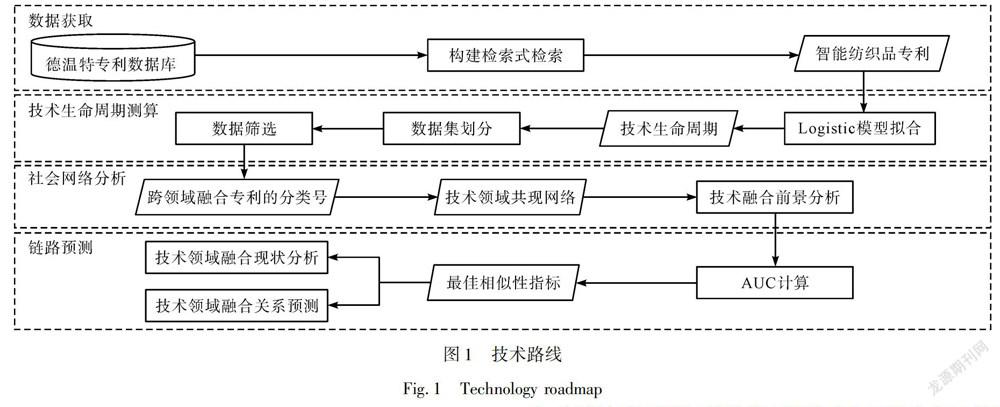
首先,應用技術生命周期理論分析專利總量的周期性規律,并判斷智能紡織領域所處的技術發展階段;其次,按照技術生命周期的特點劃分數據集,取出各數據集中實現跨領域技術融合的專利的德溫特分類代碼,并據此繪制共現網絡,隨后計算各網絡的網絡整體指標,依據網絡整體指標的變化趨勢判斷跨領域技術融合在智能紡織領域的應用前景;然后,以Area Under Curve(AUC)為標準確定各階段的最佳相似性指標,并取各階段中相似度最大的15對技術領域作為該階段的主要融合關系,通過不同階段間主要融合關系的差異,判斷技術熱點的變化;最后,基于最后一階段的網絡信息預測下一階段可能出現的融合關系。技術路線如圖1所示。
1.2 研究方法
1.2.1 技術生命周期
技術生命周期表達了技術發展的周期性特征,包含導入期、成長期、成熟期、衰退期四個階段[12]。
當前基于專利信息判斷技術生命周期的方法有很多,李春燕[12]將其歸納為五類:專利指標法、S曲線法、相對增長率法、技術生命周期圖法、TCT計算法。其中,S曲線法和TCT計算法為定量研究方法,可以計算出生命周期中的具體數值,但TCT計算法主要用于研究單件專利的技術生命周期,計算技術領域的生命周期時常采用S曲線法。本研究采用S曲線法中的Logistic曲線模型[13-14],模型方程為:4EAFA7D6-BE52-47B1-9919-0D0AAEDED6CD
f(t)=k1+a×e-r×t(1)
式中:f(t)為專利總量;t為時間序列;k、a、r為常數,k為容納量,表示能達到的最大專利總量;a為曲線的成長率;r為瞬時增長率。
1.2.2 社會網絡理論
社會網絡理論起始于20世紀30年代,在此后的幾十年間,社會網絡理論在眾多領域得以發展,形成了一套系統的研究方法。社會網絡理論以網絡的節點及連邊為研究對象,能將抽象的關系轉化為直觀的網絡圖譜,使關系得以量化,是當前重要的研究方法。本研究選取了平均度、網絡密度、平均聚集系數這三個網絡整體指標,作為網絡宏觀分析的依據。
1.2.3 鏈路預測
鏈路預測的目的是通過已知的節點和連邊信息預測潛在連邊形成的可能性。當前研究鏈路預測的算法有很多,其中,基于局部相似性指標的鏈路預測算法應用最為廣泛且操作更為便捷[11]。但值得注意的是,局部相似性指標并不唯一,且當同一指標應用于不同數據集時,其精度可能存在差異。所以,為了獲得更佳的分析和預測結果,本研究選取了5項相似性指標以供選擇,分別是Adamic Adar(AA)[15]、Common Neighbors(CN)[16]、Preferential Attachment(PA)[17]、Resource Allocation(RA)[18]和Total Neighbors(TN),具體公式如表1所示。
本研究的精度評價指標為AUC,表示預測為正的概率值比預測為負的概率值要大的可能性,即將已有連邊記作1,潛在連邊記作0,則已有連邊構成了正例,潛在連邊構成了負例。從正例中取出一條連邊,將該連邊對應的相似度記作a1,負例中取出一條潛在連邊,將該連邊對應的相似度記作a2,比較兩者大小。當a1>a2時,記作1分;當a1=a2時,記作0.5分;當a1
2.4 智能紡織品跨領域技術融合熱點與趨勢分析
2.4.1 相似性指標評估
本研究選取了5項相似性指標,分別是AA、CN、PA、RA和TN,并分別計算三個網絡中已有連邊及潛在連邊的相似度,然后利用AUC評估5項相似性指標的精度,最后選取各階段中精度最高的相似性指標用于后續的分析與預測。
由表3可知,本研究選用的5項相似性指標的AUC值都高于0.85,但三個階段中RA指標的精度均高于其他相似性指標,所以三階段都將選用RA指標進行分析。
2.4.2 跨領域技術融合熱點分析
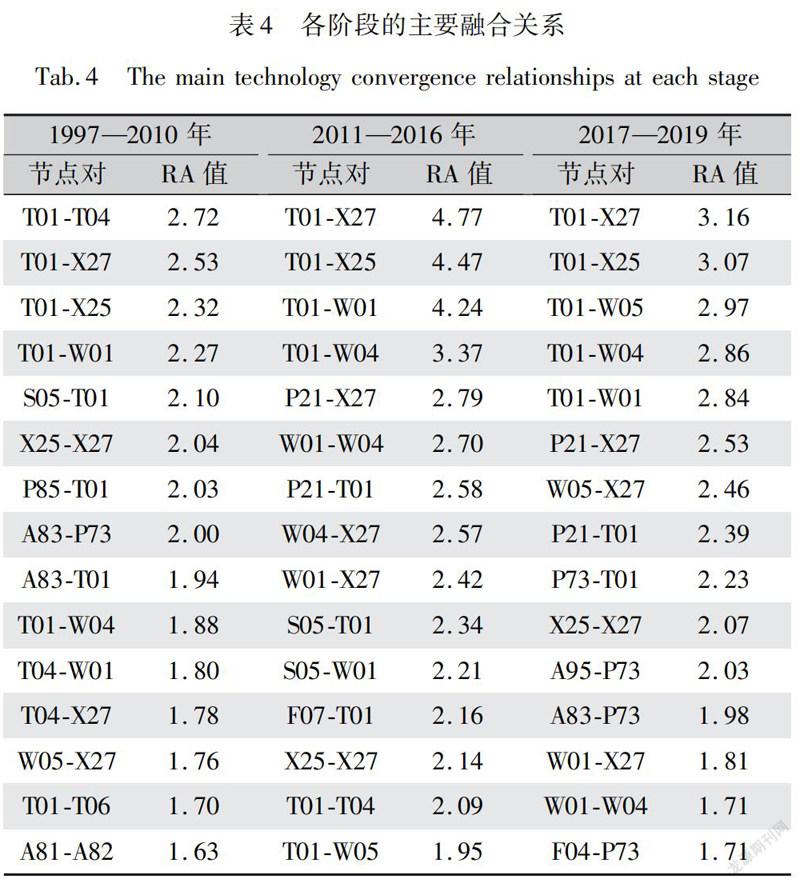
每階段選取15對相似度最高的技術領域作為該階段的主要融合關系(表4),對比不同階段的主要融合關系的異同,可知產業技術發展過程中技術熱點的變化。
由表4可知,T01-X27、T01-X25、T01-W01、T01-W04和X25-X27在三個階段中都屬于主要融合關系,其中前4對技術領域的相似度較穩定,始終維持在較高水平;而X25-X27的相似度總體呈現下滑趨勢,可見在后兩階段,紡織產業對X25-X27的關注度有所下降。但整體而言,這些技術領域組合出現的頻率仍然很高,企業可繼續強化這些技術領域間的合作。P85-T01、A83-T01、T04-W01、T04-X27、T01-T06、A81-A82、W04-X27、S05-W01和F07-T01是僅出現于第一階段或前兩階段的主要融合關系,說明技術領域間的合作是動態的,存在明顯的階段性差異。同時,由于企業在導入期尚未完全把握市場需求,沒有形成完備的技術體系,所以導入期與成長期之間的技術調整更為明顯。P21-X27、P21-T01、T01-W05、W01-W04和W01-X27是于第二階段首次出現在表4中的主要融合關系,其中,前三對融合關系在第三階段仍然保持著較高的相似度,發展前景良好,企業可以在這些融合關系中投入較多的研發精力;而后兩對融合關系在第三階段的相似度下降明顯,鑒于技術創新的風險性,企業應先考慮自身抗風險能力,再考慮是否繼續開展相關技術領域的研發工作。第三階段新增的主要融合關系,如P73-T01、A95-P73、F04-P73,同樣面臨著機遇與風險并存的局面。
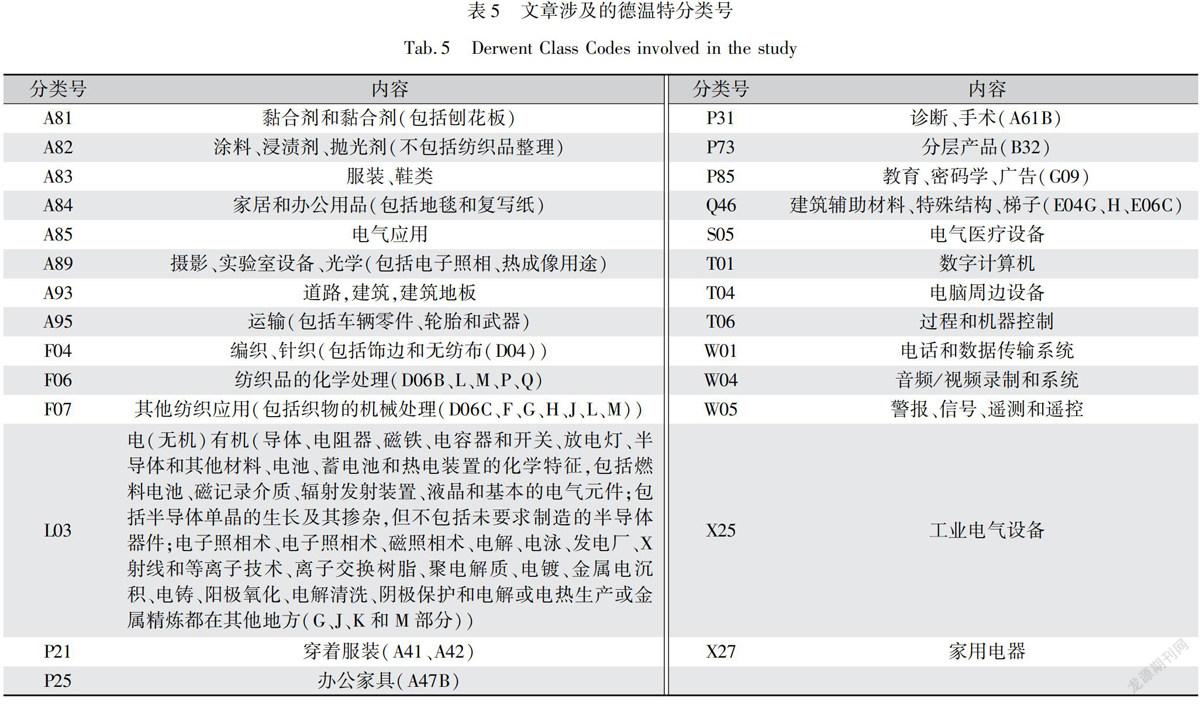
結合表4和表5可以發現,T01(數字計算機)一直是智能紡織領域開展技術創新的重點,并且該領域正不斷嘗試與其他技術領域建立新的融合關系,尤其是與通訊設備及計算機外圍設備相關的技術領域。同時,A83(服裝、鞋類)、P21(穿著服裝)等技術領域也頻繁與其他技術領域建立融合關系,說明智能穿戴設備逐漸成為智能紡織品的重點研發方向。
2.4.3 技術領域融合機會預測
為向企業提供技術創新的新方向,本研究計算了第三階段中潛在連邊的RA值(表6),通過相似度大小判斷下一階段節點間產生新連邊的可能性。
由表6可知,在智能紡織領域的后續創新活動中,P73-W05、P73-S05、A83-W01、P73-Q46、P21-P25、A89-W01、A93-T01和P25-X25這幾對技術領域間極可能建立新融合關系。其中,P73(分層產品)將嘗試與電氣醫療設備及基礎建設相關的技術領域開展合作。同時,研究發現潛在融合關系中涉及的技術領域大多曾出現在表4中,可見技術融合的熱門領域是相對穩定的,當兩個技術領域建立融合關系并取得成功后,將嘗試與其他技術領域建立聯系,有較大的技術發展潛力。本研究還對潛在融合關系中涉及的技術領域進行頻數統計(表7),發現P73的頻數顯著大于其他技術領域,所以P73可能是智能紡織領域下一階段的研發重點,若嘗試建立P73與其他領域間的新融合關系,預計會帶來較大的經濟價值。
4 結 論
通過運用技術生命周期、社會網絡、鏈路預測等方法對德溫特專利數據庫中的15 125項智能紡織品發明專利開展研究,分析了智能紡織領域的技術發展前景,以及跨領域技術融合在智能紡織領域的應用現狀和技術熱點,并預測了下一階段技術領域間的潛在融合關系,可得到如下結論。
1) 智能紡織領域正處于技術發展成熟期,該領域的發明專利預計將達21 667項,發展前景良好。雖然專利數量的增長速度有所放緩,但每年的專利申請量仍然可觀,企業可繼續嘗試不同技術領域間的合作與交流。
2) 跨領域技術融合在智能紡織領域的應用日益廣泛,其中數字計算機是智能紡織領域開展跨領域技術融合的重點,已與家用電器等技術領域建立穩定的融合關系。對于技術發展過程中較為穩定的融合關系,如T01-X27(數字計算機-家用電器)、T01-X25(數字計算機-工業電氣設備)等,企業可投入更多的研發成本,強化技術領域合作。
3) P73(分層產品)、P21(穿著服裝)、A89(攝影、實驗室設備、光學,包括電子照相、熱成像用途)和W01(電話和數據傳輸系統)在后續的技術創新活動中將扮演重要角色,極有可能與其他技術領域形成新融合關系,其中分層產品是實現突破性創新的關鍵。當然,嘗試兩個技術領域間的新融合將面臨較大的研發風險和市場風險,企業還需要綜合考慮自身的發展狀況和抗風險能力再做決策。
參考文獻:
[1]ROSENBERG N. Technological change in the machine tool industry, 1840-1910[J]. Journal of Economic History, 1963, 23(4): 414-443.
[2]AN O. Green paper on the convergence of the telecommunications, media and information technology sectors, and the implications for regulation towards an information society approach[R]. Brussels: Information Society Project Office Eu, 1997.4EAFA7D6-BE52-47B1-9919-0D0AAEDED6CD
[3]KODAMA F. Technology fusion and the new R & D[J]. Harvard Business Review, 1992, 70(4): 353-354.
[4]湯文仙. 技術融合的理論內涵研究[J]. 科學管理研究, 2006, 24(4): 31-34.
TANG Wenxian. Exploration on theory of technology convergence[J]. Scientific Management Research, 2006, 24(4): 31-34.
[5]GAMBARDELLA A, TORRISI S. Does technological convergence imply convergence in markets? Evidence from the electronics industry[J]. Research Policy, 1998, 27(5): 445-463.
[6]SONG B, SUH Y. Identifying convergence fields and technologies for industrial safety: LDA-based network analysis[J]. Technological Forecasting & Social Change, 2019, 138: 115-126.
[7]羅愷, 袁曉東. 基于LDA主題模型與社會網絡的專利技術融合趨勢研究: 以關節機器人為例[J]. 情報雜志, 2021, 40(3): 89-97.
LUO Kai, YUAN Xiaodong. A study on the technology convergence trend of patent based on LDA and social network: An example of joint robot[J]. Journal of Intelligence, 2021, 40(3): 89-97.
[8]張洋, 林宇航, 侯劍華. 基于融合數據和生命周期的技術預測方法: 以病毒核酸檢測技術為例[J]. 情報學報, 2021, 40(5): 462-470.
ZHANG Yang, LIN Yuhang, HOU Jianhua. Technology prediction method based on data fusion and life cycle: Empirical analysis of virus nucleic acid detection[J]. Journal of the China Society for Scientific and Technical Information, 2021, 40(5): 462-470.
[9]劉俊婉, 龍志昕, 王菲菲. 基于LDA主題模型與鏈路預測的新興主題關聯機會發現研究[J]. 數據分析與知識發現, 2019, 3(1): 104-117.
LIU Junwan, LONG Zhixin, WANG Feifei. Finding collaboration opportunities from emerging issues with LDA topic model and link prediction[J]. Data Analysis and Knowledge Discovery, 2019, 3(1): 104-117.
[10]雷鳴, 夏夢鴿, 汪雪鋒, 等. 基于鏈路預測的協同藥物組合推薦研究: 面向疾病并發癥診療[J]. 圖書情報工作, 2021, 65(12): 122-129.
LEI Ming, XIA Mengge, WANG Xuefeng, et al. Research on drug combination recommendation based on link prediction for concurrent diseases treatment[J]. Library and Information Service, 2021, 65(12): 122-129.
[11]李艷麗, 周濤. 鏈路預測中的局部相似性指標[J]. 電子科技大學學報, 2021, 50(3): 422-427.
LI Yanli, ZHOU Tao. Local similarity indices in link prediction[J]. Journal of University of Electronic Science and Technology of China, 2021, 50(3): 422-427.
[12]李春燕. 基于專利信息分析的技術生命周期判斷方法[J]. 現代情報, 2012, 32(2): 98-101.
LI Chunyan. The distinguishing methods of technology life cycle based on patent analysis[J]. Journal of Modern Information, 2012, 32(2): 98-101.
[13]方曦, 張莉萍. 國內外新能源汽車充電樁技術預測分析: 基于生命周期和國際專利分類號[J]. 科技管理研究, 2021, 41(8): 148-155.
FANG Xi, ZHANG Liping. Prediction and analysis on new energy vehicle charging pile technology at home and abroad: Based on lifecycle and international patent classification[J]. Science and Technology Management Research, 2021, 41(8): 148-155.4EAFA7D6-BE52-47B1-9919-0D0AAEDED6CD
[14]殷祚云. Logistic曲線擬合方法研究[J]. 數理統計與管理, 2002(1): 41-46.
YIN Zuoyun. Study on the fitting methods of Logistic curve[J]. Journal of Applied Statistics and Management, 2002(1): 41-46.
[15]ADAMIC L A, ADAR E. Friends and neighbors on the web[J]. Social Networks, 2003, 25(3): 211-230.
[16]NEWMAN M E J. Clustering and preferential attachment in growing networks[J]. Physical Review E, 2001, 64(2): 025102.
[17]BARABASI A L, ALBERT R. Emergence of scaling in random networks[J]. Science, 1999, 286(5439): 509-512.
[18]ZHOU T, LV L, ZHANG Y C. Predicting missing links via local information[J]. The European Physical Journal B, 2009, 71(4): 623-630.
[19]郭歡. 智能紡織品的研究進展及在康復輔具領域的發展前景[J]. 紡織導報, 2020(2): 81-84.
GUO Huan. Research progress of intelligent textiles and its prospects in the field of rehabilitation assistant devices[J]. China Textile Leader, 2020(2): 81-84.
Research on the trend of technology convergence for smart textile based on link prediction
ZHENG Qiaoqiao, HU Chenxia, XU Qian
(College of Economics & Management, China Jiliang University, Hangzhou 310018, China)
Abstract:The decreasing demographic dividend and rising manufacturing costs have gradually weakened Chinas competitive advantage in the international textile market, but the rise of smart textiles provides a new opportunity for the development of Chinas textile industry. Technological innovation gradually becomes a key factor affecting the development of the textile industry. In order to meet ever-changing market demands, technological innovation develops in the direction of diversification and compounding. Technology convergence as a technological innovation method that can realize technical cooperation in multiple fields is widely used in the textile field.
In order to help textile enterprises capture technological development hot spots and enhance competitiveness, this research deeply analyzes the application status and the technological development prospect of cross-domain technology convergence in the smart textile field based on 15 125 smart textile invention patents in the Derwent Innovation Index. This paper applies the technology life cycle to judge the development stage of the smart textile field. It takes the stage characteristic of the technology life cycle as the basis for dividing data sets, and extracts Derwent Class Codes of invention patents which have realized cross-domain technology convergence in each data set as the follow-up research data. The co-occurrence network of each data set is drawn based on the social network theory, and the difference between each networks overall network indicators is used as the basis for judging the application prospect of cross-domain technology convergence in the smart textile field. Then, this paper uses the link prediction algorithm based on local similarity index to define the main technology convergence relationships of each stage. The difference of each stages main technology convergence relationships is used to judge the evolutionary trend of technology convergences hot spots, and the value of local similarity index for the last stage is used to predict new technology convergence relationships. Results show that the smart textile field is in a mature stage of technological development with promising development prospects, and the number of smart textile invention patents is expected to reach 21 667. Cross-domain technology convergence is increasingly used in the smart textile field. Digital Computers is the focus of cross-domain technology convergence in the smart textile field, and it has established stable technology convergence relationships with other technical fields such as domestic electric appliances and industrial electric equipment. Enterprises can increase investment to strengthen technology convergence relationships between these technical fields. Layered products, telephone and data transmission systems, etc. will play an important role in subsequent technological innovation activities, and enterprises should fully consider their own development status and anti-risk capabilities before making R&D decisions in these technical fields.
In the information age, in the face of rapidly changing market demands, a keen awareness of market trends can help enterprises seize development opportunities and achieve success. Based on the smart textile invention patents in the Derwent Innovation Index, this paper analyzes the technological development trend of the smart textile field, hoping to provide reference for textile enterprises.
Key words:technology convergence; smart textile; link prediction; technology life cycle; social network; Derwent Innovation Index4EAFA7D6-BE52-47B1-9919-0D0AAEDED6CD
