
緯編導電織物多重性能及其制備的研究進展
2022-06-22 17:10:57王盼王朝暉
絲綢 2022年6期
王盼 王朝暉
摘要:為促進智能針織產品的設計與研發,文章系統歸納了緯編導電織物及其類別,綜述了3種不同性能導電織物作用機理及應用進展,并對其制備要點進行探討。電-力學性能織物對線圈結構依賴性極強,因其影響因素過多,無法形成統一的性能評判標準;濕度傳感織物利用織物自身、濕敏材料或導電材料親水性來實現電阻變化,因外力拉伸與濕度變化均能影響織物電阻,故制備時可增加復合層以防兩者產生耦合效應;電熱性能織物受導電材料、制備工藝及加載電壓影響,可采用鍍銀紗線或聚吡咯進行制備且前者性能優于后者。進一步指出,加強高性能纖維材料研發、改善制備工藝、加快自供電技術應用,以及建立完善的安全測試標準是智能針織產品未來的發展方向。
關鍵詞:緯編;導電織物;電-力學性能;濕度傳感;電熱性能;智能可穿戴;自供電技術
中圖分類號:TS186.2文獻標志碼:A文章編號: 10017003(2022)06005008
引用頁碼: 061107
DOI: 10.3969/j.issn.1001-7003.2022.06.007(篇序)
基金項目: 中央高校基本科研業務費專項資金資助項目(2232020G-08);上海市科學技術委員會國際合作項目(21130750100)
作者簡介:王盼(1991),女,博士研究生,研究方向為服裝先進制造。通信作者:王朝暉,教授,wzh_sh2007@dhu.edu.cn。
近年來,隨著科技的進步與經濟的發展,人們對現代紡織品的需求不再局限于防寒保暖,智能化設計已成為消費者的新需求[1-2]。智能紡織品正受到各界人士的廣泛關注,其應用領域也逐漸涉及到人們日常生活的各個方面。緯編導電織物因其獨特的組織結構與服用性能[3],成為智能紡織領域的研究重點之一。針織線圈結構不僅為導電織物提供了極好的全向拉伸性能[4],還使其具備了梭織、刺繡、無紡等其他織物無法比擬的彈性及柔軟貼體性[4]。目前研究的緯編導電織物主要利用外界刺激引起的電阻變化來實現智能化與功能化,具有結構簡單、易成形、質地輕巧、柔韌性好且可設計性強等特點[5]。其中,電-力學性能導電針織物可通過監測織物總電阻變化規律來了解織物外界受力情況,濕度傳感性能導電針織物可采用電阻率改變來表征環境濕度變化,電熱性能導電針織物可利用織物內部電阻網絡將外部電源提供的電能直接轉化為熱能。各類緯編導電織物在醫療保健、汗液監測及智能調溫等領域均具有廣泛的應用前景。
鑒于緯編導電織物具有諸多優點且應用廣泛,本文歸納了緯編導電織物的定義及其分類,綜述了緯編導電織物的電-力學性能、濕度傳感性能與電熱性能的作用機理及應用進展,探討了不同性能導電織物的制備原則與要點,并對智能針織產品未來的發展方向進行了展望。
1 緯編導電織物及其分類
1.1 緯編導電織物
緯編導電織物是指具有一定導電性能的緯編針織物,其主要通過兩種方式進行制備:一種是利用導電紗線在緯編針織機上直接編織而成[6],另一種則是在普通緯編針織物表面進行特殊處理(涂覆、印刷、浸漬等),賦予其導電性,通常以前者為主。前者多采用針織圓緯機、電腦橫機等設備進行制備,但要實現導電區域的局部定位編織時,編織設備必須具備提花與剪線功能,因無縫圓緯機可實現多處局部定位編織,可作為首選設備;電腦橫機利用其紗嘴配置及嵌花功能可實現局部區域的精確定位編織,但因其織針偏粗,在編織輕薄貼體針織物時不如圓緯機應用廣泛。后者是先將某些導電物質與分散劑、還原劑及黏合劑等按照一定比例進行混合[7],再采用涂層、浸漬等方法,將其均勻附著于針織物表面,形成連續穩定的導電層。該制備方式生產的導電針織物較前者而言缺乏整體穩定性,難以確保其附著導電物質的均勻度及耐久性。
1.2 按照導電成分進行分類
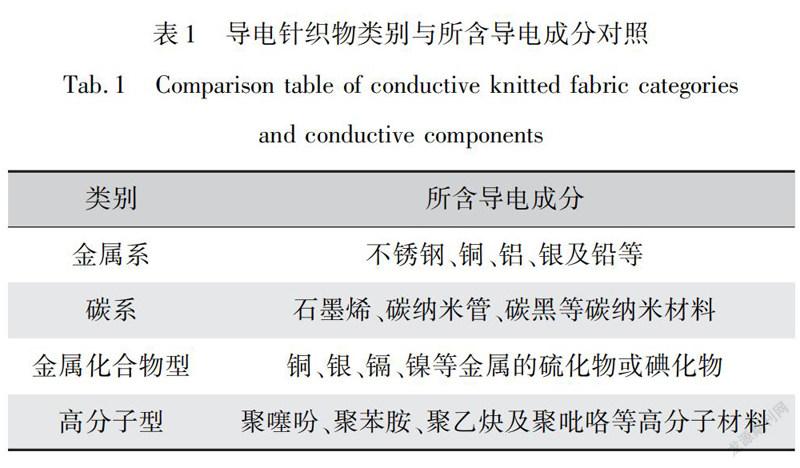
緯編導電織物根據所含導電成分不同,主要分為金屬系導電針織物、碳系導電針織物、金屬化合物型導電針織物及高分子型導電針織物四大類,如表1所示。
金屬系導電針織物具有良好的導熱性和導電性,其多采用金屬混紡紗線或外鍍金屬紗線直接編織而成,其中不銹鋼混紡與鍍銀導電針織物在紡織領域應用最為廣泛;碳系導電針織物主要利用涂層法、摻雜法或碳化處理等獲得導電性,顏色通常為黑色,導電物質容易脫落且手感較差;金屬化合物系導電針織物多采用吸附法、混合紡絲法或化學反應法制備,其導電性不如碳黑系但牢度較好;高分子型導電針織物是利用導電高分子材料實現導電行為,由于高分子型導電纖維剛度過大、難溶、難熔且成型困難[8],故該類織物主要通過涂層法制備。
2 緯編導電織物多重性能及作用機理
隨著紡織品不斷地向智能化、功能化發展,導電針織物也逐漸被賦予多重性能,目前主要包括電-力學性能、濕度傳感性能及電熱性能,這三個性能均需設計外加電路才可實現。
2.1 電-力學性能及作用機理
導電針織物的電-力學性能是指具有大應變和高彈回復性的導電針織物在承受各種外力作用時,因發生形變而呈現
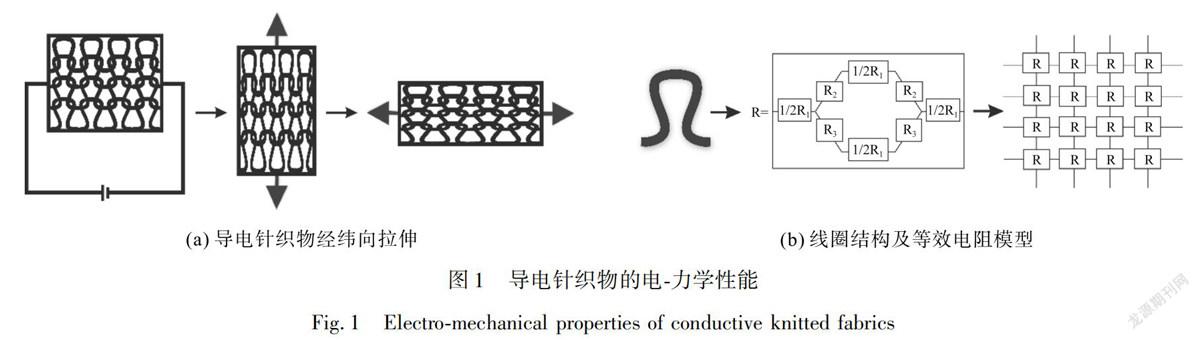
出相應的電學特征。該類織物對針織線圈結構的依賴性極強,如圖1(a)所示,導電針織物在外力作用下線圈結構發生形變導致電阻變化[9]。在整個受力過程中,線圈間接觸電阻與長度電阻變化導致織物電信號發生改變,通過監測織物總電阻變化規律即可了解織物外界受力情況。該性能可實現人體生理數據(運動、呼吸、心跳等)的實時、無感采集[10],多應用于醫療保健及運動健身領域。B48DEDB0-EFB8-41B5-B6E2-27DDC842923C
因導電針織物經緯向組織結構不同[11],其不同拉伸方向和橫縱尺寸所造成的電阻變化也存在一定差異。通常,同一導電針織物經向拉伸電阻變化范圍大于緯向[12];導電針織物的橫列數與縱行數之比越大,其靈敏度越高、性能越好;當橫縱列數相同時,緯平針組織的靈敏度最佳,1×1羅紋組織次之,2×1羅紋組織最差;緯編導電織物在經向拉伸時,其電阻先隨織物伸長呈線性上升,隨后呈緩慢上升至電阻值穩定,再呈線性下降直至趨于穩定。如圖1(b)所示,為了簡化導電針織物的線圈電路分布[13],先將線圈單元簡化為電阻六角模型(R1和R2為線圈自身長度電阻,R3為線圈間接觸電阻),再將其看做一個電阻結構單元并按照導電針織物組織結構進行橫、縱向排布,最終形成一個復雜的串并聯電路網。利用基爾霍夫電流定律(KCL)和電壓定律(KVL)對該非線性電路進行分析求解,可得到固定橫縱列數導電針織物的等效電阻。
雖然緯編導電織物電-力學性能的相關研究很多,但因其受影響因素太多(紗線種類、織物密度、組織結構、橫縱尺寸及編織工藝等),且其中任一因素發生改變均會影響現有電阻網絡模型,使得此性能織物靈敏度、線性度及應變范圍等相關性能參數難以形成統一的評判標準,因此,該類智能針織產品尚未實現大規模推廣。
2.2 濕度傳感性能及作用機理
導電針織物的濕度傳感性能是指具有一定吸水性的導電針織物在周圍濕度發生變化時,其電阻也會產生相應改變。該性能對針織結構不具依賴性,主要依靠織物自身、濕敏材料或導電材料的親水性來實現濕度傳感。該類織物主要通過電阻率改變來表征環境濕度變化[14-15],可用于監測尿失禁、傷口愈合、出汗量或服裝微氣候等方面。
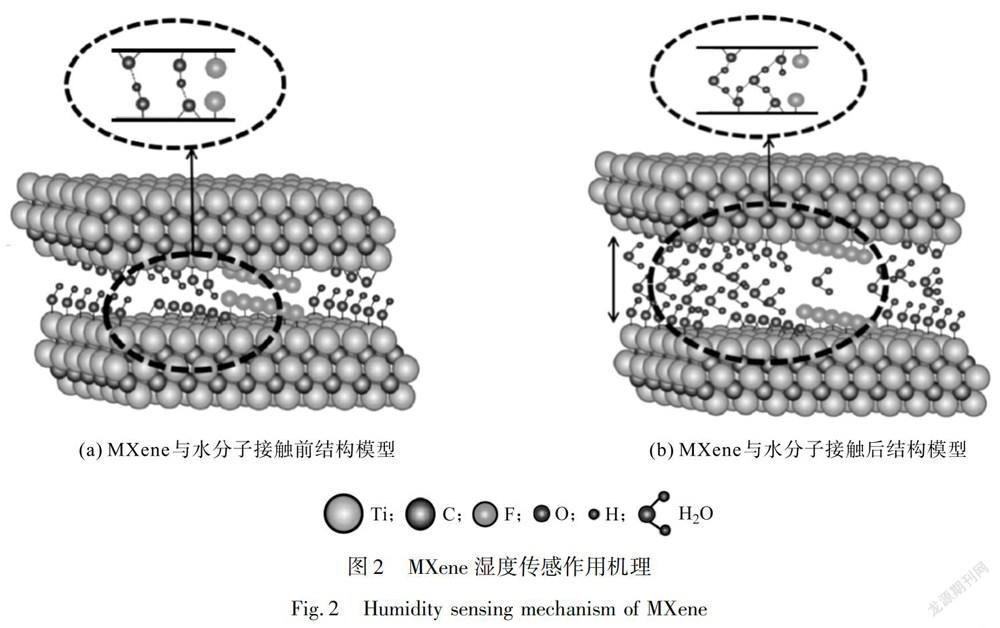
導電針織物所含導電成分不同,其作用機理亦不相同。針對大多數導電針織物而言,通常濕度越大,導電性能越好,其電阻越小,但存在少數導電針織物隨濕度增加,導電性能變差,其電阻愈來愈大。例如,用碳納米管(SWCNT)與聚乙烯醇(PVA)長絲制備的導電針織物,SWCNT具有極好導電性,而PVA長絲不導電但容易吸水膨脹[16],兩者結合后,可利用PVA在潮濕環境下發生溶脹來增加碳納米管間隙,從而使織物電阻增大。另外,經新型二維類石墨烯結構MXene處理制備的導電針織物同樣可利用MXene的導電性和親水性來實現濕度傳感[17],其作用機理如圖2所示。MXene未接觸水分子時,其上下層結構間距由—OH之間的鍵能決定;當MXene與水接觸后,水分子進入其結構層中間,與MXene的含氧官能團形成新的—OH,使得MXene結構層間的距離增加,且周圍環境濕度越大,其距離越大,從而導致含MXene導電針織物電阻增大。在潮濕條件下,導電針織物的經向和緯向表現出不同的電學行為,鑒于其緯向靈敏度和線性度更佳,故多采用導電針織物的緯向來監測電阻變化[18]。
目前緯編導電織物濕度傳感性能的研究相對較少,仍處于起步階段。因針織結構的柔軟貼體性,未來可考慮將其集成于服裝上或者利用針織全成形技術實現一體成形,以代替傳統測試方法,實現皮膚表面濕度與出汗量的實時測量。另外,若能在該性能織物表面增加一層離子選擇性薄膜或生物分子酶膜,甚至可以實現汗液成分的檢測。
2.3 電熱性能及作用機理
導電針織物的電熱性能是指導電針織物在外加電路作用下,由于電阻存在而產生通電發熱現象。該性能是利用織物內部電阻網絡將外部電源提供的電能直接轉化為熱能[19],其多應用于極地防寒服、智能家居及體育防護等領域。
若將導電針織物視作純電阻電路,由焦耳定律(式(1))可知,電流通過織物產生的熱量與電流的平方、織物電阻均成正比,這說明可通過改變電流或織物電阻來控制織物的產熱量,電流大小依靠外接電源控制,織物電阻由導電材料和制備工藝共同決定。以鍍銀紗線導電針織物為例,可采用鍍銀紗線與非導電紗線橫列間隔編織方式[20],來增加織物內部電阻,其織物結構及等效電阻如圖3所示。由熱傳遞相關理論(式(2))可知[21],電加熱導電針織物可達到的平衡溫度與其表面積、電阻成反比,而與加載電壓成正比,這表明可通過適當增大加載電壓、減小織物電阻及表面積的方式,提高導電針織物的平衡溫度。另外,導電針織物電熱性能還與其最大負載電流、熱穩定性、電熱溫升及發熱均勻性等指標相關。最大負載電流是導電針織物允許通過的最大電流[22],該值越大則織物能達到平衡溫度越高;熱穩定性可通過導電針織物達到平衡溫度時電阻變化率進行表征(式(3)),可反映織物電阻受溫度影響程度,該值越小代表織物熱穩定性越好;電熱溫升是導電針織物平衡溫度與環境溫度的差值[23],用于反映導電針織物的調溫幅度大小;發熱均勻性是衡量導電針織物電熱性能的重要指標,可通過觀測導電針織物表面溫度分布情況進行評價。
Q=I2Rt??? (1)
式中:Q為熱量;I為電流;R為導電針織物電阻;t為通電時間。
T=PhS+Ta=U2hSR+Ta(2)
式中:T為平衡溫度;P為消耗功率;S為導電針織物表面積;U為加載電壓;h為對流傳感系數;Ta為環境溫度。B48DEDB0-EFB8-41B5-B6E2-27DDC842923C
φ/%=ΔRR0×100??? (3)
式中:φ為電阻變化率;ΔR為電阻變化量;R0為導電針織物的初始電阻。
目前緯編電加熱針織物的研究較多且一些較為成熟的電加熱針織產品已經投入市場,但現有產品仍存在一些不足之處。比如,電加熱針織產品的溫控系統不夠智能化,產品多采用分檔手動調溫模式,無法根據溫度變化自動調節加熱量;電加熱針織產品主要使用充電寶進行能源供應,存在便攜性差、工作時間較短等問題。因此,未來電加熱針織產品可在全自動溫控系統設計和無線電能傳輸方面進行研究,以提升產品性能和用戶體驗。
3 緯編導電織物的制備要點
緯編導電織物性能不同,其制備工藝、原則及側重點各不相同,要根據實際應用需求,進行合理設計,以生產出性能優良的緯編導電針織產品。
3.1 電-力學性能導電針織物的制備要點
紗線原料選擇、組織結構設計、編織工藝及電壓加載方式均對導電針織物的電-力學性能具有重要影響,故其制備原則主要圍繞以下幾點展開。
1) 在紗線原料選擇方面,因該性能導電針織物需要具備優良的導電性、彈性及高度回復性[24-25],故在實際生產中,通常采用鍍銀導電紗線或不銹鋼混紡導電紗線加入氨綸彈性紗、滌綸紗等普通紗線共同執行編織,不但能增加導電織物的保形性,還能改善其電-力學性能。
2) 在織物組織結構設計方面,由于當前現有的電力學模型較為單一[26-27],故導電針織物的組織結構設計不宜過于復雜,一般采用常見的基本組織,如緯平針組織、羅紋組織及正反針組織等。
3) 在編織工藝選擇上,主要采用提花添紗和嵌花添紗兩種工藝,采用工藝不同,電壓加載方式亦不相同,如圖4所示。因采用嵌花添紗工藝編織的導電針織物,背面不存在浮線[28],故提高了導電針織物的靈敏度、穩定性與美觀性。
3.2 濕度傳感導電針織物的制備要點
與電-力性能導電針織物相比,濕度傳感導電針織物除了要具備良好的導電性外,還要具備一定吸水性、耐腐蝕性及尺寸穩定性,在其制備過程中需注意以下幾點。
1) 為避免導電針織物因長期處于潮濕環境下生銹或被氧化導致靈敏度降低[29],要選擇化學性能穩定的原料進行制備。
2) 為提高導電針織物的吸水性,要對導電針織物進行親水處理,但在選擇親水助劑時要保證其不會與導電物質產生化學反應,還要具備良好的耐久性。
3) 由于外力拉伸變形與濕度變化均能影響導電針織物電阻變化規律,故在進行織物結構設計時,可在導電針織物背面增加復合層,以限制織物橫縱向拉伸變形,防止兩者產生耦合效應。
當利用金屬導電紗線制備濕度傳感織物時,可選用不銹鋼滌綸混紡紗線以質地緊密厚實的組織結構(羅紋組織、毛圈組織等)進行制備,織片下機后將其浸入溫度為25 ℃、質量分數為20%的聚酯聚醚型親水整理劑溶液中進行親水處理[18],隨后在160 ℃的高溫下進行干燥處理,最后可獲得具有良好吸水性與導電性的濕度傳感針織物;當采用MXene制備濕度傳感織物時,先將針織物樣片置于蒸餾水中用超聲波清洗半小時進行除雜處理[30],然后將織物放入65 ℃的烘箱中烘干,隨后將其放入質量濃度為5 mg/mL的MXene溶液中,待織物表面完全被MXene顆粒包覆[31],顏色變為黑色,將其撈出并置于65 ℃烘箱中再次烘干,取出即可得到基于MXene的濕度傳感針織物。
3.3 電熱性能導電針織物的制備要點
導電針織物發熱效果主要受導電材料、制備工藝及加載電壓影響。在導電材料選擇上,多采用鍍銀紗線或聚吡咯來進行制備,兩種導電加熱織物對比如表2所示。聚吡咯涂層加熱織物在制備難易、熱穩定性方面較優,但在耐水洗性、服用性能及平衡溫度方面較差,故兩者綜合比較,鍍銀紗線制備的電加熱織物具有更大優勢。
采用鍍銀紗線與滌綸紗線制備導電發熱織物時,織物發熱均勻度跟鍍銀紗線與滌綸紗線橫列間隔排布方式相關[32],兩橫列間隔越小,發熱均勻性越好,但間隔過小會降低織物整體電阻,使其發熱效率降低,經研究發現兩者橫列比為1︰2時發熱均勻性最佳。在組織結構設計時,多采用緯平針組織、羅紋或雙羅紋組織,較少使用提花組織、襯緯組織,因襯緯組織將導電紗線作為緯紗直接襯入[33],其發熱效率較低,可根據實際需要,確定具體組織結構類型。在進行加載電壓設計時,主要考慮兩點:一是要注意不能超過導電紗線的最大負載電流[34];二是要找到最佳電壓加載位置,因電壓加載位置不同,會影響織物平衡溫度與升溫速率,所以要經過多次嘗試來確定最佳電壓加載位置。
利用液相原位聚合法進行聚吡咯涂層織物制備時[35],其基本制備步驟如下:先將針織物樣片(純棉或黏膠纖維織物)進行除雜晾曬,再將其置于一定摩爾濃度的吡咯單體溶液中進行預濕,半小時后加入適量FeCl3·6H2O溶液,使溶液中FeCl3與吡咯單體摩爾質量比為1︰2并不斷攪拌,等充分反應后,將樣布取出放入2%乙醇溶液中進行洗滌,最后將樣布撈出控干[36]。在整個制備過程中,聚吡咯涂層織物電阻隨吡咯單體溶液摩爾濃度增大而減小;隨反應時間的增加先減小后增大;隨反應溫度升高而增大,但反應溫度過高會阻礙聚合反應的進行。實踐證明,當采用0.4 mol/L的吡咯溶液、反應時間為2 h、反應溫度為室溫時,即可制備出發熱效果良好的聚吡咯涂層織物。B48DEDB0-EFB8-41B5-B6E2-27DDC842923C
4 結 語
本文綜述了緯編導電織物電-力學性能、濕度傳感性能及電熱性能的作用機理與應用進展,并探討了不同性能緯編導電織物的制備原則及要點,為導電針織產品后續的設計研發提供了理論依據與技術指導。
緯編導電織物的諸多優點使其在智能可穿戴領域占有絕對優勢,智能針織品的普及與應用已成為必然趨勢。隨著智能針織產品應用領域的拓展與大規模市場化,其在材料耐久性、結構穩定性、能源供應及產品安全性等方面的問題日益顯著,針對這些問題,本文指出了解決途徑。
1) 加強高性能纖維材料的研發。纖維材料是導電針織物的基礎,對智能針織產品的各項性能具有直接影響,研發高性能纖維材料不僅能解決材料耐久性問題,還能提高產品的其他性能,如高導電性、高彈性、耐高溫性及抗輻射性等。
2) 改善現有的制備工藝。導電針織物因其線圈結構的特殊性,經反復拉伸、洗滌會發生一定程度變形而影響自身性能,因此要采取一系列的改革措施對現有的制備工藝進行優化,以提高產品的結構穩定性。
3) 加快自供電技術應用。自供電技術可利用特殊織物將周圍環境中的各種能量(人體運動、摩擦、光能或太陽能等)收集起來并將其轉化成電能,為低功耗電子元件供電。如果將其與智能針織產品結合,既能實現零電能消耗,又能節約成本、保護環境。
4) 建立完善的安全測試標準。智能針織產品的安全性主要包括化學成分安全性、電路安全性、信息安全性、阻燃性及電磁輻射等,通過制定出相應的測試標準,以規范智能針織產品市場。
參考文獻:
[1]蔡倩文, 王金鳳, 陳慰來. 緯編針織柔性傳感器結構及其導電性能[J]. 紡織學報, 2016, 37(6): 48-53.
CAI Qianwen, WANG Jinfeng, CHEN Weilai. Structures and electrical properties of weft-knitted flexible sensors[J]. Journal of Textile Research, 2016, 37(6): 48-53.
[2]陳斌, 李娜娜, 蔡璐, 等. 導電針織物結構設計及性能研究[J]. 針織工業, 2015(6): 23-25.
CHEN Bin, LI Nana, CAI Lu, et al. Structure design of conductive fiber knitted fabric and its property analysis[J]. Knitting Industries, 2015(6): 23-25.
[3]錢鑫, 蘇萌, 李風煜, 等. 柔性可穿戴電子傳感器研究進展[J]. 化學學報, 2016, 74(7): 565-575.
QIAN Xin, SU Meng, LI Fengyu, et al. Research progress of flexible wearable electronic sensors[J]. Acta Chemica Sinica, 2016, 74(7): 565-575.
[4]SEYEDIN S, ZHANG P, NAEBE M, et al. Textile strain sensors: A review of the fabrication technologies, performance evaluation and applications[J]. Materials Horizons, 2019, 6(2): 219-249.
[5]王棟, 卿星, 蔣海青, 等. 纖維材料與可穿戴技術的融合與創新[J]. 紡織學報, 2018, 39(5): 150-154.
WANG Dong, QING Xing, JIANG Haiqing, et al. Integration and innovation of fiber materials and wearable technology[J]. Journal of Textile Research, 2018, 39(5): 150-154.
[6]KADIR O, OAGUR A, ASLI A, et al. Textile based sensing system for lower limb motion monitoring[J]. Biosystems & Biorobotics, 2019, 21(1): 395-399.
[7]CHEN Z F, WANG Z, LI X M, et al. Flexible piezoelectric-induced pressure sensors for static measurements based on nanowires/graphene heterostructures[J]. ACS Nano, 2017(11): 4507-4513.
[8]ZHAO C, SHU K, WANG C, et al. Reduced graphene oxide and polypyrrole /reduced graphene oxide composite coated stretchable fabric electrodes for super capacitor application[J]. Electrochimica Acta, 2015, 172(1): 12-19.
[9]田明偉, 李增慶, 盧韻靜, 等. 紡織基柔性力學傳感器研究進展[J]. 紡織學報, 2018, 39(5): 170-176.
TIAN Mingwei, LI Zengqing, LU Yunjing, et al. Recent progress of textile-based flexible mechanical sensors[J]. Journal of Textile Research, 2018, 39(5): 170-176.B48DEDB0-EFB8-41B5-B6E2-27DDC842923C
[10]韓曉雪, 繆旭紅. 氨綸緯編導電織物縱向電力學性能[J]. 紡織學報, 2019, 40(4): 60-65.
HAN Xiaoxue, MIAO Xuhong. Longitudinal electrical physical properties of spandex weft-knitted conductive fabric[J]. Journal of Textile Research, 2019, 40(4): 60-65.
[11]HANG Y J, LONG H R. Resistive network model of the weft-knitted strain sensor with the plating stitch-Part 2: Resistive network model during the elongation along course direction[J]. Journal of Engineered Fibers and Fabrics, 2020, 15(35): 1-16.
[12]SEYEDIN S, MORADI S, SINGH C, et al. Continuous production of stretchable conductive multi-filaments in kilometer scale enables facile knitting of wearable strain sensing textiles[J]. Applied Materials Today, 2018, 11: 255-263.
[13]謝娟. 針織物傳感器雙向延伸電-力學性能及肢體動作監測研究[D]. 上海: 東華大學, 2015.
XIE Juan. Research into Electro-Mechanical Properties of Knitted Sensor under Strip Biaxial Elongation and Application in Monitoring Body Movements[D]. Shanghai: Donghua University, 2015.
[14]吳雪顏, 盛斌, 黃元申. 石墨烯濕度傳感器研究進展[J]. 傳感器與微系統, 2020(9): 1-3.
WU Xueyan, SHENG Bin, HUANG Yuanshen. Research progress on graphene-based humidity sensor[J]. Transducer and Microsystem Technologies, 2020(9): 1-3.
[15]熊瑩, 陶肖明. 智能傳感紡織品研究進展[J]. 針織工業, 2019(7): 8-12.
XIONG Ying, TAO Xiaoming. Research progress of smart sensing textiles[J]. Knitting Industries, 2019(7): 8-12.
[16]ANABEl R, LUISA F G, JORGE A D, et al. Fabrication of bulk alumina structures with humidity sensing capabilities using direct ink write technique[J]. Rapid Prototyping Journal, 2021, 27(4): 11-20.
[17]王麗紅. 基于柔性包芯紗的應變/濕度傳感器制備及其智能可穿戴應用研究[D]. 青島: 青島大學, 2020.
WANG Lihong. Preparation of Strain/Humidity Sensor Composed by Flexible Core-Sheath Yarn and its Application in Smart Wearable Clothing[D]. Qingdao: Qingdao University, 2020.
[18]CHEN Q, SHU L, FU B L, et al. Electrical resistance of stainless steel/polyester blended knitted fabrics for application to measure sweat quantity[J]. Polymers, 2021, 13(7): 1-20.
[19]李雅芳. 基于鍍銀紗線的加熱織物制備及其熱力學性能研究與仿真[D]. 天津: 天津工業大學, 2017.
LI Yafang. Research and Simulation of Heating Fabric Preparation Based on Silver-Plated Yarn and its Thermodynamic Properties[D]. Tianjin: Tiangong University, 2017.
[20]李潔瓊, 馬大力. 鍍銀導電紗線智能電加熱針織毛衫的設計開發[J]. 針織工業, 2020(10): 62-65.
LI Jieqiong, MA Dali. Development of intelligent electric heating knitted sweater with silver plated conductive yarn[J]. Knitting Industries, 2020(10): 62-65.B48DEDB0-EFB8-41B5-B6E2-27DDC842923C
[21]HAMDANI S T A, POTLURI P, FERNANDO A. Thermo-mechanical behavior of textile heating fabric based on silver coated polymeric yarn[J]. Materials, 2013, 6(3): 1-8.
[22]張阿真, 鄭瑞平, 劉皓. 電加熱服裝服飾的研究進展[J]. 材料科學與工程學報, 2020, 38(6): 1032-1040.
ZHANG Azhen, ZHENG Ruiping, LIU Hao. Research progress of flexible heating element and its application in wearables[J]. Journal of Materials Science and Engineering, 2020, 38(6): 1032-1040.
[23]KIM H, LEE S. Characterization of electrical heating performance of CFDM 3D-printed graphene/polylactic acid (PLA) horseshoe pattern with different 3D printing directions[J]. Polymers, 2020, 12(12): 2955.
[24]TOGNETTI A, LORUSSI F, MURAG D, et al. New generation of wearable goniometers for motion capture systems[J]. Journal of Neuro Engineering and Rehabilitation, 2014, 11(1): 56-73.
[25]RAJI R K, MIAO X H, WAN A L, et al. Knitted piezoresistive smart chest band and its application for respiration patterns assessment[J]. Journal of Engineered Fibers and Fabrics, 2019, 14(4): 1-14.
[26]QIU Q, ZHU M M, LI Z L, et al. Highly flexible, breathable, tailorable and washable power generation fabrics for wearable electronics[J]. Nano Energy, 2019, 58(1): 750-758.
[27]劉嬋嬋, 繆旭紅, 李煜天. 基于針織的肘部彎曲傳感器傳感性能研究[J]. 絲綢, 2019, 56(12): 16-21.
LIU Chanchan, MIAO Xuhong, LI Yutian. Research on sensing performance of knitted elbow bending sensor[J]. Journal of Silk, 2019, 56(12): 16-21.
[28]張佳慧, 王建萍. 圓形緯編針織物電極導電性能及電阻理論模型構建[J]. 紡織學報, 2020, 41(3): 56-61.
ZHANG Jiahui, WANG Jianping. Electric conduction and resistance theory model of circular weft knitted electrodes[J]. Journal of Textile Research, 2020, 41(3): 56-61.
[29]BI S Y, HOU L, LU Y X. An integrated wearable strain, temperature and humidity sensor for multifunctional monitoring[J]. Composites Part A, 2021, 149(5): 99-103.
[30]GIUSEPPE R, VALENTIAN T, CLAUDIO C, et al. Structural and morphological characterizations of MWCNTs hybrid coating onto cotton fabric as potential humidity and temperature wearable sensor[J]. Sensors & Actuators B: Chemical, 2017, 252: 428-439.
[31]ZHANG X H, CHAO X J, LOU L, et al. Personal thermal management by thermally conductive composites: A review[J]. Composites Communications, 2021, 23(1): 100585-100595.
[32]李雅芳, 劉皓, 趙義俠. 基于鍍銀紗線的電加熱織物溫度場模擬與電熱性能[J]. 材料工程, 2019, 47(2): 68-75.
LI Yafang, LIU Hao, ZHAO Yixia. Electric heating fabrics based on silver plated yarn and simulation of temperature field[J]. Journal of Materials Engineering, 2019, 47(2): 68-75.B48DEDB0-EFB8-41B5-B6E2-27DDC842923C
[33]盧俊宇, 陳莉, 劉皓. 針織加熱織物的設計及其電熱性能測試[J]. 上海紡織科技, 2017, 45(3): 31-34.
LU Junyu, CHEN Li, LIU Hao. Design and electrothermal performance of knitted heating fabric[J]. Shanghai Textile Science & Technology, 2017, 45(3): 31-34.
[34]王宏付, 張海棠, 柯瑩. 智能防寒服裝研究進展[J]. 服裝學報, 2021, 6(1): 29-35.
WANG Hongfu, ZHANG Haitang, KE Ying. Research progress on intelligent cold protective clothing[J]. Journal of Clothing Research, 2021, 6(1): 29-35.
[35]李萍, 蔣曉文. 智能電加熱服的研究進展[J]. 棉紡織技術, 2019, 47(9): 79-84.
LI Ping, JIANG Xiaowen. Research progress of intelligent electric heating clothing[J]. Cotton Textile Technology, 2019, 47(9): 79-84.
[36]KIM H, LEE S, KIM H. Electrical heating performance of electro-conductive para-aramid knit manufactured by dip-coating in a graphene/waterborne polyurethane composite[J]. Scientific Reports, 2019, 9(1): 2-11.
Research progress on multiple properties and preparation of weft-knitted conductive fabrics
WANG Pan, WANG Zhaohui
(a.College of Fashion and Design; b.Key Laboratory of Clothing Design and Technology, Ministry of Education; c.Shanghai Belt andRoad Joint Laboratory of Textile Intelligent Manufacturing, Donghua University, Shanghai 200051, China)
Abstract:Weft-knitted conductive fabrics have become one of the research focuses in the field of smart textiles due to their unique organizational structure and wearability. The knitted loop structure not only provides the conductive fabric with excellent omnidirectional stretch properties, but also provides elasticity, softness and fit that other fabrics cannot match. In recent years, the researched weft-knitted conductive fabrics, which mainly use resistance changes caused by external stimuli to achieve intelligence and functionalization, have the characteristics of simple structure, easiness to form, light texture, good flexibility and strong designability. They have broad application prospects in fields such as healthcare, sweat monitoring, and smart temperature regulation.
At present, weft-knitted conductive fabrics are endowed with multiple properties. Among them, conductive knitted fabrics with electro-mechanical properties can help us understand the external force by monitoring the change law of the total resistance of the fabric. The selection of yarn raw materials, the design of weave structure, the weaving process and the way of voltage loading have important effects on the electro-mechanical properties during preparation. This type of fabric can realize real-time, non-inductive acquisition of human physiological data, and is mostly used in the fields of medical care and sports and fitness. Conductive fabrics with humidity sensing properties do not depend on the knitted structure, but mainly rely on the hydrophilicity of the fabric itself, humidity sensitive materials or conductive materials to achieve humidity sensing. This type of fabric mainly characterizes environmental humidity changes through resistivity changes. Since both external stretching and humidity changes can affect fabric resistance, a composite layer to prevent coupling effects between the two can be added during preparation. This type of fabric can be used for monitoring incontinence, wound healing, sweating or microclimate of garments and other related fields. Conductive knitted fabrics with electrothermal properties can directly convert electrical energy provided by external power sources into thermal energy by using the internal resistance network of the fabric, and are mainly affected by conductive materials, preparation processes and loading voltage during preparation. Silver-coated yarn or polypyrrole can be used as the conductive material, and the former has better performance than the latter. This type of fabric is mostly used in such fields as polar winter clothing, smart home and sports protection.B48DEDB0-EFB8-41B5-B6E2-27DDC842923C
Weft-knitted conductive fabrics with electro-mechanical properties are a hot research topic because of many factors (such as yarn type, fabric density, weave structure, horizontal and vertical dimensions, and weaving process, etc.). Any change of any of these factors will affect the existing resistance network model, so there is no unified evaluation standard for the related performance parameters such as sensitivity, linearity and strain range of this kind of fabrics. There are relatively few studies on weft-knitted conductive fabrics with moisture sensing properties. However, due to the softness and fit of the knitted structure, it is expected to replace the traditional test method and realize the real-time measurement of skin surface humidity and sweat amount. In addition, if a layer of ion-selective film or biomolecular enzyme film can be added to the surface of fabrics with such properties, the detection of sweat components can even be realized. At present, some relatively mature electric heating knitted products have been put into the market, but there are still some deficiencies in the existing products. For example, the temperature control system of electric heating knitted products is not intelligent enough, and the electric heating knitted products have problems of poor portability and short working time. Therefore, the future research direction of such products mainly lies in the design of automatic temperature control system and wireless power transmission to improve product performance and user experience.
The multiple advantages of the weft-knitted conductive fabric make it an absolute advantage in the field of smart wearables, and the popularization and application of smart knitwear have become an inevitable trend. With the expansion and large-scale marketization of the application field of smart knitted products, the problems of material durability, structural stability, energy supply and product safety have become increasingly prominent. The key to solving these problems lies in the following points: First, the research and development of high-performance fiber materials should be strengthened. The development of high-performance fiber materials can not only solve the problem of material durability, but also improve other properties of the products. Second, the existing preparation process should be improved. Due to its structural characteristics, conductive knitted fabrics will deform and the performance will be affected after repeated stretching and washing. Therefore, the preparation process should be optimized to improve its stability. Third, the application of self-powered technology should be accelerated. If the self-powered technology is combined with smart knitted products, it can not only achieve zero power consumption, but also save costs and protect the environment. Finally, a sound security testing standard should be established. The market of smart knitted products should be regulated by developing corresponding test standards.
Key words:weft-knitted; conductive fabrics; electro-mechanical properties; humidity sensor; electrothermal property; smart wearables; self-powered technologyB48DEDB0-EFB8-41B5-B6E2-27DDC842923C
