
聚焦文本,分析人物性格
2023-11-13 09:23:16廣東
瘋狂英語·新讀寫 2023年9期
廣東 譙 麗
【問題導讀】
近幾年的高考英語讀后續寫試題都是故事類文本。故事類文本的特點就是記人和敘事融為一體,用人物描寫故事,用故事襯托人物。這類文本對故事中主要人物的思想感情和性格特點進行描述或有所暗示,還揭示了故事蘊含的意義。厘清人物關系和抓住人物特征,可以幫助我們在續寫中準確把握人物角色和關系,確定文本主題,鋪設故事情節。
【名師導學】
讀后續寫中,我們可以通過分析人物的細節描寫來“讀懂”人物。我們可以關注人物的所看、所說、所做、所聞、所想和所感。人物的語言能夠體現人物的出身、教養、經歷和性格;人物的所做通常是其思想和性格的表現;而人物的所想、所感可以表現人物的喜、怒、哀、樂。抓住人物的語言、動作、情感描寫,我們就可以讀懂人物,厘清文本,從而進行合理的情節預設和故事續寫。
【案例導引】
閱讀下面材料,根據其內容和所給段落開頭語續寫兩段,使之構成一篇完整的短文。
It was somewhere between spring and summer, and my mom and I were driving through the countryside.Back then, I was 13 years old, and always felt unhappy with Mom.But little did I know that this trip was going to be a special one.
A pot of flowers sat in the back seat, whose heavenly scent filled the car.
Suddenly, in the middle of nowhere, my mom pulled over.“What are you doing?” I cried, fearing that the car had broken down and we'd be stuck there, so far from home.But that wasn't the case.My mom hopped out of the car, grabbing the flowers from the back seat.“It'll just be a minute,” she called back through the open windows.
My eyes impatiently skimmed the edge of the road before settling on a little sign showing that it was a nursing home.I looked back to the building, somewhat annoyed, as my mom reappeared, empty-handed.
Before she started the car, curiosity drove me to ask, “Do you know someone there?”She shook her head.“Then what did you do with the flowers?” She smiled slightly, “I gave them to the receptionist.” “What?” She laughed at my confusion.“I told the receptionist to give the flowers to whoever needs them, especially those who haven't gotten any in a while.”
I kept silent for a moment.Not long after we continued our driving, I spoke again,“Did you leave your name?” To this she answered instantly, “No.Leaving flowers there for someone who will appreciate them makes me feel good, which is enough of a thank you for me.”
Suddenly, still thinking about Mom's deeds, I heard something burst loudly.It was our car that broke down! Nothing could be worse, because neither my mom nor I understood how to repair it, and we didn't know where the garage was.It also seemed impossible to wait for any passer-by, since we had seen so few along the way.
注意:續寫詞數應為150左右。
Paragraph 1:
We were worried about what could be done.___________________________________
_____________________________________________________
Paragraph 2:
As we drove along,a flower shop came into sight on the road._____________________
_____________________________________________________
一、原文的語篇要素
二、原文主題
本文中,13 歲的“我”對媽媽有諸多的不滿和誤解,但在一次旅途中,“我”看到媽媽匿名送花給養老院,也是這次旅程讓“我”明白媽媽是多么善良和值得尊敬。故事的主題:親子關系與友善。
三、原文的情節脈絡發展
四、原文情節中“我”的情感變化
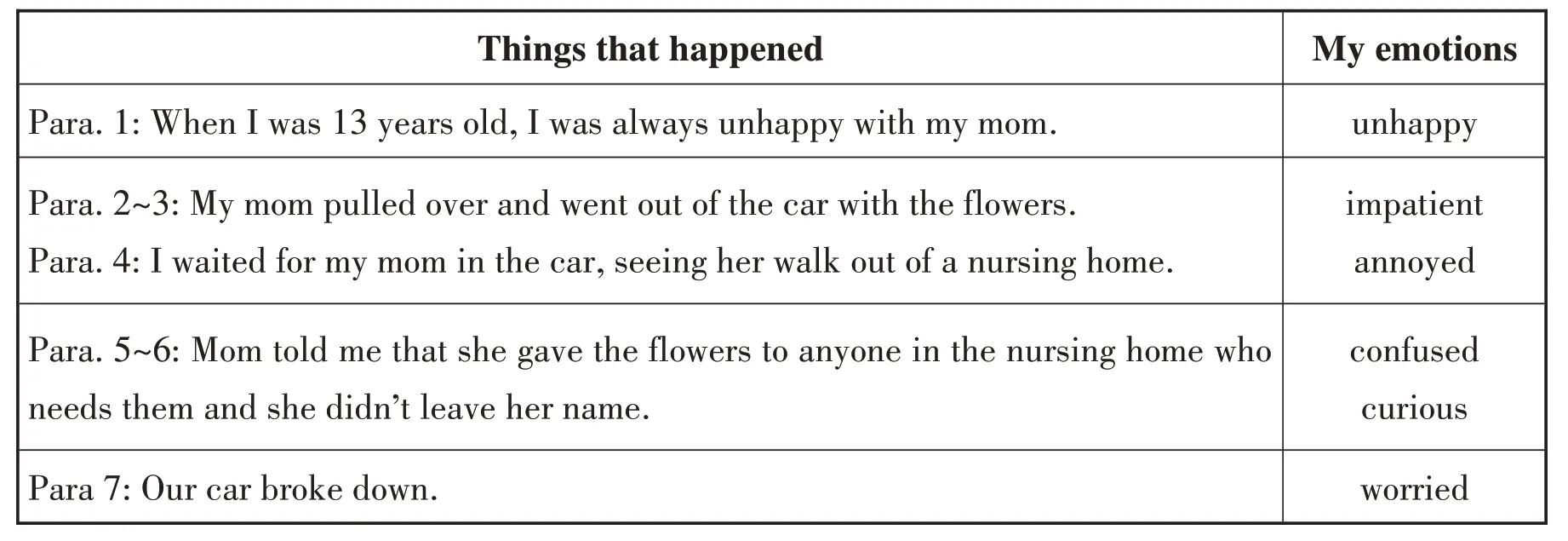
_________________________Things that happened Para.1: When I was 13 years old, I was always unhappy with my mom.________________Para.2~3: My mom pulled over and went out of the car with the flowers.Para.4: I waited for my mom in the car, seeing her walk out of a nursing home.Para.5~6: Mom told me that she gave the flowers to anyone in the nursing home who needs them and she didn't leave her name.Para 7: Our car broke down.__________________________________________________My emotions_unhappy____impatient annoyed confused curious worried____
五、分析人物性格

人物 分析維度 體現的人物性格 通過人物性格的分析,_________________________________________________________________________________________________________________________________________________推測后文情節語言描寫:“What are you doing?” I cried, fearing that the car had broken down and we'd be stuck there, so far from home.I動作描寫:My eyes impatiently skimmed the edge of the road before settling on a little sign showing that it was a nursing home.心理描寫: I looked back to the building, somewhat annoyed, as my mom reappeared, empty-handed.媽媽半路停車,“我”很大聲地喊叫,質問媽媽在做什么,這體現了“我”對媽媽的不友好,說明“我”_____________________________________________________________________________與媽媽的關系不融洽。媽媽下車后,“我”不耐煩地瞥向媽媽前往的地方,這依舊體現了正值青春期的“我”對媽媽的不____________________________________________________________________________________理解。看到媽媽再次出現在視野內,“我”感到很煩惱,這體現了“我”對媽媽的不__________________________________________________________________________________________________________________________耐煩。根據文章第一段的最后一句“But little did I know that this trip was going to be a special one.”可知,這次旅程是特別的。那特別的地方是什么呢?那就是“我”的性格的變化——從以前的叛逆不懂事到變得理解、欣賞、敬佩“我”的媽媽。
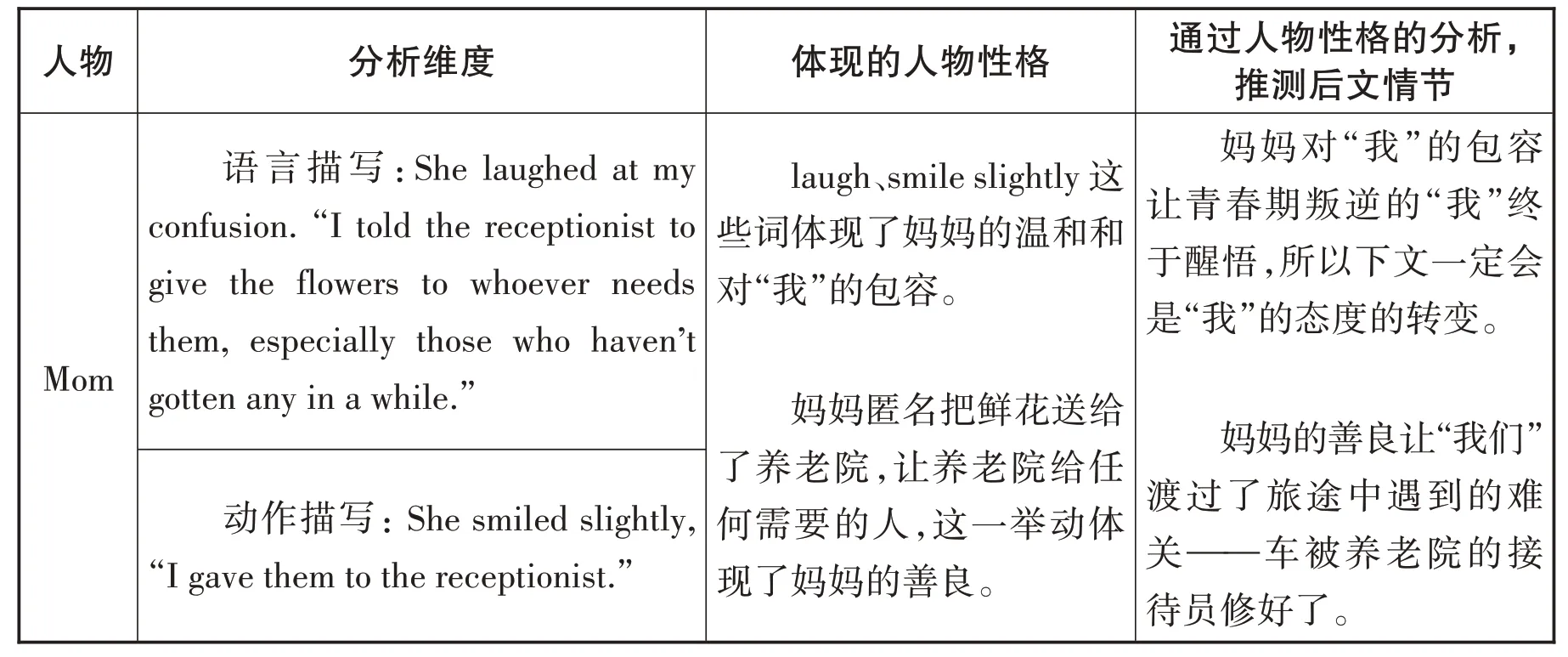
(續表)
六、構思情節發展
根據故事的主題、情節、人物情感和性格的分析,原文呈現了故事的“起因—經過”部分:處于青春期的“我”對媽媽有諸多的不理解和不滿。有一次在旅途中,看到媽媽匿名給養老院送花,“我”感到很驚訝,也很困惑。續寫的兩段分別是故事的“發展(行動)—沖突—解決”部分:“我們”的車壞了,誰會來幫“我們”修車呢?(行動)—再次啟程,經過花店的時候,“我”會做什么呢?(行動)—為什么會這么做呢?(沖突解決)
續寫第一段展開語言和動作描寫細節時,可以嘗試回答以下問題并考慮多種可能性:
(1)How did I feel when our car broke down?
(2)Was our car repaired?
(3)Who helped us repair the car?
根據以上問題,續寫第一段的具體情節可以這樣安排:車壞了后,“我”的心情;養老院的接待人員遇到“我們”,幫“我們”修車;“我們”之間的互動。
續寫第二段展開細節描寫時,可以嘗試回答以下問題并考慮多種可能性:
(1)Seeing the flower shop, what did I do?
(2)Did I buy some flowers?
(3)Why did I buy flowers?
根據以上問題,續寫第二段的具體情節可以這樣安排:再次啟程,“我們”經過一家花店;“我”讓媽媽停車,“我”走進花店;“我”買了一束花送給媽媽,這緩和了“我”和媽媽之間的關系。
參考范文
Paragraph 1:
We were worried about what could be done.Under the hot burning sun, I felt that I was suddenly thrown into a world of hopelessness.I scratched my head and walked back and forth hopelessly.All of a sudden, one man with his hands waving at Mom came into our view.“He is the receptionist from the nursing home,” Mom explained to me.“Why are you here?” Mom asked excitedly.“I just intended to thank you for your flowers.” What amazed me most was that he was a retired garage man.How lucky we were! As a consequence, he had our car repaired in a short while.
Paragraph 2:
As we drove along,a flower shop came into sight on the road.I paced quickly into the flower shop, where a bunch of flowers glowing red in full bloom caught my eyes.Having witnessed the effect of my mother's kindness, I decided to send Mom the sweet flowers.Soon, the heavenly scent filled the car again.With tears streaming down her face, her flushed face was shining with excitement.Through this trip, I discovered that I actually felt proud of her.Looking back to that day, I was always grateful for the lesson the trip taught me for having such a great mother.
【模擬導練】
閱讀下面材料,根據其內容和所給段落開頭語續寫兩段,使之構成一篇完整的短文。
It was Tamika's turn to tell her class where she went this summer.She stood up proudly.
“This summer I went to Bradley,” Tamika announced.“There is a big market there.My mom bought a painting, and I got second-hand inline skates.We had a great time there.”
“That's not a trip,” Jeremy whispered loudly to his partner.“It's only half an hour from here.My dad and I often go to Bradley to buy tools for his repair shop.”
“Jeremy, no interrupting,” said Miss Snowden, their teacher.“And Bradley has a fine market.I'm glad that Tamika can tell us about it.Go ahead, Tamika.” Miss Snowden smiled warmly at her, encouraging her to continue.
But Tamika didn't feel proud of her family's trip to Bradley anymore and she just felt embarrassed.Tamika dropped her head and said in a low voice that she was finished, and then hurried back to her desk.She hoped that the other kids didn't notice her face turning red.
Tamika listened as Peter talked about his cruise to Jamaica.She heard about Mary's trip across the Atlantic to Ireland.She heard about John's horseback ride through the Grand Canyon.It seemed as if everyone but her had taken a big trip over the summer.“I never get to go anywhere,” Tamika thought to herself.A sense of sadness clouded her the whole day.
After school, things got worse.One of the wheels on Tamika's skates came loose.Now she couldn't even skate.Sitting on the sidewalk, Tamika tried to fix her wheel but did not know how.Then Miss Snowden happened to pass by.She walked up with a smile on her face, asking, “You look unhappy, Tamika.Why are you sitting here?” Tamika lowered her head, tears building up inside her eyes.“Want to talk about it?” Miss Snowden asked kindly.Tamika nodded, trying to avoid Miss Snowden's eyes.Bending down, Miss Snowden said in a whisper, “You know, Tamika, we don't always have to travel far to learn anything.” Tamika looked up and seemed to understand what Miss Snowden meant.
注意:續寫詞數應為150左右。
Paragraph 1:
At this moment,Jeremy was walking by and saw them.__________________________
_____________________________________________________
Paragraph 2:
“I can fix it,”Jeremy said with confidence.___________________________________
_____________________________________________________
【評價導思】
1.你能否正確地分析文章中人物的性格?你是從哪些方面進行分析的呢?
_____________________________________________________
_____________________________________________________
2.續寫這篇文章的時候,你能否根據人物的性格設計比較合理的續寫情節?
_____________________________________________________
_____________________________________________________
3.你在續寫時是否使用了一些高級句式、詞匯等潤色文章?
_____________________________________________________
_____________________________________________________
猜你喜歡
民用飛機設計與研究(2020年4期)2021-01-21 09:15:02
甘肅教育(2020年8期)2020-06-11 06:10:02
制造技術與機床(2019年10期)2019-10-26 02:48:08
電子制作(2018年18期)2018-11-14 01:48:24
電子制作(2018年18期)2018-11-14 01:48:06
山東工業技術(2016年15期)2016-12-01 05:31:22
小學教學參考(2015年20期)2016-01-15 08:44:38
人間(2015年20期)2016-01-04 12:47:10
中國中醫藥現代遠程教育(2014年11期)2014-08-08 13:23:44
語文知識(2014年1期)2014-02-28 21:59:13
