3D 打印中的生物可接受性參數
2024-01-27 19:38:32艾瑞爾阿尤布拉齊
世界建筑 2024年1期
艾瑞爾·陳,阿尤布·拉齊
隨著城市的發展,人類對地球上有限的空間和資源的爭奪不斷加劇,許多野生動物因此失去家園甚至失去生命。我們有必要在城市中引入更多植被及其所包含的微生物,以重建一個更多元的生態系統,并通過調節溫度和CO2等條件,增強城市環境的可持續性和韌性。生物可接受性設計是將生物多樣性融入現有城市基礎設施的一種解決方案,尤其適用于高密度城市環境和與自然界隔絕的室內環境。利用3D 打印技術的高精度,我們可以設計出特定的復雜幾何形狀,起到促進生物生長的作用。
雖然許多設計師已開始涉足生物可接受性結構的設計,但設計參數與生物生長潛力之間的關系仍未被充分探索。因此,本研究試圖通過一系列3D 打印的陶瓷構件來研究3D 打印參數與生物生長之間的關系,這些陶瓷構件利用導水幾何形狀和3D 打印參數來控制生物生長。水分的獲取是生物生長的關鍵因素,因此也是本研究的重點。附生藻類和苔蘚是用于研究的目標生物,它們的生長速度相對較快,生長效果明顯。本研究在3 個不同的尺度上展開:構件的整體形態、微凹槽的形式和材料孔隙度。我們通過4 項實驗測試了陶瓷構件的不同幾何參數和制造參數對生物附著能力、水擴散和導流的影響,以及對后續構件上生物的生長速度的影響。
實驗結果證明了3D 打印的幾何參數和制造參數在影響陶瓷構件的生物可接受性中的重要性。本研究得到的基本參數可作為今后工作中生成生物可接受性幾何形式的參考。雖然實驗的重點是水分獲取和生物附著能力,但包括環境條件在內的許多其他因素也會對生物可接受性產生影響。無論如何,創造生物可接受性結構是將自然重新引入貧瘠的城市環境的重要一步,這需要積極且有意識的設計手法。本研究在幾何學、生產制造、生物學等交叉領域的既有知識的基礎上,為設計師提供了可供參考的設計參數。隨著更多關于生物可接受性設計知識的積淀,我們的設計范式將從創造貧瘠的城市環境轉向創造更多與自然有機融合的空間。

4 使用最佳的管道深度和數量可以更好地控制水流 Dye channeling,optimal channel depth and count allow better control of water flow
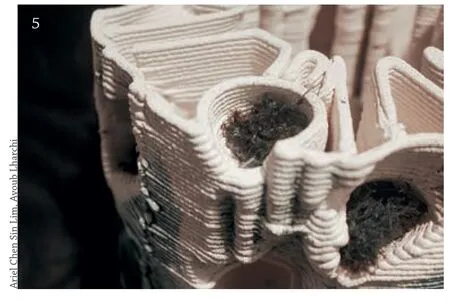
5 在空腔內插入苔蘚,以粘附和促進潮濕的微氣候 Insertion of moss within cavities designed to allow adhesion and facilitate moist micro-climates

6 根據實驗結果開發原型 Development of prototypes from experiment results
The rise of urban environments corresponds to the displacement and loss of wildlife as humankind competes for limited space and resources.There is a need to introduce vegetation and accompanying microorganisms to recreate a diverse ecosystem and promote more sustainable,resilient urban environments with essential regulation of conditions such as temperature and carbon.Bio-receptive design presents a solution to integrate biodiversity into existing urban infrastructure,particularly in high-density areas or indoor environments isolated from the biosphere.Leveraging on the high level of precision in additive manufacturing,complex and specialised geometry can be designed to promote biological growth.
While many designers have started engaging in creating bio-receptive structures,the relationship between design parameters and growth potential remains an unexplored area.Hence,this research investigates the correlations between parameters in 3D printing and bio-growth through a series of 3D-printed ceramic structures that utilise water-channelling geometries and 3D printing parameters to control biological growth.As a primary factor for growth,water access is the focus of this research;epiphytic algae and bryophytes,which provided relatively fast and visible growth results,are the targeted organisms.The investigation was conducted on three different scales: overall macro form,micro-grooves,and material porosity.The four experiments test the impact of geometrical or fabrication parameters on its ability to allow adhesion of living organisms,water diffusion and channelling,and its subsequent impact on biological growth on the structure.
The results of the experiments highlight the importance of geometrical and fabrication parameters that can affect the resultant bio-receptivity.The basic parameters in this research serve as a guideline for consideration in future work in generating bio-receptive geometries.Although the experiments focus mainly on water access and adhesion of organisms,there are many factors that also play a role in promoting bio-receptivity including the environmental conditions.Nevertheless,the creation of bio-receptive structures is a step towards re-integrating nature into sterile urban environments which requires an active and intentional design approach,and this paper builds upon the existing knowledge for designers in the intersection of geometry,fabrication,and biology.With more build-up of knowledge in producing bio-receptive designs,our design paradigm can shift away from sterile urban environments towards more nature-integrated spaces.
猜你喜歡
天天愛科學(2022年9期)2022-09-15 01:12:54
天天愛科學(2022年4期)2022-05-23 12:41:48
當代水產(2022年3期)2022-04-26 14:26:56
中老年保健(2021年12期)2021-08-24 03:30:40
中國傳媒大學學報(自然科學版)(2021年1期)2021-06-09 08:43:00
小讀者(2021年2期)2021-03-29 05:03:48
中國生殖健康(2020年6期)2020-02-01 06:28:50
航空世界(2020年10期)2020-01-19 14:36:20
華人時刊(2019年13期)2019-11-17 14:59:54
中國生殖健康(2019年11期)2019-01-07 01:28:02