關(guān)注續(xù)寫的多維度銜接
2024-05-21 03:17:33龍艷琴
瘋狂英語·新讀寫 2024年5期
龍艷琴

【問題導(dǎo)讀】
讀后續(xù)寫要求我們在閱讀完原文后,根據(jù)要求和提示句把文章未寫完的部分補(bǔ)充完整,使之構(gòu)成一個完整的故事。因此,一篇好的讀后續(xù)寫,不僅要有豐富的內(nèi)容、巧妙的構(gòu)思和規(guī)范的表達(dá),還需要把這些內(nèi)容有效地銜接起來,使續(xù)寫的內(nèi)容與原文在邏輯和語言上都能保持銜接與連貫。而我們在讀后續(xù)寫實(shí)踐中往往存在以下問題:主題理解不清,續(xù)寫內(nèi)容缺少與原文的合理銜接,續(xù)寫的情節(jié)或角度與原文脫節(jié),人物性格與原文不一致,語言風(fēng)格與原文差異太大,敘事節(jié)奏過快或過慢,等等。
【名師導(dǎo)學(xué)】
銜接是一種使上下文之間取得連接與過渡的寫作技法,主要作用是使文章保持意義上的連貫和語言表達(dá)上的流暢。除此之外,在讀后續(xù)寫的寫作中,還應(yīng)保持情節(jié)與原文的連貫、語言風(fēng)格和人物性格的協(xié)調(diào)以及敘事節(jié)奏的一致。只有關(guān)注多維度的銜接,才能在原文的基礎(chǔ)上續(xù)寫出符合故事情節(jié)發(fā)展、可讀性強(qiáng)的故事。
讀后續(xù)寫要求續(xù)寫的段落與原文思維連貫、語言風(fēng)格一致。以下以案例為指導(dǎo),闡述如何“續(xù)”原文中的思維和語言,以激活學(xué)生的思維和語言,從而更好地進(jìn)行續(xù)寫。
【案例導(dǎo)引】
閱讀下面材料,根據(jù)其內(nèi)容和所給段落開頭語續(xù)寫兩段,使之構(gòu)成一篇完整的短文。
One weekend in July, Jane and her husband, Tom, had driven three hours to campovernight by a lake in the forest. Unfortunately, on the way an unpleasant subject came upand they started to quarrel. By the time they reached the lake, Jane was so angry that shesaid to Tom,“ I'm going to find a better spot for us to camp.” Then she walked away.
With no path to follow, Jane just walked on for quite a long time. After she hadclimbed to a high place, she turned around, hoping to see the lake. To her surprise, she saw nothing but forest and, far beyond, a snowcapped mountain top. She suddenly realized thatshe was lost.
“Tom!” she cried.“ Help!”
No reply. If only she had not left her mobile phone in that bag with Tom. Jane keptmoving, but the farther she walked, the more confused she became. As night was beginningto fall, Jane was so tired that she had to stop for the night. Lying awake in the dark, Janewanted very much to be with Tom and her family. She wanted to hold him and tell him howmuch she loved him.
Jane rose at the break of day, hungry and thirsty. She could hear water trickling (滴落)somewhere at a distance. Quickly she followed the sound to a stream. To her great joy, shealso saw some berry bushes. She drank and ate a few berries. Never in her life had shetasted anything better. Feeling stronger now, Jane began to walk along the stream andhoped it would lead her to the lake.
As she picked her way carefully along the stream, Jane heard a helicopter. Is that forme? Unfortunately, the trees made it impossible for people to see her from above. A fewminutes later, another helicopter flew overhead. Jane took off her yellow blouse, thinkingthat she should go to an open area and flag them down if they came back again.
注意:續(xù)寫詞數(shù)應(yīng)為150左右。
Paragraph 1:
But no more helicopters came and it was getting dark again._____________________________________________________________________________________________________________________________________________________________________________________________
Paragraph 2:
It was daybreak when Jane woke up.________________________________________________________________________________________________________________________________________________________________________________________________________________________
文本解讀
一、思維上的銜接與連貫
一篇好的文章或一個好的故事,它的情節(jié)設(shè)計(jì)通常有理有據(jù)且引人入勝,它的語言表達(dá)通常合理且嚴(yán)密,它的內(nèi)容緊緊圍繞主題而展開。所以讀后續(xù)寫要想寫得完美,必須延續(xù)原文的合理情節(jié),模仿其語言風(fēng)格,實(shí)現(xiàn)續(xù)寫內(nèi)容與原文在思維和語言上的連貫性。
1. 讀透原文,厘清語篇要素
2. 厘清故事線索,保持時間、空間上的連貫性
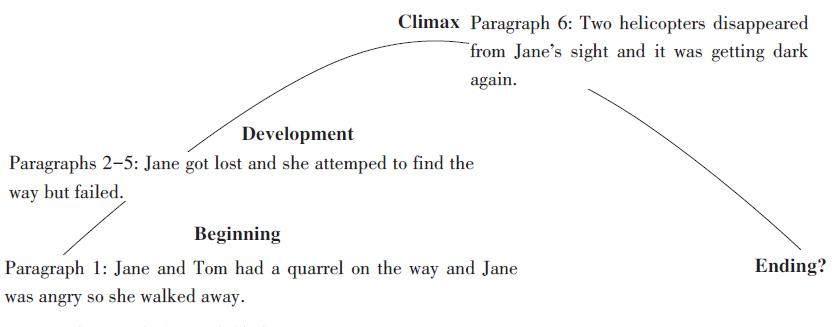
簡和她的丈夫湯姆去野營,途中因兩人發(fā)生爭吵,簡負(fù)氣另尋營地,結(jié)果在森林中迷了路。簡又餓又怕,且兩次錯過了救援機(jī)會,只能硬著頭皮獨(dú)自一人在森林中過夜……
3. 關(guān)注故事的發(fā)展脈絡(luò),保持故事情節(jié)上的連貫性
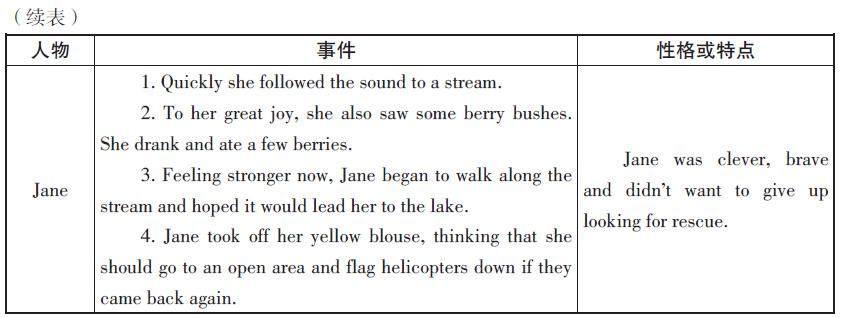
4.主要人物性格或特點(diǎn)的連貫
根據(jù)上表分析可知,主人公簡深愛著她的丈夫,而且她是一個聰明、勇敢、堅(jiān)強(qiáng)的女性。因此,在續(xù)寫時要延續(xù)主人公的這些性格特點(diǎn)。
5. 厘清文章主題,保持主題的連貫
本文結(jié)合了人與自然和人與社會的話題,選取了生活中較常見的題材——爭吵、迷路等日常沖突,從愛和冷靜的角度引導(dǎo)學(xué)生關(guān)注和周圍人在生活上的小沖突。續(xù)寫時要延續(xù)原文的主題思想,所設(shè)計(jì)情節(jié)要圍繞主題展開。
6. 品讀首句,把握敘事節(jié)奏
續(xù)寫部分所給的兩個段首句是非常重要的提示信息,它們決定了續(xù)寫的敘事節(jié)奏。在進(jìn)行續(xù)寫時,要給予特別的關(guān)注。根據(jù)續(xù)寫部分第一段的首句“But no morehelicopters came and it was getting dark again.”可知,本段落的時間跨度不大,情節(jié)的發(fā)展方向應(yīng)該是天黑后發(fā)生的事情;而根據(jù)續(xù)寫部分第二段的首句“It was daybreakwhen Jane woke up.”可知,故事的發(fā)展已經(jīng)來到了第二天天亮之后,所以續(xù)寫時應(yīng)該把重點(diǎn)放在天亮后主人公的所作所為。
因此,本故事的敘事節(jié)奏不宜過快,而應(yīng)在保持與原文主題一致的情況下有序推進(jìn)。
二、語言上的銜接與連貫
語言是思維的工具,在“續(xù)”好語篇中思維的同時,還需要“續(xù)”好語篇中的語言。讀后續(xù)寫要求學(xué)生有與上文連貫的思維,續(xù)寫的內(nèi)容要有具體的情節(jié)和豐富多樣的語言表達(dá)。所以在續(xù)寫時,要圍繞主題意義,延續(xù)原文的語言風(fēng)格,運(yùn)用恰當(dāng)?shù)臄⑹鲂哉Z言和描寫性語言進(jìn)行完整的語篇構(gòu)建。
1. 續(xù)文與段首句之間的銜接
續(xù)寫部分第一段的段首句“But no more helicopters came and it was getting dark again.”包含兩個重要信息——“當(dāng)天不可能有直升機(jī)再來了”以及“天色暗了下來”。因此,續(xù)寫時要在這兩個重要信息的基礎(chǔ)上展開情節(jié)設(shè)計(jì):天馬上黑了,不會再有直升機(jī)來了,那么主人公簡會有怎樣的心情?她會想什么,做什么?
2. 關(guān)注續(xù)寫部分第一段與第二段的銜接
根據(jù)續(xù)寫部分第二段的段首句“It was daybreak when Jane woke up.”回推第一段的結(jié)尾應(yīng)該是簡睡著了,而續(xù)寫部分第二段發(fā)生的時間是天亮之后,那么該段的情節(jié)可能是簡睡醒后繼續(xù)想辦法獲救。結(jié)合文章的主題可推測,簡最后獲救并與湯姆重歸于好,反推這一段的主要情節(jié)應(yīng)該是湯姆乘坐直升機(jī)出現(xiàn),救出了簡。
3. 語言風(fēng)格的銜接與連貫
原文的語言風(fēng)格為敘述性語言和描寫性語言的結(jié)合,因此,續(xù)寫時應(yīng)該延續(xù)原文的語言風(fēng)格,在慢推進(jìn)時多選擇描寫性語言,在快推進(jìn)時選擇敘述性語言。在語言的使用上,原文用詞豐富多變、句式多樣,續(xù)寫時可以借鑒和模仿,以求達(dá)到語言形式和語言表達(dá)的協(xié)同。
4. 關(guān)注續(xù)寫內(nèi)容間的銜接
在具體表達(dá)上,續(xù)寫段落的內(nèi)容之間要保持前后的銜接與連貫,此時可以運(yùn)用主位推進(jìn)的手法和技巧進(jìn)行語言表達(dá)的順序安排。如“But no more helicopters came andit was getting dark again.”的后一句為“Immediately, absolute darkness ruled the forest.”,段首句中的述位dark變成了續(xù)寫第一句的主位。這種主位推進(jìn)的策略可很好地保持句子之間的銜接與連貫。
參考范文
Paragraph 1:
But no more helicopters came and it was getting dark again. Immediately, absolutedarkness ruled the forest. Jane, exhausted and scared, lay down near a stone, missing herfamily at a distance. All the fantastic memory crowded in and she couldnt help crying,“Hadn‘t I quarreled with Tom, walked away and climbed to the high place, I wouldnt betrapped in this awful place, confronted with the danger of dying.” She regretted what shedid, and then became asleep with shining tears in her eyes.
Paragraph 2:
It was daybreak when Jane woke up. And, as luck would have it, a helicopter just cameby! Jane yelled and skipped, waving her yellow blouse. To her great joy, the helicopter noticed her and landed. What astounded her most was that it was Tom who sat in thehelicopter! Out rushed Tom. A huge smile spread across Jane‘s face and the couple huggedtightly for a long time. It was the narrow escape that made Jane perceive that love waspriceless. Over the next years, a change came over the couple. Reasoned discussionreplaced fierce arguments and politeness replaced contradiction. They treasured the lifeand love more.
【模擬導(dǎo)練】
閱讀下面材料,根據(jù)其內(nèi)容和所給段落開頭語續(xù)寫兩段,使之構(gòu)成一篇完整的短文。
Pam Bales left her car and stepped onto the snowcoveredJewell Trail. She planned asixhourhike through New Hampshires Mount Washington State Park. The hike up thelower part of Jewell was pleasant. At 8:30 am, still below the treeline, she took the first in aseries of onthetrailselfies.
Less than an hour later, she took another photo, after she‘d climbed into colder air anddeeper snows. She made her way across the snowcoveredridge toward Mount Washington.Then she noticed something: a single set of footprints in the snow ahead of her. Shed beenfollowing faint tracks all day and hadn‘t given them much thought, because so many peopleclimb Jewell Trail. But these, she realized, had been made by a pair of trainers, not suitablefor hiking on snow.
By 11 am, Bales was getting cold and decided to abandon her plan. The only thingkeeping Bales on Jewell Trail was the trainer tracks in the snow. As she fought the windand heavy sleet (雨夾雪), the tracks made a hard lefthand turn off the trail.
Now she was alarmed. She was sure the hiker could not get through in the low visibilityand was heading straight toward the challenging trails of the Great Gulf Wilderness. Balesstood there, stunned. The temperature and clouds were in a race to find their lowest point,and darkness was mere hours away. She turned to the left and called out“ Hello!” into thefrozen fog.
Nothing. She called out again,“ Is anybody out there? Do you need help?”
The strong westerly winds carried her voice away. She blew her rescue whistle. For afleeting moment she thought she heard someone reply, but it was just the wind playinggames with her mind. She stood listening, then turned and walked cautiously in the directionof the single set of tracks. Bales followed the tracks cautiously for 20 to 30 meters. Sherounded a slight corner and saw a man sitting motionless.
注意:續(xù)寫詞數(shù)應(yīng)為150左右。
Paragraph 1:
When she approached him and said hello, he did not react._______________________________________________________________________________________________________________________________________
Paragraph 2:
After waking the man up, Bales recognized that they had to get out of there soon._______________________________________________________________________________________________________________________________________
【評價導(dǎo)思】
1. 我是否做到了續(xù)寫的內(nèi)容與原文在情節(jié)上保持連貫?
____________________________________________________________________________________________________________
____________________________________________________________________________________________________________
2. 續(xù)寫這篇文章的時候,我是否關(guān)注了語言層面的銜接?
____________________________________________________________________________________________________________
____________________________________________________________________________________________________________
3. 在思維連貫上,我還有哪些方面做得不夠?
____________________________________________________________________________________________________________
____________________________________________________________________________________________________________
猜你喜歡
小哥白尼(野生動物)(2022年6期)2022-08-17 08:05:28
小哥白尼(野生動物)(2022年4期)2022-07-16 03:37:32
科學(xué)大眾(2022年11期)2022-06-21 09:20:52
小哥白尼(野生動物)(2022年2期)2022-06-01 06:21:20
小哥白尼(野生動物)(2022年1期)2022-04-26 14:01:18
文苑(2020年4期)2020-05-30 12:35:30
小學(xué)生作文(中高年級適用)(2018年3期)2018-04-18 01:24:47
華北電力大學(xué)學(xué)報(bào)(社會科學(xué)版)(2016年4期)2016-12-01 03:59:30
臺聲(2016年2期)2016-09-16 01:06:53
少兒科學(xué)周刊·少年版(2015年4期)2015-07-07 21:11:17