Exploring Pauses in English ReadingClassroom Interaction:A Conversation Analytic Approach
2024-11-04 00:00:00
中學生英語·閱讀與寫作 2024年9期


Abstract: This paper examined the pedagogical employment of pauses in classroominteractions in EFL reading lessons in senior high school using a conversationanalytic approach. The data for this study were collected from two EFL classes at thesame Chinese high school, each taught by a different teacher. The length and contextof pauses naturally occurring in the whole lessons were analyzed in terms of readinglessons in EFL classrooms. Findings were as follows. Appropriately prolonged pausescombined with teachers’explicit interventions can enhance the quality and quantityof students’ answers and promote their involvement, maximizing their learningopportunity. These results offer valuable insights for recommendations regardingclassroom interactions for teaching reading in English lessons in senior high school.
Key words: conversation analysis; pause; English reading teaching; classroominteraction; turn-taking
1. Introduction
This paper attempts to examine the way to employ pauses within the context ofEnglish reading classroom interaction in high school. “There are talking words andwords talked, like talking silences and silences talked” (Baldini, 1988: 14). Silentpauses are scarcely just the complete refusal to speak. Instead, in different turntaking structures, they have different roles, giving rise to various interactionalbehaviours (Ingram amp; Elliott, 2014)
Pauses shape the structure of students’participation, potentially enhance thequality of their responses and cultivate students’thinking ability. So far, somestudies have explored pauses as part of the sequential organization observing lessonsof a certain subject such as mathematics (e.g., Ingram amp; Elliott, 2014; Maroni,Gnisci amp; Pontecorvo, 2008; Maroni, 2011). However, few relevant studies havestepped into a certain lesson type of a subject such as English reading class in highschool. A conversation analytic approach provides a more detailed insight into therole of pauses in classroom interaction (Walsh, 2013). Therefore, this study aims toexplore the pedagogical significance and the employment of pauses in Englishreading classroom interaction in high school using a conversation analytic approach.
2. Literature review
2.1 Turn-taking in classroom interaction
The sequential-production model (Sacks, Schegloff, amp; Jefferson, 1974) posits thatturn-taking in conversation occurs at transition relevance places (TRPs), which arethe ends of turn constructional units like words, phrases, clauses, or sentences.According to Sacks et al. (1974), conversations generally follow these rules: Only oneperson speaks at a time, with minimal overlaps and no gaps. When a speaker finishesa turn and nominates someone to continue, that person must speak next withoutinterruption. If no one is nominated, any participant can take the floor, and if no onedoes, the current speaker may continue
However, classroom turn-taking often differs from ordinary conversation due toinherent features of classroom interaction (McHoul, 1978; van Lier, 1984). Inclassrooms, interactions are less discursive and more focused on pedagogical goals,with the teacher typically dominating the communicative rights and duties, arrangingturn-taking and controlling turn-taking and topics (Seedhouse, 2004; G佼mez Alemanyamp; Mauri Maj佼s, 2000; Margutti, 2006; Walsh, 2002).
For example, based on the analysis of geography classrooms, McHoul (1978)found that the turn-taking rules differ from those in ordinary conversation. First, onlythe teacher has the right to be the initial speaker. Second, the teacher can nominatethe next speaker, but if they don’t, they must continue speaking, preventing studentsfrom self-selecting. Third, students usually select the teacher as the next speaker,reflecting the teacher’s dominant role. If a student doesn’t nominate the nextspeaker, another student can self-select, with the teacher’s approval, or the currentstudent can continue speaking. Such similar phenomena also largely prevail theconversations in the TESOL classroom (Walsh, 2002).
In conclusion, classroom turn-taking emphasizes the teacher’s right to speakfirst, minimizing overlap and preventing students from self -selecting as the nextspeaker. This structure allows teachers to pause and create space in their turnswithout interruptions from students.
2.2 Pauses in classroom interaction
Sacks et al. (1974) identify three types of silences in everyday conversation:gaps, lapses, and pauses. A pause occurs within a turn, such as when a speakerselects the next speaker but then remains silent, causing a salient pause (Levinson,1983). A gap happens before a new speaker is chosen, before another participantchooses himself to speak, or before the current speaker resumes (Jaworski, 1993: 17).A lapse is a prolonged gap when neither the current speaker nor another participantspeaks. In classrooms, teachers often take the next turn if there is silence, resultingin few lapses.
While silent pauses do not convey spoken content, they carry significantinformation and are intricately linked with discourse (Clair, 1998). In everydayconversations, pauses can express a range of emotions and attitudes, such ashostility, sympathy, agreement, or disagreement (Maroni, 2011). In classroom settings,pauses also play crucial roles in the teaching and learning process.
A fundamental role of pauses in teaching is to manage student participation andmaintain classroom order (McHoul, 1978). Typically, a teacher asks a question ormakes a statement, pauses, and then nominates a student to respond, therebycontrolling both verbal and non-verbal student participation.
Besides, extending pauses in classroom interaction allows both students andteachers to think, refine answers, and reflect on contributions (Tobin, 1987). It hasbeen acknowledged that teachers often repeat questions within one second if there isno response and give feedback within 0.9 seconds of hearing an answer. Rowe (1974)identified two types of wait time: Wait Time I (after posing a question) and WaitTime II (after a student’s response). Training teachers to extend these pauses to 3-5seconds led to fewer discourse errors, better scaffolding, and improved studentresponses. Lengthening pauses can shift teachers’expectations, viewing students ascapable learners needing more time rather than those needing immediate help (Rowe,1986; Kirton et al., 2007).
However, caution is needed when extending pauses. Maroni (2011) found thatlonger pauses do not always lead to coherent answers or collaborative learning.Effective long pauses require the teacher to initiate them and encourage otherchildren’s collaborative participation.
In addition, pauses can convey negative attitudes and predict behavior. Gilmore(1985, 1987) found that in an urban American elementary school, teachers used pausesto show dissatisfaction, reprimand, or restore order. Black students often used silentpauses as a form of protest, defiance, and to uphold their reputation among peers.
Most relevant studies on pauses in classroom interaction focus on primary andjunior schools rather than in high school. This study aims to examine the pedagogicalrole of pauses from the perspective of the relationship between turn-taking and pausesin high school English reading classroom interaction.
3. Methodology
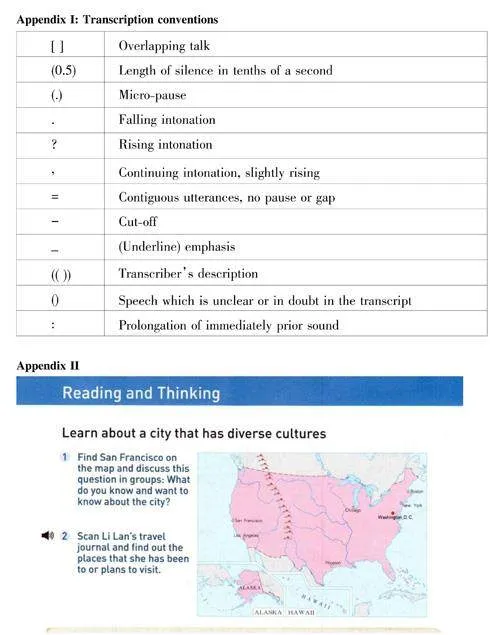
Data were collected from two EFL classes, each with 38 students seated in rows,at the same high school in China. Both classes used the same teaching material, atravel journal (see Appendix II). While each teacher had a distinct approach, allother variables were consistent: Students were 16-17 years old, intermediate-levelChinese L1 speakers with similar proficiency.
Approximately 80 minutes of classroom interaction were first recorded on video.The recordings were then transcribed using the notation system (see Appendix I) fromIngram amp; Elliott (2014), inspired by Jefferson (2004). Pause and gap lengths weremeasured using Nvivo (version 8). The data were finally analyzed using conversationanalysis (CA), chosen for its detailed focus on interaction. CA is an inductive,qualitative approach that examines how naturally occurring interactions aresequentially organized and understood by participants (Gao, 2008). This methodologyprovided an in-depth exploration of turn-taking and the role of pauses in high schoolEnglish reading classes.
4. Results and discussion
This section presents the study’s findings through three excerpts fromthe corpus, examining the interaction methods of two non- native Englishspeakingteachers.
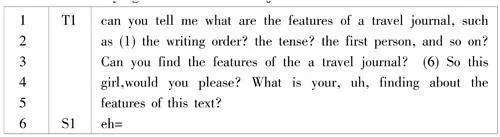
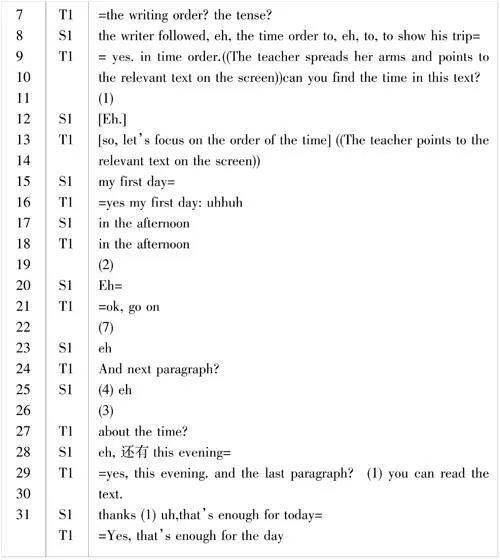
Extract 1 occurs after students watched a video about San Francisco as a leadinactivity. This extract is the first half of a reading activity, where students areasked to discuss the features of a travel journal and find evidence of these featuresin the text. In this segment, Teacher 1 (T1) asks a student to discuss the text’schronological order.
From the extract, a number of observations can be made regarding the featuresof turn taking and pauses employed by the teacher in a English reading lesson.Firstly, the structure of conversation in English reading class follows the rules inclassroom interaction proposed by McHoul (1978). Unlike ordinary conversation,speakers minimize pauses to make communication smooth, in a reading classteachers prefer to make use of pauses to provide students space for learning (Walsh,2013). In classroom conversation in a reading lesson, after raising a question,teachers tend to pause to allow students read the relevant text and think deeply intothe question and prepare the answer, which is beneficial to students’thinking abilityand independent learning ability. It is always after the pause that teachers nominatea student to answer the question
From the extract, several observations can be made about turn-taking and pausesemployed by the teacher in an English reading lesson. Firstly, the structure ofconversation follows McHoul’s (1978) rules for classroom interaction. Unlikeordinary conversation, where pauses are minimized for smooth communication,reading class teachers use pauses to give students space for learning (Walsh, 2013).After posing a question, teachers pause to allow students to read the relevant text,think deeply about the question, and prepare their answers, enhancing their thinkingand independent learning abilities. Teachers typically nominate a student to answerthe question only after this pause.
However, whether students make full use of pauses in a reading class isquestionable. The discontinuity in students’answers about the time order suggeststhey haven’t fully prepared for the reasoning stage. Despite quickly responding tothe initial question, the issue isn’t solely due to a short pause (Rawe, 1986).Notably, the teacher’s initial question didn’t require students to provide textevidence or underline relevant phrases, likely causing students to relax and not delvedeeper into the text. This makes the pause ineffective. Besides, the reasoning processrequires students to review the entire text, which is time-consuming. If students areinformed in advance about the reasoning stage, they are more motivated to examinethe text carefully. Therefore, to maximize the effectiveness of pauses in readinginstruction, teachers should not only extend pauses before nominating students butalso provide detailed instructions and follow-up questions when necessary.
Secondly, a key distinction between classroom and ordinary conversation is thatteachers often excitedly repeat students’ answers immediately. This repetitionprompts the student to continue their response while other students refrain frominterrupting due to the teacher’s dominance, leading to an unequal distribution ofparticipation (G佼mez Alemany amp; Mauri Maj佼s, 2000; Margutti, 2006). However,this extended interaction between the teacher and one student can discourageothers from participating.
In fact, when teachers repeat students’answers, it can make students believethe teacher will always provide the correct answer, reducing their motivation to listenand evaluate their peers’responses. To counter this, teachers should pause after astudent’s response and ask questions like“Who can repeat the answer?”or“Do youagree with her?”This approach promotes mutual understanding and encouragesactive listening. By coordinating pauses with follow-up questions, teachers can shiftsome responsibility to students, fostering their accountability to the learningcommunity (Wolf, 2005). In summary, pauses after a student’s answer can enhanceother students’thinking and participation.
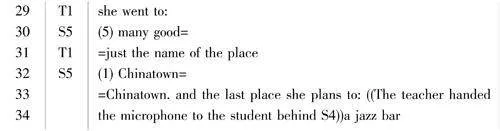
Extract 2 occurs after Teacher 1 elicits from students what typically appears in atravel journal. Teacher 1 then asks students to scan the text to find the places Li Lanvisited on Wednesday and Thursday. The goal of this activity is to organize the basicinformation of the text according to a timeline.
Although the teacher pauses for six seconds before nominating four students toanswer, each providing one place, half of the students start their turns with atleast five seconds of silence and hesitation, marked by sound prolongations. Theobservation reveals that students are not fully prepared to answer the question,despite its simplicity and explicit answers in the text. The difficulty stems from theshort pause the teacher provided before nominating S2. Although the question iseasy, students need time to scan the entire text to find the four places. Theteacher’s continuous instructions after initially telling students to scan the texthinder their concentration and information processing. Ultimately, she pauses foronly six seconds, which is insufficient for students to read the text silently. Thisanalysis suggests that the teacher did not allocate enough time for students to readand comprehend the text.
Some studies, such as Kirton et al. (2007), reported that primary school studentsin mathematics lessons felt bored when required to wait despite knowing the answer.This suggests that extended wait times are suitable only for questions requiringthoughtful consideration (Riley, 1986). This study supports this view. Although thequestion in this extract is lower-level and closed, it requires time to read the entiretext to find scattered answers. Therefore, in English reading classes, reading timemust be considered when determining the length of pauses for student thinking time.
Extract 3:
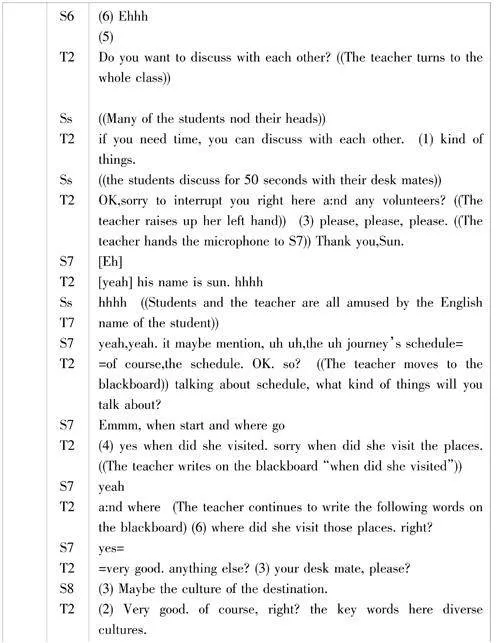
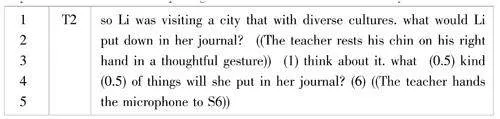
Extract 3 occurs after students have reviewed background information from thepreceding page but before they read the text for the first time. Teacher 2 poses thequestion, “What kind of things will she include in her journal?”This question aimsto predict the content of the passage and stimulate students’curiosity about the text.
In this extract, Teacher 2 first poses the question and then nominates S6 toanswer. When S6 remains silent for 6 seconds and utters a filler like“Eh,”followedby another 5 seconds of silence, the teacher recognizes that the question might bechallenging. Consequently, the teacher initiates a pair discussion for students tobrainstorm. After the discussion, S7 provides several answers, such as “when start”and“where go”, while S8 adds details about the destination’s culture, extending S7’ssecond answer.
This observation highlights that, following the discussion, students can respondmore fluently and independently. Although the teacher allowed 6 seconds for theclass to consider the question and an additional 11 seconds for S6, these extendedpauses did not elicit an immediate response. The teacher effectively used the silenceto assess how best to assist the students, opting for peer discussion rather thanpressuring S6 for an answer. This approach transformed the pause into a productivelearning opportunity (Walsh, 2013), demonstrating that extended pauses alone do notguarantee a response. Instead, teacher intervention—such as initiating briefdiscussions—can help maximize student participation and learning by turningprolonged pauses into collaborative brainstorming sessions.
5. Conclusions
This paper demonstrates that the structure of classroom interaction in senior highschool English reading lessons aligns with McHoul’s (1978) framework. It identifiestwo key groups of findings related to the use of pauses in reading lessons.
The first group of findings are concerned about wait time I. Complex texts andthe nature of reading comprehension necessitate repeated review and informationprocessing, which can be challenging for L2 learners. Even lower-level questionsmay require extended pauses to accommodate this reading time. If a task is toodifficult, simply lengthening pauses may not suffice. Instead, converting pauses intogroup discussions can help students brainstorm and improve understanding.Additionally, incorporating follow-up questions that require logical reasoning ordetailed text analysis can enhance the effectiveness of pauses, encouraging deeperengagement and improving responses.
The second group of findings are related to wait time II. To engage morestudents, teachers should extend Wait Time II by using pauses to check otherstudents’understanding or prompt evaluations of previous answers, rather thanrepeating answers immediately. This approach keeps all students attentive and shiftssome control from the teacher to the students, fostering greater accountability withinthe learning community (Wolf, 2005).
In summary, carefully adjusting pause strategies can significantly enhance learning opportunities in senior high school English reading classes.
References
Alemany, G, Maj佼s T M. Strategies to regulate content development and interactivityin the classroom[J]. , 2000, 15:157-171
Baldini, M. Le [M]. Roma: Citt Nuova Editrice, 1988.
Gilmore, P. Silence and sulking: emotional displays in the classroom[M]. Tannen, D.,Saville-Troike, M. , Cambridge: Cambridge UniversityPress,1985: 98-120, 139-162.
Gilmore, P. Sulking, stepping, and tracking: the effects of attitude assessment onaccess to literacy[M]. Bloome, D. , Norwood, NJ: Ablex,1987: 98-120.
Ingram, J. amp; Elliott, V. Turn taking and ‘wait time’in classroom interactions[J]., 2014, 62: 1-12.
Jaworski, A. [M]. SagePublications, 1993.